‘The Almanack of Love Is the Almanack of the Devil’
[SAURIN, Bernard-Joseph, attributed.]
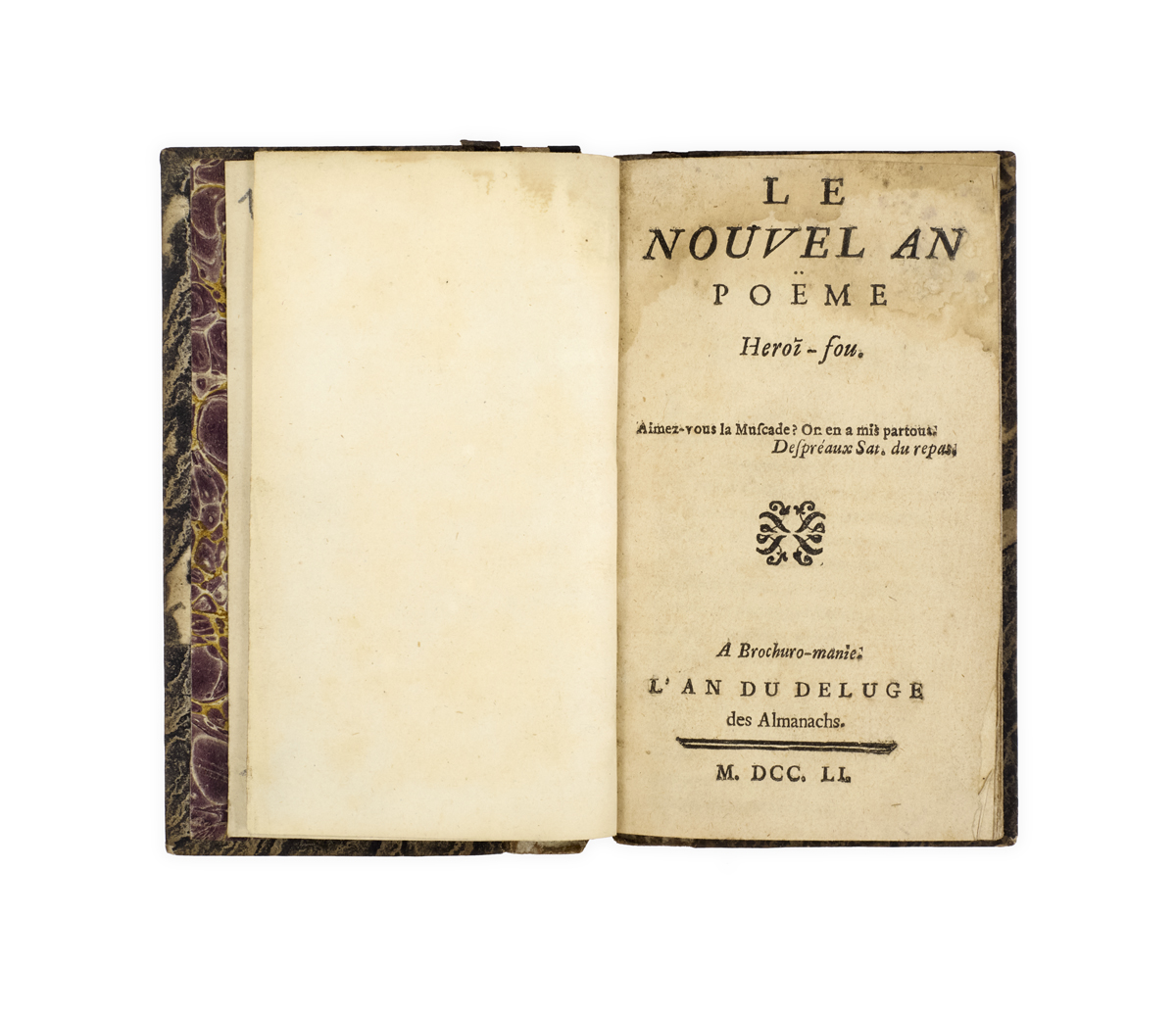
Le nouvel an, pöeme heroī-fou. ‘A Brochuro-manie, l’an du deluge des Almanachs’, [i.e. Paris?], 1751.
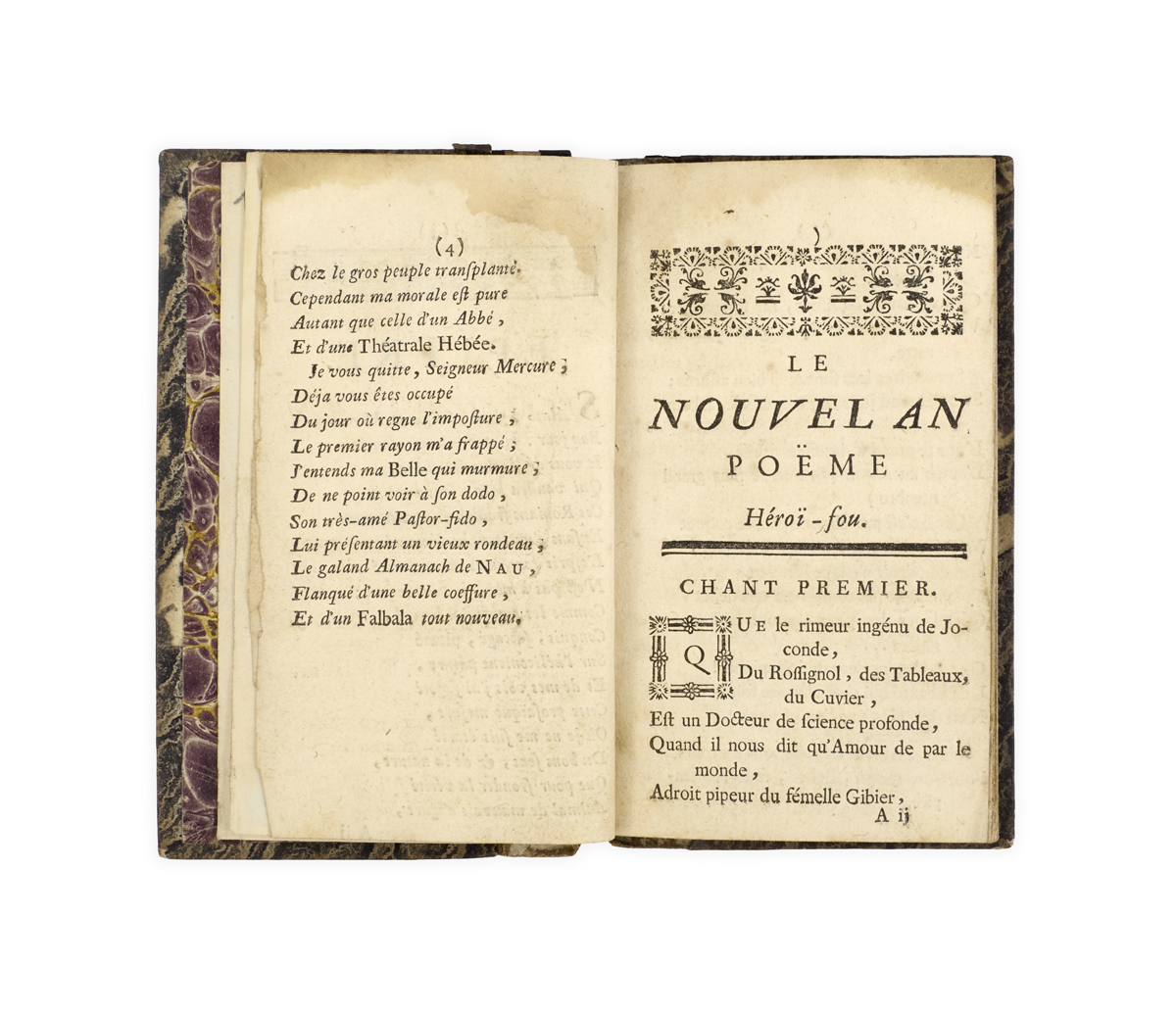
18mo, pp. 55, [1, blank]; woodcut tailpieces, typographic headpieces; marginal dampstaining throughout, oilstain at inner margin of pp. 10–11; but a good copy in nineteenth-century sheep-backed boards with marbled sides; superficial splits to joints, small losses to front boards and spine, endcaps chipped.
An extremely rare satirical tale of two lovers in nine chants, fictitiously printed in ‘Brochuromania’ during the ‘year of the deluge of almanacks’, satirising the craze for literary almanacks in eighteenth-century France.
The work is attributed to Saurin (1706–1781), a lawyer, playwright, and poet, and a friend of the likes of Voltaire, Madame de Staël, and Montesquieu. The heroine, Agnes (known here as Licoris), cruelly spurns her admirer, the young Lindor, crushing his gift of oranges to a pulp; Love intervenes, telling Lindor that the ‘astrologers painted the progress, phases, and return of love; all happens as they predict’ (trans.), and provides him with a handsome morocco-bound almanack full of gallant tales written by an abbot.
Lindor, much inspired (‘It is in you and you alone, most powerful booklet, that will determine my happiness or eternal sorrow’ (p. 47, trans.)), leaves the almanack with Licoris, who is swayed by its contents and his ability to adapt its romantic language for his own benefit. Although the lovers enjoy temporary happiness, it is ultimately short-lived and clouded by Lindor’s deceit. A final note to the reader warns of the danger of over-reliance on the hollow expressions of love contained in the almanacks of the day: ‘Although this is fable, beautiful ladies, beware of almanacks; they conceal wicked things beneath pleasant almanacks. The almanack of love is the almanack of the Devil’ (p. 55, trans.).
There appears to have been another issue, undated, without the fictitious imprint and by a ‘Mlle ***’, with an engraved title (see Goncourt (1897), lot 628.2).
No copies traced outside France; not on OCLC or Library Hub. CCfr finds three copies, at Tours, Reims, and Chartres.