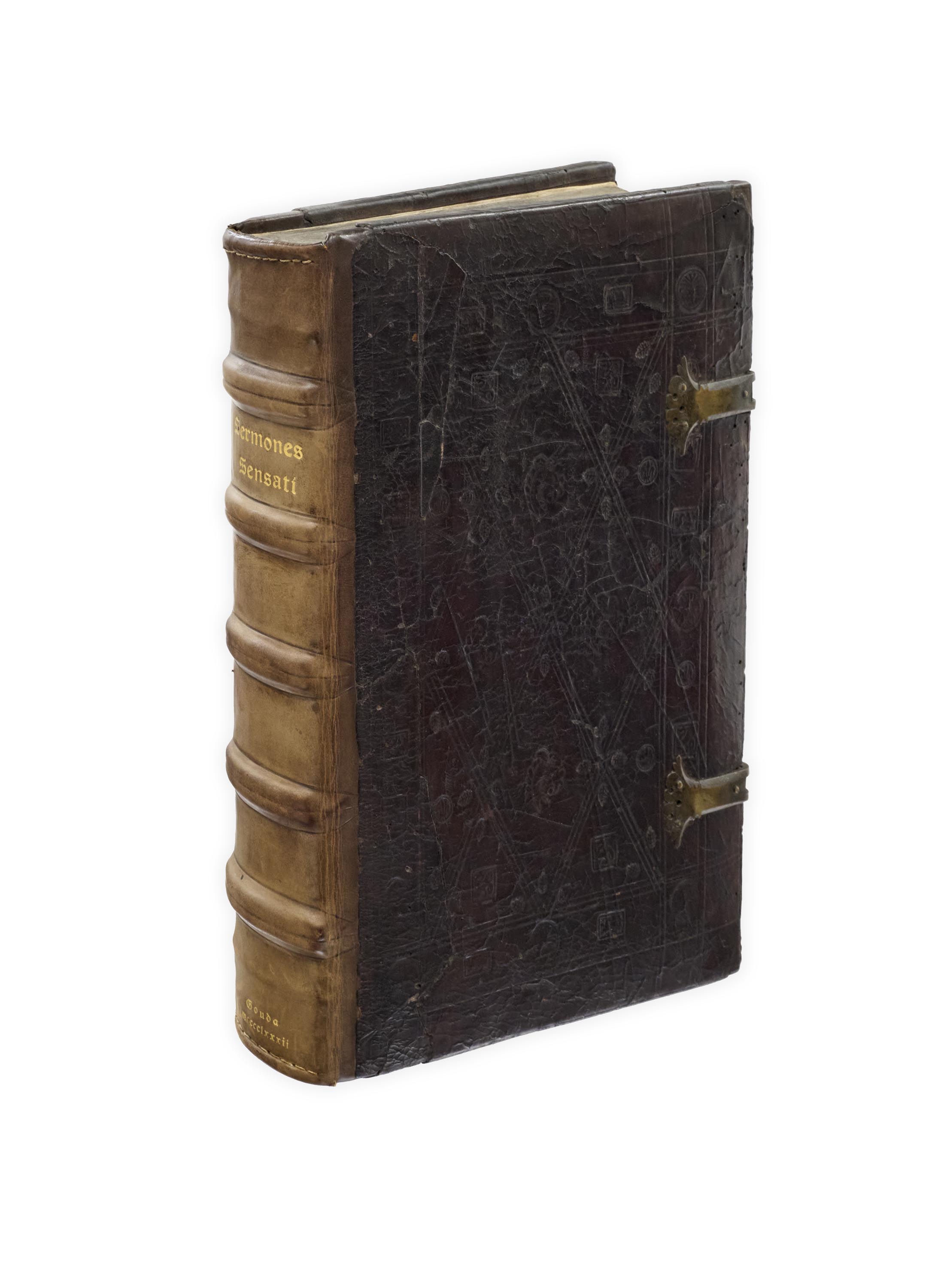
Fighting Cocks and Dragons
[SERMONS.]
[Sermones sensati.] [(Colophon:) Gouda, Gerard Leeu, 20 February 1482.]
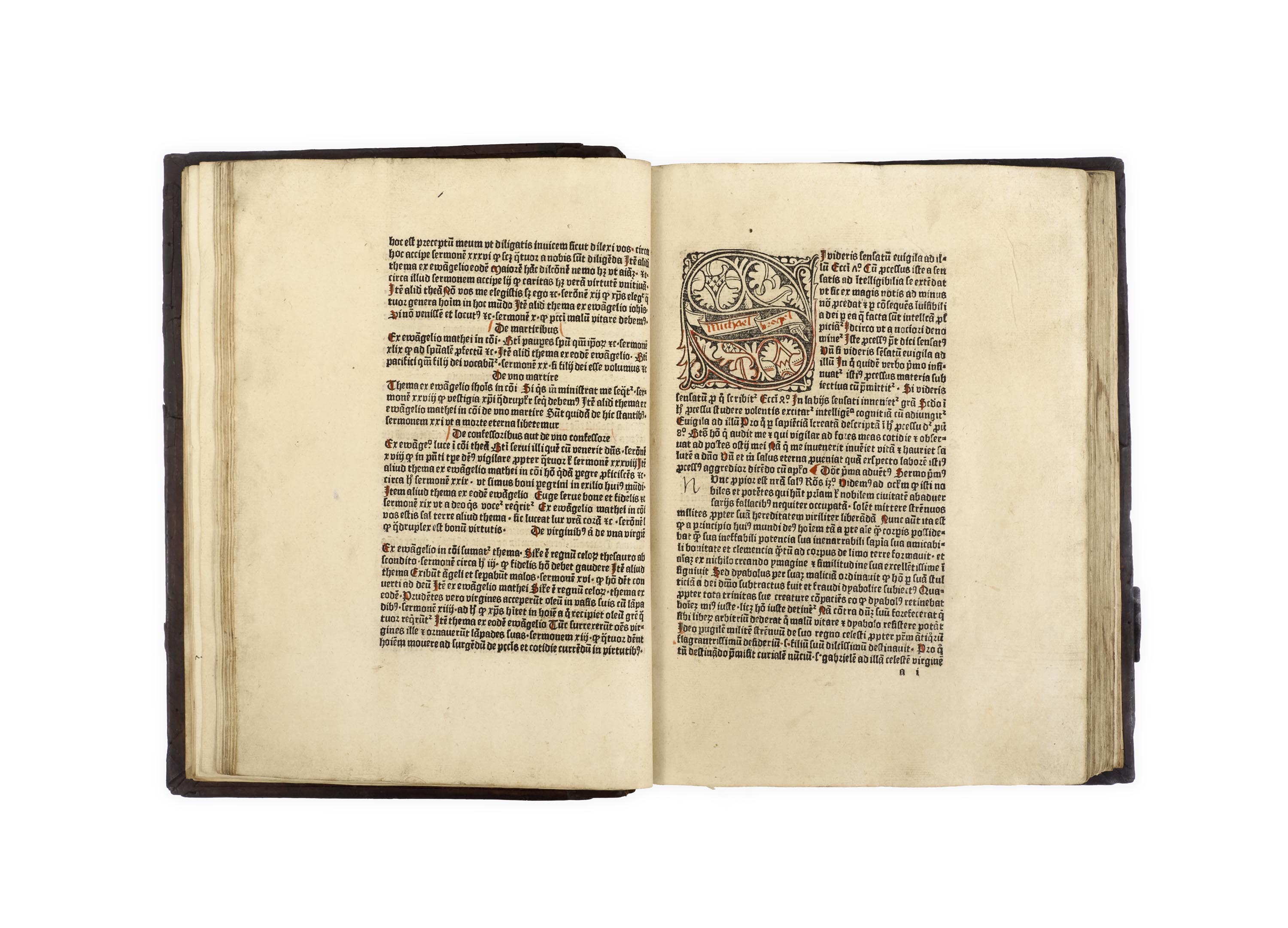
Chancery folio, ff. [202] (of 212); A8 B–C6 a–z8 [et]8, lacking quire z8 and preliminary and final blanks A1 and [et]8; gothic letter, large woodcut initial on a1r containing the contemporary inscription ‘Michael Brogel’ (the rubricator?) in red ink, red paraphs, underlining and initial strokes; neat repairs to A2v (affecting one word), skilfully repaired paper-flaw to b5 just touching text, light stain on e8, blank lower margin of t5 and blank outer margin of v5 excised, final quire lightly soiled with a few small wormholes (some repaired); contemporary Netherlandish blind-stamped calf over wooden boards, boards panelled in blind and tooled with a small dragon, two fighting cocks, a leaf, a fleur-de-lys, a palm leaf(?), and a larger outlined leafy tool, brass catches to fore-edge (clasps perished); rebacked and recornered in calf, somewhat worn and scuffed with small wormholes, endpapers renewed; contemporary annotations in brown ink to c. 10 pp. (see below), armorial bookplate of John Vertue to front pastedown.
First and only incunable edition of a rare homiletic compilation, in a strictly contemporary Netherlandish blind-stamped binding, from the abbey of Berne.
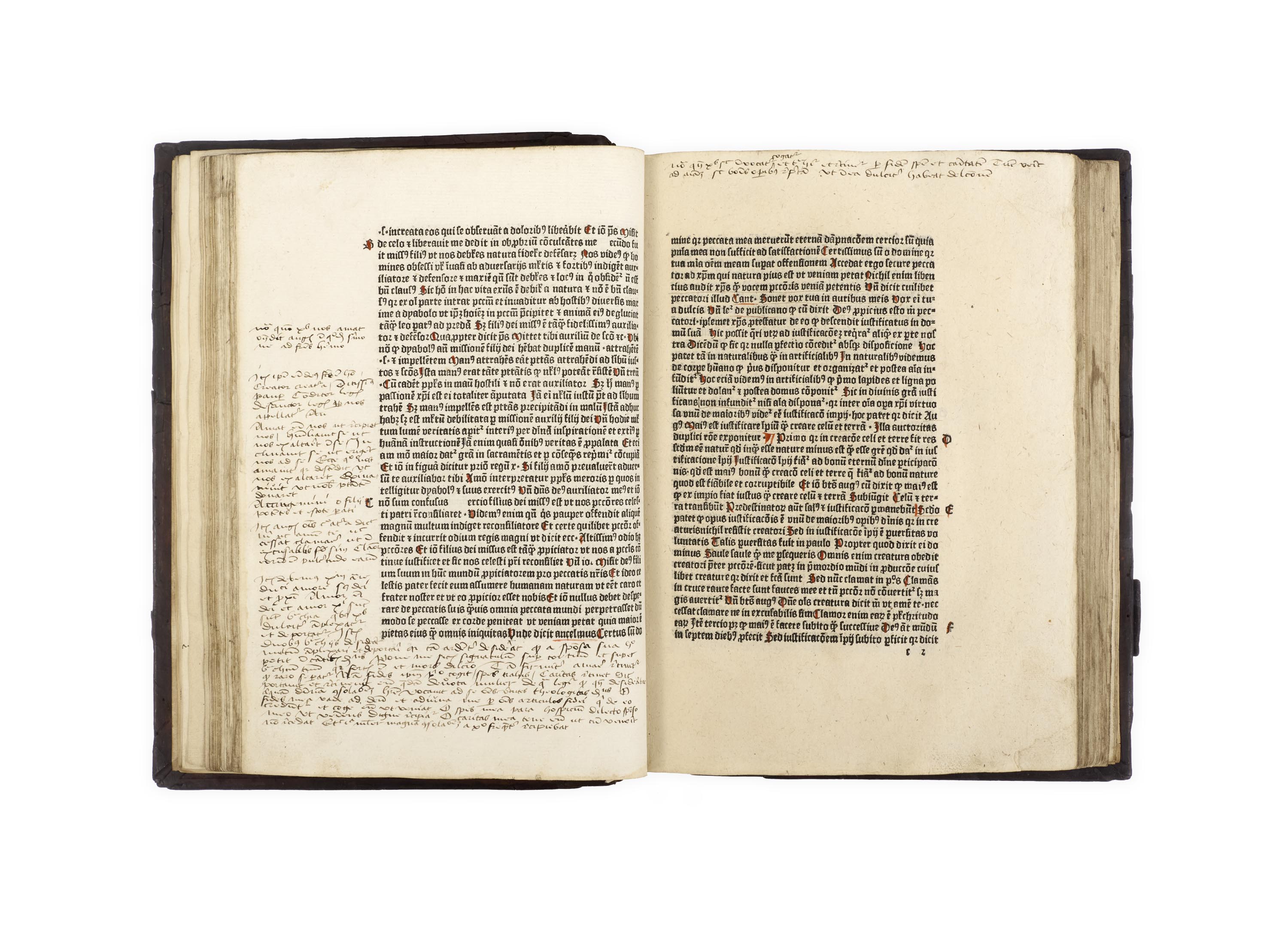
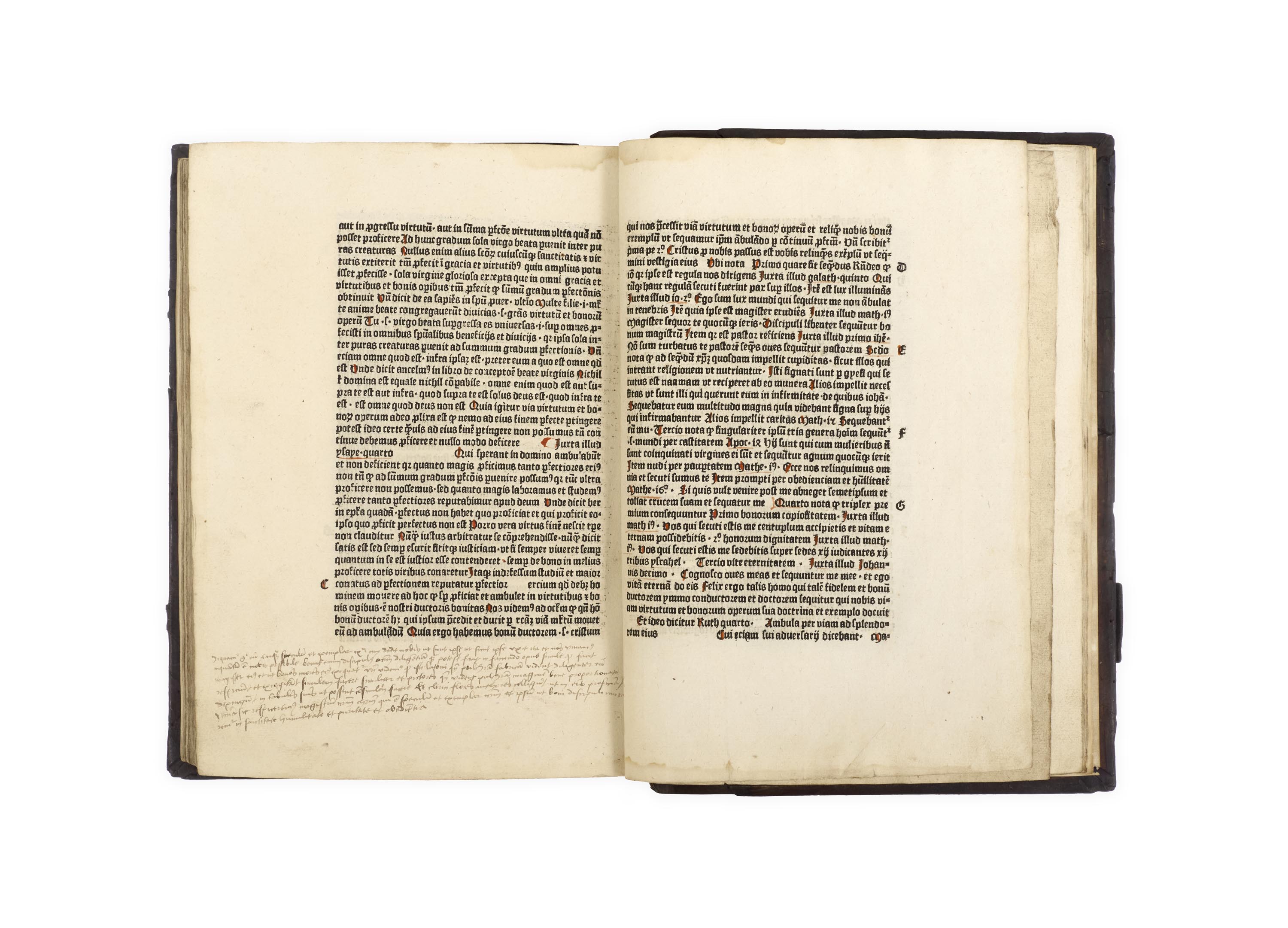
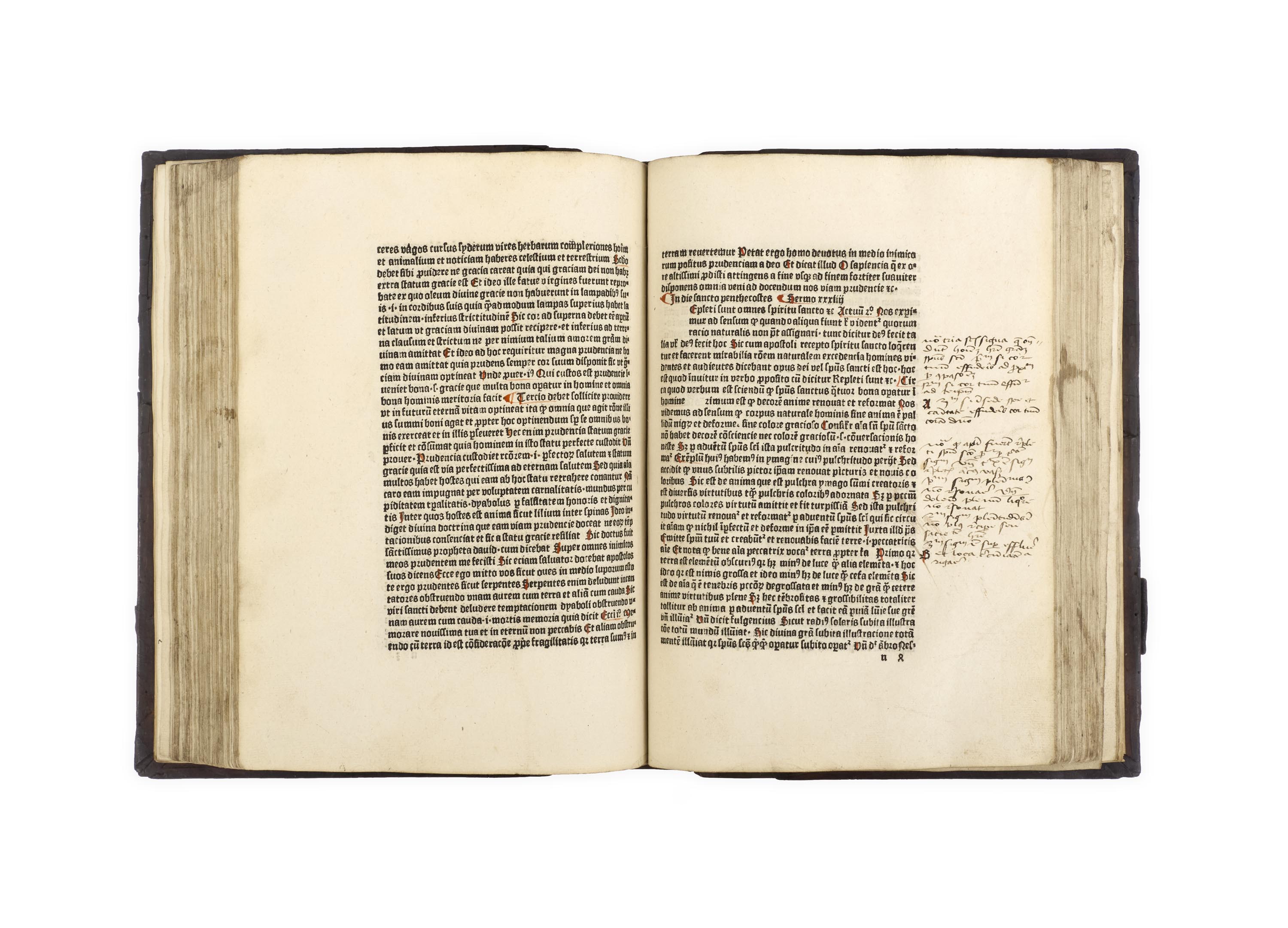
This collection of fifty-nine sermons was named from a verse in Ecclesiastes, which is quoted several times at the start of the text on a1. The rubrication is particularly helpful in the first two quires, where the summaries of the topics within the sermons have been linked with red lines to make them easier to read. The annotations include manicules and short notes, though a few pages (c1v–c2r, n4r, y7v) contain longer and more detailed comments, many of which (beginning ‘non’) seem to disagree with the text.
There are two variants of this printing recorded; this is the variant with the marginal letters printed in quire a, and the word ‘cunctis’ (not ‘multis’) in the colophon (identified as issue BZ in the literature).
The fighting cocks, dragon, and fleur-de-lys tools on the binding are illustrated in Foot, figs. 13.2 number 3 (p. 152), 13.4 number 3 (p. 154), and 13.6 number 1 (p. 157); they are all found together on a Netherlandish binding with early Brussels provenance (British Library IB.49502). The close connection between Johannes de Westfalia in Louvain (the printer of the other text originally bound in this volume; see provenance below) and the Oxford book trade in the early 1480s led to the imitation of Netherlandish book stamps like these in Oxford bindings by the Rood and Hunt binder, as described by Foot.
Provenance:
1. The Premonstratensian abbey of Berne, in the diocese of Utrecht, founded in 1134 (and still active today). Their library was sold at auction on 13 December 1887: Catalogue d’une précieuse bibliothèque provenant d’une ancienne Abbaye (Leiden, J.W. van Leeuwen, 1887). This book was lot 120, where it was bound with Thomas de Chabham, Liber poenitentialis (Louvain, Johannes de Westfalia, c. 1483–1485) in a contemporary stamped calf binding. The abbey was plundered and burned during the Eighty Years’ War, its goods confiscated at the end of the Thirty Years’ War, followed by several more forced moves. Since 1857 its home has been in Heeswijk, near s’Hertogenbosch.
2. John Vertue (1826–1900), appointed the first Roman Catholic Bishop of Portsmouth in 1882.
ISTC records only five copies in the US (LoC, Harvard, Huntington, Newberry, Walters Art Museum).
C 5376; BMC IX 34; GW M41752; Goff S442; BSB-Ink S-325; Bod-inc S-183; ISTC is00472500. See Foot, ‘Influences from the Netherlands on bookbindings in England during the late fifteenth and early sixteenth centuries’ in Studies in the history of bookbinding (1993), pp. 146–163.