SMITH, Charlotte.
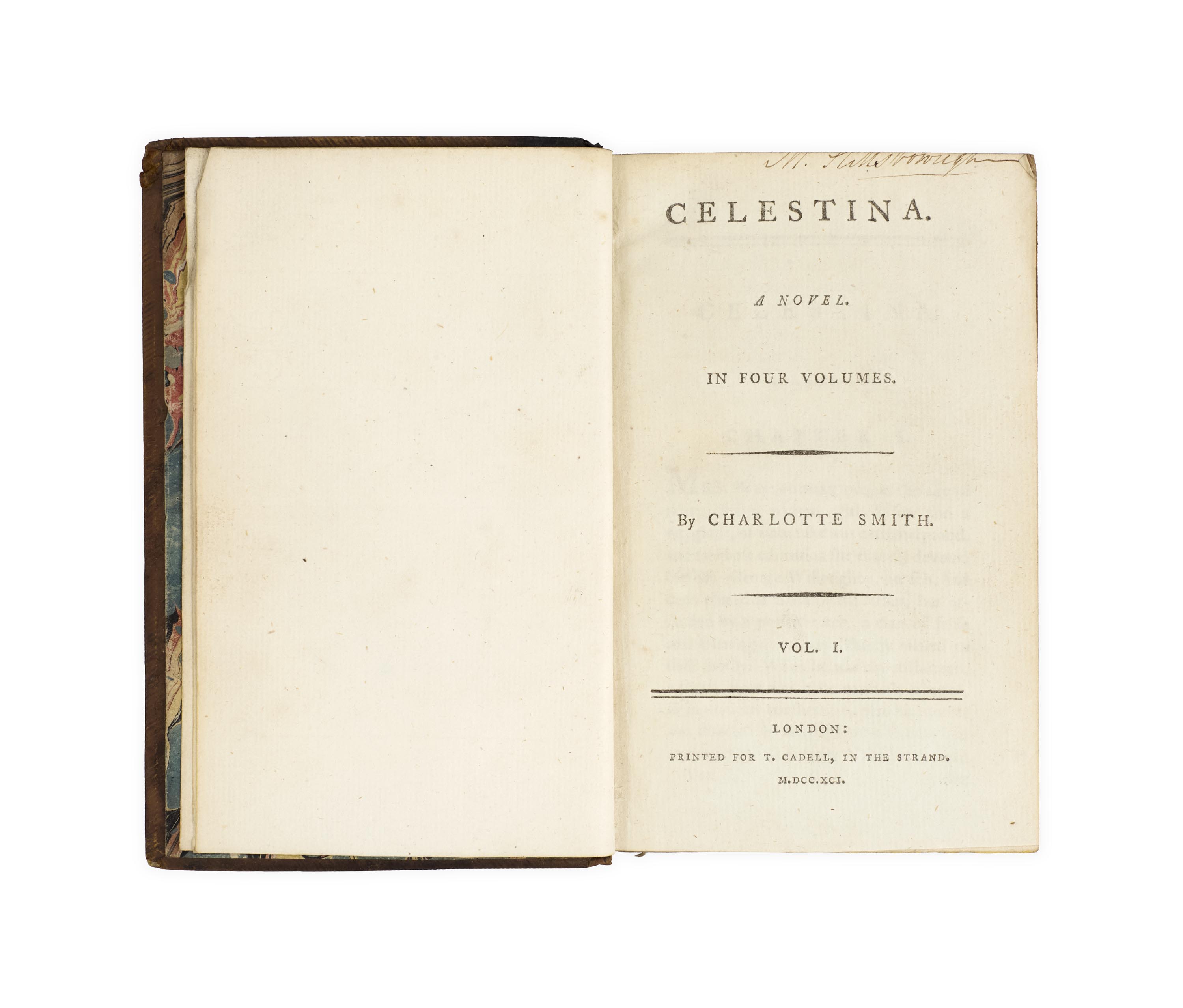
Celestina. A Novel … London, Printed for T. Cadell … 1791.
Four vols, 12mo, pp. [2], 273, [1]; [2], 313, [1, advertisements]; [2], 303, [1]; [2], 353, [3], without half-titles but with the terminal advertisement leaf in vol. IV; a good copy in contemporary mottled calf, rubbed, spine chipped, two labels wanting; ownership inscription to each volume ‘M Hillsborough’ (cropped), Hillsborough monogram to spine.
First edition. Celestina is less deliberately ‘Gothic’ than most of Mrs Smith’s novels, but the influence of its travelling heroine and of its Pyrenean scenes on the Mysteries of Udolpho (1794) is noted by J. M. S. Tompkins, who regards Willoughby (the male protagonist) as the prototype of ‘the travelling hero, new style’, who, unlike Jason of old, travels for the sake of a wounded heart – and for the beauties of the scenery. The heroine travels, too, in the western Highlands and Islands, providing Mrs. Smith with some of her finest opportunities for descriptive writing.
Among its more radical features were its treatment of the friendship between Celestina and her servant Jessy; the sympathetic depiction of a dying prostitute; a revolutionary episode in the South of France, in which a local tyrant is overthrown; and some meta-textual incursions by Smith herself.
Provenance:
From the library of Mary Hill (née Sandys, 1764–1836), Marchioness of Downshire, later Baroness Sandys. Lady Downshire was a wealthy heiress, society hostess, and literary patron who married the young but ill-fortuned politician Arthur Hill in 1786. Raised by her uncle, one of Samuel Johnson’s ‘Streatham worthies’, she became a friend of both the Prince of Wales and Mrs Fitzherbert, and once entertained the Prince for four days at the family seat of Ombersley. She built up a fine collection of contemporary fiction, mostly by women, to add to the family library.
Garside 1791:68; Summers, Gothic Bibliography, p. 271.