A Phrenologist on Pedagogy
SPURZHEIM, Johann Gaspar.
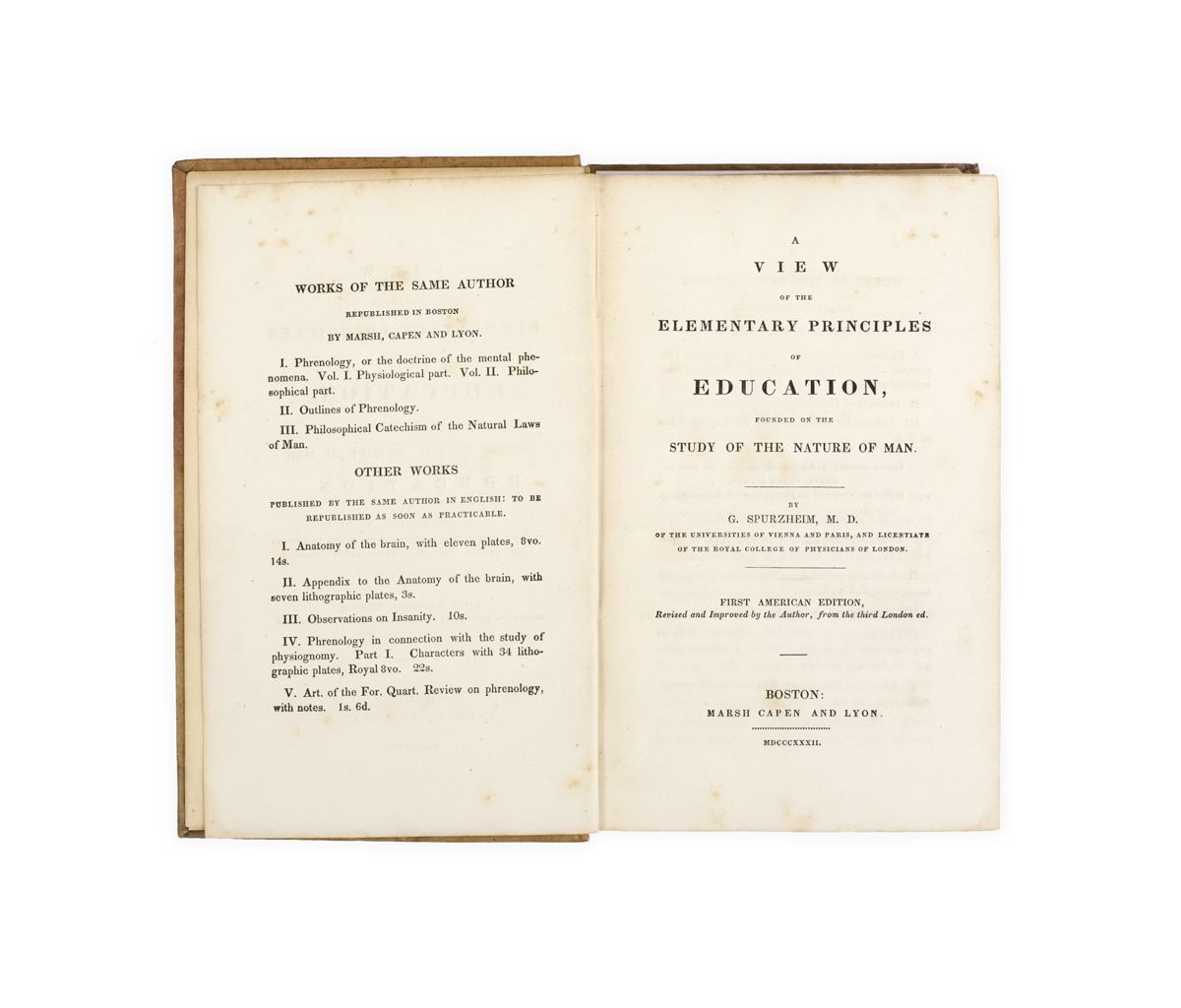
A View of the elementary Principles of Education, founded on the Study of the Nature of Man. Boston, Marsh Capen and Lyon, 1832.
8vo, pp. xii, 318; some foxing, else a good copy; bound in contemporary pink cloth, printed spine label; faded, joints tender but holding firm, very slightly cocked, inkspots to spine.
Added to your basket:
A View of the elementary Principles of Education, founded on the Study of the Nature of Man.
First American edition (first Edinburgh, 1821) of this eccentric work on education by the German phrenologist Johann Caspar Spurzheim, including observations on the development of the brain, drawn in part from the study of ancient cultures.
Spurzheim (1776–1832), instrumental in popularising the discipline of phrenology, was assistant to Franz Joseph Gall – considered the father of the field – before their falling out in 1812. He travelled from his native Germany to Great Britain, where his works were published, and eventually to America, where his ideas were received with spectacular enthusiasm. He died in Boston in November 1832 of typhoid fever, the year in which this edition was published, having presumably seen it coming off the press, and was buried by an adoring Bostonian crowd; there followed a public autopsy, after which his brain, skull, and heart were preserved in alcohol and displayed.
For Spurzheim, the ideal model of education will improve the arts and sciences, diminish moral evil, and make mankind happy. The section on the education of women is particularly odd, including a tirade against Mary Wollstonecraft and the observation that she is, in many ways, ‘like a man’. ‘Mary Wolstoncroft [sic] denies that women from birth, independently of education, have a fondness for dolls … Mary Wolstoncroft is very wrong to take herself as the standard of her sex, while general observations show, that throughout nature the love of offspring is stronger in females than in males’ (p. 211).
Spurzheim does not believe, however, that education can ‘abolish all disorders’ (p. 266), and there follows a rather bizarre appendix on reducing crime (cracking down on ale-houses, confining drunkards for twenty-four hours), addressing poverty (preventing the poor from propagating), prison reform (advocating for juvenile correction centres), and a series of case studies on murders committed by the mentally ill (including 'child-murder').
We find no copies of this edition in the UK.