A Croatian Colosseum
STANCOVICH, Pietro.
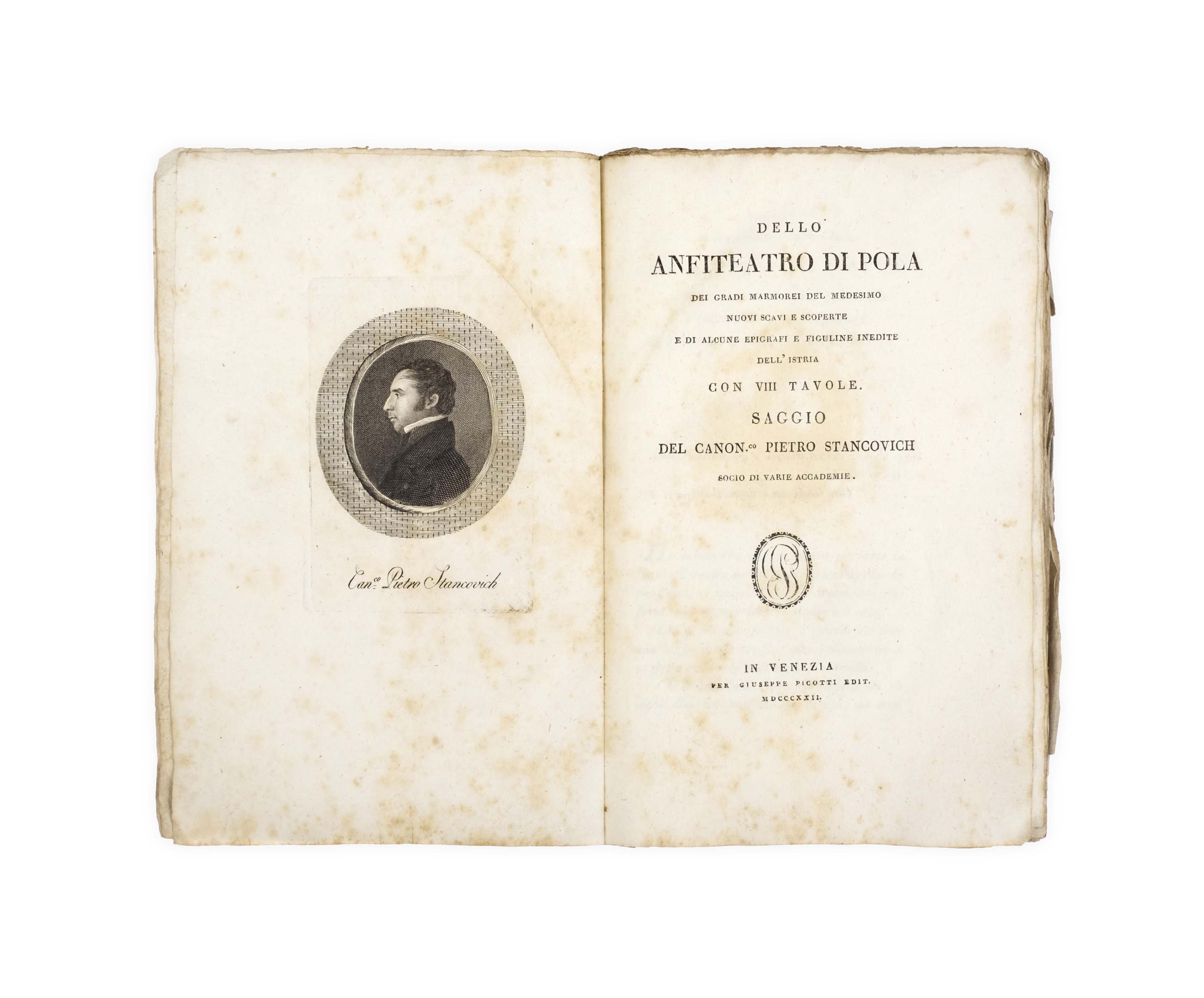
Dello anfiteatro di Pola, dei gradi marmorei del medesimo, nuovi scavi e scoperte, e di alcune epigrafi e figuline inedite dell’Istria, con VIII tavole. Saggio. Venice, Giuseppe Picotti, 1822.
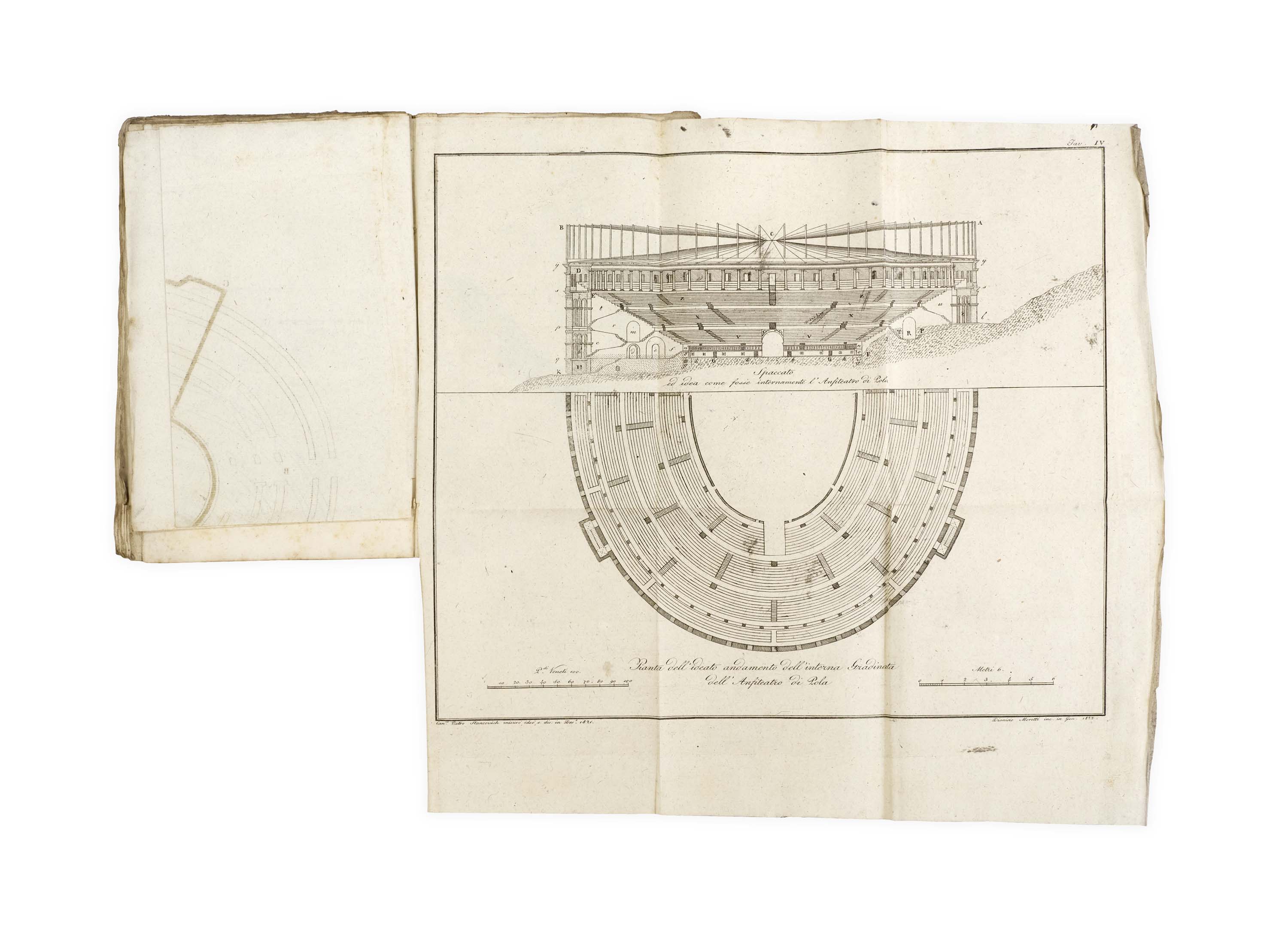
8vo, pp. [iv], 144, [2, errata], with copper- engraved frontispiece portrait of the author, folding letterpress table at p. 64, 5 engraved plates (of which 4 folding) by Dionisio Moretti after designs by Stancovich (one dated January 1822), and 2 folding letterpress tables (numbered VI–VII); woodcut printer’s device to title; occasional light marginal foxing, a few marginal creases to plates, but a very good copy; uncut in the original yellow printed publisher’s wrappers; binding a little soiled and stained.
Added to your basket:
Dello anfiteatro di Pola, dei gradi marmorei del medesimo, nuovi scavi e scoperte, e di alcune epigrafi e figuline inedite dell’Istria, con VIII tavole. Saggio.
First edition, uncut in the original wrappers, of Pietro Stancovich’s description of the Roman amphitheatre in Pola (modern Pula) on the Istrian peninsula.
The priest Pietro Stancovich (1771–1852) was the author of numerous works on the antiquarian remains of his native Istria and Trieste, as well as experiments in agriculture, including a domestic olive press; his library of three thousand volumes survives in the Istrian town of Rovinj. Stancovich’s pride in his homeland led him to argue, mistakenly, that St Jerome came from Istria rather than Croatia. He also compiled a catechism in Croat, the language of rural Istrians.
The Istrian peninsula, now part of Croatia, is still renowned for its extensive Roman remains. Pola itself was a Roman port and its amphitheatre, a substantial arena built at the same time as the Colosseum in Rome, survives to this day and has been returned to active use. Stancovich’s extensive description was considered sufficiently significant to be abridged for inclusion in the learned journal Nuovo giornale de’ letterati of 1822 (pp. 232–253). His account ends with the recent travails of the amphitheatre’s survival, including the Venetian plan to remove the amphitheatre to Venice in the late sixteenth century, which was scotched by the Venetian patrician Gabriele Emo, commemorated in an inscription transcribed on p. 137.
This copy is OPAC SBN variant B, containing the final errata leaf after the plates. The wrappers are reused from a previous Picotti publication, Limen grammaticum (1820), with the printed title showing through.