With Annotations on Artillery and Algebra
TARTAGLIA, Niccolò Fontana.
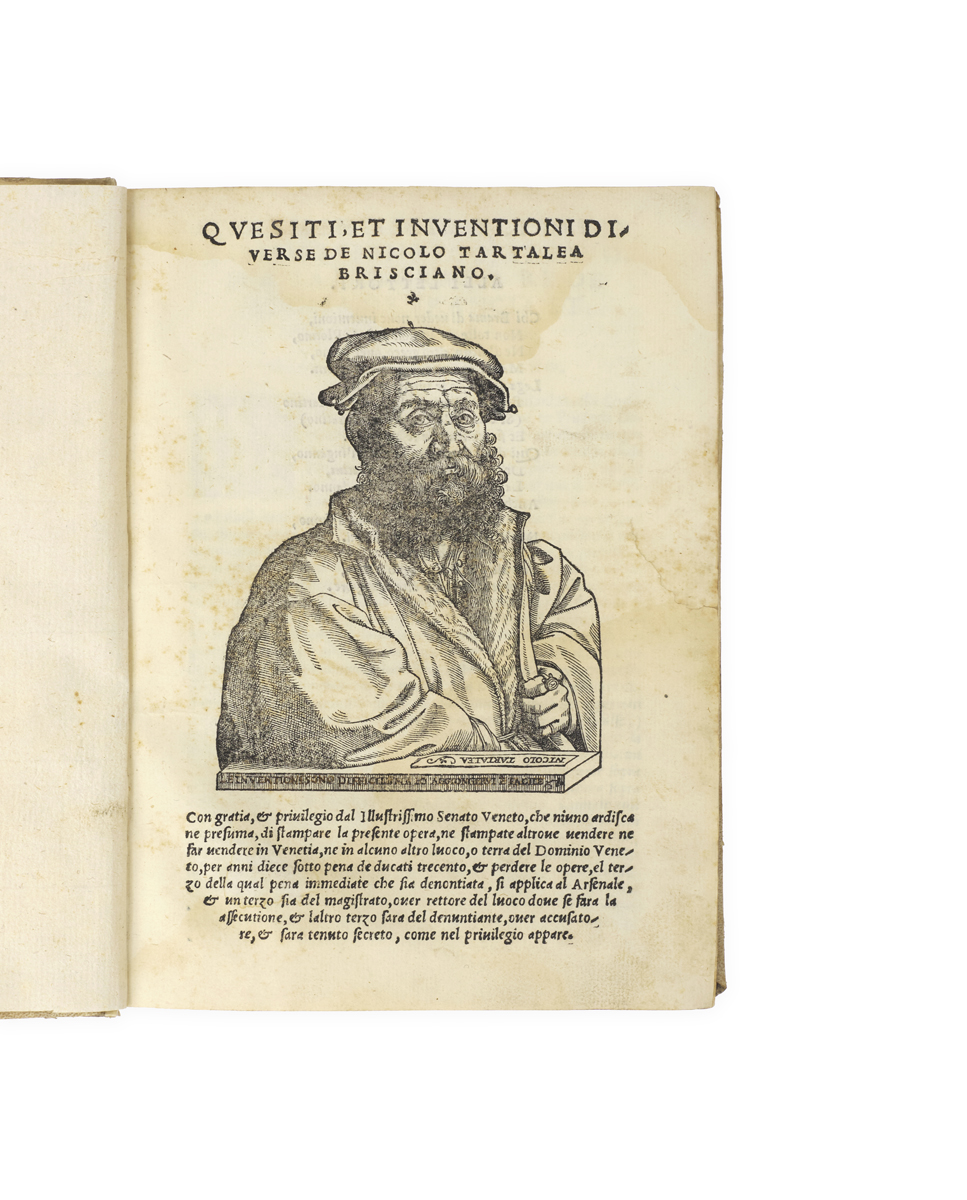
Quesiti, et inventioni diverse. [(Colophon:) Venice, Venturino Ruffinelli ‘ad instantia et requisitione, & a proprie spese de Nicolo Tartalea Brisciano Autire’, July 1546.]
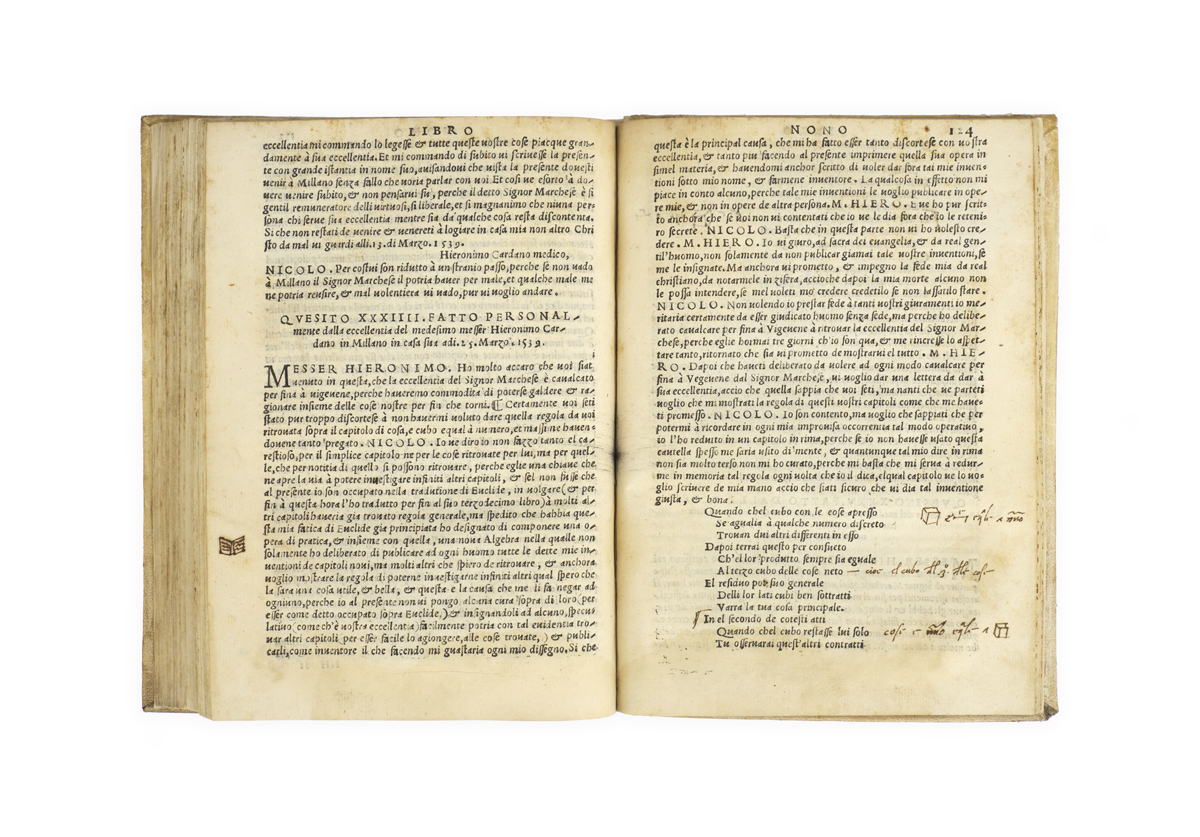
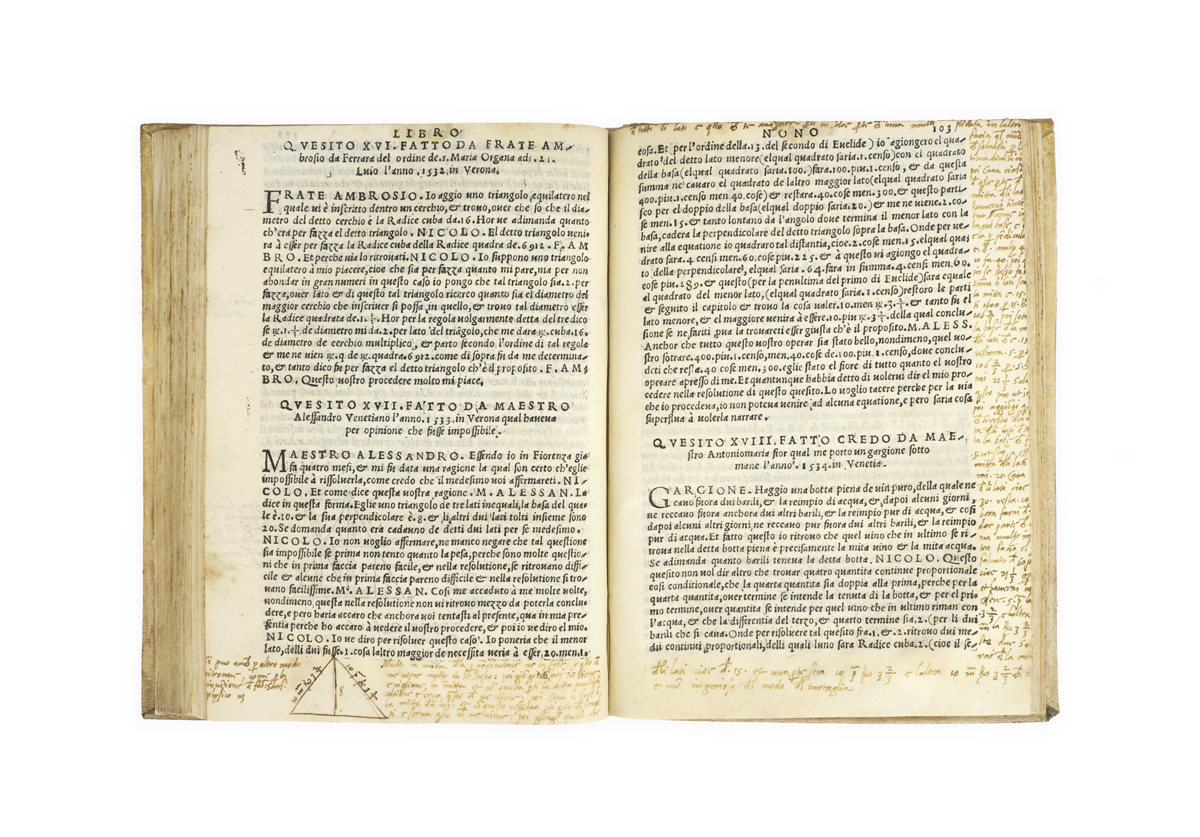
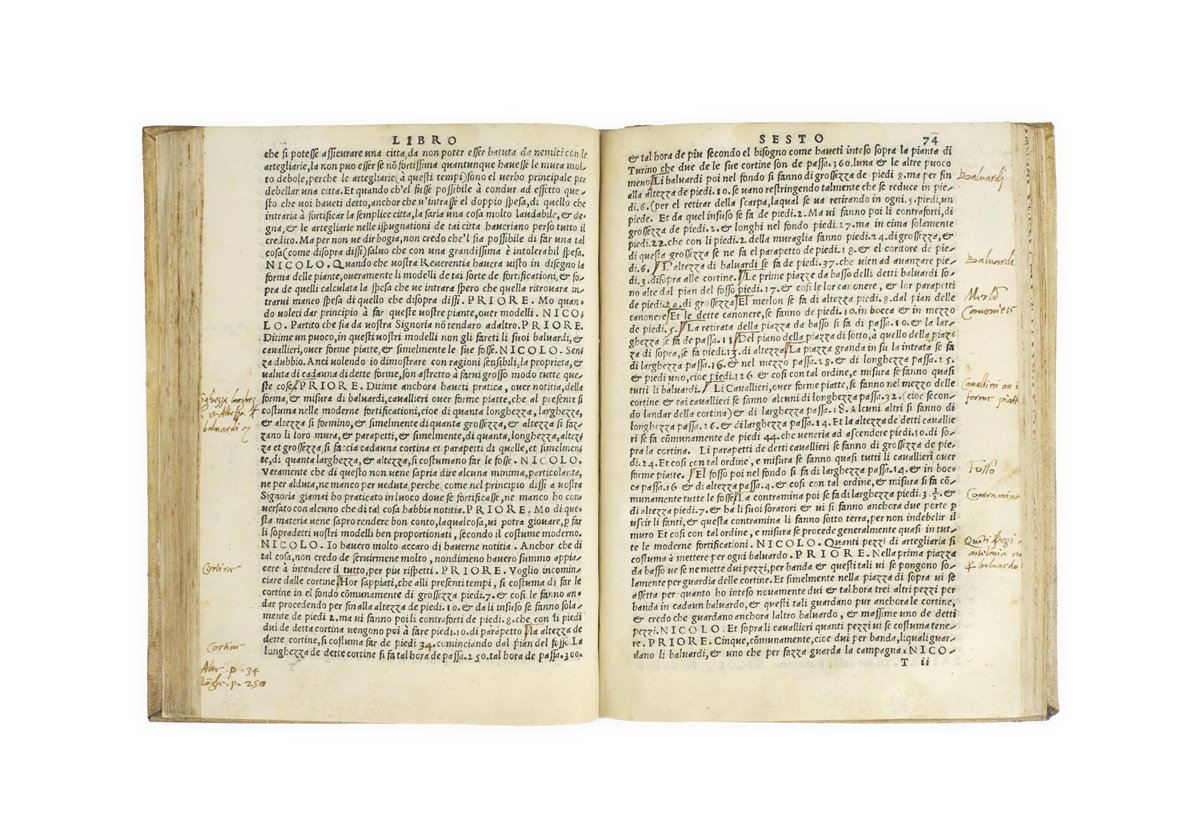
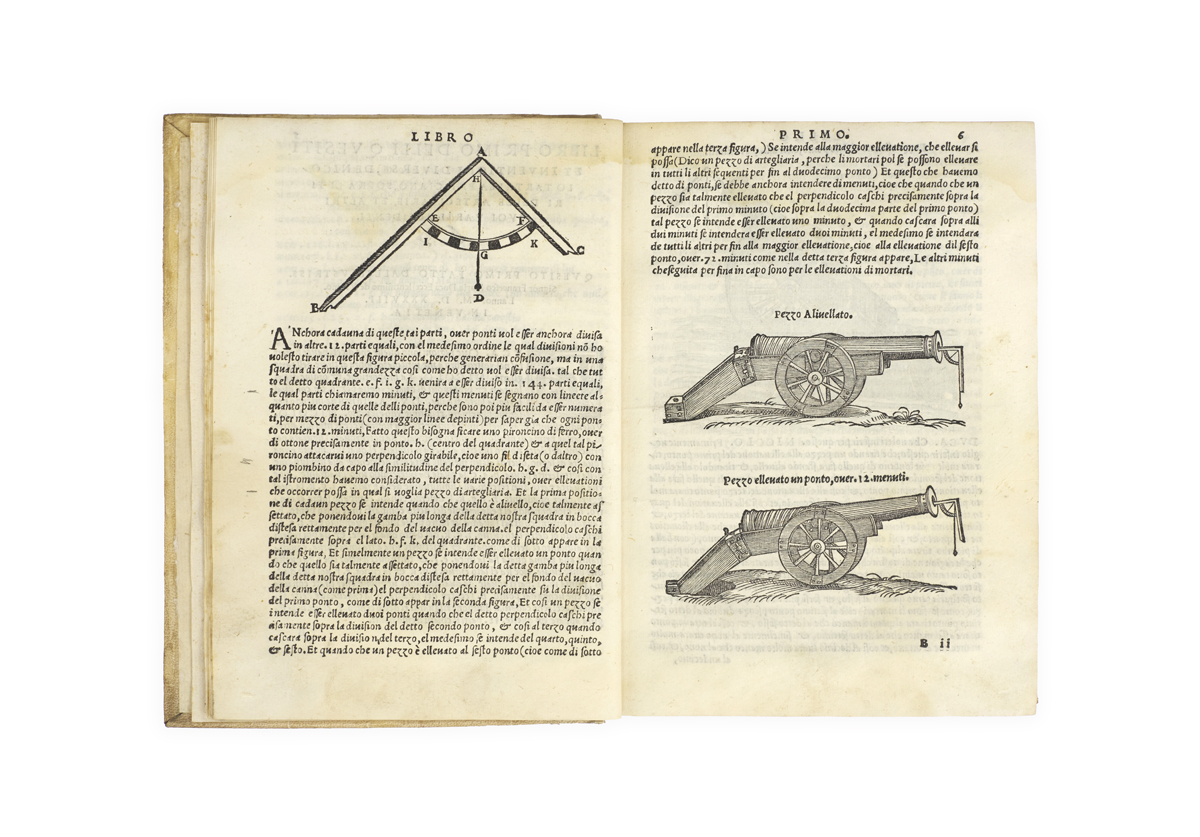
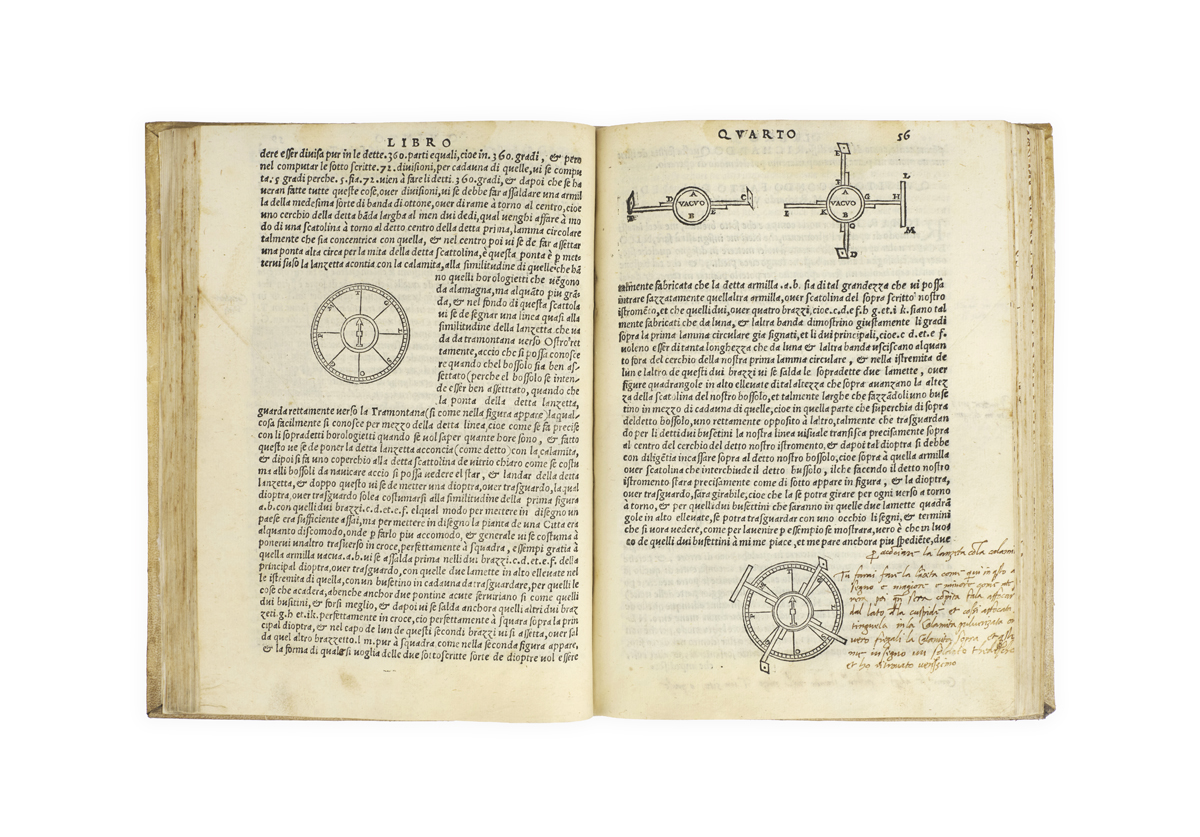
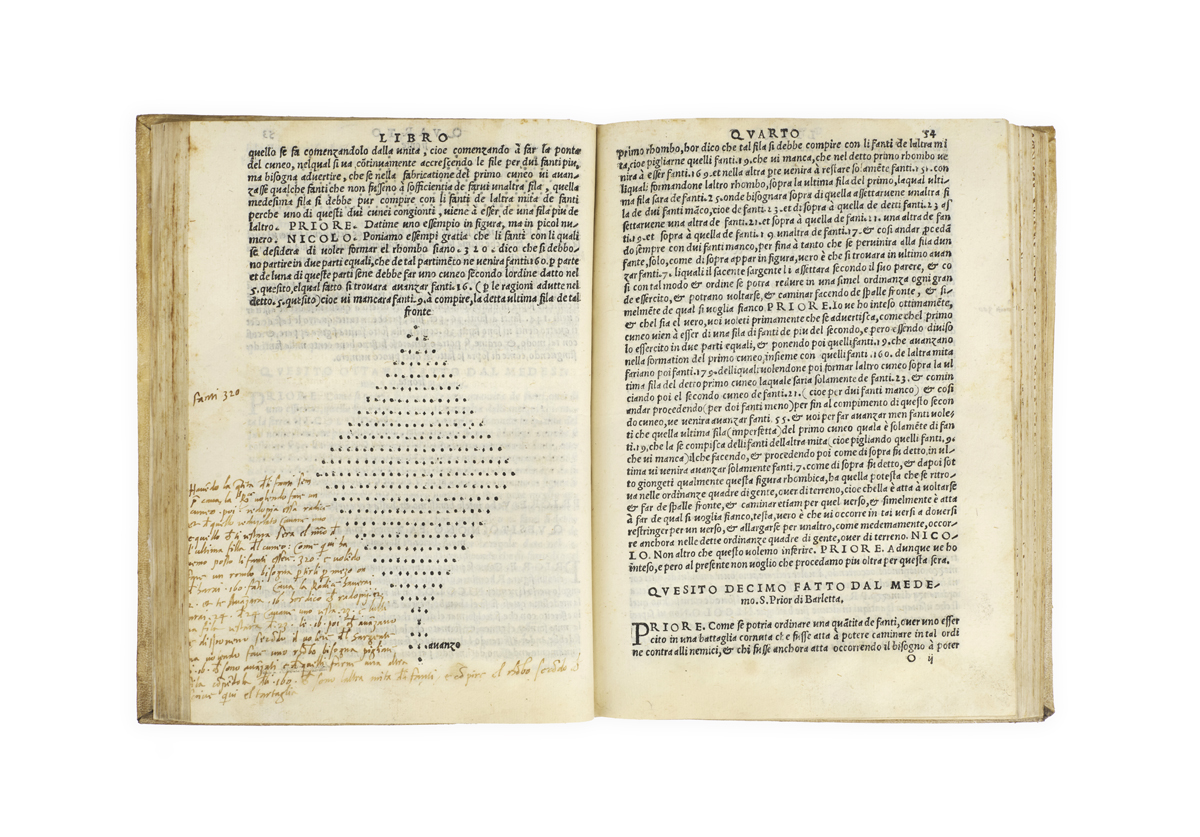
4to, ff. 132, [2, contents], without folding plate as usual; large woodcut portrait of Tartaglia to title-page with the motto ‘Le inventioni sono difficili ma lo aggiungervi è facile’, woodcut historiated initials, over 60 woodcut in-text diagrams and illustrations; very light marginal dampstaining to first and last leaves, occasional slight foxing, small closed marginal paperflaw to title-page neatly repaired verso, a single marginal annotation on f. 124 excised, but a very good copy; recased in old vellum, rebacked; small chip at foot of spine; contemporary annotations in Italian in light brown ink to c. 44 pp. with small marginal drawings including a cannon and a book, errata corrected in manuscript.
First edition, annotated throughout by a contemporary reader, of Tartaglia’s highly influential work on ballistics and algebra, containing his polemical rule for solving cubic equations.
Brescian mathematician Niccolò Tartaglia (or Tartalea, 1499/1500–1557) taught mathematics at Verona in 1521 and in Venice in 1534, publishing the first Italian translations of Euclid and Archimedes and originating the science of ballistics in his 1537 Nova scientia. Divided into nine books, the present work is dedicated to Henry VIII, whose interest in the study of warfare had been indicated to Tartaglia by Richard Wentworth, the king’s envoy in Venice. Wentworth is one of the many interlocutors in Tartaglia’s 171 quesiti, dialogues in which the author discusses the merits of cannonballs made from lead, iron, and stone, saltpetre and the creation of gunpowder, methods of fortification, arithmetic, geometry, and algebra.
‘The most important mathematical subject with which Tartaglia’s name is linked is the solution of third-degree equations. The rule for solving them had been obtained by Scipione Ferro in the first or second decade of the sixteenth century but was not published at the time. It was rediscovered by Tartaglia in 1535, on the occasion of a mathematical contest with Antonio Maria Fiore … On 25 March 1539, Tartaglia told Girolamo Cardano about it at the latter’s house in Milan. Although Cardano had persistently requested the rule and swore not to divulge it, he included it in his Ars magna (1545)’ (DSB). Tartaglia retaliated by publishing their correspondence within his quesiti, including Cardano’s solemn vows not to publish on cubic equations until Tartaglia did.
Our copy, containing the often-lacking table of contents, has been annotated in a single hand: this early reader takes particular interest in the manufacture of explosives and fortification, numbering the steps for making gunpowder and noting the names of key ingredients. Most copiously annotated, however, is the ninth and final book, in which the annotator, inter alia, visualises and checks Tartaglia’s equations through diagrams and calculations and provides an alternative method to the author’s ‘ingenioso modo’ of finding the side lengths of a scalene triangle.
BM STC Italian, p. 658; Adams T 183; Cockle, Foreign 660; Marini, pp. 11–12; Norman II 2054; Riccardi II I:11; Wellcome I 6225. See DSB XIII, pp. 258–262.