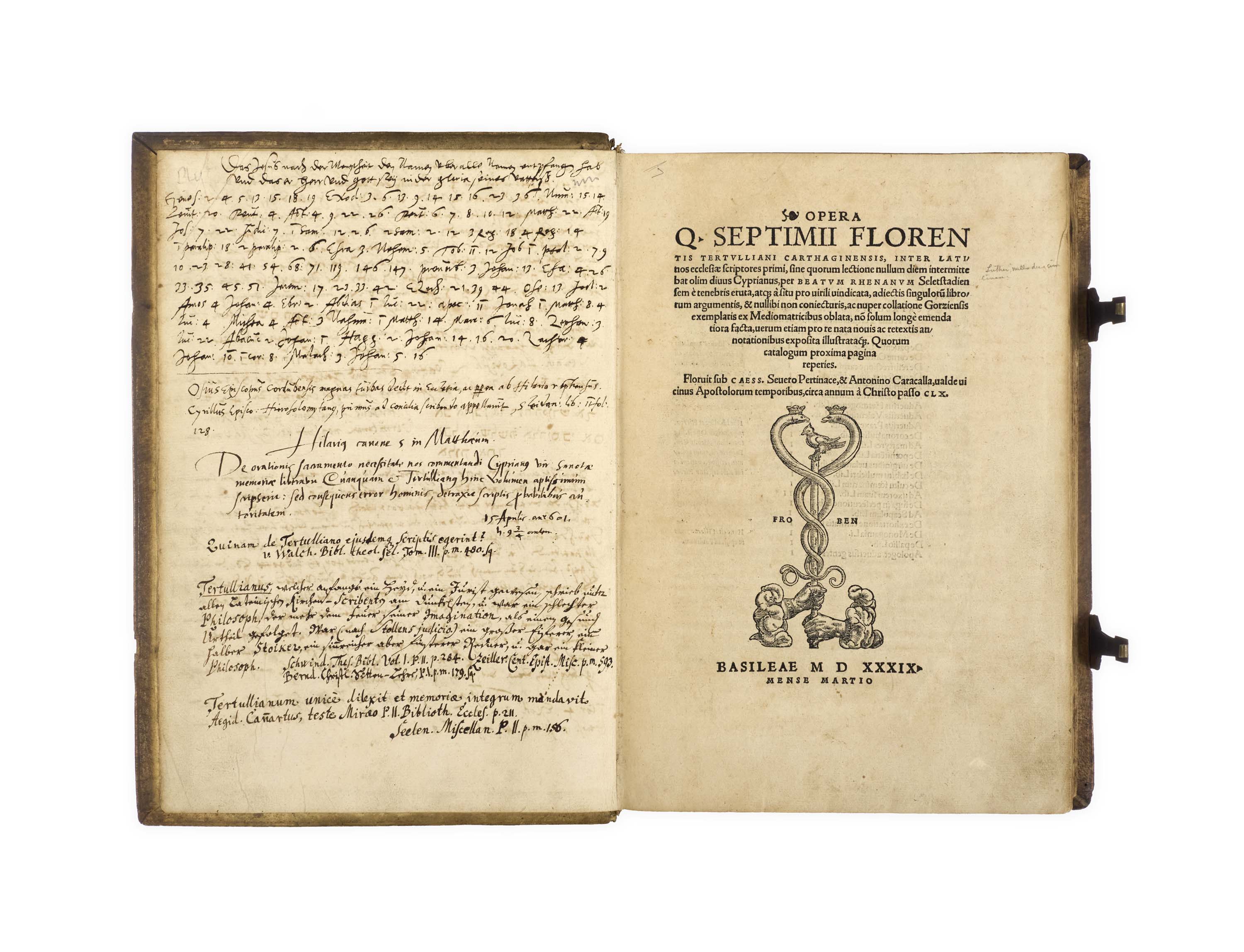


With Rhenanus’ ‘Rubbish’
TERTULLIAN.
Opera … per Beatum Rhenanum Seletstadiensem e tenebris eruta, atque a situ pro virili vindicata, adiectis singulorum librorum argumentis, & nullibi non coniecturis, ac nuper collatione Gorziensis exemplaris ex Mediomatricibus oblata, non solum longe emendiora facta, verum etiam pro re nata novis ac retextis annotationibus exposita illustrataque. Basel, [(colophon:) Hieronymus] Froben [and Nikolaus Episcopius], March 1539.
Folio, pp. [xx], 766, [2, blank], [32]; woodcut Froben device on title-page and final verso, woodcut initials; an excellent copy; bound in contemporary blind-stamped pigskin over wooden boards by Wilhelm Frank of Nuremberg (EBDB w003126), several roll-tools including one of Spes, Fides, and Charitas with the initials WF, brass clasps to fore-edge, spine lettered later in ink; binding a little rubbed with a few minor scuffs and stains; engraved armorial bookplate (a griffin surmounted by a crest of peacock feathers) to rear pastedown, contemporary marginal annotations in Latin and Greek at the beginning of the volume, including a quotation from Ovid Metamorphoses XV about Pythagoras on p. 38, some underlining in black or red ink, a few later manicules in pencil, note in red ink on rear free endpaper, numerous manuscript notes to front endpapers, one dated 15 April 1601.
Added to your basket:
Opera … per Beatum Rhenanum Seletstadiensem e tenebris eruta, atque a situ pro virili vindicata, adiectis singulorum librorum argumentis, & nullibi non coniecturis, ac nuper collatione Gorziensis exemplaris ex Mediomatricibus oblata, non solum longe emendiora facta, verum etiam pro re nata novis ac retextis annotationibus exposita illustrataque.
Third Froben edition of Tertullian’s extant writings, studiously edited and re-revised by Beatus Rhenanus, with extensive annotations showing considerable engagement with the text by early readers seeking to contextualise Tertullian.
Tertullian is now considered a significant early Christian apologist, writing more than a century before the acceptance of Christianity under the Emperor Constantine, providing a window into life in the early Church before the conforming zeal of the fourth century, in the wake of the Council of Nicaea. Beatus Rhenanus (1485–1547) first edited Tertullian in 1521, which he revised in 1528 and again, here, in 1539, with a new preface addressed ‘to theologians and all pious people’, and with additional readings from a manuscript in the abbey of Gorze (Lorraine). Reformers, even moderate ones like Beatus Rhenanus (and his teacher Erasmus), were interested in Tertullian as an early witness to Christianity before the Church became fully institutionalised and dogmatic. The progress of these three editions of Tertullian attest to Beatus’s careful attention to the manuscript sources in his annotations, which he modestly calls his rubbish or trifles (‘hasce annotationum mearum quisquilias’).
The manuscript annotations on the front flyleaf, entitled ‘De nomine Jhesus’, in German, Hebrew, and Latin, relate to the name of Jesus and the name of God, referring to the work by Johannes Reuchlin (here called Capnion) entitled De verbo mirifico. Other authors mentioned in the text are Erasmus, Sebastian Münster, and Giovanni Pico della Mirandola. The annotations in this hand cover two and a half pages; at the end of those is a note in a different hand about Hosius, the fourth-century bishop of Cordoba, then a note headed ‘Hilarius canones in Matthaeum’ (the fourth-century Hilarius of Poitiers, whose commentary on Matthew was greatly influenced by Tertullian) dated 15 April 1601, and below that some bibliographical notes about Tertullian in a later hand. Both Hosius and Hilarius were opposed to the Arian position on the Trinity.
OCLC records only four copies in the US: Harry Ransom Center, Mount Angel Abbey, Concordia Seminary, and Illinois.
USTC 679656; VD16 T 561.