A Royal Debt
THICKNESSE, Philip.
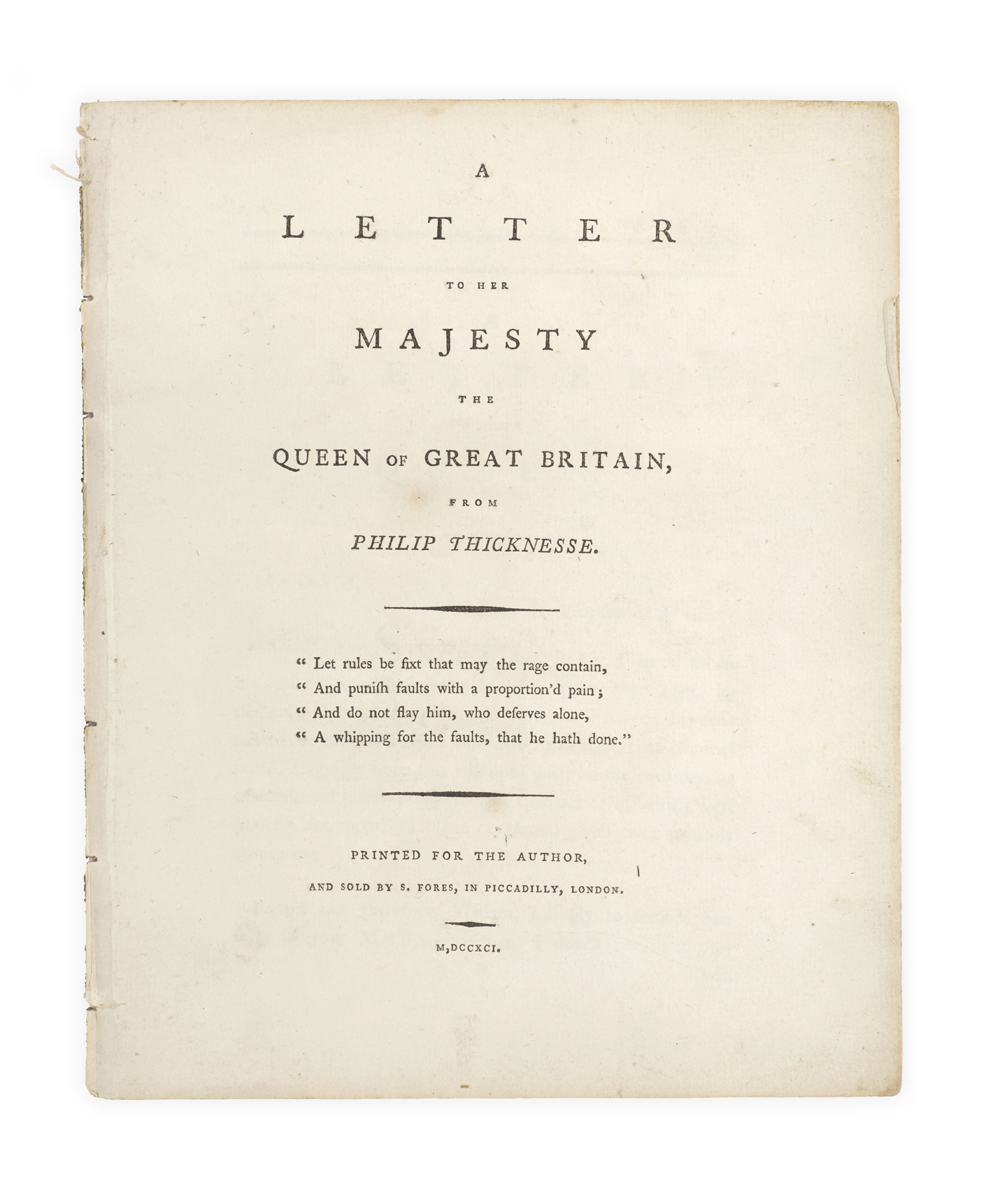
A Letter to her Majesty the Queen of Great Britain …. Printed for the Author, and sold by S. Fores … London, 1791.
4to, pp. [2], 13, [1]; a fine copy, lower edge partly untrimmed, disbound.
First and only edition, very rare. Thicknesse had been commander of the garrison at Harwich when Queen Charlotte first arrived in England after a difficult sea passage in 1761. ‘I cannot help here observing that during a great part of the afternoon … I was driving my post-chaise, in a scarlet coat, upon the beach, to make it visible that her Majesty might not only be there safely landed … but that Admiral Campbell … well knew that at my cottage … now well known to every body, was to be found better accommodation than could have been procured at Harwich …’; Anson though insisted on landing, against a contrary wind, in the main harbour.
Shortly afterwards Thicknesse acquired a portrait of Frederick Prince of Wales (found in a drawer in a house bought from the Duchess of Kendal by his wife’s father), which he hoped one day to give to the royal family, and indeed contrived to do so via the French traveller and writer Louis Dutens, and John James Majendie, English tutor to the Queen. Although the Queen liked the portrait she was unable to accept the gift, but the portrait was not returned to Thicknesse for six weeks, despite his repeated efforts – a circumstance he attributes here to some dubious machinations by the two Frenchmen. Some years later, in 1766, Thicknesse moved to France, when he contrived again to gift the portrait to the Queen, this time through Lord Rochford and this time successfully. Rochford told the Queen “‘He had it from Mr. Thicknesse, at Paris.” Permit me, therefore, Madam, to say, that Mr. Thicknesse is now at Paris again; not because he prefers France to England, but that it is more convenient for his residence, and more suitable to his present circumstances’, i.e. great poverty. If his Majesty ‘may think it right to make me some compensation, or return the picture … I humbly submit to your Majesty’s consideration’. In 1789, ‘nothing daunted by the early stages of the French Revolution [the Thicknesses] made a brief trip to Paris … [then] departed more wholeheartedly in 1792’ – Philip died of a seizure en route to Italy, and his wife was arrested and confined for eighteenth months.
ESTC shows two copies only: British Library, and Yale (trimmed to an octavo).