Early Chinese Lithography
[THOM, Robert].
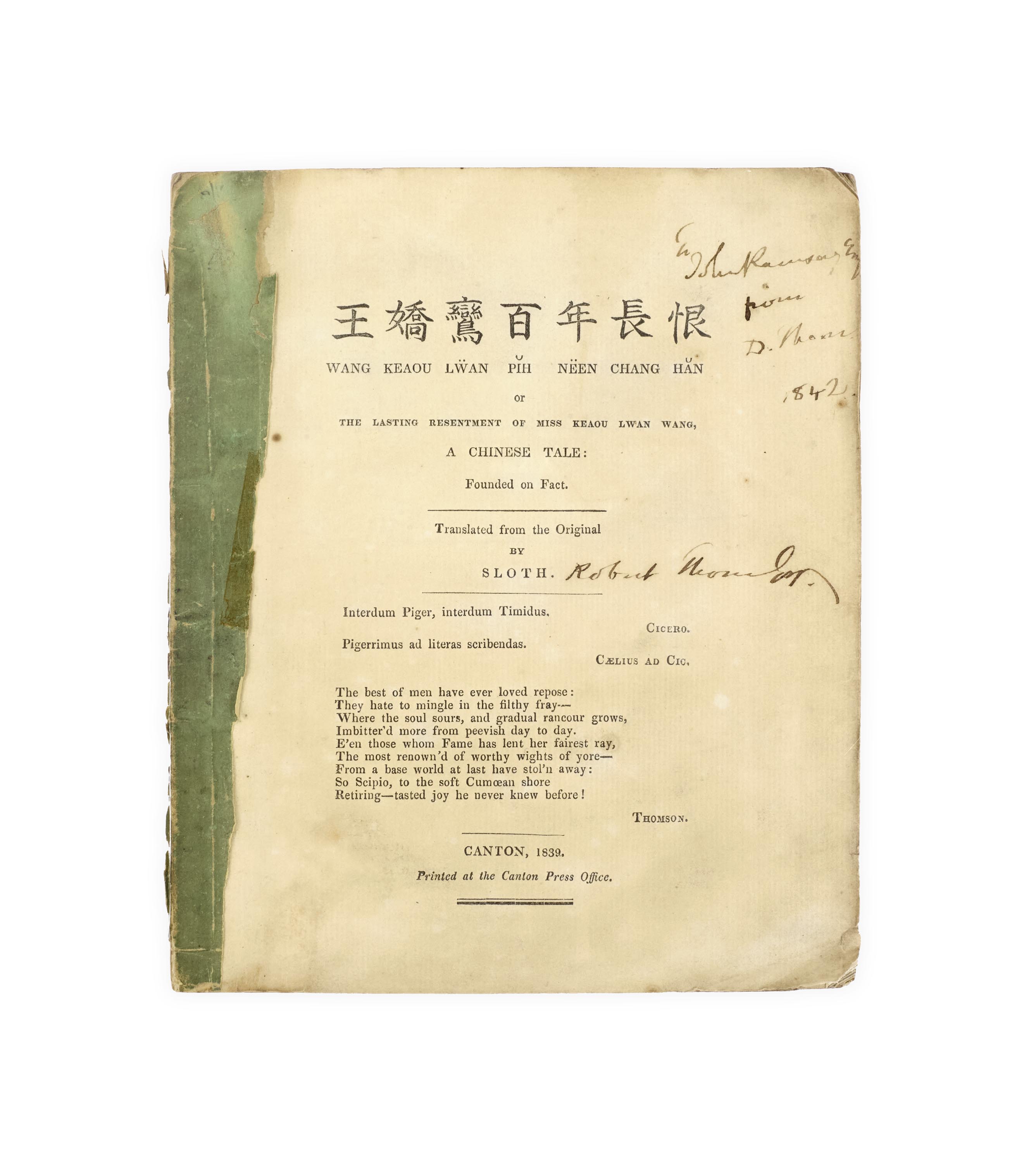
王嬌鸞百年長恨 Wang Keaou Lẅan pǐh nëen chang hǎn or the lasting Resentment of Miss Keaou Lwan Wang, a Chinese Tale: founded on Fact. Translated from the original by Sloth … Canton, Canton Press Office, 1839.
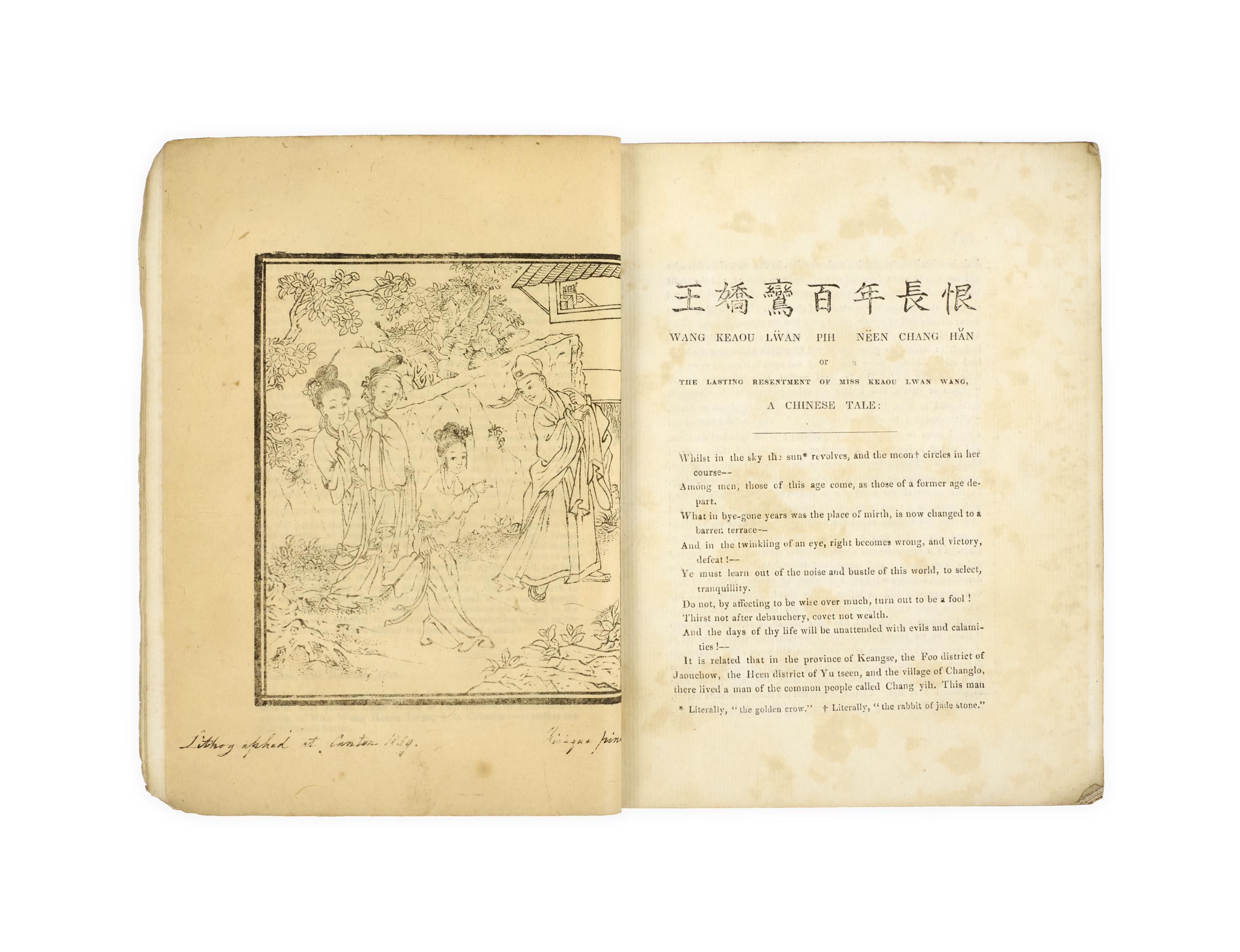
4to, pp. viii, 66, [2, blank], with a lithographic illustration on rice paper (‘Lithographed at Canton 1839’), the rest printed on thick laid paper; title-page slightly dusty, terminal blank frayed, else a good copy preserving a large fragment (loose) of the original green printed paper wrapper (duplicating the title-page but with an printed overslip naming Thom as the author); inscribed on the wrapper and title-page ‘To John Ramsay Esq from D. Thom 1842’.
Added to your basket:
王嬌鸞百年長恨 Wang Keaou Lẅan pǐh nëen chang hǎn or the lasting Resentment of Miss Keaou Lwan Wang, a Chinese Tale: founded on Fact. Translated from the original by Sloth …
First and only edition, scarce, loosely translated from a Chinese novella which appears in the seventeenth-century story collection Jingu qiguan (‘Wonders old and new’). It contains a very early example of lithographic printing in China, in this case to reproduce a woodcut illustration.
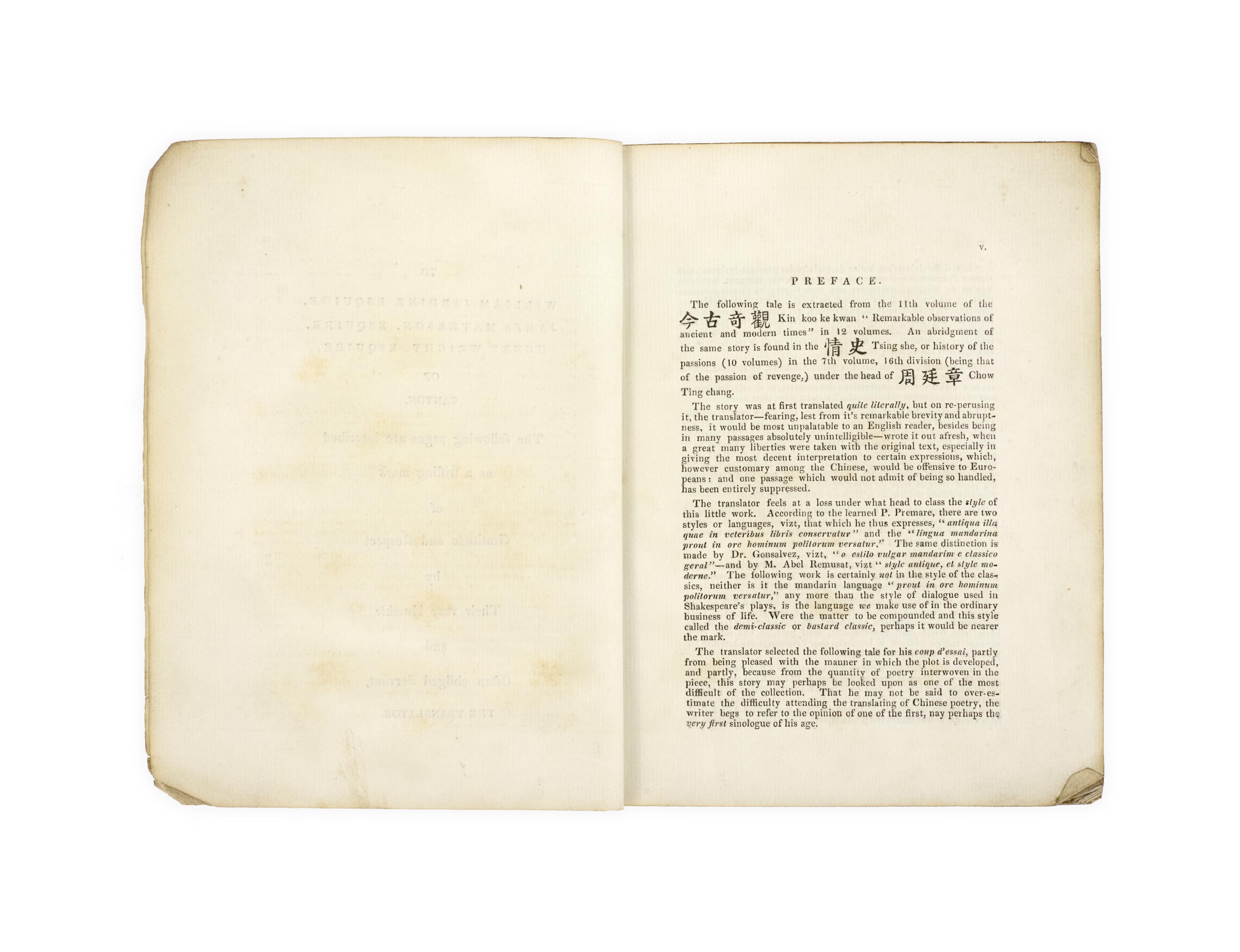
The translator, ‘Sloth’, was Robert Thom, a Scottish factor who had been employed in Canton by Jardine, Matheson & Co from 1833 (the work is dedicated to William Jardine, James Matheson, and Henry Wright). According to John Macvicar, who had engaged Thom for the firm, Thom was ‘very industrious and obliging’ though ‘his manners are rather against him, being very Scotch’. His introduction here points to the difficulties of translating from Chinese to English, and the relative disadvantage of missionaries in Canton to those in Peking, who are surrounded by literary men – by contrast ‘our Chinese associates are Hong merchants, Linguists, Compradores, and Coolies’; but he was nevertheless assisted by a native Chinese teacher. Perhaps on the back of this demonstration of his linguistic abilities, Thom was employed as a translator during the First Opium War from 1839; he narrowly avoided being shot in 1840, and succeeded Robert Morrison during the Treaty negotiations in 1843. He was later appointed consul to Ningpo, where he died in 1846.
Like Sloth’s earlier translation of Aesop into Chinese, a number of copies of the work were shipped back to Britain and into the care of the author’s brother Rev. David Thom (1795-1862), minister of Scottish church in Liverpool. This copy was inscribed in 1842; we know of one other, inscribed to the Honourable Societies of the Inner and Middle Temple in 1849.