Earliest Life Expectancy Statistics in Italy
Data Subsets Including Monks, Nuns, and Jews
TOALDO, Giuseppe.
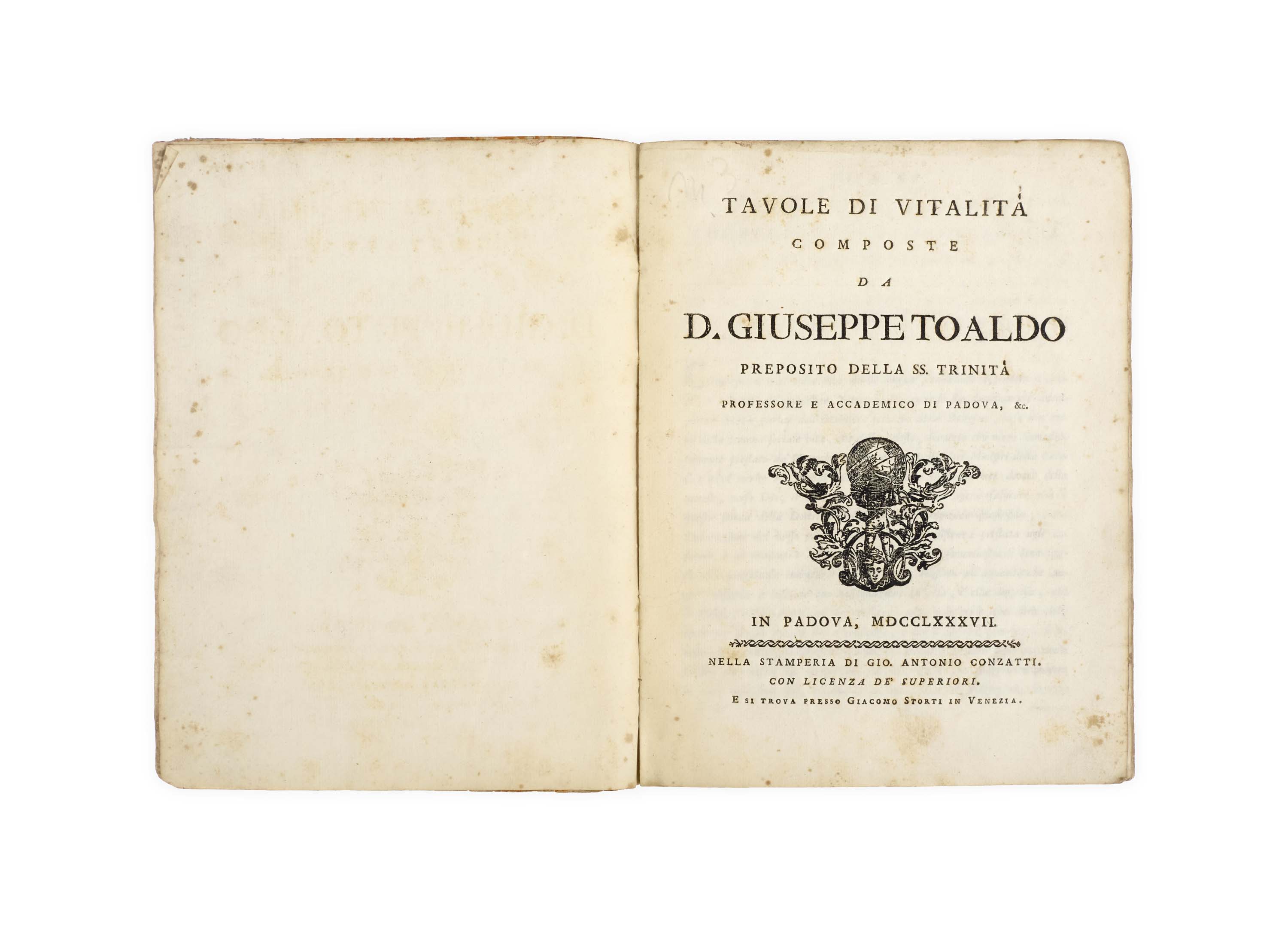
Tavole di vitalità. Padua, Conzatti, 1787.
4to, pp. 32, including a set of tables from p. 25; woodcut device on title, woodcut tailpieces, printed in italic and roman types; a little foxing, more so in the margins, but a very good, wide-margined copy in contemporary wrappers covered with orange block-printed patterned paper; spine defective, edges a little frayed, upper cover partially detached from wrapper, some discolouration to the sides; old paper library shelfmark pasted to upper wrapper.
Sole edition of the first Italian published study on demographic statistics, and the first scientific treatment in Italy of child mortality, conducted by a professor of astronomy at the University of Padua, the editor of Galilei. As a priest, Toaldo had familiarity with, and access to, large sets of population data never before used for scientific purposes: parish records, but also records from the Ghettos in Verona and Padua. His meticulous collection and presentation of data and calculation of life expectancy lasted for over twenty years. When it appeared in print, it was innovative, particularly in the creation and study of data subsets, evident in the tables. He shows distinct statistics for men and women (women resulting more longevous than men); for population dwelling in cities, mountains, and country; for population in monasteries and nunneries (whom his figures show as enjoying higher life expectancy than lay folk); Jews. In his preface, Toaldo places his vital statistics within the new discipline of ‘political arithmetic’, thus conceptually framing his work as a contribution to the social sciences.
Riccardi II 528. Not in Goldsmiths’ or Kress; not in Einaudi. Scarce outside Italy: OCLC finds two copies in the US (Columbia, Cornell), one each in the Netherlands (International Institute of Social History), Germany (Berlin), France (BNF), and UK (BL).