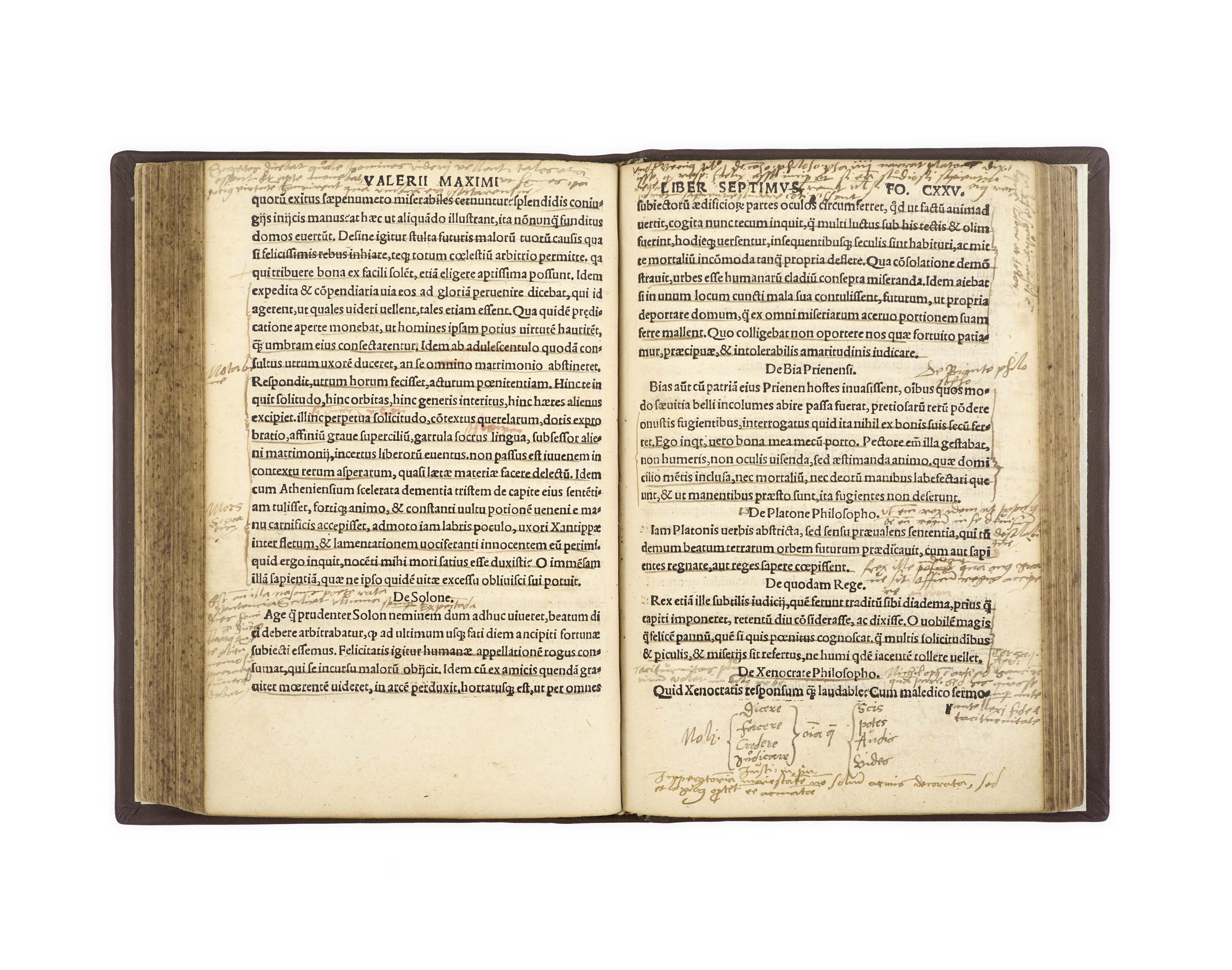
‘Do Not Say/Do/Believe/Judge All That You Know/Can Do/Hear/See’
VALERIUS MAXIMUS, Gaius.
Valerii Maximi dictorum, & factorum memorabilium libri novem. [(Colophon:) Sélestat, Lazarus Schürer, December 1520.]
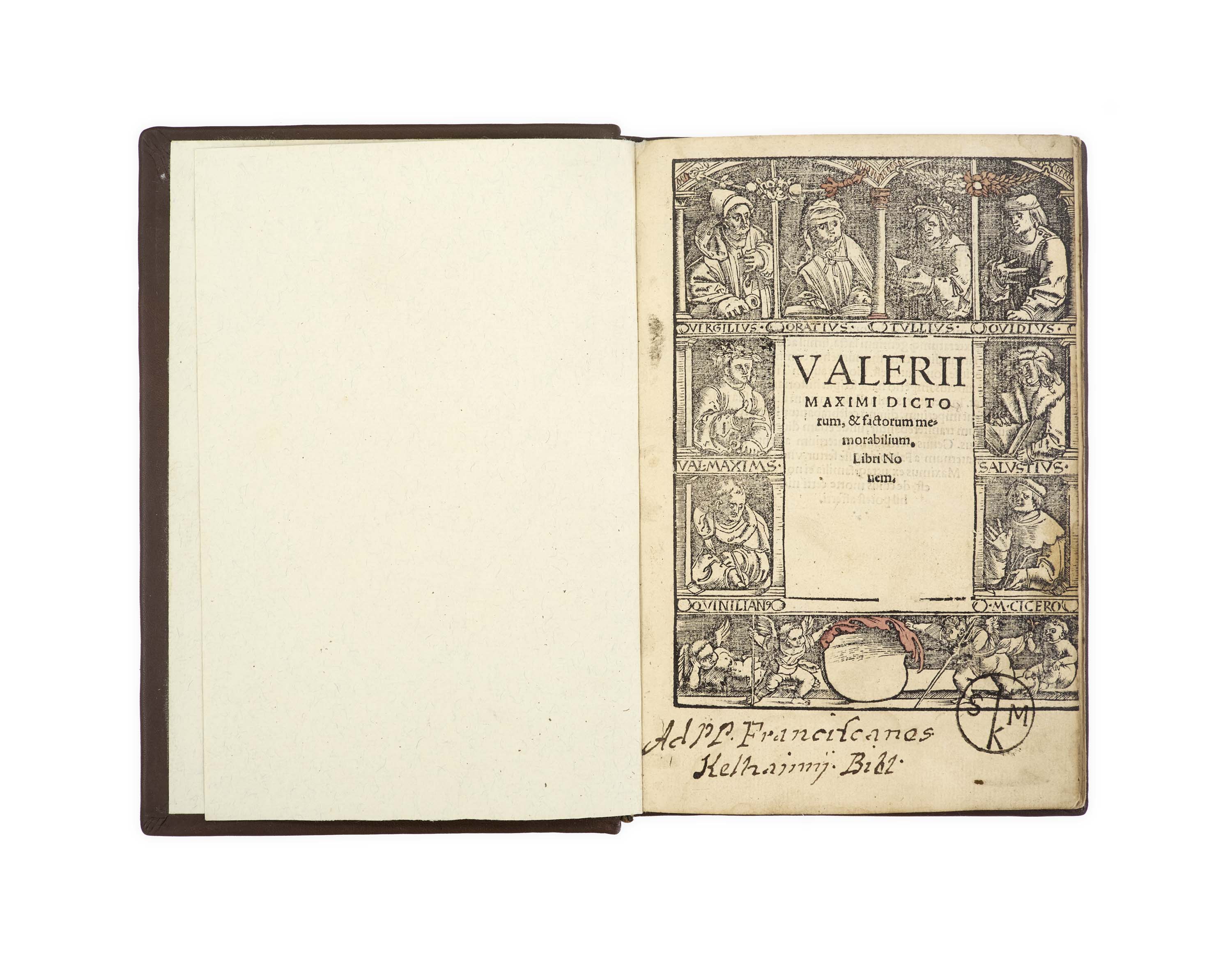
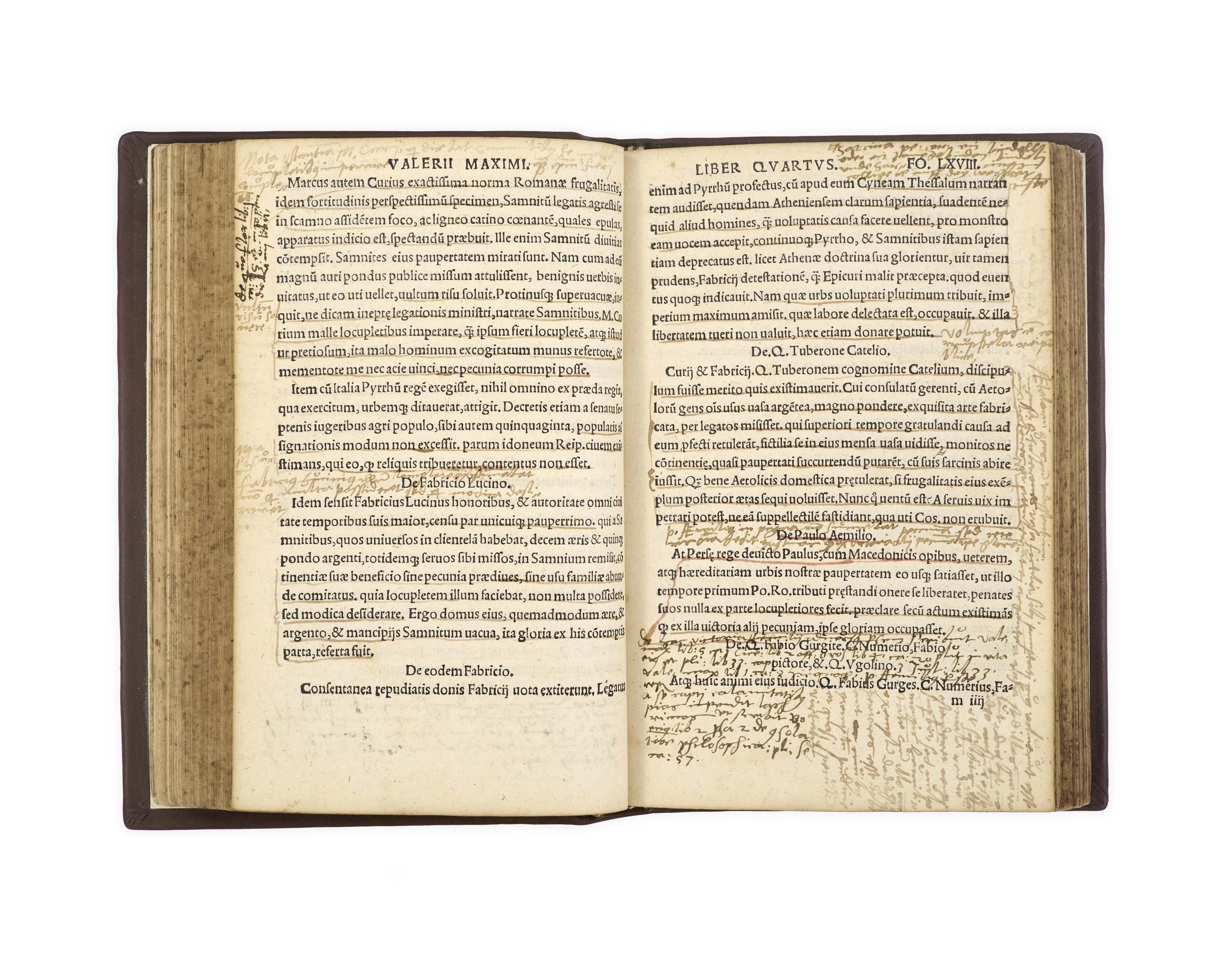
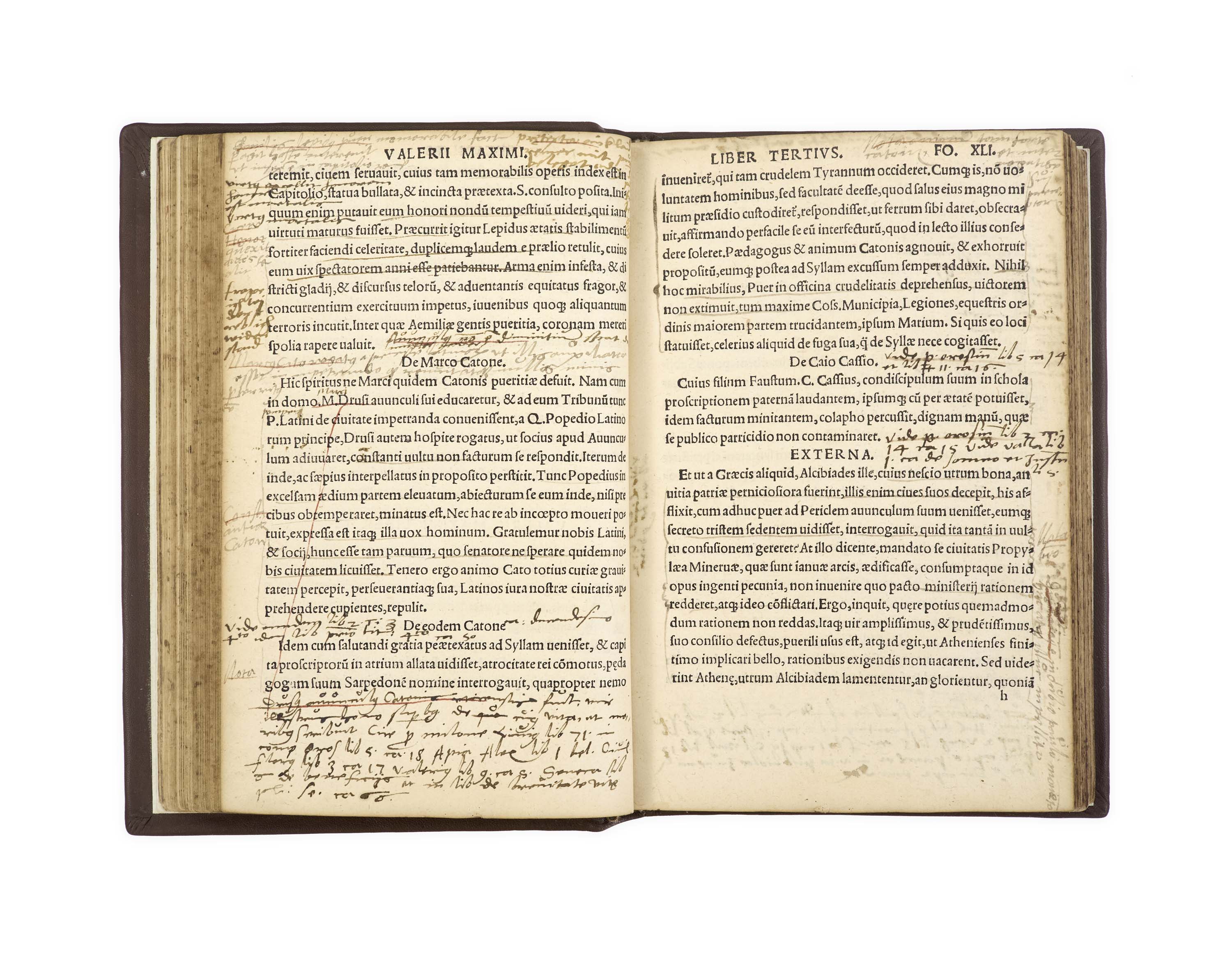
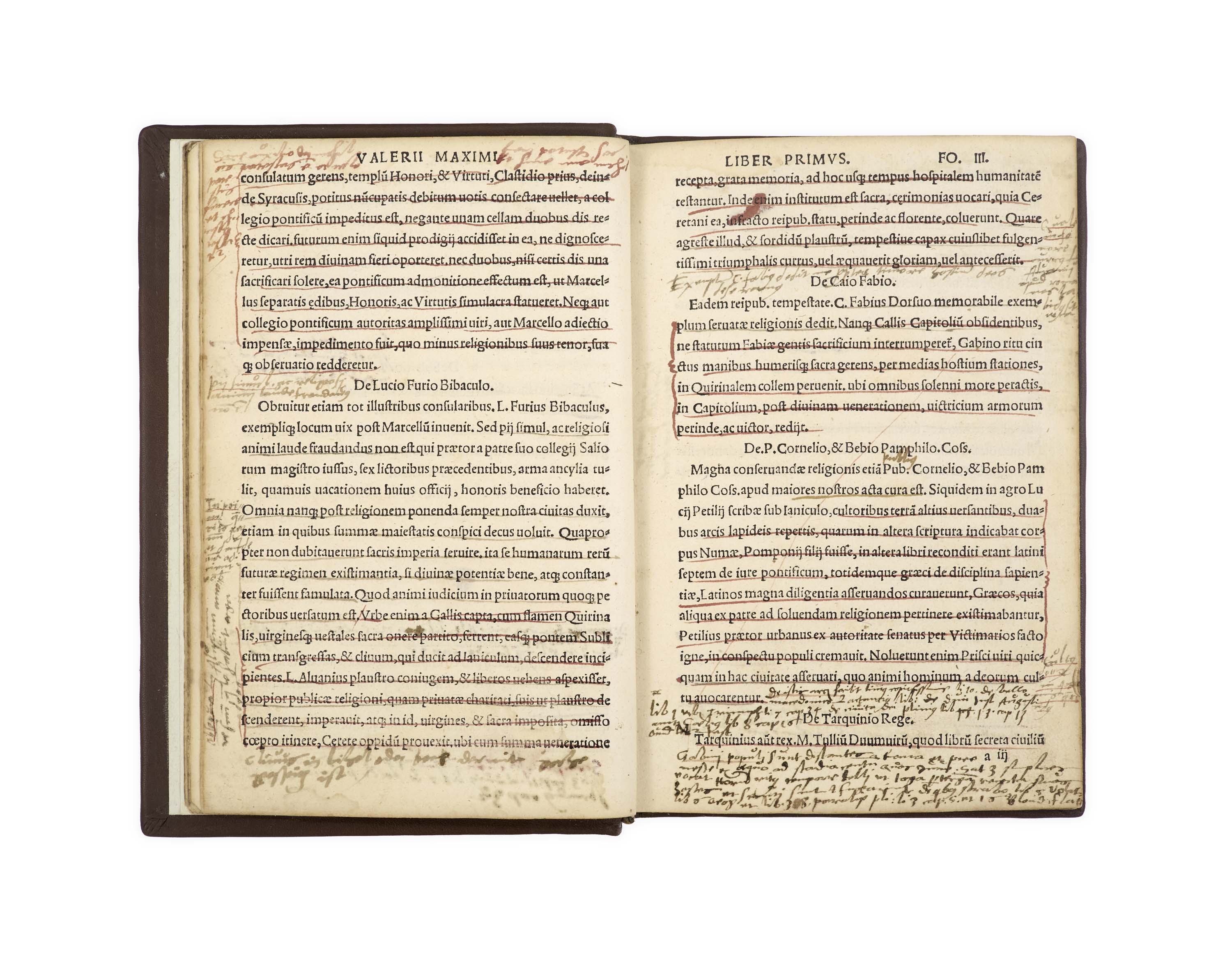
4to, ff. [6], CLXXIX, [1]; elaborate woodcut border to titlepage with a little hand colouring, armorial woodcut printer’s device to recto of last leaf; title border slightly trimmed at outer margin, a few marginal wormholes at end, some light dampstaining and toning; overall a good copy in recent brown calf to style; sixteenth-century annotations and underlining in brown and red ink to almost every page; ?eighteenth-century ownership inscription to title ‘Ad PP. Franciscanos Kelhaimii Bibl.’ (library of the Franciscans of Kelheim) with circular ink stamp ‘SMK’ (also partly visible to edges of textblock).
Very rare edition of Valerius Maximus printed at Sélestat in eastern France, profusely annotated in a sixteenth-century German hand.
Valerius Maximus’s Facta et dicta memorabilia, ‘mostly drawn from Livy and Cicero, are arranged roughly as follows: book 1, religion, omens, prophecies; book 2, social customs; books 3–6, virtuous conduct (fortitude, moderation, humanity, etc.); books 7–8, a miscellaneous group including good fortune, military stratagems, famous law-suits, eloquence, and many other items; book 9, evil conduct. The examples on each topic are divided into ‘Roman’ and ‘foreign’. The work … was very popular in the Middle Ages; two epitomes were made of it’ (Oxford Companion to Classical Literature).
Lazarus Schürer (d. 1531) began his career in Strasbourg before moving south to Sélestat where he worked initially as a printer and then as director of the town’s celebrated Latin school. The attractive woodcut titlepage incorporates eight portraits of classical Latin writers, including Valerius Maximus himself.
The annotations here, in a German hand, are evidence of an extraordinarily thorough reading of Valerius Maximus’ work. Our annotator draws upon many other classical writers – inter alios Cicero, Homer, Juvenal, Livy, Ovid, Pliny, Quintilian, Sallust, Seneca, Strabo, and Xenophon – to enhance the printed text. He provides a footnote on the city of Gabii to the east of Rome (f. IIIr); lists various authorities for the life of Servius Tullius (f. IXr); gives a potted biography of Plato (f. XIIr); quotes from Aristotle’s Ethics on friendship (f. XCIIIIv); and refers to Boethius on the subject of fortune (f. CXVIIIr). There are also quotations from the German humanist Heinrich Bebel, including one on eloquence. A schematic note appears at the foot of f. CXXVr: ‘Do not {say/do/believe/judge} all that {you know/can do/hear/see}’ (trans.).
No copies traced in the UK and only one in the US (University of Illinois).
USTC 700277; VD16 V-136.