[WINE.]
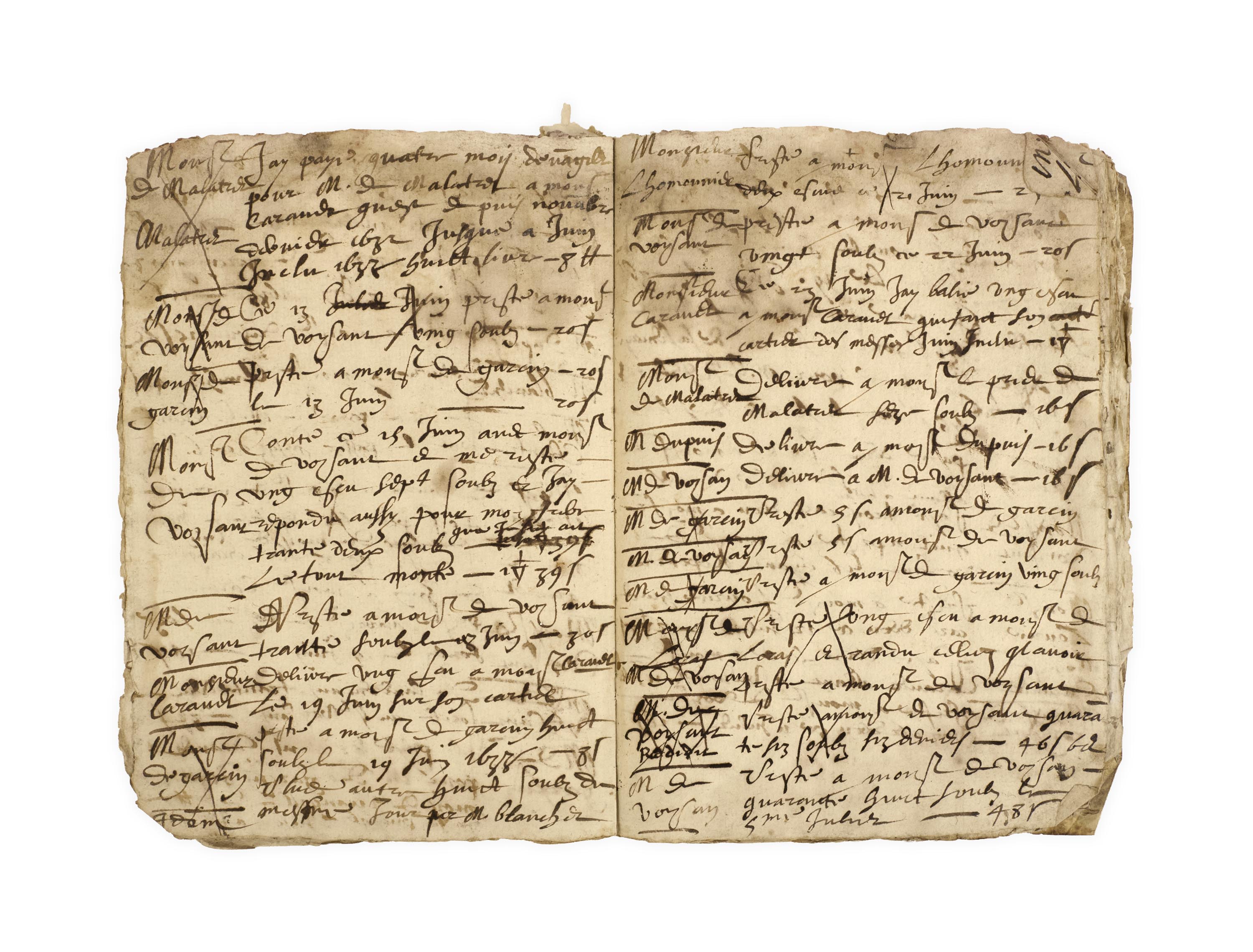
Account book of a Rhône valley wine merchant. France (vicinity of Lyon), c. 1641–8.
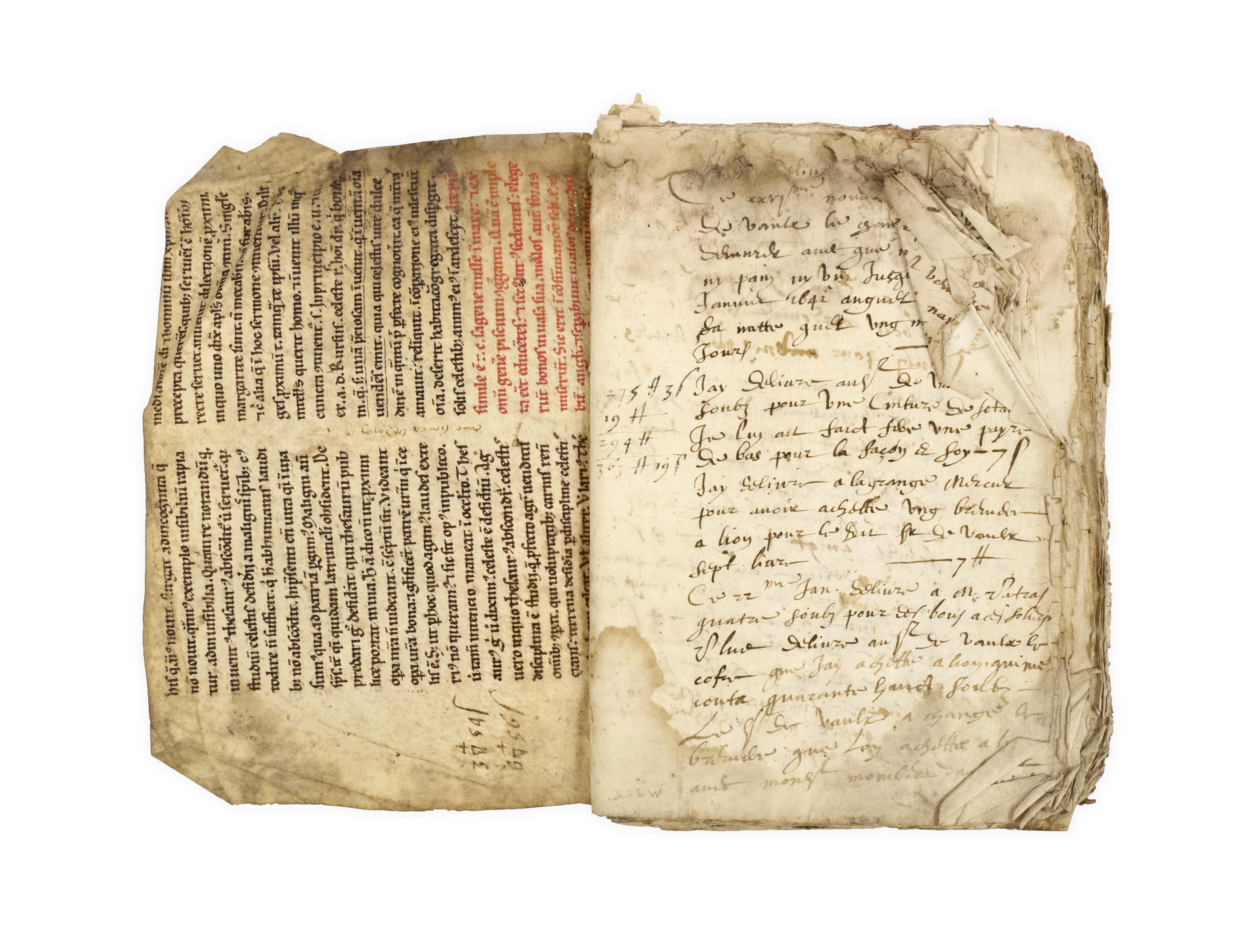
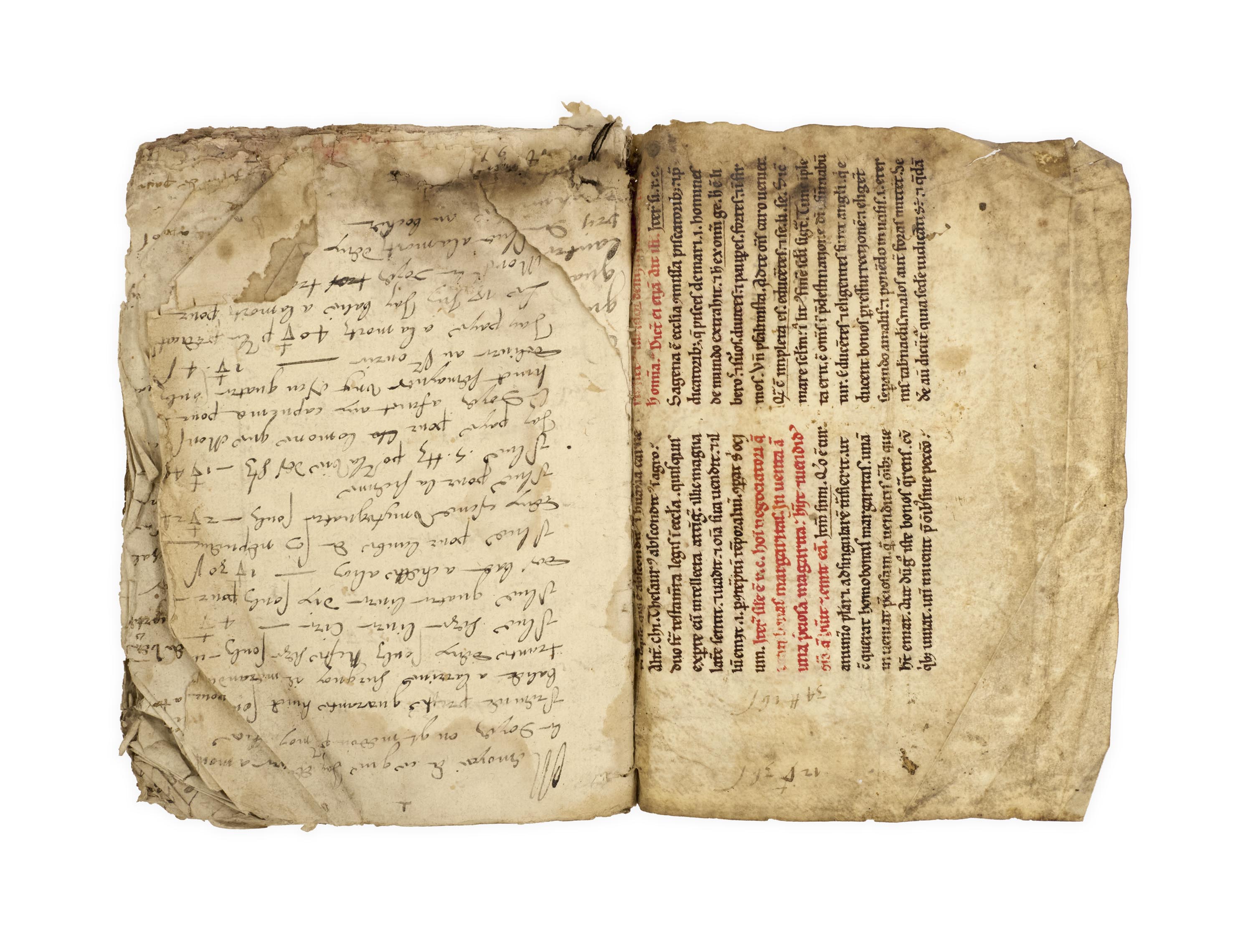
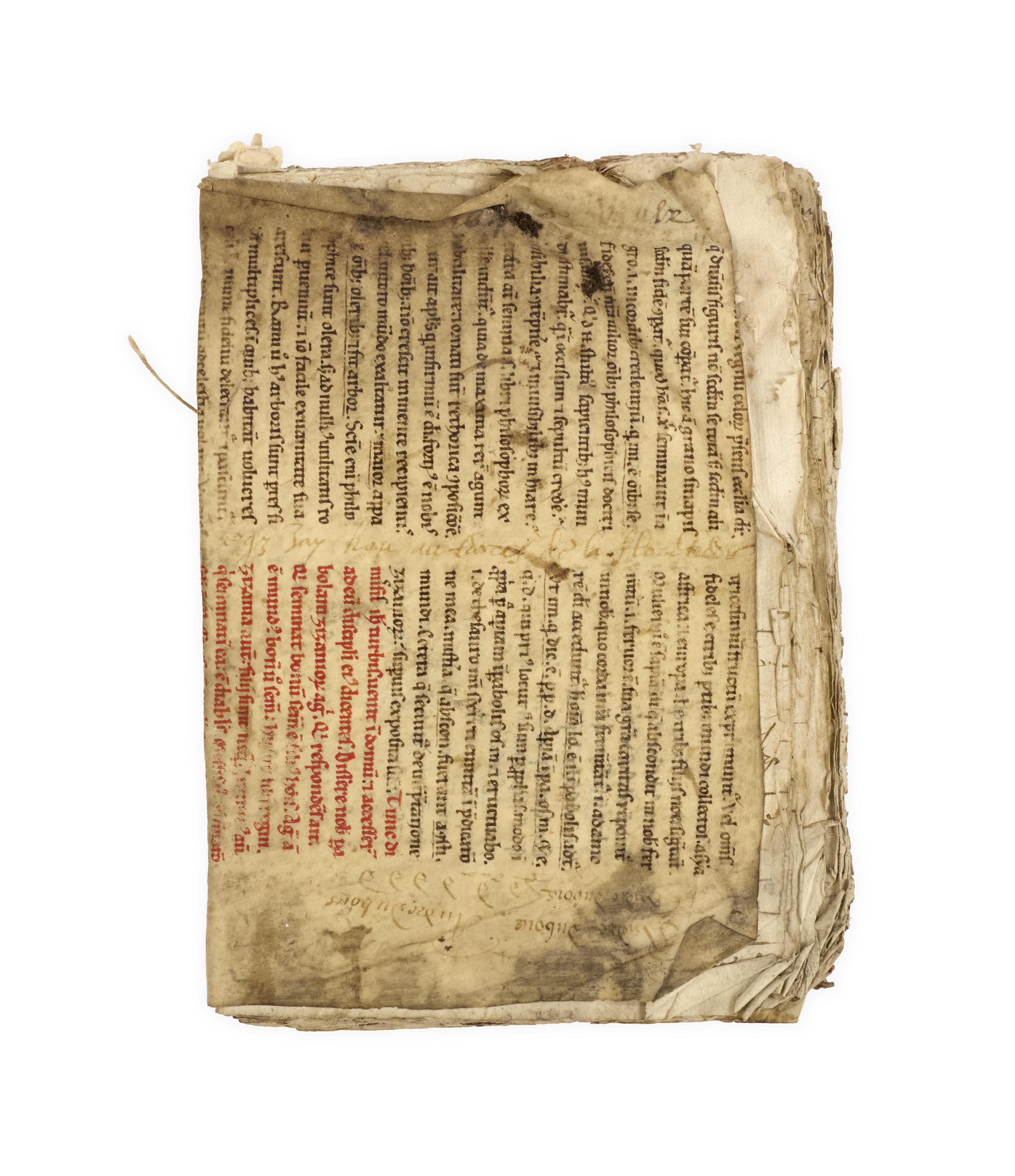
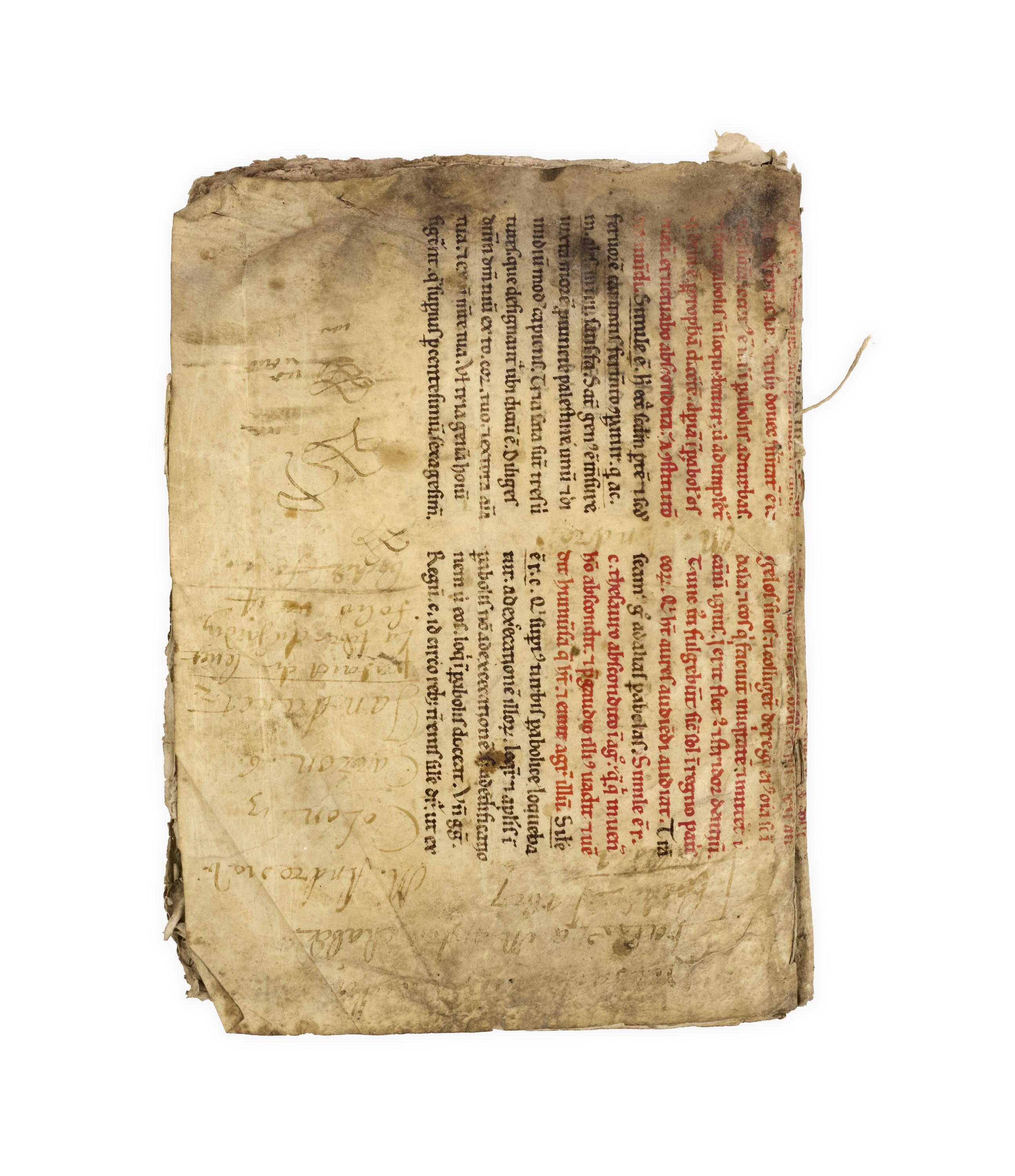
Manuscript in French on paper, small 4to, ff. [50], of which nine blank, remains of a further leaf torn out at beginning, written from both ends, with two further leaves loosely stitched in; damp- and mould-stained at foot resulting in softening of paper and consequent losses, some staining and soiling elsewhere, many leaves crumpled at edges and/or with corners folded down; bound in a vellum wrapper re-using a leaf from a twelfth-century gospel commentary.
Account book of a Rhône valley wine merchant, bound in a leaf from an early manuscript of an influential gospel commentary once attributed to Anselm of Laon but more usually given to Geoffrey Babion.
The account book’s compiler seems to have been a wine merchant who lived and worked in or near Lyon: on the final page are mentioned various items (including a ‘cofre’) ‘que Jay achetté a lion’. The first of the two loosely stitched-in leaves is a schedule of ‘Les tonos [i.e. tonneaux] que Jay vendu au mareschal ceste p[resen]te annee 1646 […]’ and comprises a list of barrels marked with various letters or numbers – and, in one case, ‘par mes armes’ (of which there is a small drawing). The second stitched-in leaf is a letter signed by the ‘mareschal’ in question, ‘Pierre Faure Mareschal de Vezeronce’, and dated 15 November 1646. It begins ‘Monsieur Je vous prie de m’envoyer le tonneau de vin que Jay achepté de vous demain sil vous plaist’. Vézeronce (now Vézeronce-Curtin) is a village a few miles east of Lyon. The letter is addressed to one ‘Monsieur le Seuroffin(?)’, who must therefore be the account book’s owner. Elsewhere in the manuscript is a reference to ‘mes vignes’ – he was evidently both a grower and a wine merchant in a part of the Rhône valley near Lyon.
Manuscript waste:
The wrapper preserves an almost complete leaf (c. 280 x 200 mm, text area 220 x 150 mm) from Enarrationes in Evangelium Sancti Matthaei, produced in France, third quarter of twelfth century, containing chapter 13 (Migne, Patrologia Latina 162, cols. 1374–7), double columns of 38 lines written in a very good French romanesque hand in dark brown ink, Biblical passages commented on written in red ink, ruling not discernible, some early underlining; stained, soiled, rubbed and creased, one corner crumpled, trimmed at head just affecting top line of innermost column, several post-medieval inscriptions, nevertheless both sides almost entirely legible.
The Enarrationes is one of a surprisingly small number of twelfth-century commentaries on St Matthew. Stegmüller records about forty manuscripts. Most copies are anonymous, but two are ascribed to Anselm and five to Geoffrey Babion, who has been plausibly identified with Geoffrey du Loroux, archbishop of Bordeaux from his election in 1136 to his death in 1158. Beryl Smalley studied the Enarrationes in detail, concluding that its author’s importance ‘lies in the fact that he acted as a bridge between post-Laon teaching and lectures on St Matthew in the Paris schools. Peter Comestor and Peter the Chanter both quote him, sometimes by the name of Master Geoffrey Babion and more often anonymously’ (B. Smalley, ‘Some gospel commentaries of the early twelfth century’, in Recherches de théologie ancienne et médiévale, vol. 45 (January–December 1978), pp. 147–180, p. 170). She dated the text c. 1140 and was inclined to reject the ascription to Babion: ‘it seems wiser to leave [the author] anonymous. We may guess that he studied and perhaps taught in some school or schools in northern France, before entering a religious house where he wrote his Enarrationes, using material which he had collected in the schools. His Enarrationes came to be regarded as “solemn and authentic”, to quote Comestor, under Geoffrey Babion’s name. The reason was that they fulfilled a desideratum’ (idem, p. 175).
The text here comments on various of Christ’s parables (of the weeds, of the treasure, of the merchant, of the net). The fragment’s seventeenth-century re-use as the wrapper of an account book compiled in or near Lyon may indicate a medieval provenance in that vicinity.