Dead or Alive?
[WINSLOW, Jacob Benignus.]
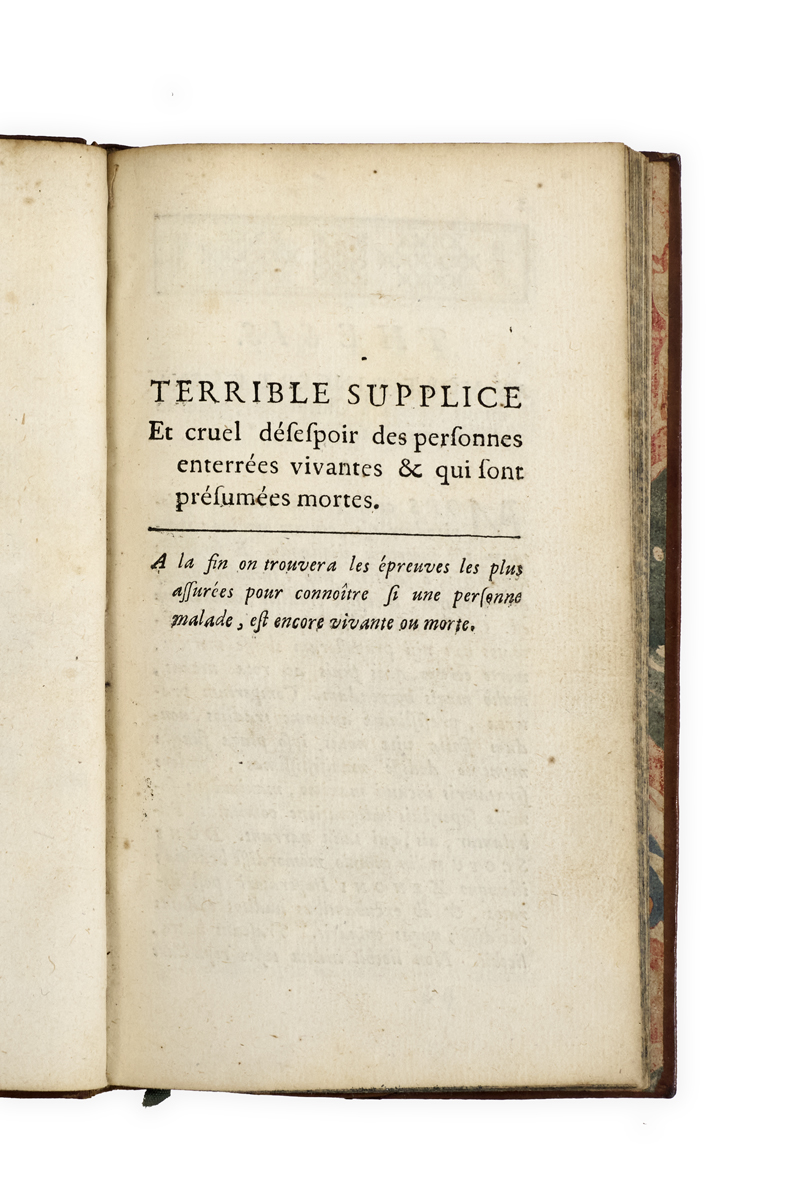
Terrible supplice et cruel désespoir des personnes enterrées vivants & qui sont présumées mortes. [Paris, Joseph Bullot, 1752].
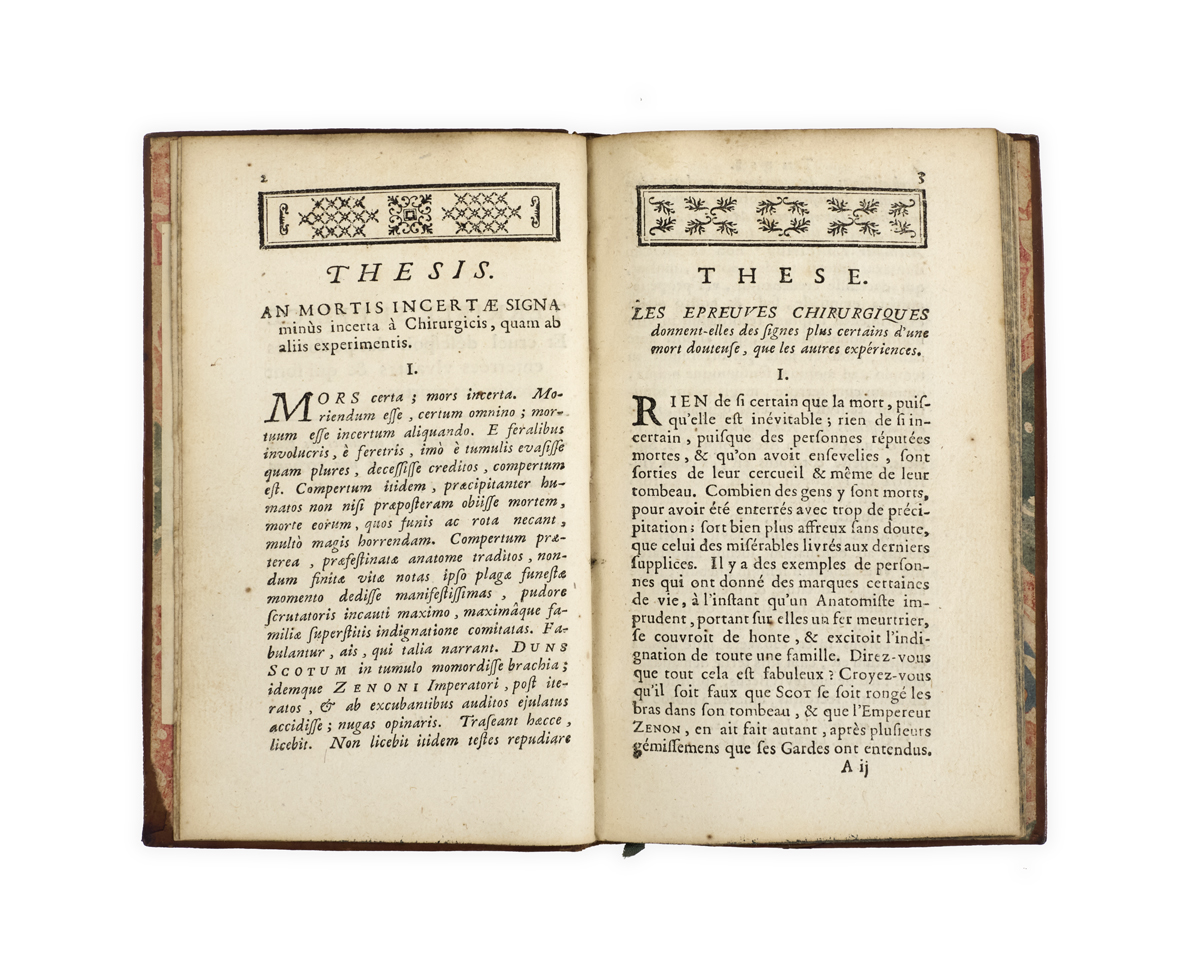
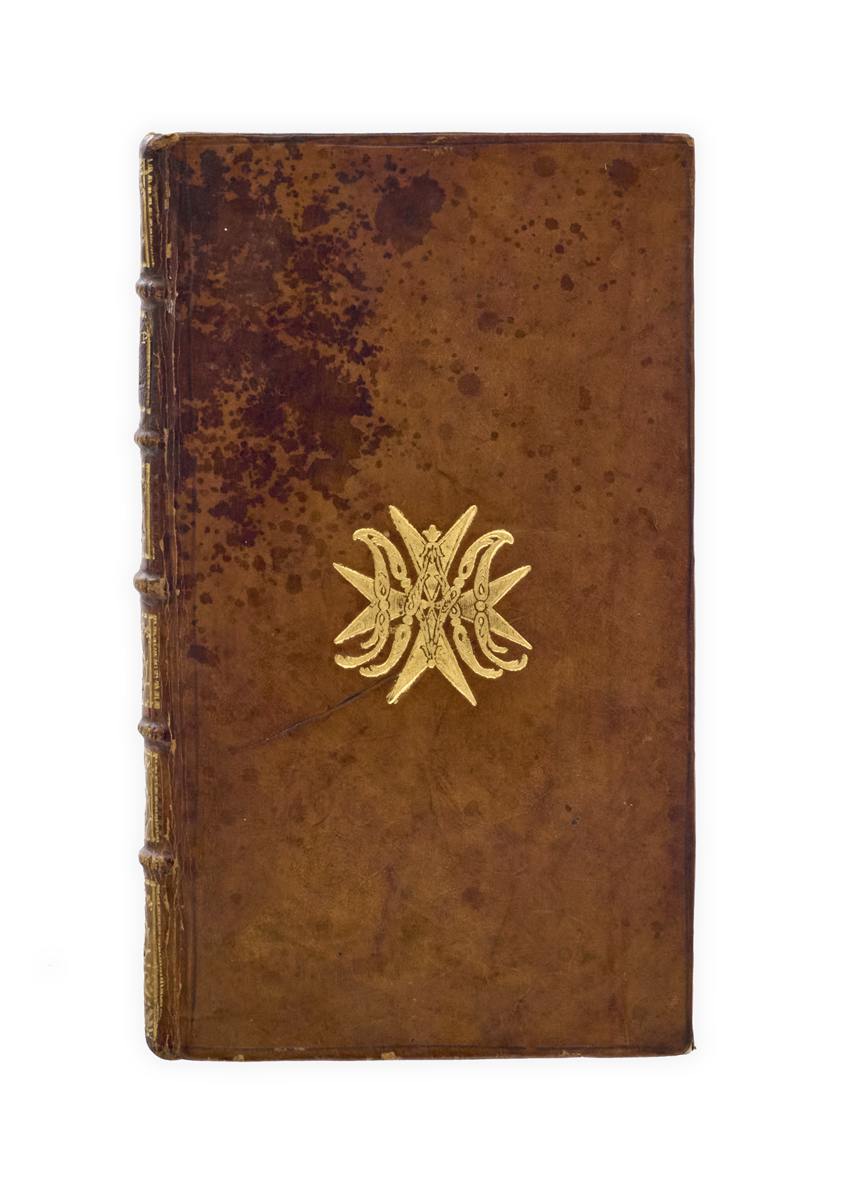
12mo, pp. 35, [1 (blank)]; typographic headpieces to pp. 2–3; small marginal wormhole to lower corner of last few leaves, the odd spot, lightly toned throughout; else a very good copy in contemporary polished calf, Maltese cross with monogram ‘A.M.’ blocked in gilt to both boards, spine gilt in compartments to a floral design; some spotting to upper board, small inkstain to lower board; engraved bookplate ‘Ex libris A Kuhnholtz-Lordat’ to front pastedown.
Added to your basket:
Terrible supplice et cruel désespoir des personnes enterrées vivants & qui sont présumées mortes.
Extremely rare first edition of this anonymous French translation – here facing the original Latin – of this treatise on those who have been erroneously buried alive, this translation with an added list of proofs of death in French not present in previous editions.
First published in Latin in 1742, the present work was translated into French by Jacques-Jean Bruhier in the same year as Dissertation sur l’incertitude des signes de la mort, et des enterremens & embaumemens précipités, and argues that the surgical and medical tests then used by physicians to determine proof of death (e.g. the pallor or temperature of the body, respiration, pulse, or rigidity of members) were insufficient and resulted in numerous people being buried alive.
Here, the Danish-born French anatomist Winslow (or Winsløw) describes numerous instances of accidental presumption of death: one doctor attempted to perform a caesarean section on a woman thought to be dead, only to find that she was grinding her teeth during the operation; a man who had been buried for some three or four days was exhumed, only to die moments afterwards; and one woman thought to be dead suddenly awoke when a servant attempted to exhume her and cut a ring from her finger; he also cites the ‘false suffocation’ of hysterical women, hypochondriacs, or those exposed to toxic fumes.
To ascertain whether someone is still indeed alive, Winslow suggests, inter alia, irritating the nostrils with horseradish or mustard to make them sneeze; enemas; applying stinging nettles to the body; making loud noises and shouting into the ears of the presumed deceased; pricking the palms of the hands and the soles of the feet; sticking long needles under the fingernails and toenails; using boiling water or hot wax to stimulate the body; and applying hot pokers to the hands, the feet, or the top of the head.
Ours is an entirely different translation to Bruhier’s, and the appendix of épreuves to prevent hasty burials seems to appear here for the first time, suggesting that those presumed to be deceased should be left in bed with the sheets and blankets they used during their illness; that a blistering agent or cautery stone should be used to stimulate the bladder; the firmness of the eyeball and the cloudiness of the cornea should also be assessed; a final note regarding infectious diseases suggests that the tombs of the diseased be properly sealed.
Provenance:
Likely from the library of nineteenth-century French bibliophile Count Achille Kuhnholtz-Lordat, with bookplate to front pastedown.
No copies traced in the US or the UK. OCLC finds four copies only, two in France and two in Denmark.