All Sewn Up
[WOMEN’S CHARITY.]
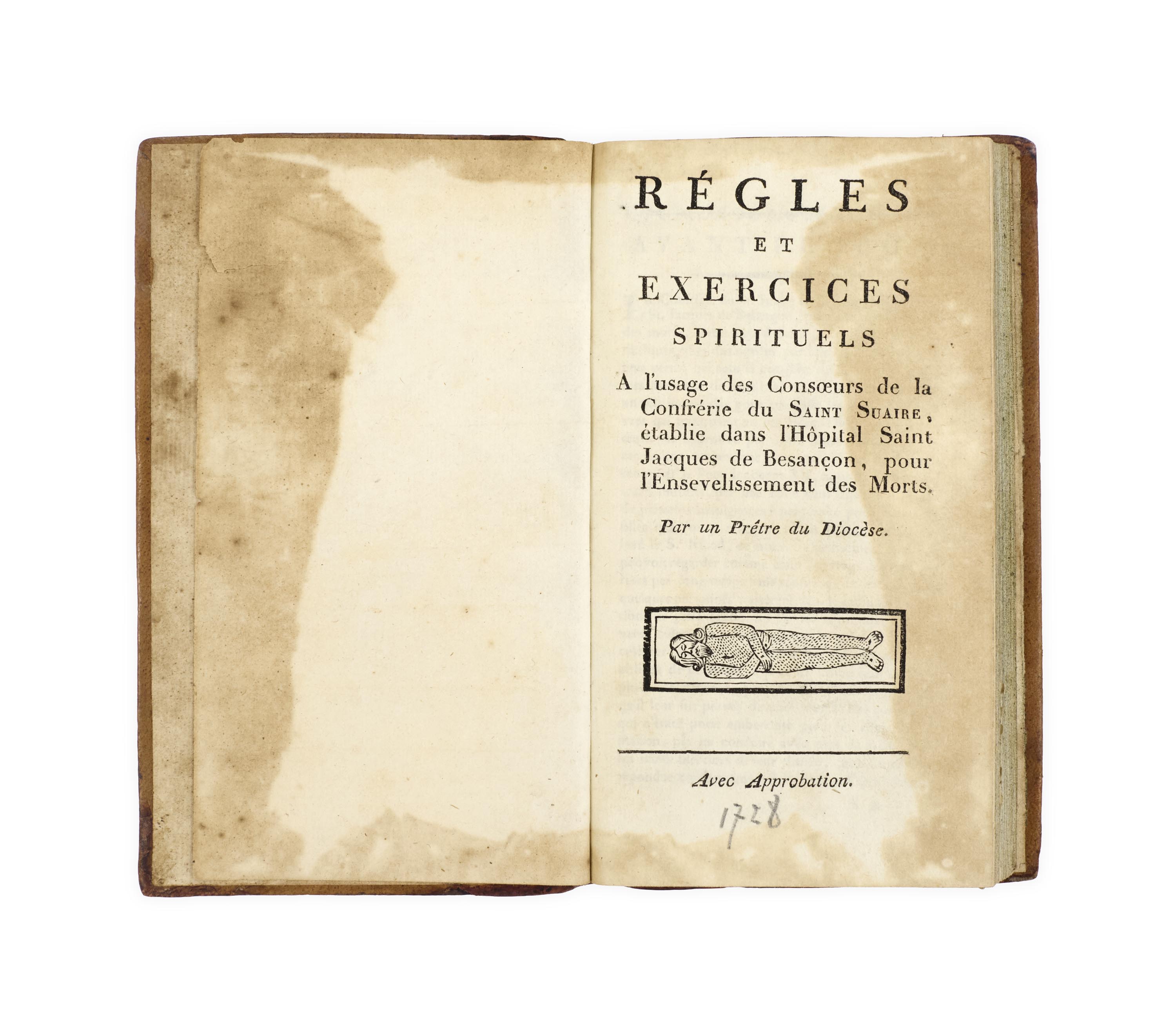
Régles et exercices spirituels a l’usage des consoeurs de la Confrérie du Saint Suaire, établie dans l’hôpital Saint Jacques de Besançon, pour l’ensevelissement des morts. Par un prêtre du diocèse. [Besançon, c. 1728].
12mo, pp. 131, [1, blank]; small woodcut of Christ upon a shroud to title; approbation dated ‘20 mai 1728’; browning to title, final leaf, and endpapers due to acidity from turn-ins; otherwise a very good copy in contemporary tree-patterned sheep, spine decorated in gilt with red morocco lettering-piece; neat repairs at head and foot of spine and to corners.
Added to your basket:
Régles et exercices spirituels a l’usage des consoeurs de la Confrérie du Saint Suaire, établie dans l’hôpital Saint Jacques de Besançon, pour l’ensevelissement des morts. Par un prêtre du diocèse.
Rare set of regulations and spiritual exercises composed for the use of the lay sisters of the Confrérie du Saint Suaire at Besançon, in eastern France, who undertook to give a dignified burial to the city’s poor.
The Confrérie du Saint Suaire (Association of the Holy Shroud) was established at the hospital of Saint Jacques in Besançon by Archbishop Antoine-Pierre de Grammont in 1697, with the support of Pope Innocent XII, its name inspired by the famous Shroud of Besançon, which was purported to bear the imprint of Christ’s body.
The Régles opens with a most interesting preface, in which the compiler writes: ‘what could be more edifying to the entire Church than to see modest and virtuous women forgetting the delicacy of their sex, and overcoming all natural repugnance, to enshroud corpses, most of which are revolting with the stench of their ulcers and the malignancy of the diseases to which they succumbed’ (trans.).
The regulations that follow explain that the Confrérie was open to women of good character under the age of thirty, who upon admission were to enter their names in the register and pay fifty sols into the treasury. The fifth and sixth rules describe the burial ceremony: having chosen a shroud to fit the size of the corpse, two sisters would hold the corners while two others would whisk away the sheet covering the body, upon which the shroud was swiftly placed so that no part of it was exposed to view. The corpse was then wrapped and the shroud sewn up on one side, before the body was carried on a litter to the place of burial accompanied by the sisters’ prayers. The compiler entreats the sisters to display as much respect for the bodies of the poor as they would for the body of Christ.
Other regulations cover the purchase of clean shrouds; the election of the prioress, counsellors, and sacristan, forbidding any political machinations (‘toute brigue’); the appointment of a priest to oversee ‘books, papers, rents and receipts’; matters of discipline, including expelling the ‘incorrigible’; and sisters leaving to marry or take orders.
The remainder of the text includes prayers to be recited before and after burial; the indulgences granted to the sisters by Innocent XII; consideration of sins (including ‘keeping, selling, lending or reading’ inappropriate books, illicit physical pleasures, and overindulgence in wine); and meditations on Christ’s Passion.
Only one copy traced in the UK (Bodleian) and one in the US (Johns Hopkins).