Pioneering Polish–Jewish Neurologist
ZAND, Nathalie.
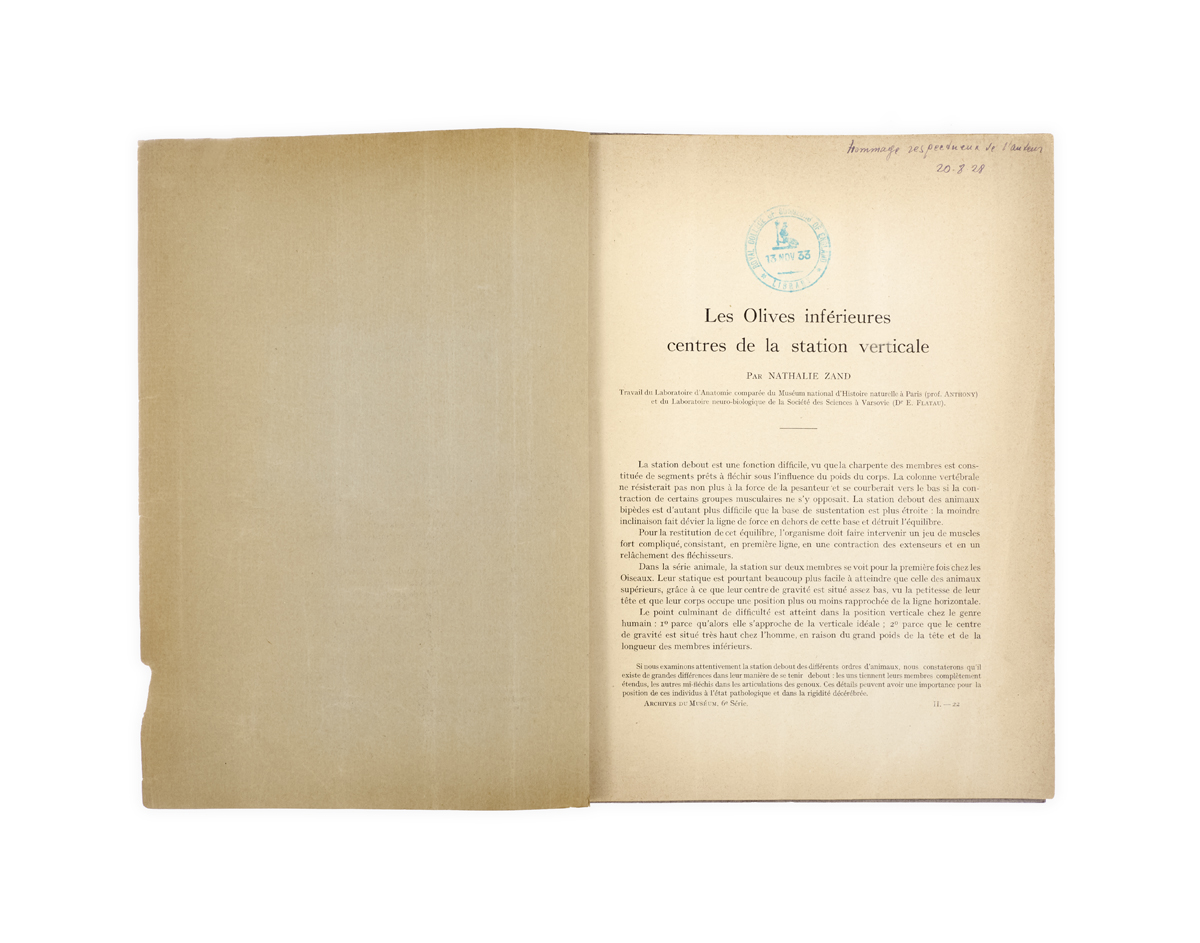
[Drop-head title:] Les olives inférieures centres de la station verticale … Travail du Laboratoire d’Anatomie comparée du Muséum national d’Histoire naturelle à Paris (prof. Anthony) et du Laboratoire neuro-biologique de la Société des Sciences à Varsovie (Dr E. Flatau). [Offprint from:] Archives du Muséum d’Histoire Naturelle, 6e Série, T. II. [Paris, 31 December 1927.]
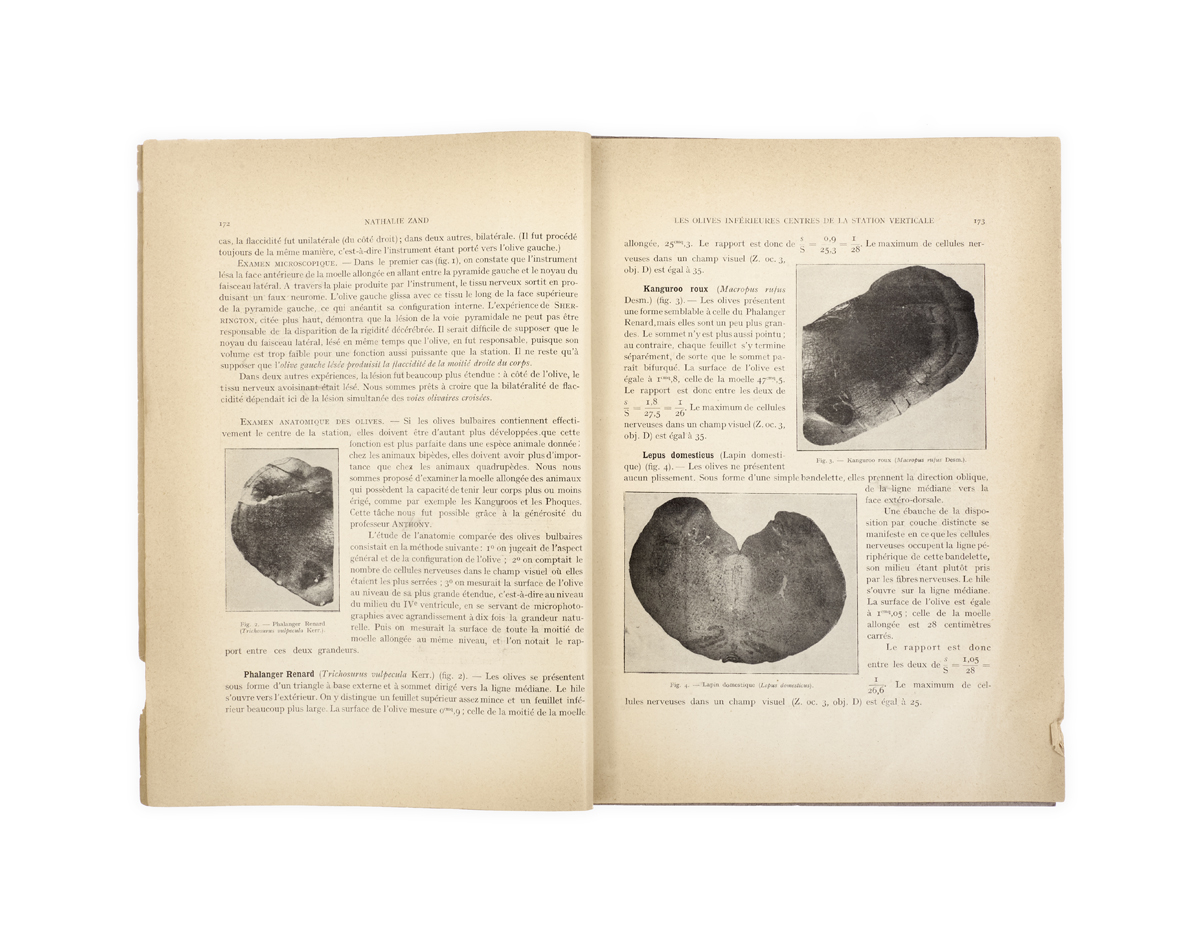
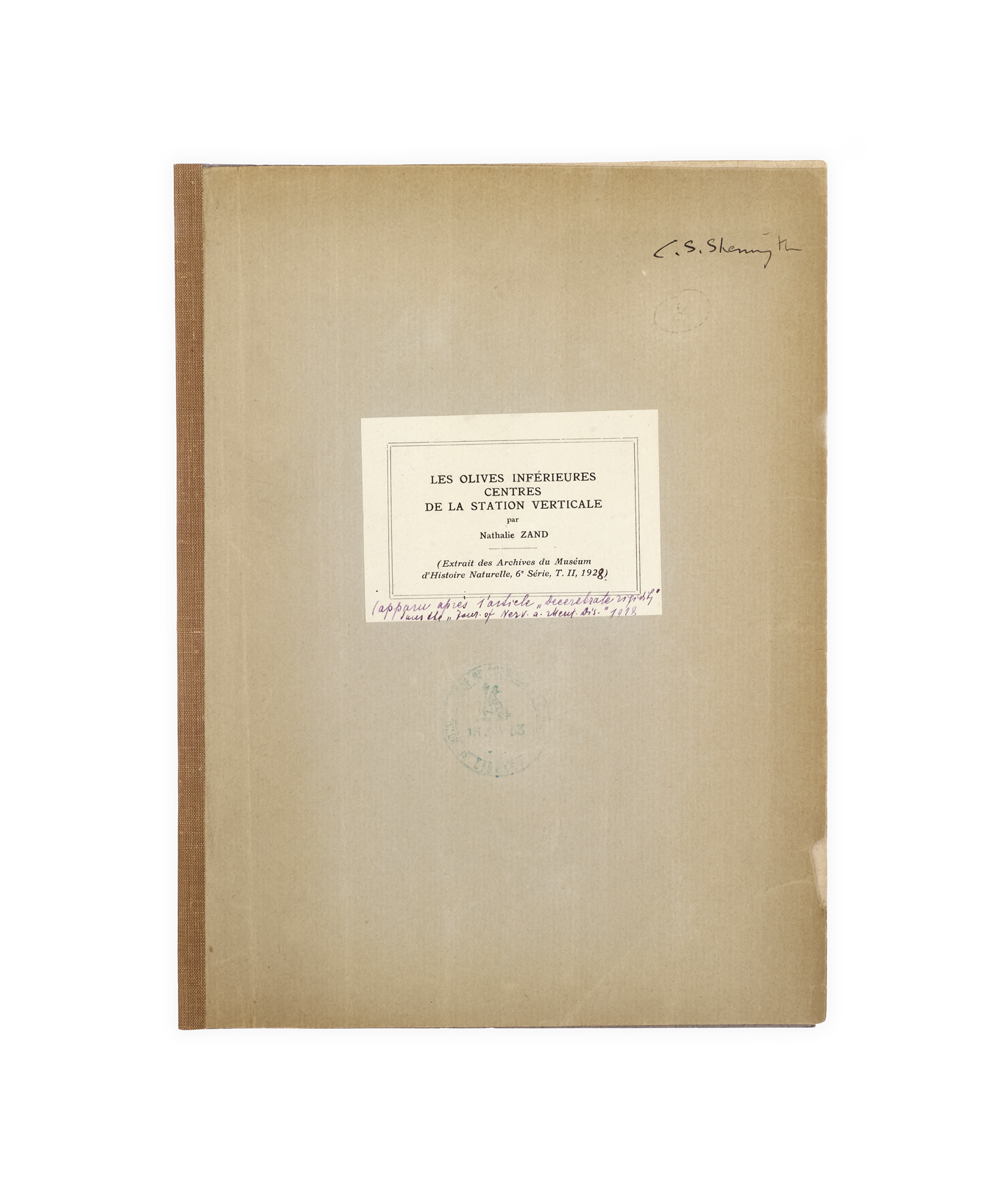
4to, pp. [169]–178; 6 halftone illustrations in the text; uniform browning throughout, edges chipped; else a good copy in cloth-backed wrappers, retaining original brown front wrapper with printed paper label; a few chips to fore-edge; label to front wrapper dated 1928 in manuscript with inscription ‘apparu après l’article “Decerebrate Rigidity” dans le “Journ. of Nerv. a. Ment. Dis.”’, presentation inscription to p. [169] ‘hommage respecteux de l’auteur’ (dated 20 August 1928), ownership inscription ‘C.S. Sherrington’ to front wrapper (see below), green ink stamp of the Royal College of Surgeons Library (dated 13 November 1933) to front wrapper and p. [169].
Added to your basket:
[Drop-head title:] Les olives inférieures centres de la station verticale … Travail du Laboratoire d’Anatomie comparée du Muséum national d’Histoire naturelle à Paris (prof. Anthony) et du Laboratoire neuro-biologique de la Société des Sciences à Varsovie (Dr E. Flatau). [Offprint from:] Archives du Muséum d’Histoire Naturelle, 6e Série, T. II.
Scarce offprint of a work on the inferior olivary nucleus by the Polish–Jewish neurologist Nathalie Zylberlast-Zand (1883–1942) – later executed during the Second World War – our copy presented to Nobel Prize-winning neurophysiologist Sir Charles Sherrington, whose work is cited at length in Zand’s article.
Born in Warsaw, Zand studied medicine at the University of Geneva and worked closely with the pioneering neurologist and psychiatrist Edward Flatau at his neurology laboratory and at the Jewish Hospital of Czyste in Warsaw. She authored some eighty works in Polish, French, German, and English, on meningitis, encephalitis lethargica, paralysis, epilepsy, and Korsakoff syndrome, inter alia.
A staunch advocate for women’s rights in the medical profession, she was a founding member of the Association of Polish Female Physicians (Zrzeszenie Lekarek Polskich), affiliated with the Medical Women’s International Association, in 1925, and in 1937 she was the sole Polish delegate to the Fourth International Conference of the International Association of Women Physicians in Edinburgh. She vocally opposed eugenics, offered parenting advice to working-class families, and volunteered at the Jewish orphanage in Warsaw, where she collaborated with the pedagogue and children’s rights activist Janusz Korczak, director of the orphanage (famous for refusing to flee the country and instead remaining with the children when the orphanage was forcibly relocated to the Warsaw Ghetto; he and the orphans were murdered at Treblinka).
Zand continued to practise as a physician in the Warsaw Ghetto; during the liquidation of the ghetto, her friends helped her escape to a hiding place on the ‘Aryan side’ of the city; she and her friend, the Jewish gynaecologist Zofia Garlicka, were caught by the Gestapo and taken to Pawiak prison, where Zand was executed the following day, aged fifty-nine. ‘“Polish medical women are firmly convinced that equality of rights should be strictly maintained and take active steps whenever their rights seem to be threatened” was one of her last recorded pronouncements.
‘That was dangerous doctrine. Dr. Zand and Dr. Garlicka were among the thousands of freedom-loving people who “disappeared”’ during the Nazi occupation of Poland’ (Lovejoy, p. 174). Of the three million Polish Jews who perished during the Holocaust, some three thousand were physicians.
Provenance:
Sir Charles Scott Sherrington (1857–1952) studied at Gonville and Caius College, Cambridge, earning his membership of the Royal College of Surgeons in 1884 and his Bachelor of Medicine and Surgery from Cambridge in 1885. The inventor of the term ‘synapse’, Sherrington was awarded the 1932 Nobel Prize in Physiology or Medicine in 1932 for his Integrative Action of the Nervous System. Zand refers to Sherrington’s research nearly a dozen times in the present work, largely with reference to decerebrate rigidity: Sherrington had found in his experiments that animals which had undergone spinal and vagal transections could stand up without reflex actions controlled by the brain.
While it is not clear whether the two neurologists had met at the time of the article’s publication, they likely went on to encounter each other at the First International Neurological Congress in Bern in 1931, where Sherrington was awarded an honorary doctorate and Zand was a speaker (one of six women out of nearly two hundred and fifty).