The Genesis of Guatemala
ZECEÑA, Basilio.
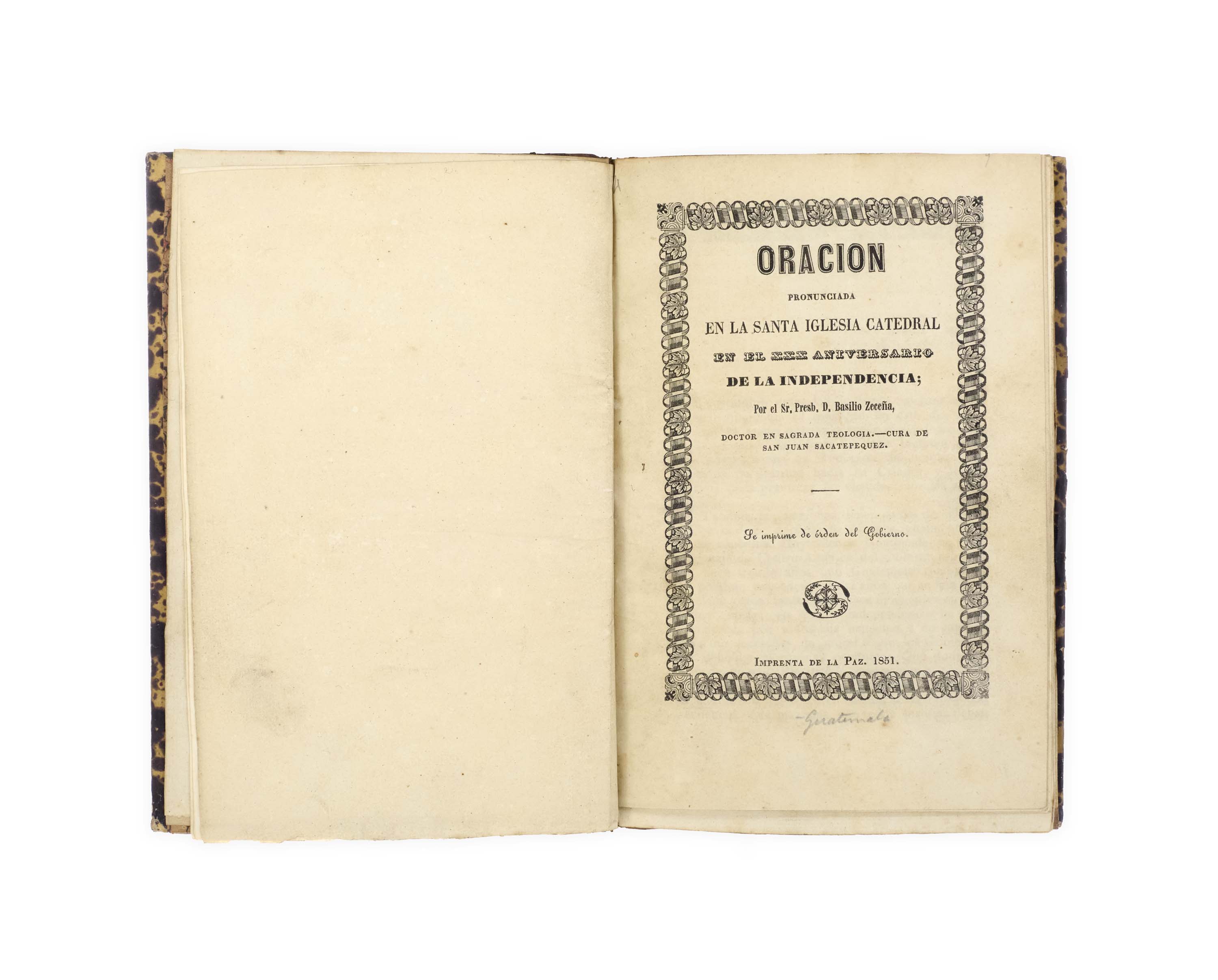
Oracion pronunciada en la santa iglesia catedral en el XXX aniversario de la Independencia … Se imprime de órden del Gobierno. [Guatemala], imprenta de La Paz, 1851.
[bound with:]
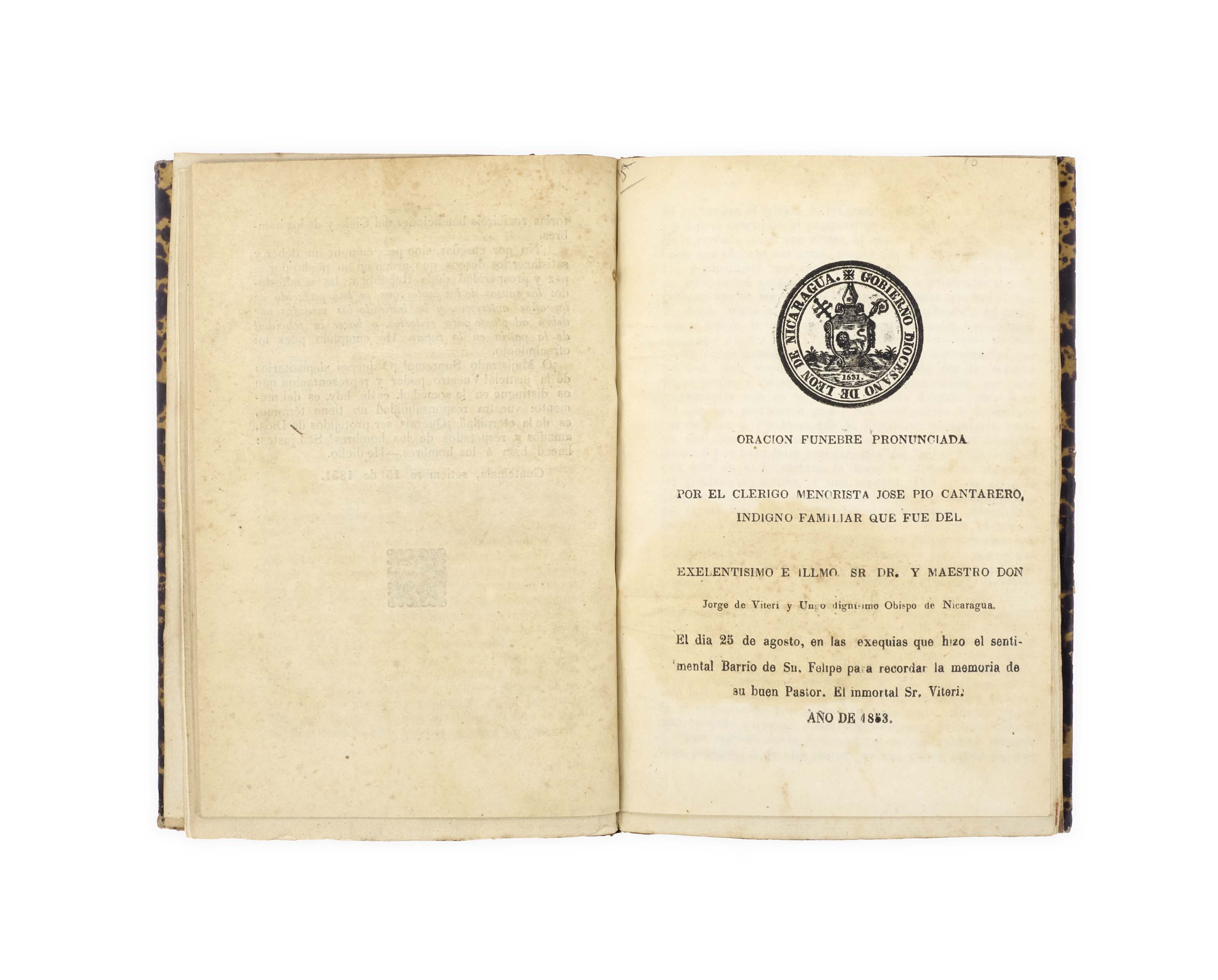
PIO CANTARERO, José. Oracion funebre pronunciada por el clerigo menorista Jose Pio Cantareno, indigno familiar que fue del exelentisimo e illmo. Sr Dr. y Maestro Don Jorge de Viteri y Ungo dignisimo Obispo de Nicaragua. [León, Nicaragua], 1853.
Two works in one vol., 8vo, I: pp. [2], 17, [1, blank]; title within decorative border, headpiece and tailpiece, II: pp. [13], [3, blank]; woodcut armorial of the diocese of León de Nicaragua to first page; second work previously folded in three with creases visible and final verso somewhat soiled, blank section on final leaf of text excised; good copies, bound in contemporary calf-backed mottled paper boards, flat spine lettered directly in gilt, marbled endpapers; extremities slightly rubbed; contemporary manuscript notes in Spanish on final verso of second work, bookplate of Brasseur de Bourbourg ‘ex collectione Americana’, and bookplate of Alphonse Pinart.
Added to your basket:
Oracion pronunciada en la santa iglesia catedral en el XXX aniversario de la Independencia … Se imprime de órden del Gobierno.
A pair of contemporary works commemorating the creation of modern Guatemala and El Salvador, one of which is unrecorded.
The first work was a speech given on the anniversary of Guatemala’s independence from the Spanish in 1821; this was an annual event in the Guatemalan calendar, taking place on 15 September. Its author, Basilio Zeceña (1793–1856), was a priest, theologian and politician in the new state of Guatemala.
The second work, another speech but of a more sombre nature, was a funeral oration for the churchman and statesman of El Salvador, Jorge de Viteri y Ungo (1802–1853), a supporter of the conservative faction after the dissolution of the Central American Federation in 1840. He had been appointed the first bishop of San Salvador in 1842, but was subsequently expelled for his political loyalties, and then became bishop of León in Nicaragua in 1849. Apparently he died from poisoning.
A Latin quotation from I Machabees 9:20 has been added in contemporary manuscript to the head of the first page of the second work: ‘And all the people of Israel bewailed him with great lamentation, and they mourned him for many days’. The contemporary notes in Spanish on the final verso read ‘El sacramento de la nueva ley es in signo sensible, sagrado y permanente de la gracia interior, instituido por Jesu Cristo para nuestra santificacion’ (The sacrament of the new law is a sensible, sacred and permanent sign of internal grace, instituted by Jesus Christ for our sanctification), followed by ‘Suspiramos’ (we sigh) and ‘Hasta las heres’(?) in a later hand, and the name Gaspar written twice in pencil.
Copies of the first work are recorded in the University of California at Berkeley, Kansas, Tulane, Texas, and in Chile; the University of North Carolina at Chapel Hill has a volume of these independence day speeches from 1844 onwards, including this one. The second work is seemingly unrecorded: we have not been able to trace another copy.
Provenance:
1. Charles-Étienne Brasseur de Bourbourg (1814–1874) was a priest and historian with an interest in American history. He spent time in central America in the 1850s, in Mexico City and Guatemala, studying ethnography and antiquities, finding links between the Mayan civilisation and the Egyptians. He compiled a bibliographical account of central American writings, Bibliothèque Mexico-guatémalienne (Paris, Maisonneuve & Cie, 1871); this volume is listed on p. 158.
2. Alphonse Pinart (1852–1911) was also a keen student of ethnography, travelling widely in Russia and the Americas. He met Brasseur in 1867, at the International Expo in Paris, and subsequently purchased much of his library. His papers are housed at the University of California at Berkeley.