Social Satire
[ANON.]
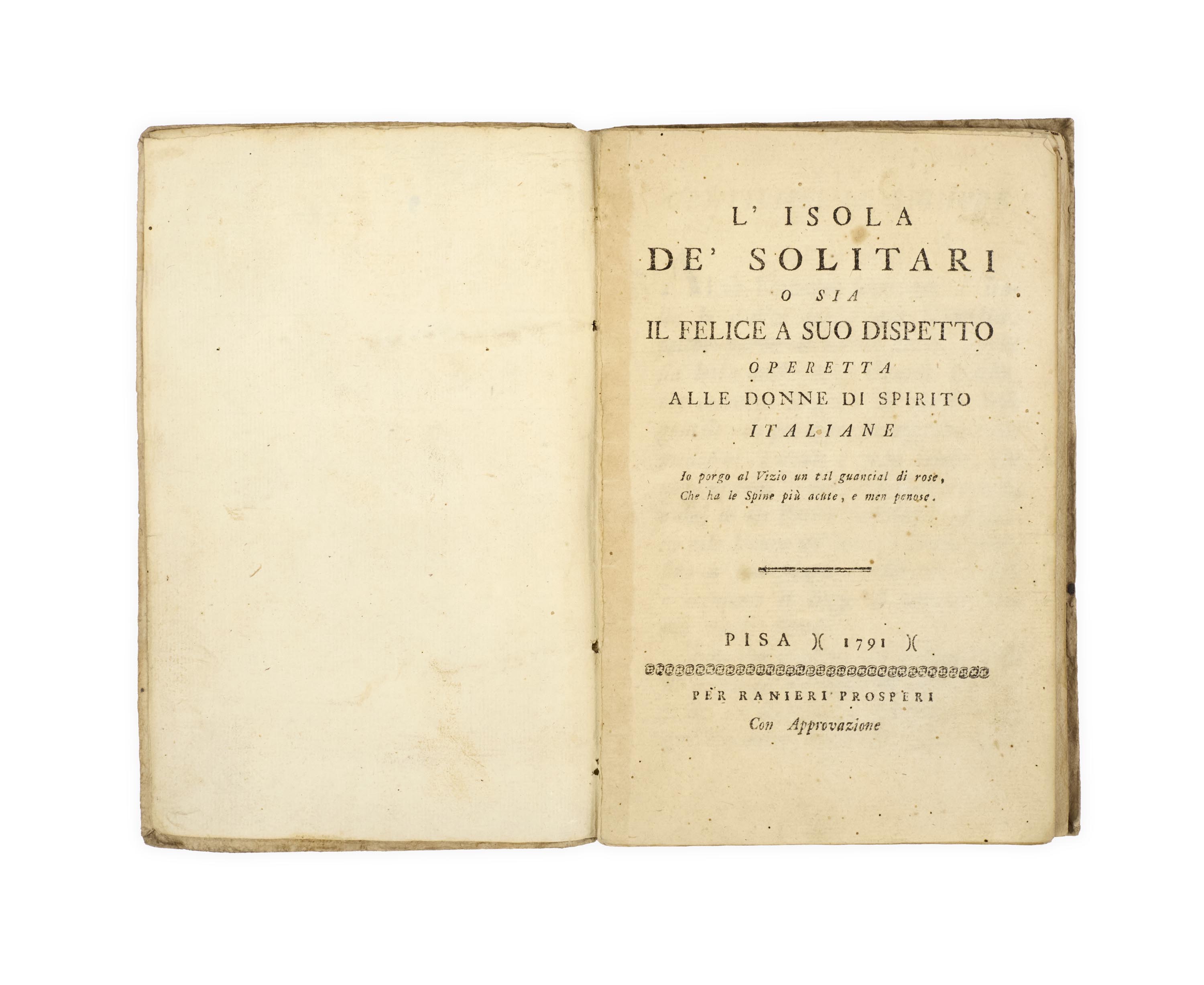
L’Isola de’ solitari o sia il felice a suo dispetto operetta alle donne di spirito italiane. Pisa, Ranieri Prosperi, 1791.
8vo, pp. 36; title reinforced to inner margin, some spotting and toning; a good copy in contemporary carta rustica; a little worn and marked.
Added to your basket:
L’Isola de’ solitari o sia il felice a suo dispetto operetta alle donne di spirito italiane.
First and only edition of a very rare, late eighteenth-century social satire, taking a swipe at intellectual academies and society’s ingratitude towards good actions.
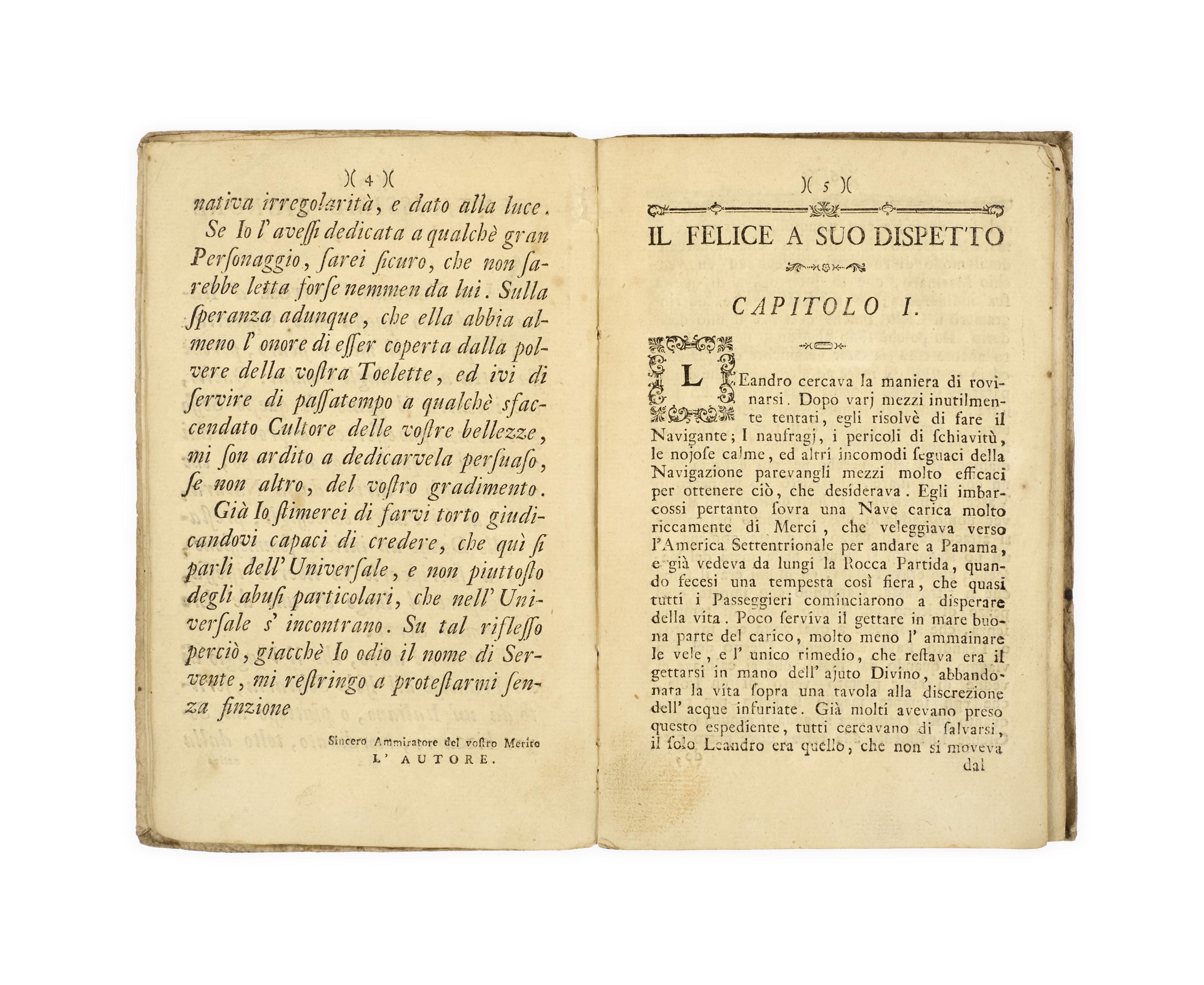
The anonymous author dedicates his work to Italy’s ‘women of wit’, hoping that it will at least have the honour of gathering dust in their toilettes.
The text narrates the adventures of Leander, a Frenchman blessed with good fortune, who seeks to ruin himself in order to learn the true meaning of wretchedness. Having failed to achieve ruination in the army, but not prepared to go as far as getting married, he decides to become a sailor, and duly boards a merchant ship bound for North America and Panama. His hopes are raised when he is shipwrecked and left stranded on an island, but here he discovers not only delicious raw fish and currant juice in abundance, which he eats to the sound of sweet birdsong, but also two thousand guineas washed ashore in a chest.
A chance encounter with one of the island’s inhabitants, Conon, offers fresh hope. Conon takes Leander to the temple of Minerva, where the goddess’s ‘scholarly’ children (who are in fact daft) have an academy. Here they encounter Mr Tantalus, a loud and obnoxious lawyer, whom Leander duly beats with a stick, convinced that this will secure his own downfall. Imagine his disappointment when the island’s other lawyers reward him with a hundred florins for ridding them of such a pest. Discussions with an astronomer, a physician, an entomologist, a philosopher, a mathematician, and an ethicist get him no nearer to his goal, but in the end a poet advises him that the only way to ruin himself is by doing good. Inspired by the bard’s words, Leander catches a Portuguese ship back to France where he finally achieves his downfall: by adopting a son, who steals from him and beats him; by giving money to friends, who soon turn against him; and by sheltering young women and helping the poor, which wins him only envy, slander, and ingratitude.
No copies traced on OCLC, and only one found on OPAC SBN, at the Archivio Storico Civico e Biblioteca Trivulziana in Milan. Not in Melzi.