With Cartographical Cuts
ARIOSTO, Lodovico.
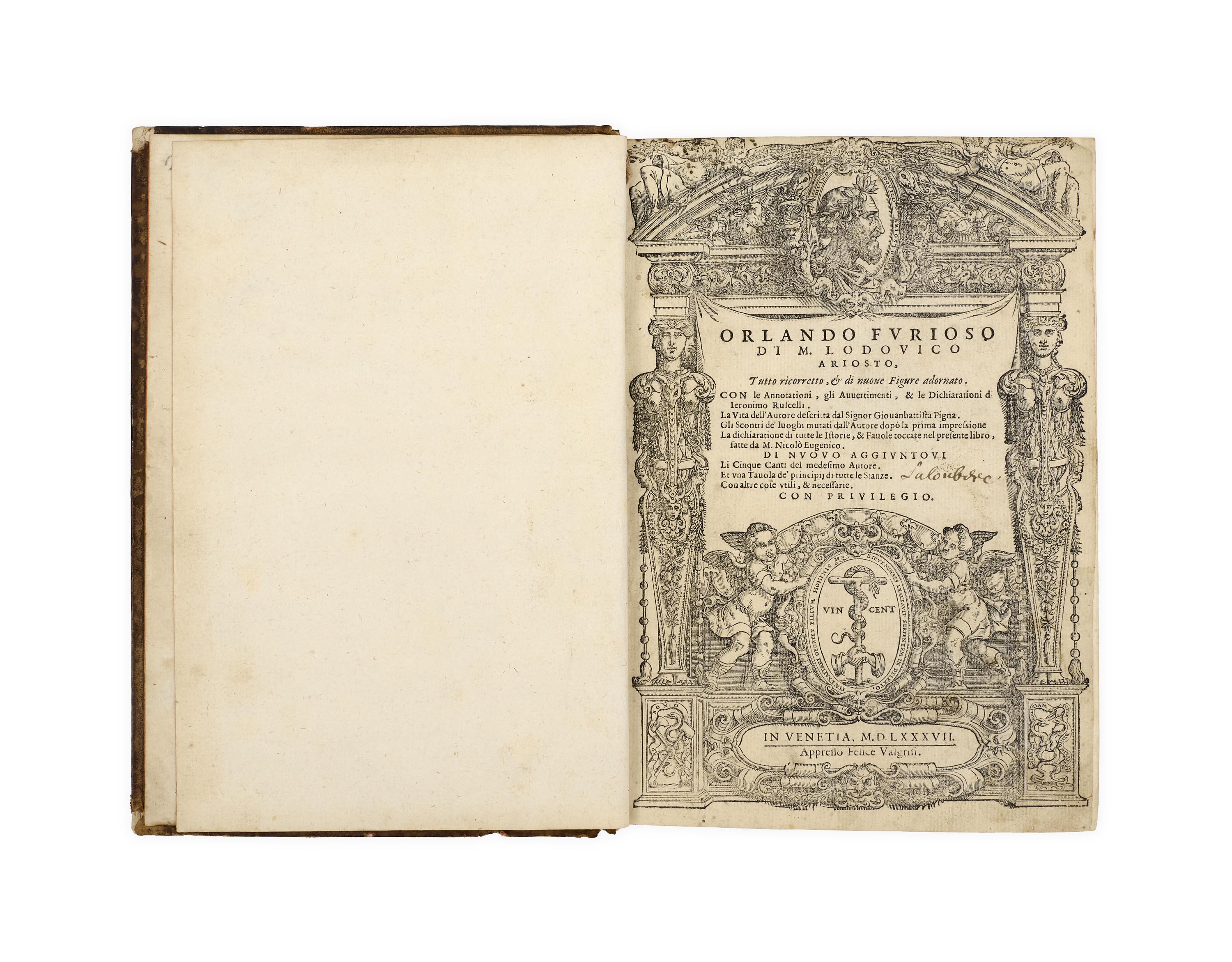
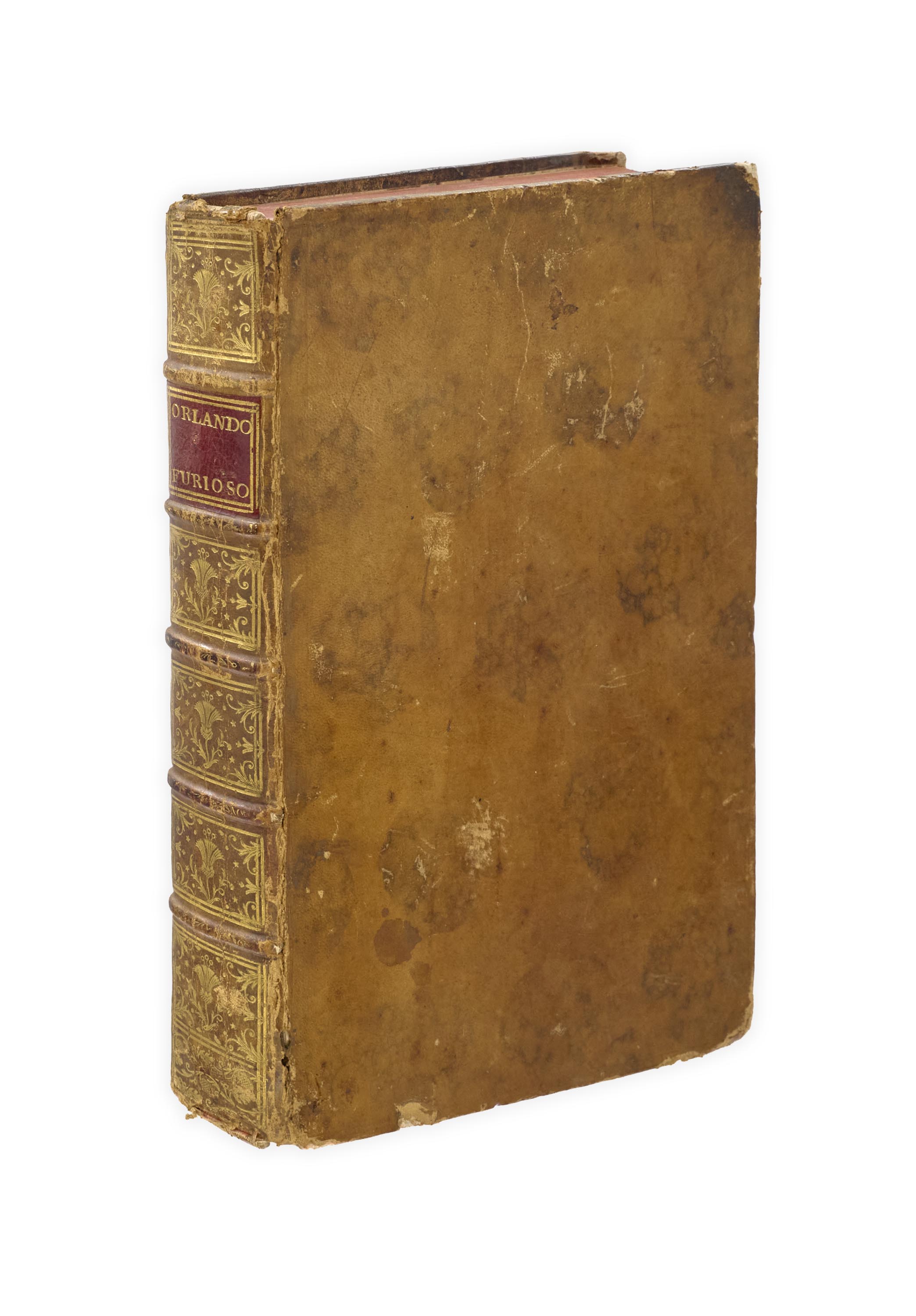
Orlando furioso … Tutto ricorretto, & di nuove Figure adornato. Con le Annotationi, gli Avvertimenti, & le Dichiarationi di Ieronimo Ruscelli … Di nuovo aggiuntovi li Cinque Canti del medesimo Autore … Venice, Felice Valgrisi [(colophon:) Valerio Bonelli], 1587.
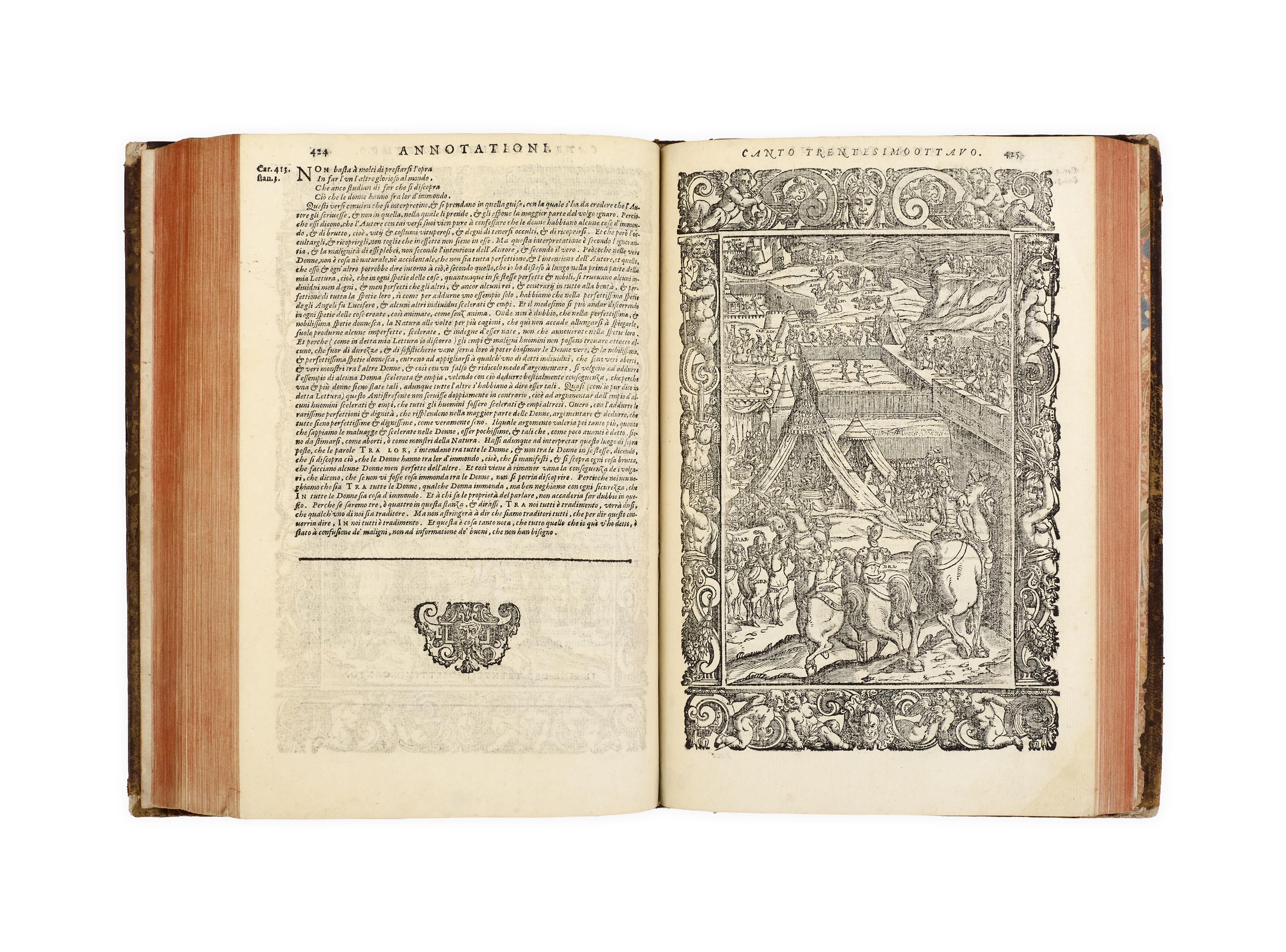
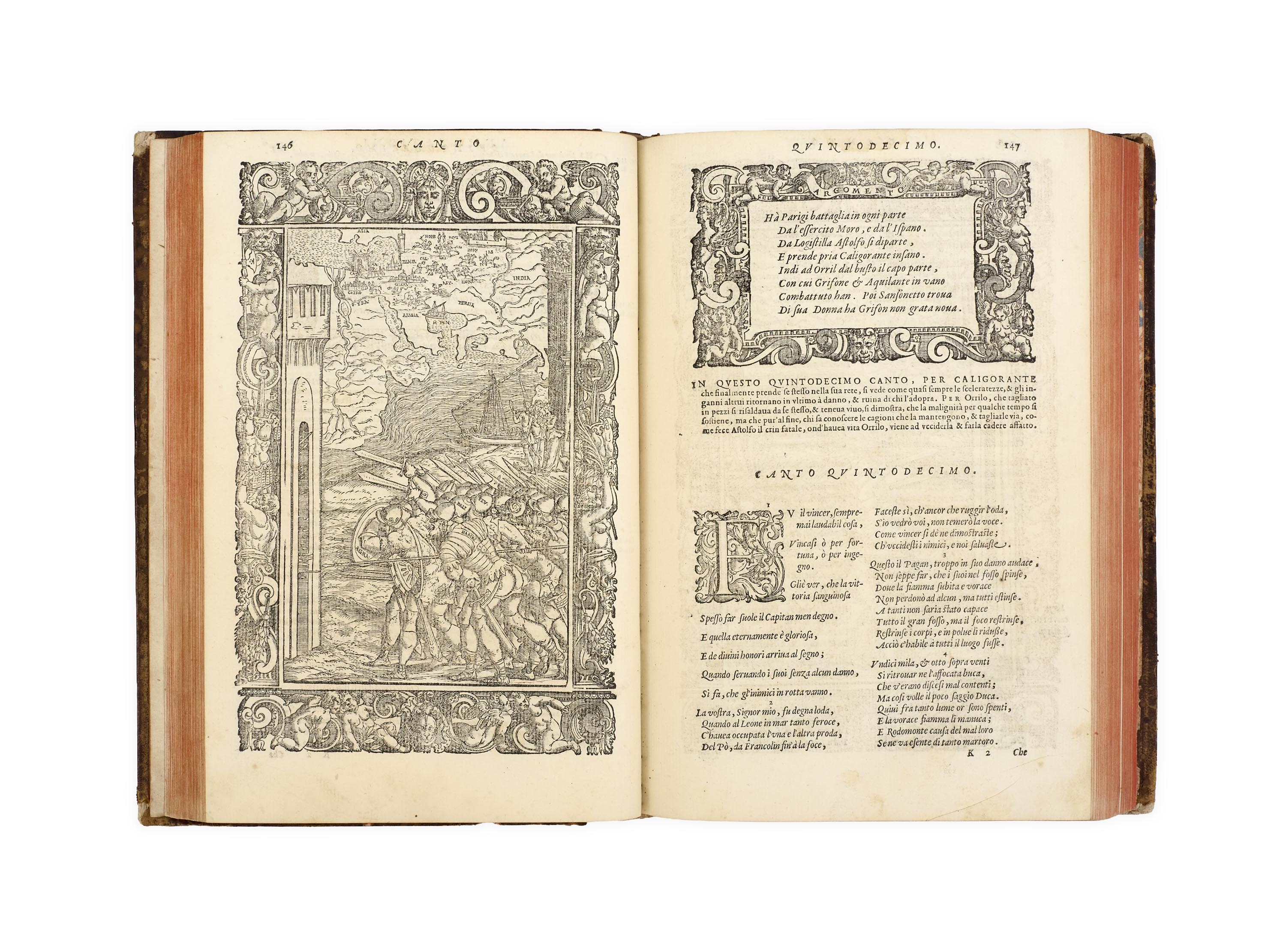
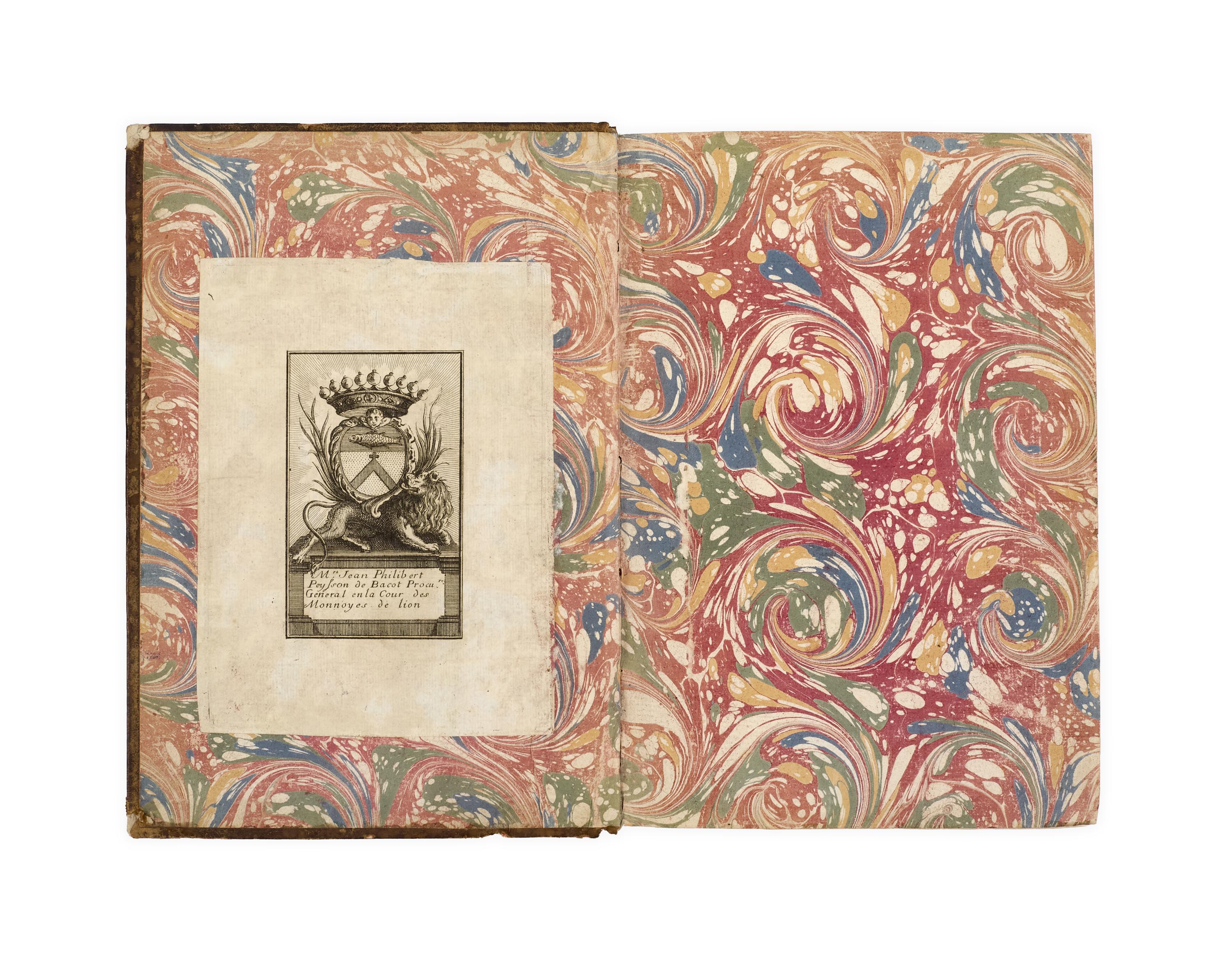
4to, pp. [xvi], 654, [32]; without the final blank VV8; title printed within elaborate architectural woodcut border incorporating a portrait of Ariosto (after Titian) and the Valgrisi printer’s device, part-title to I cinque canti with a larger Valgrisi device, full-page woodcut illustration within woodcut borders opposite start of each canto, verse summary (argomento) of each canto within a woodcut cartouche, woodcut initials, woodcut head- and tailpieces; title-page a little short at outer margin with a few small stains and slightly shaved at head, minute printing flaw to *8 affecting a few characters and woodcut to verso, slight staining to quires N, Q, and V, VV1 trimmed at outer margin, nonetheless a very good copy; bound in eighteenth-century French mottled sheep, spine gilt in compartments with gilt red morocco lettering-piece, edges stained red, marbled endpapers; somewhat rubbed with a few bumps at extremities, joints cracked, endcaps chipped; seventeenth-century inscription ‘Laloubere’ to title-page, engraved armorial bookplate ‘Mre Jean Philibert Peysson de Bacot Proc.re General en la Cour des Monnoyes de lion’ to front pastedown.
Added to your basket:
Orlando furioso … Tutto ricorretto, & di nuove Figure adornato. Con le Annotationi, gli Avvertimenti, & le Dichiarationi di Ieronimo Ruscelli … Di nuovo aggiuntovi li Cinque Canti del medesimo Autore …
A richly illustrated edition of Orlando furioso, with numerous maps and views incorporated into the full-page woodcuts, from a notable eighteenth-century library in Lyon.
Valgrisi’s first edition of Orlando furioso, prepared by Girolamo Ruscelli, appeared in 1556, containing a short life of Ariosto, verse and prose summaries, a list of characters, commentary, allegories, a list of Ariosto’s (supposed) emendations made after the 1532 edition (considered his definitive text), and an index of first lines for each stanza, some of which was derived from earlier editions. Ruscelli also amended the orthography in line with contemporary editorial practice, and ‘corrected’ what he considered to be mistakes. Ariosto’s incomplete sequel, containing just five cantos, was first included by Valgrisi in 1565.
Although formerly attributed to Dosso Dossi, the large woodcut illustrations are more likely the work of the printer and engraver Donato Bertelli, active in Venice from 1558 to around 1592, whose initials ‘D B’ appear the first woodcut illustration (see Coccia). Many of the woodcuts form composite images, combining several events in one illustration and often including maps or views to locate the action; Bertelli was familiar with producing bird’s-eye views in his engraved maps and Coccia notes that this interest in cartography is very unusual for the illustration of a chivalric epic (p. 298).
In the steep competition between publishers to sell the much-reprinted Orlando, Valgrisi’s full-page illustrations were likely intended to set his editions above the smaller woodcuts of his principal rival, Giolito of Florence, and evidently proved popular: the Valgrisi Orlando remained in print into the seventeenth century, long after Giolito’s final edition in 1560.
Provenance:
Jean-Philibert Peysson de Bacot (d. 1770) of Lyon; his sale, Jacquenod, Lyon, from 26 July 1779, lot 847.
EDIT16 CNCE 2820; USTC 810807; cf. Mortimer, Harvard Italian 29 (1562 Valgrisi edition). See Coccia, ‘Le illustrazioni dell’Orlando Furioso (Valgrisi 1556) già attribuite a Dosso Dossi’ in La Bibliofilía 93 (1991), pp. 279–309.