New York Private Press
ARNOLD, Edwin, Sir.
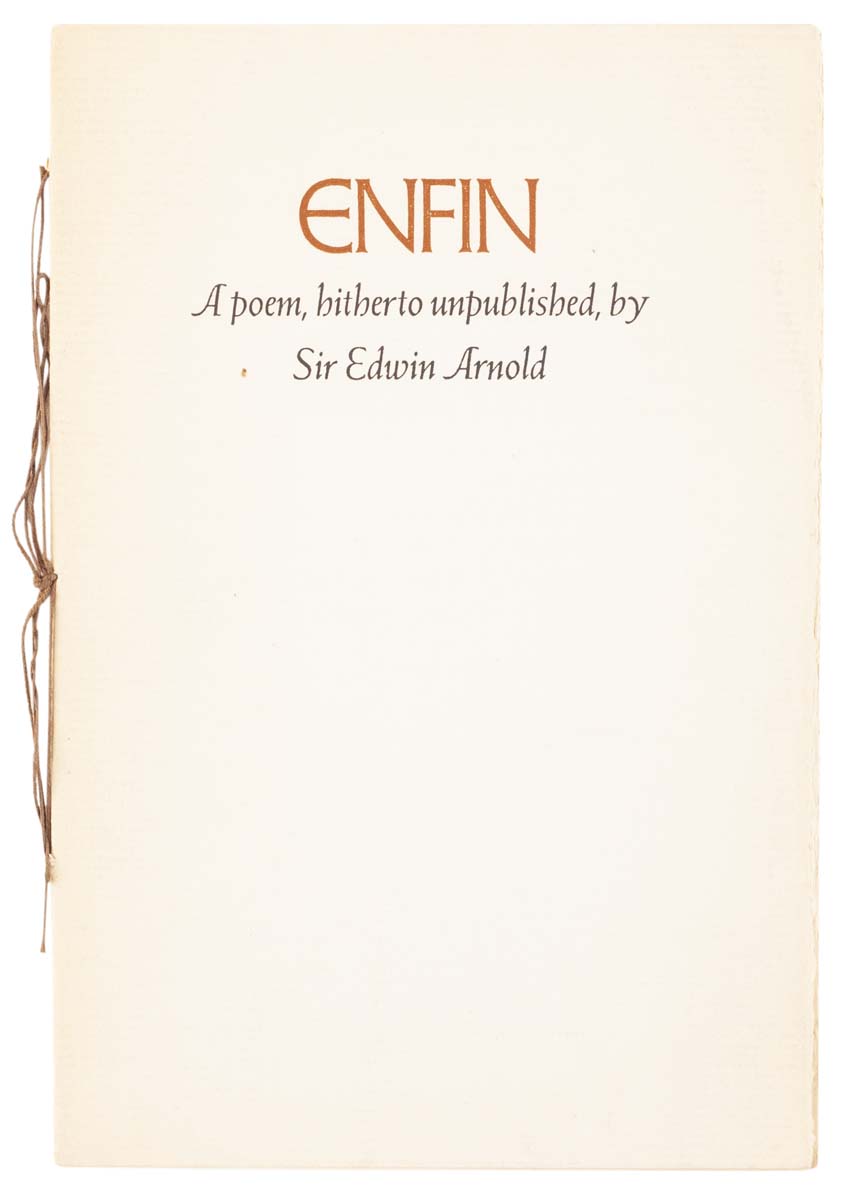
Enfin: A Poem, hitherto unpublished ... New York, Thomas Perry Stricker for Julian Biddulph Arnold, February 1936.
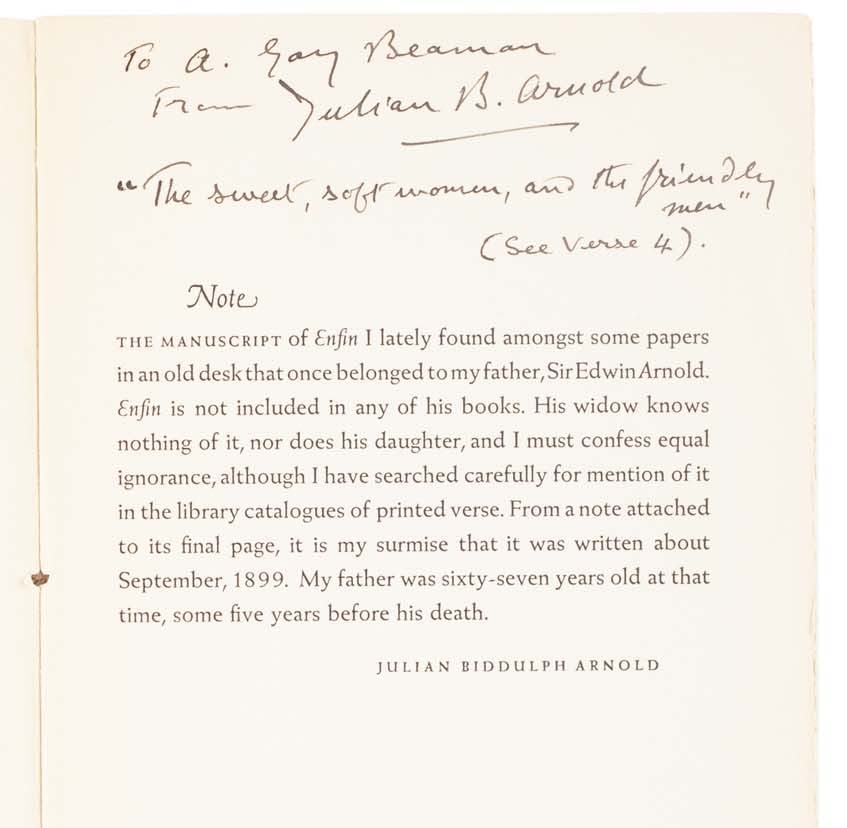
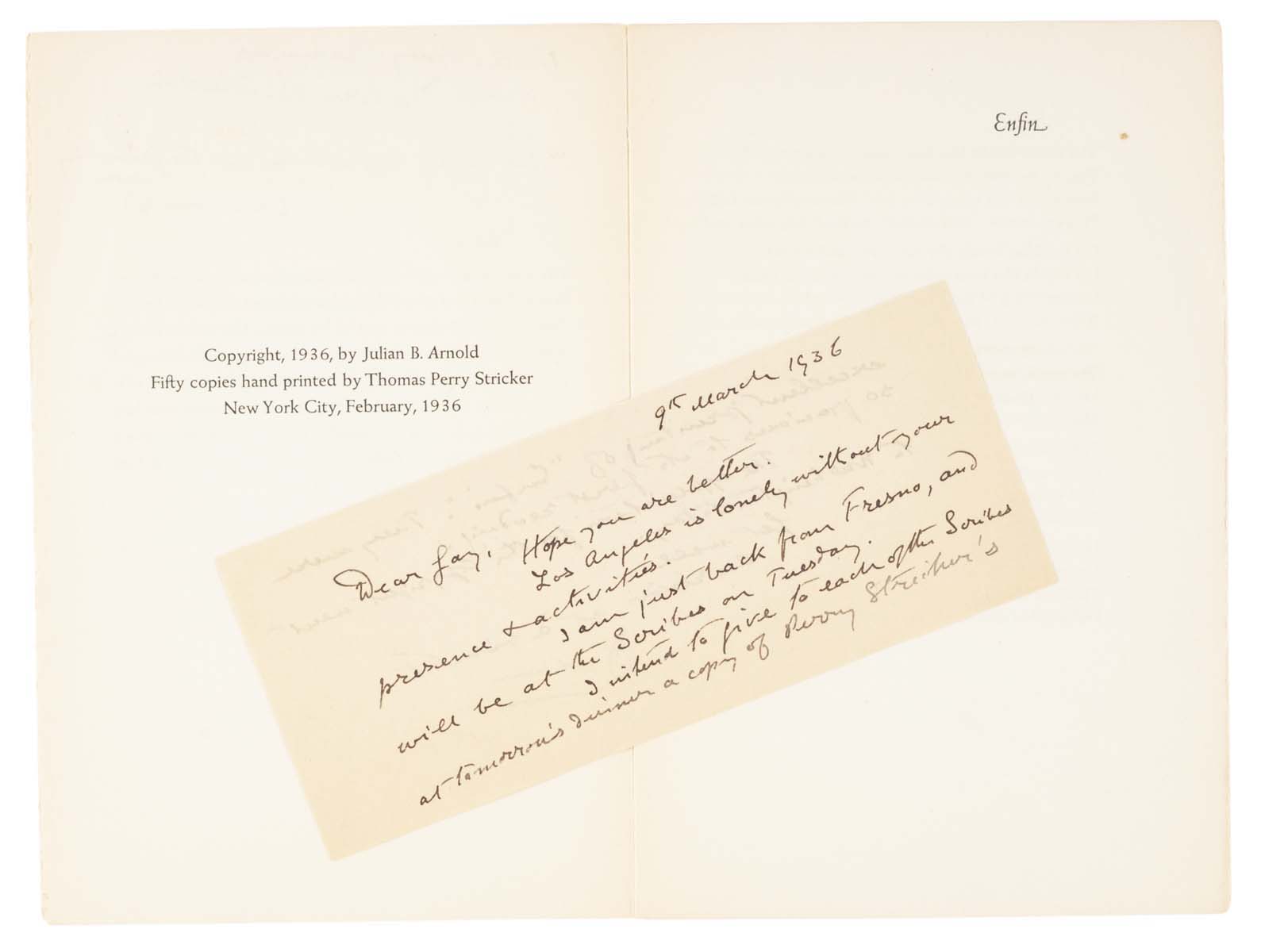
8vo, pp. [5], [3 (blank)]; a pristine copy sewn in the original wrappers, printed in black and brown; preliminary editorial note inscribed by Julian Arnold to A. Gay Beaman with the quote ‘“The sweet, soft woman, and the friendly men” (see verse 4)’; 14-line autograph note tipped in, by Julian Arnold, dated 9 March 1936, brown ink (see below).
First edition, one of only fifty copies hand-printed by the self-taught printer Thomas Perry Stricker, presented by the editor – the author’s son – and accompanied by his autograph note regarding the printing and planned circulation of the poem.
The English poet and journalist Edwin Arnold (1832–1904) is perhaps best known for his long narrative poem The Light of Asia, or The Great Renunciation, which was among the first works to popularise the life and philosophy of Buddha in the West. A similarly epic treatment of Hinduism was less enthusiastically received. Arnold was a vegetarian and vice-president of the West London Food Reform Society, a vegetarian group based in Bayswater, with Mahatma Gandhi as secretary.
Though mostly famous as a poet, Arnold, as editor of the Daily Telegraph, also contributed to notable contemporary colonial enterprises: he worked with the New York Herald to arrange the journey of H.M. Stanley to find the course of the Congo River, and first conceived the idea of a railway line traversing the entire African continent (he was the first to employ, in 1874, the phrase ‘Cape to Cairo railway’ subsequently popularised by Cecil Rhodes).
The poem Enfin was published posthumously by Edwin’s son Julian, whose preliminary address to the reader states that a manuscript of which no one had been aware was found in a drawer. Julian’s research dated the composition to September 1899, when his father was sixty-seven. The manuscript note by Julian to ‘Gay’ tipped into this copy reveals that Julian, who wrote from Los Angeles (having just returned from Fresno), was very pleased with the printing, and planned to give one copy each to the ‘Scribes’ in Los Angeles. The inscription ‘see verse 4’ perhaps encourages a play on Gay’s name: ‘And what gay journeying there was! and, then | The sweet, soft women, and the friendly men’. Stricker (1898–1945) taught himself to set type in 1930, and from 1935 to 1938 was in New York, where he produced exhibition catalogues for the American Institute of Graphic Arts; in 1940, due to illness, he sold his printing equipment to the book designer and printer Ward Ritchie.
OCLC locates three copies only (California Polytechnic, Library of Congress, and UCLA); no copy appears in any New York institution, despite its New York imprint. Not in Library Hub.