Browning, Whitman, Shelley, Byron, Turgenev, and the Rossettis
AUSTIN, Alfred.
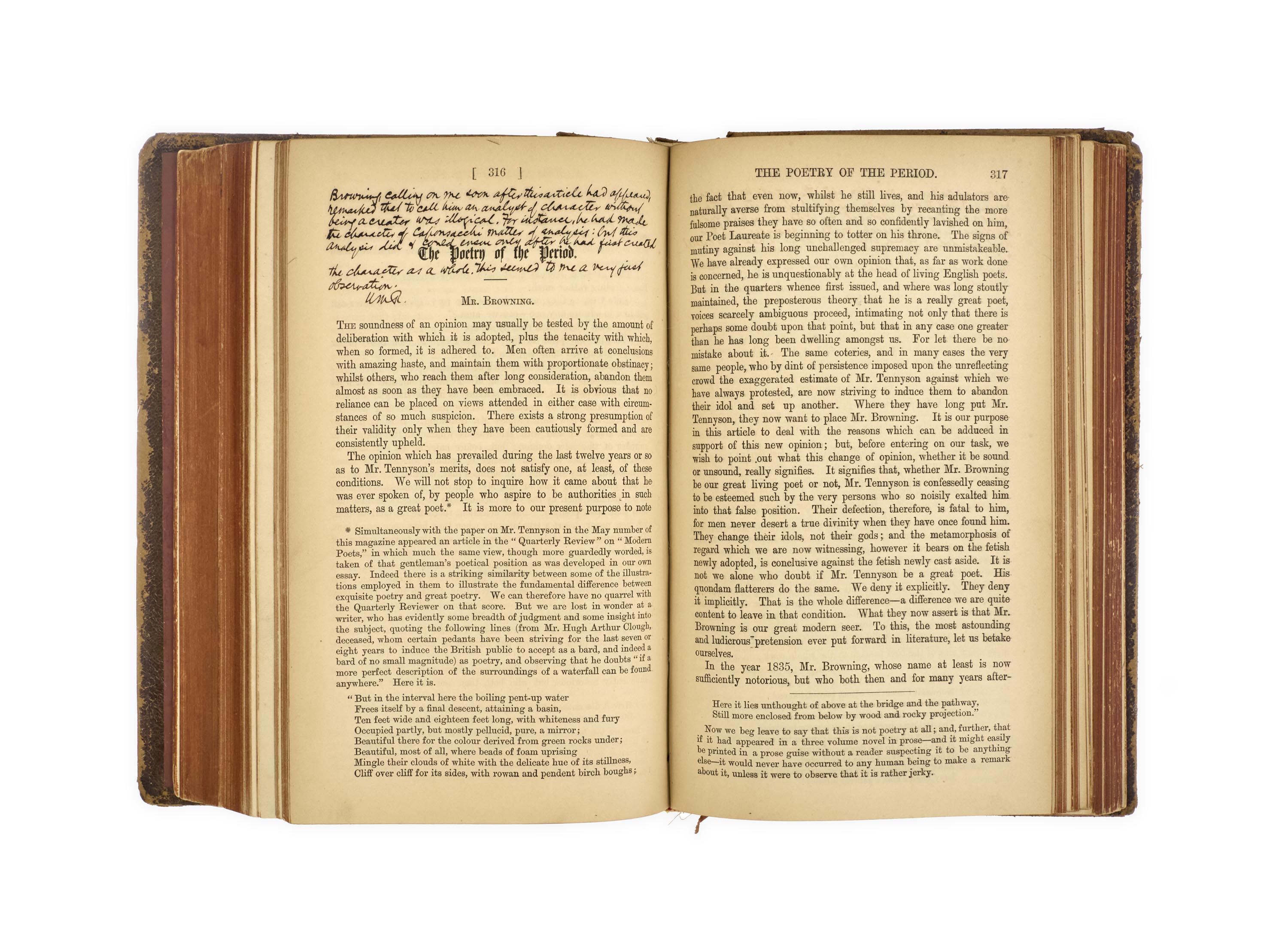
‘The Poetry of the Period: Mr Browning’ [and] ‘The Poetry of the Future’, from Temple Bar, London, October 1869.
[bound with:]
TURGENEV, Ivan. ‘The Idiot. From the Russian of Turgenieff: by W. R. Ralston’, from Temple Bar, May 1870.
[and with:]
BLIND, Mathilde. Review of Rossetti’s edition of The Poetical Works of Percy Bysshe Shelley (1870).
[and with:]
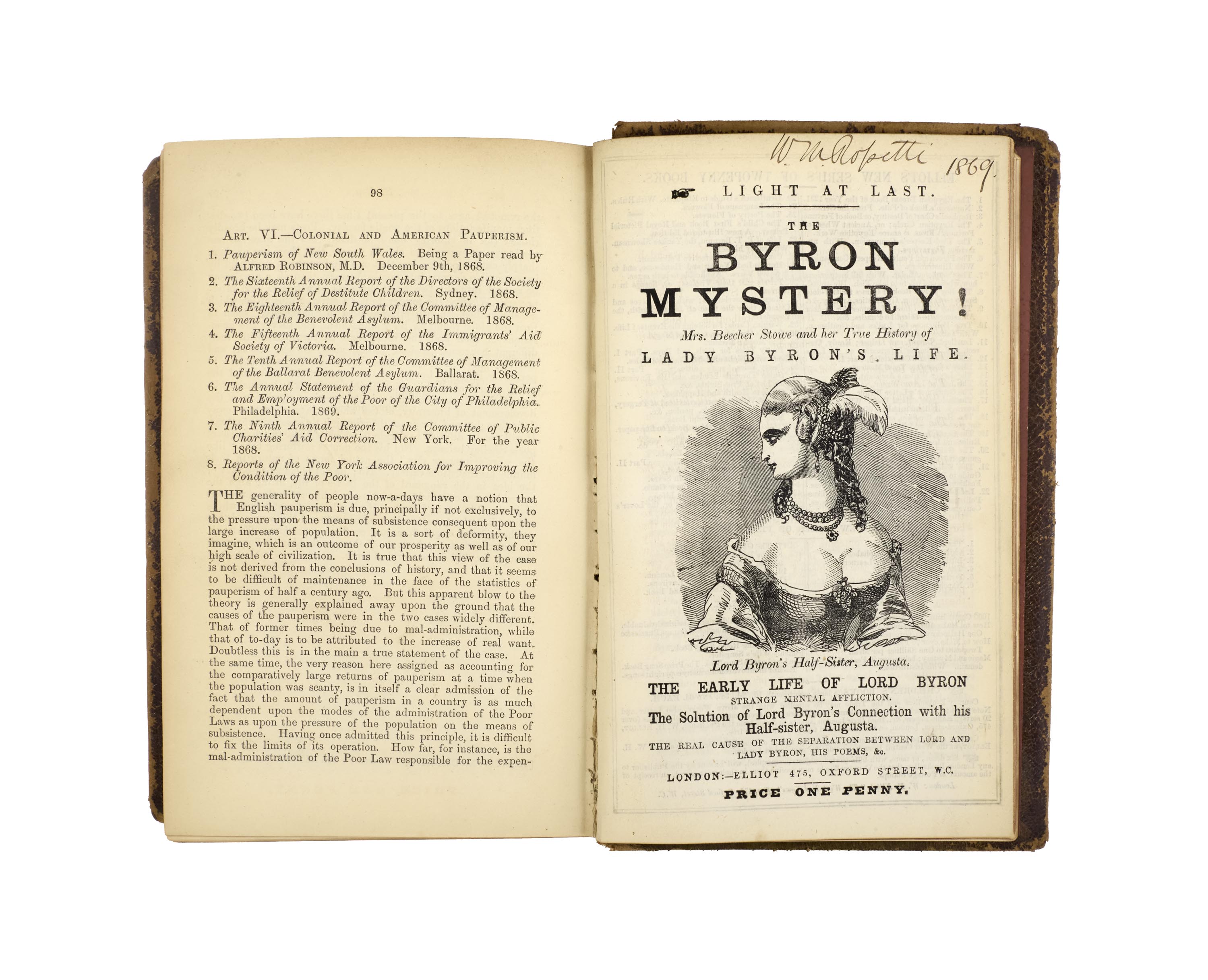
[BYRON.] Light at Last! The Byron Mystery! Mrs. Beecher Stowe and her true History of Lady Byron’s Life … London, Elliot, [1869.]
[and with:]
SWINBURNE, Algernon Charles. Ode on the Proclamation of the French Republic. London, F. S. Ellis, 1870.
[and with:]
HERAUD, John Abraham. The Descent into Hell: a Poem. London, J. Murray, 1830.
[and nineteen other works.]
Twenty-five works, 8vo, including pamphlets and periodical extracts; Austin: pp. 315–334, 313–328; Blind: pp. 75–98; Byron: pp. 16, with a portrait on the title-page (ownership inscription of WMR 1869); Swinburne: pp. [3]–23, [1], wanting half-title; Heraud: pp: [6], 228, [2], wanting half-title; bound together in green morocco, worn, front hinge detached; ownership inscription of William Michael Rossetti, with his manuscript index to front endpapers.
Added to your basket:
‘The Poetry of the Period: Mr Browning’ [and] ‘The Poetry of the Future’, from Temple Bar,
A fascinating and characteristic tract volume from the library of William Michael Rossetti, collecting publications and articles relating to the Rossettis and their circle.
In Poetry of the Period (published in book form in 1870) the conservative poet Alfred Austin (1835–1913) launched a sustained satirical attack on, among others, Tennyson, Morris, Swinburne, Whitman, and Browning, whose ‘detestable gibberish’ received a particular castigation. William Michael Rossetti has annotated the article at the head: ‘Browning calling on me soon after this article had appeared, remarked that to call him an analyst of character without being a creator was illogical … This seemed to be a very just observation’. Browning was much admired by the Rossettis (‘We found more deep and well-nigh unmixed satisfaction in Browning than in any other living British poet’, Some Reminiscences), and William Michael met him a number of times, most significantly in Italy in 1860. The chapter ‘Poetry of the Future’ dealt with Whitman, and quoted Rossetti, Whitman’s pre-eminent champion in Britain, frequently and disparagingly. Whitman later published his own retaliatory article under the same title.
‘The Idiot’ was a short story by Turgenev which made its first appearance in English here in a translation by William Ralston. When the Russian novelist visited England in 1870–1, Ralston introduced him to the Rossettis in person at Cheyne Walk: ‘I never saw a man more impressive than Turguénief in person, and in tone of conversation’ (Some Reminiscences).
The German-born poet, critic, and political activist Mathilde Blind (1841–1896) had emigrated with her mother and stepfather to London in 1852 where their house was frequented by the likes of Marx and Mazzini. A ‘wild Shelleyan’ just emerging as a force in London’s literary Bohemia, she was introduced by Swinburne to William Michael when he was at work on his 1870 edition of Shelley’s poems, and published this important review after it was published.
Harriet Beecher Stowe’s ‘Story of Lady Byron’s Married Life’ had appeared in Macmillan’s in September 1869, printing for the first time information about Byron’s incest with his half-sister. William Michael Rossetti, who was then at work on edition of Byron’s poems, was angry, saying that her statements had ‘no authority’. Light at Last! (NLS only in Library Hub), quotes some of Stowe’s article and similarly decries the accusation. Two articles on the same subject from Temple Bar are also bound in.
Swinburne’s Ode on the Paris Commune appeared in September 1870, just as William Michael Rossetti was about to depart for Germany (Some Reminiscences, pp. 355–6). Swinburne’s moderate position was closely modelled after that of Mazzini, but his friend Rossetti afterwards declared himself an ‘ultrarepublican’, in favour of the communards.
John Abraham Heraud (1799–1887) was a founder of the Syncretic society, an important if much ridiculed predecessor of the Aesthetic movement. He was impressed by The Germ, inviting William Michael Rossetti to dinner, but his own Descent into Hell cannot have made much of an impression on his guest – ‘I have not read it’ says WMR in Some Reminiscences.