A Mirror for Princes and Manual for Courtiers
BALZAC, Jean-Louis Guez de.
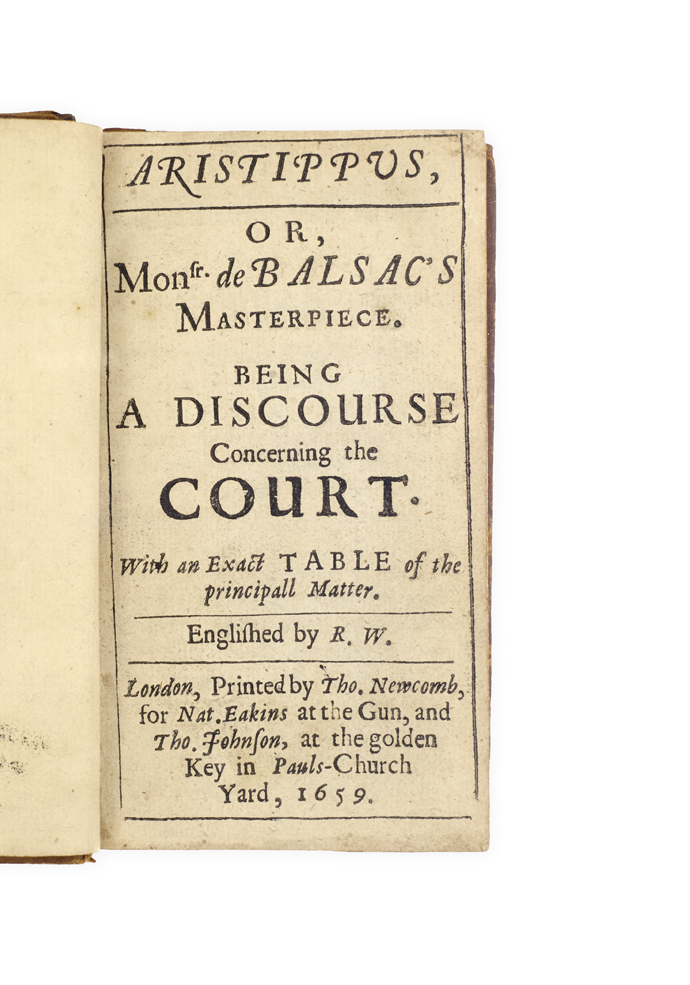
Aristippus, or, Monsr. de Balsac’s Masterpiece, being a Discourse concerning the Court … Englished by R.W. London, Tho. Newcomb for Nat. Eakins and Tho. Johnson,1659.
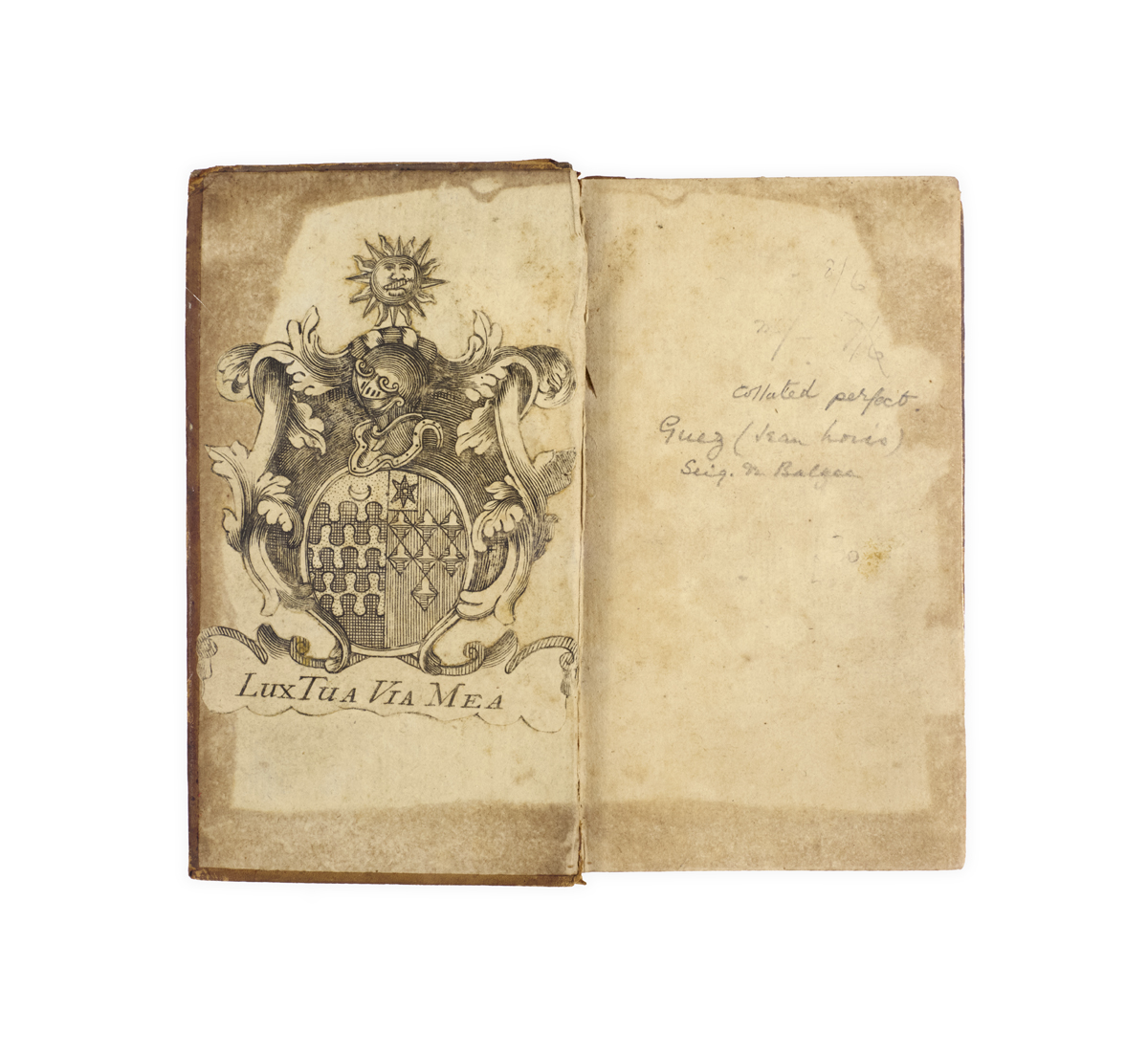
12mo, pp. [16], 159, [17]; typographic headpieces, two criblé woodcut initials; trimmed slightly close at head, shaving a few running-titles, small tear to upper corner of E2 affecting pagination and a few characters, sporadic light foxing; else a very good copy in eighteenth-century calf, speckled edges; rubbed, joints and hinges worn, spine label wanting, headcap chipped; eighteenth-century clear-cut armorial bookplate of Edward Blount of Blagdon to front pastedown, with motto ‘Lux tua vita mea’ (Franks 2886).
Added to your basket:
Aristippus, or, Monsr. de Balsac’s Masterpiece, being a Discourse concerning the Court … Englished by R.W.
First edition in English of Balzac’s Aristippe (first published posthumously in 1658), a treatise on wisdom in political administration and on the nature of life at court, dedicated to Queen Christina of Sweden, who was an admirer.
Jean-Louis Guez de Balzac (1597–1654), a founding member of the Académie française, was particularly reputed for the quality of his prose, seen as raising it to the same perfection as Malherbe did for French verse. His preface ends in praise of Christina’s intellect and qualities as a ruler: ‘Let us therefore praise, let us bless … the great, the incomparable Christina, for the good examples she gives to so wicked an Age, for having made an end of War … It’s she who Sovereignly understands the Sciences and the Arts’ (p. [15]).
Set in 1618, the work itself is structured as a series of lessons given by a fifty-five-year-old French-born German Catholic wise man called Aristippus to the Landgrave of Hesse on the qualities of an ideal ruler. His sage advice includes ‘Jealousie of love between particular persons hath been cause of a great war’; ‘Favor is a Daughter which often kills her own Mother’; ‘There can be no interregnum more unhappy then the life of such a Prince, who suffers himself after that manner to be governed by his Favorites’; and ‘A woman and her children are most powerfull hindrances to stop a man who seeks after glory’. At the end is an apposite extract from an earlier work, The Elegant Combat (1634), comprising his conversations with Pierre du Moulin.
Provenance:
With the bookplate of Edward Blount (d. 1726) of Blagdon, Devon. ‘He was a friend of the poet (and fellow-Catholic) Alexander Pope, and correspondence between the two survives; he was also involved in seeking to have legislation passed to relieve the financial pressures faced by Catholics’ (Book Owners Online).
ESTC R7761; Wing B 612.