The Power of Persuasion
BEROALDO, Filippo.
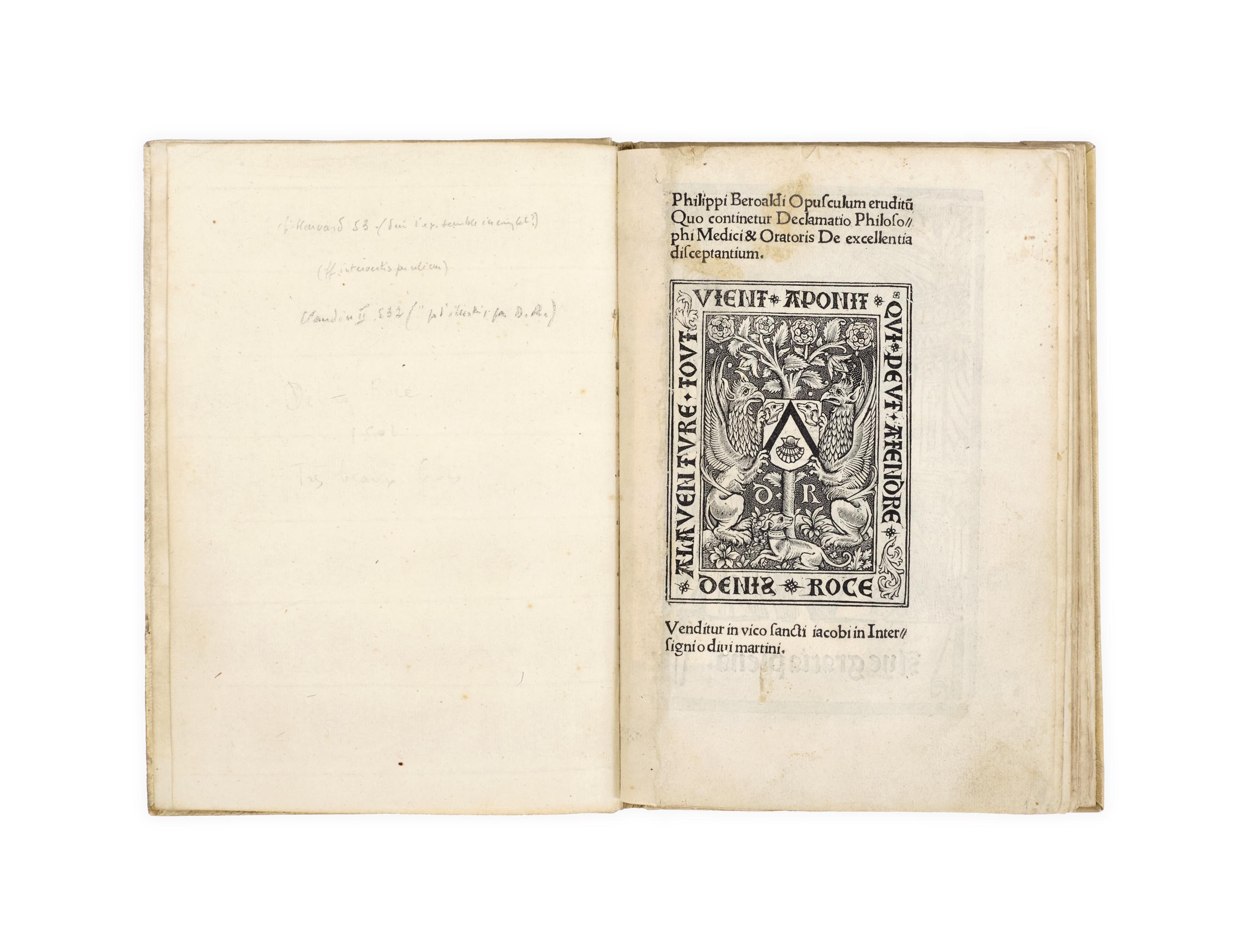
Opusculum eruditum quo continetur Declamatio philosophi medici & oratoris de excellentia disceptantium. [(Colophon:) Paris], Denis Roce, [1 August 1501].
[bound with:]
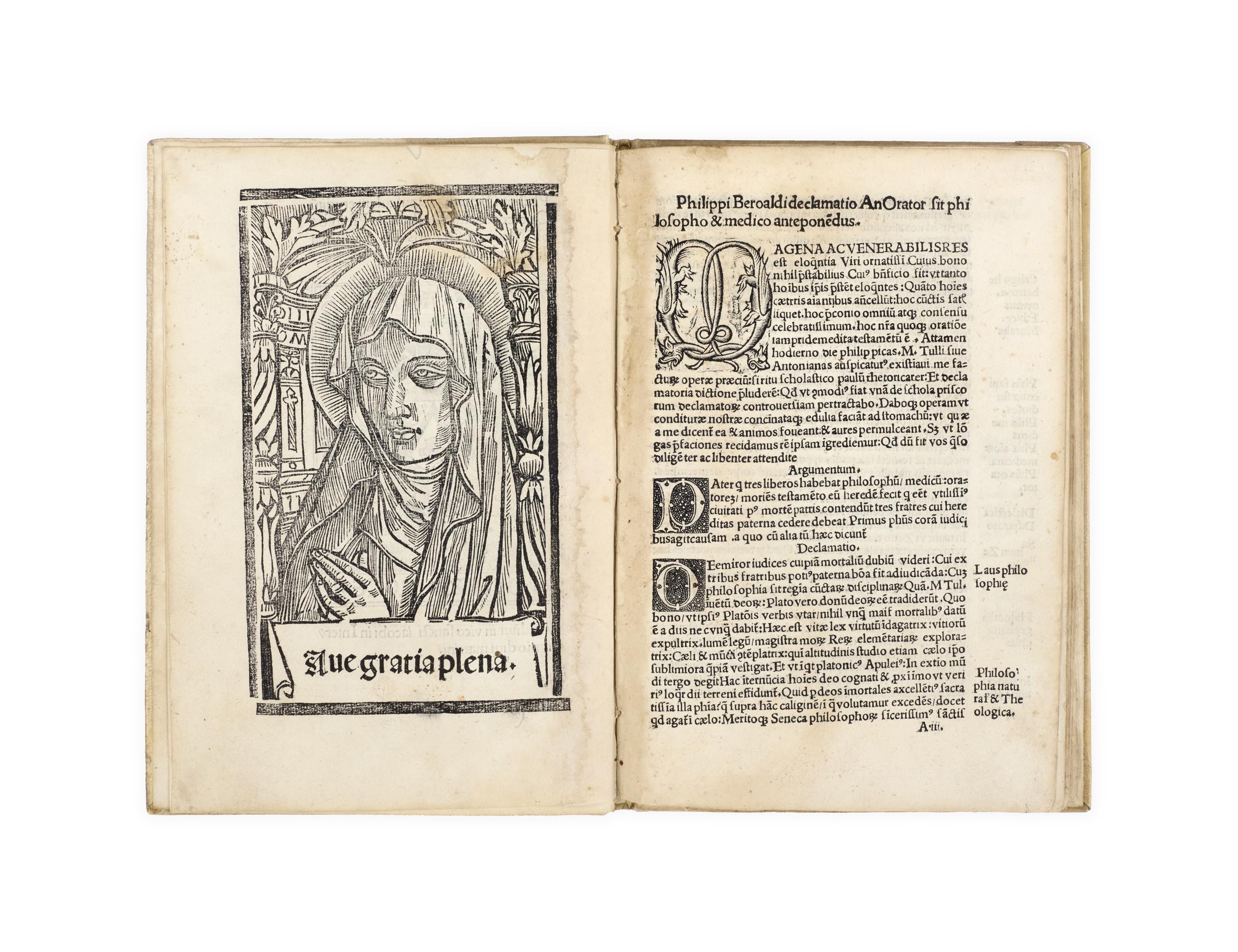
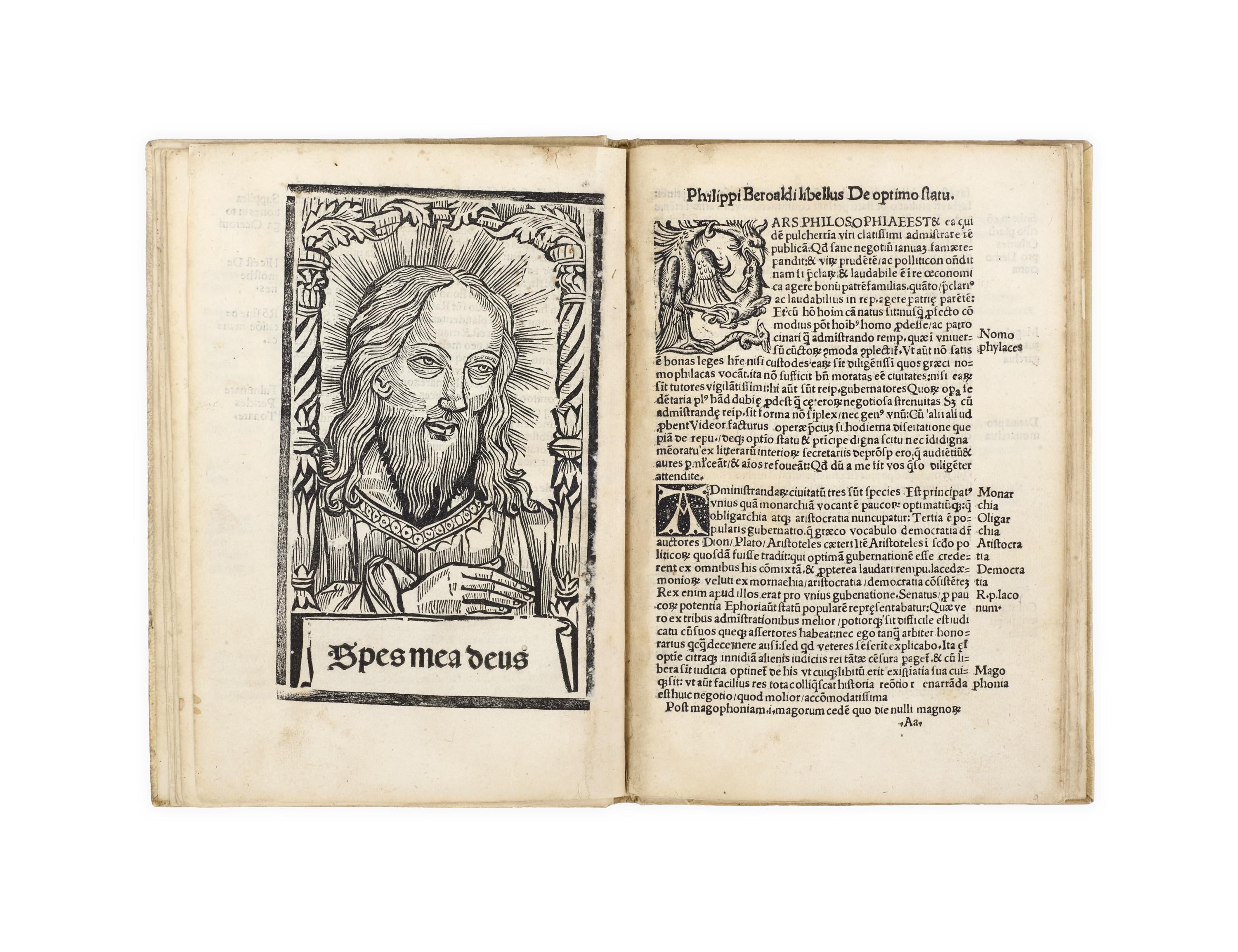
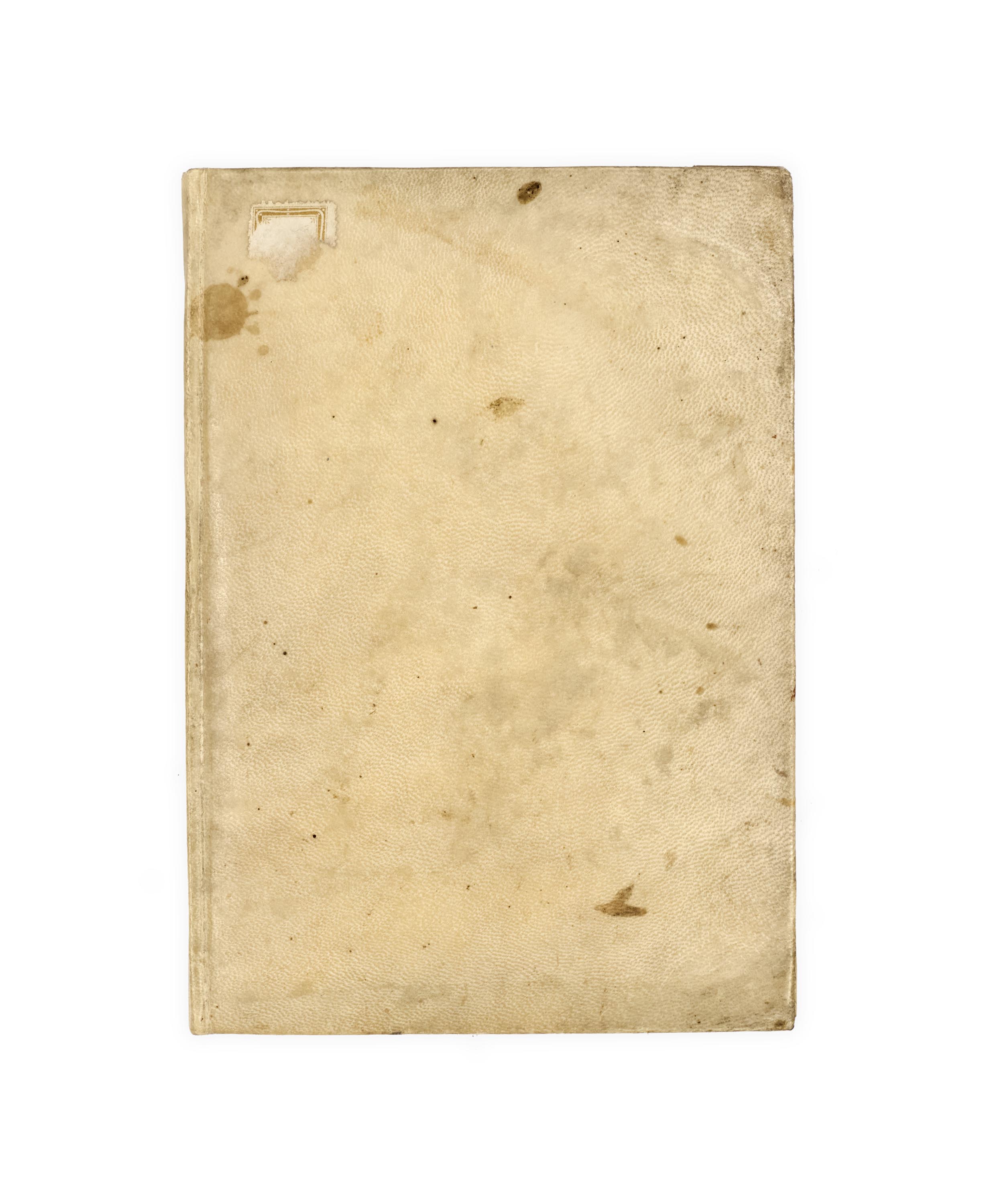
BEROALDO, Filippo. [Drophead title:] Libellus de optimo statu. [(Colophon:) Paris, Denis Roce, ‘decimo nono ydus Augusti’ (26 July?) 1501.]Two works in one vol., 4to, Opusculum: ff. [8], A2.7 misbound; metalcut printer’s device to title-page, full-page woodcut of the Virgin Mary to verso of title with the letterpress caption ‘Ave gratia plena’, woodcut initials, full-page woodcut of Christ to final verso with the letterpress caption ‘Spes mea deus’; Libellus: ff. [14], Bb2.5 misbound; woodcut initials, repeated woodcut of Christ to final verso; backfolds repaired, marginal repair to final leaf, short marginal tears, a few small wormholes, a few scattered stains, otherwise a good copy; recased in old vellum over boards.
Added to your basket:
Opusculum eruditum quo continetur Declamatio philosophi medici & oratoris de excellentia disceptantium.
Second Paris editions (first 1500) of Beroaldo’s short texts on the power of persuasion and the ideal state; the first editions with illustrations, large and striking woodcuts of the Virgin Mary and Christ.
These two works by Filippo Beroaldo (1453–1505) were first printed together in Bologna in 1497. He dedicated De optimo statu (On the ideal state) to the de facto ruler of Bologna, Giovanni Bentivoglio; other editions were entitled De optimo statu et de principe, preempting Machiavelli’s choice of title for his own short work of political theory. However, Beroaldo provides what is essentially a list of princely virtues, in the manner of earlier specula principum; he concludes that a monarchy is the best form of government, where the monarch acts in the best interests of the state. Although they approached princely behaviour from different angles, it has been suggested that Machiavelli did indeed read Beroaldo’s treatise, though he was more influenced in his other writings by Beroaldo’s commentaries on Roman drama.
These second Parisian editions, printed by Michel Tholoze for Roce, follow Kerver’s editions of the previous year; they omit Beroaldo’s preface, and the absence of a separate title-page for the second part perhaps indicates that the two were intended to be issued together. Roce published numerous short works by Beroaldo, for students at the university to pick and choose which ones to buy for their studies.
The woodcuts are somewhat large and crude, perhaps more in the manner of a pilgrim badge than a book illustration. ‘The blocks are cut with unusually strong lines, and the uneven edges suggest that these subjects may originally have been part of a larger block divided into panels’ (Mortimer, p. 71). They also seem somewhat incongruous, given the secular nature of the texts that they accompany.
Uncommon: we have traced copies of both works in the British Library, Harvard, and the Newberry; the first work is also in Christ’s College, Cambridge and the National Library of Medicine; the second is also held by the LSE.
USTC 142763 & 142758; BP16 100016 & 100015; Declamatio: Mortimer, Harvard French 53. Not in Adams.