Medieval Fables
[BONIOHANNES de Messana, attributed.]
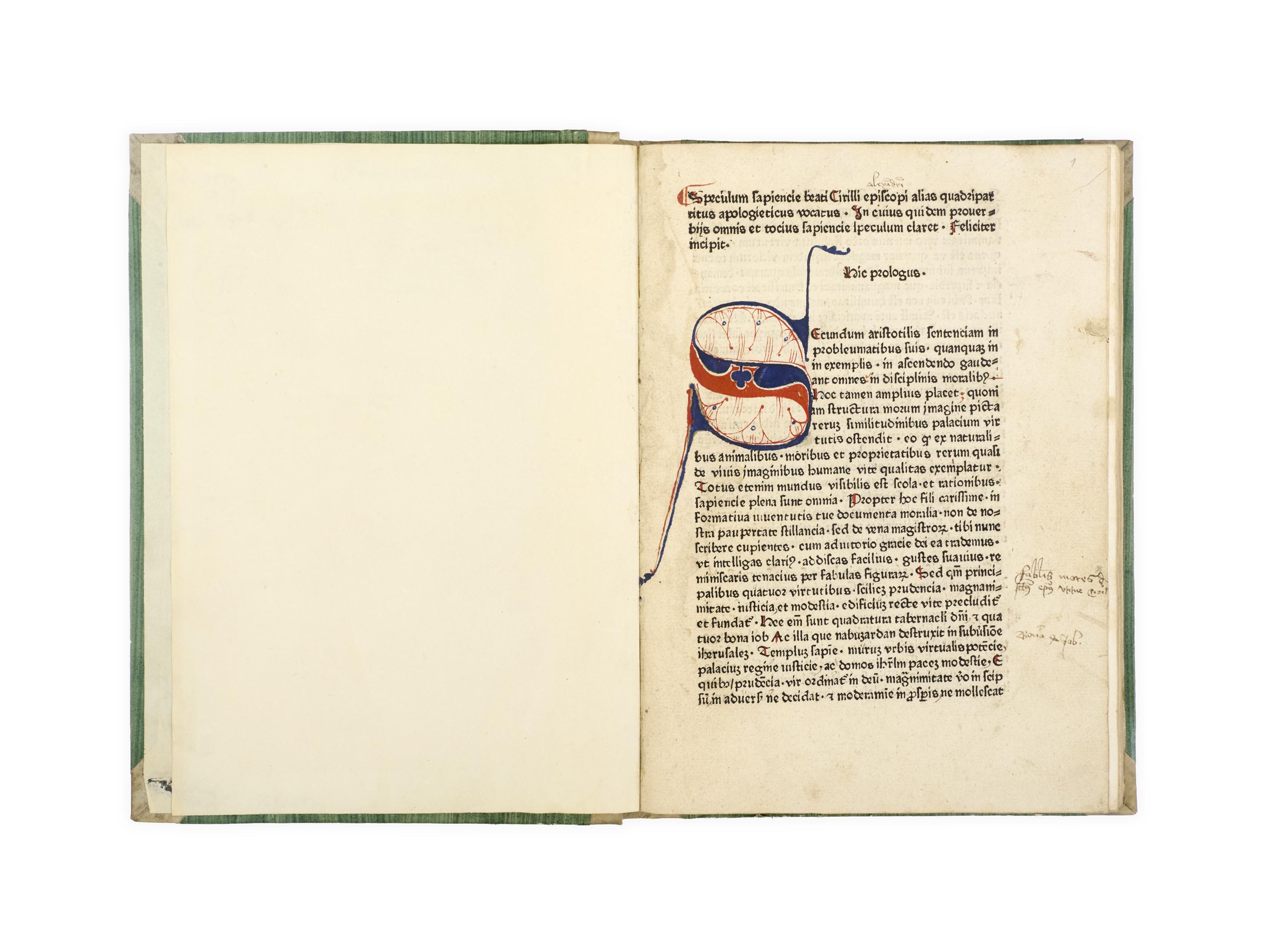
Speculum sapiencie beati Cirilli episcopi alias quadripartitus apologieticus vocatus. In cuius quidem proverbiis omnis et tocius sapiencie speculum claret. [Basel, Michael Wenssler, c. 1475.]
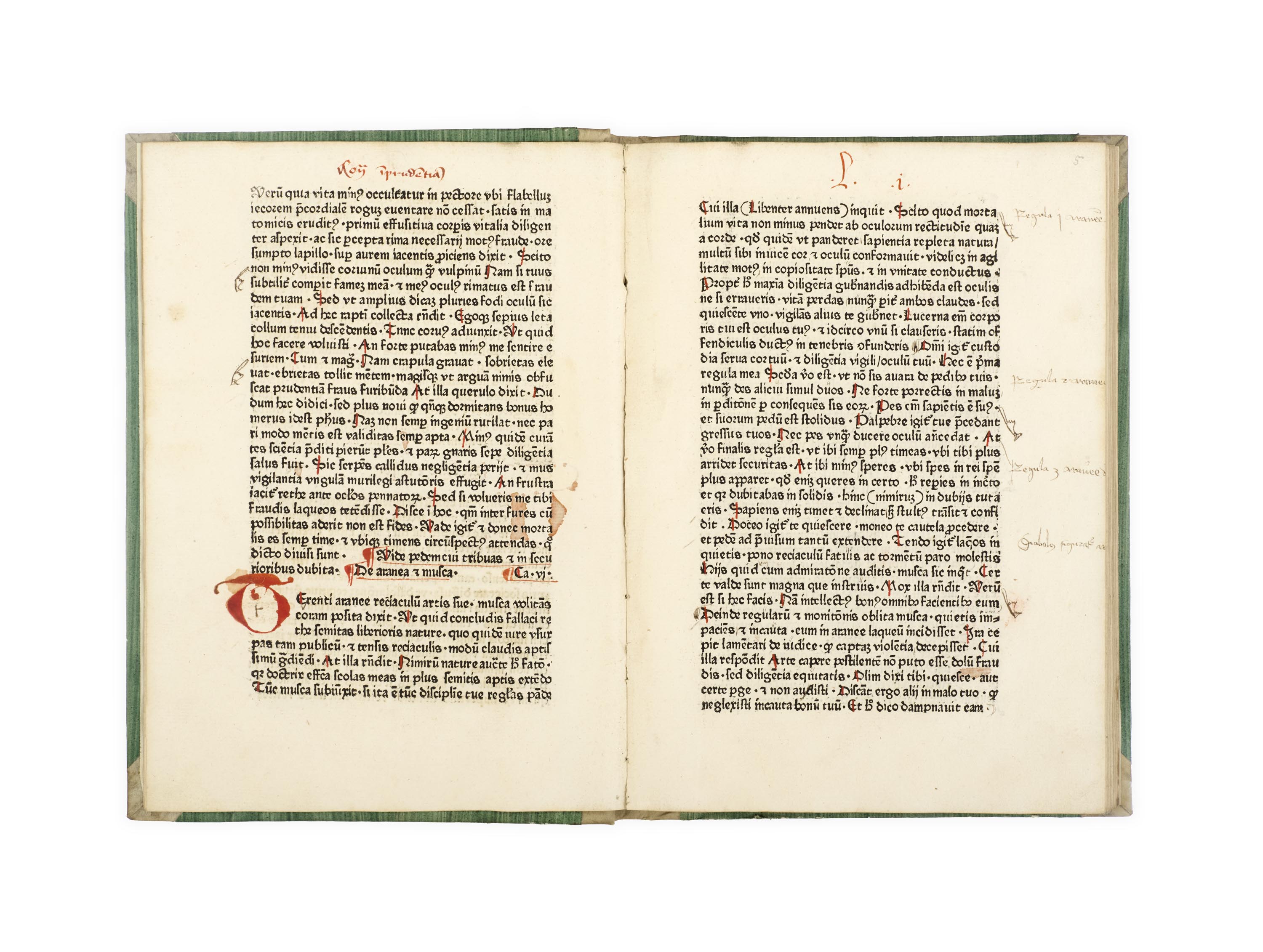
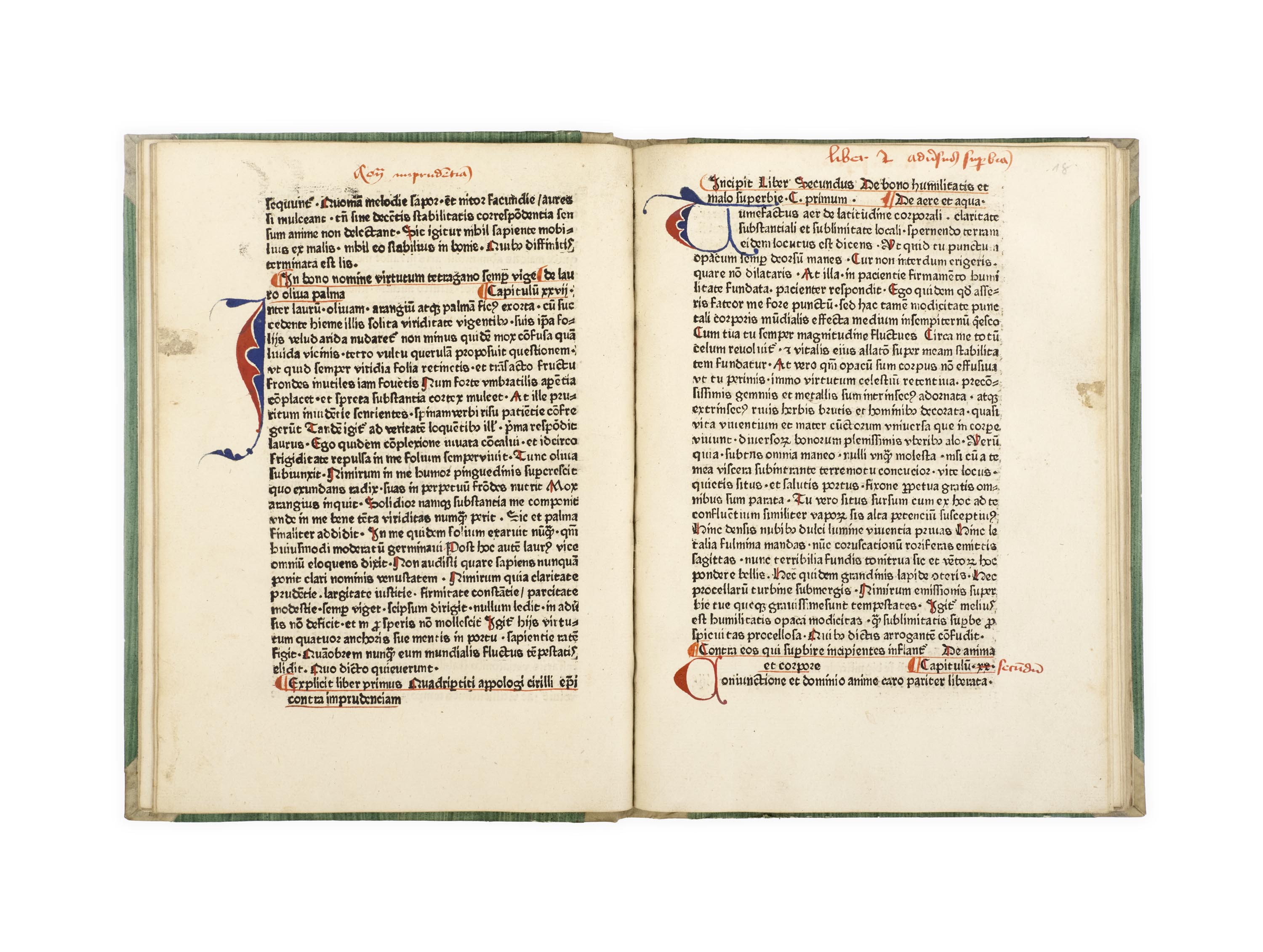
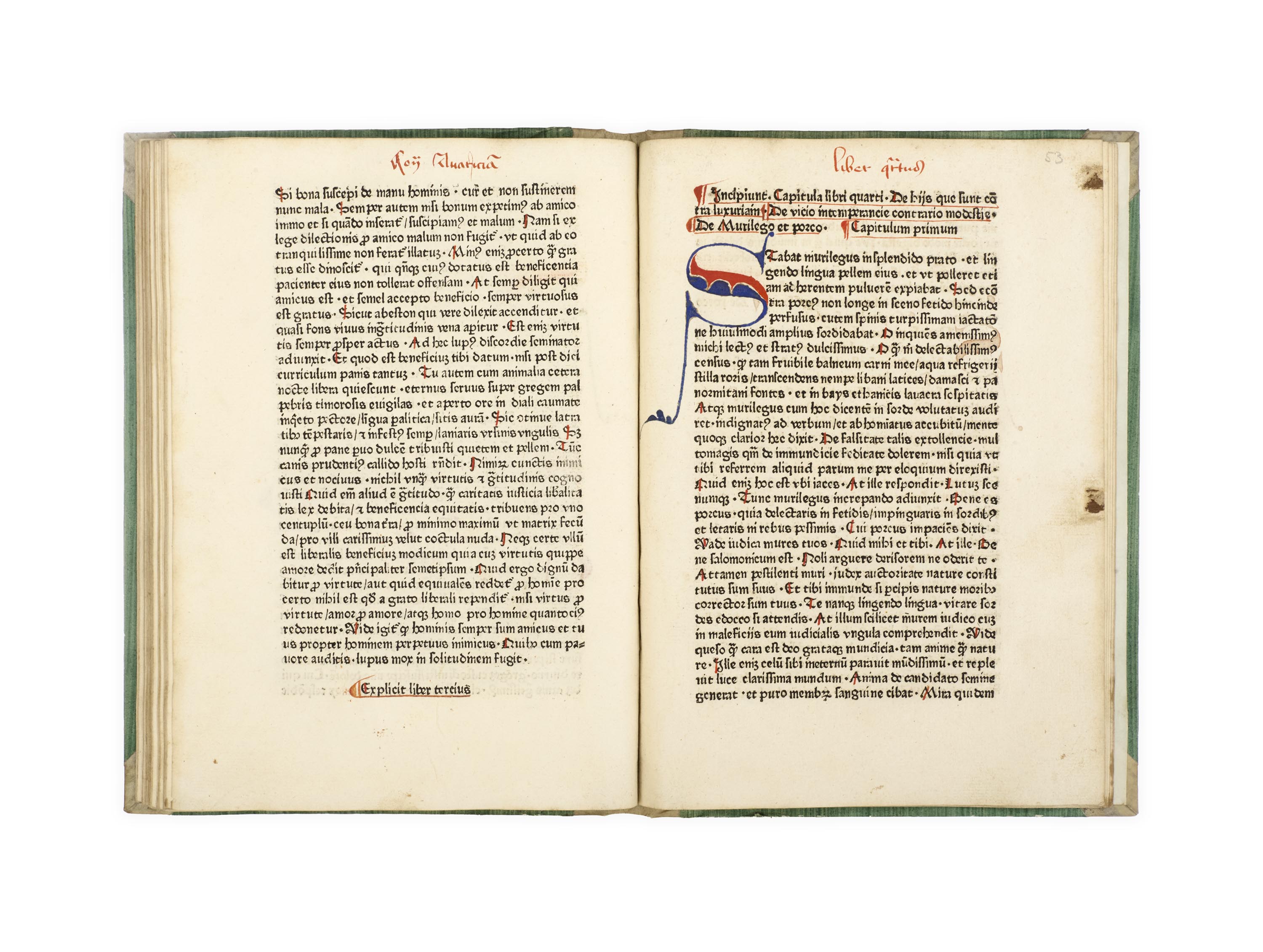
Folio, ff. [61]; [a–c10 d7 e–g8], last page blank; gothic letter, capital spaces with smaller initials supplied in red (several erroneous initials corrected in contemporary manuscript in brown ink), large initial ‘S’ in blue and red to f. [1]r with decorative infilling, other initials in blue and red to ff. [17]v, [18]r, and [53]r, paragraph marks in red, capitals touched in red, chapter headings underlined in red, headlines and book numbers supplied to upper margins in red in a neat contemporary scribal hand; some show through from initials, occasional small marks, old repair to blank lower margin of f. [21], remains of fore-edge tabs; a very good copy in twentieth-century vellum-backed boards with green paste-paper sides and vellum tips, title in faint manuscript at head of spine; extremities rubbed; marginal annotations and manicules in brown ink in a contemporary hand to 10 pp. at the beginning, modern pencil foliation.
Added to your basket:
Speculum sapiencie beati Cirilli episcopi alias quadripartitus apologieticus vocatus. In cuius quidem proverbiis omnis et tocius sapiencie speculum claret.
An attractive early incunable edition of the wonderful collection of medieval fables known as the Speculum Sapientiae or Quadripartitus Apologeticus, attributed in manuscripts and early editions to ‘Cyrillus Episcopus’ but now ascribed to the fourteenth-century Italian Dominican Boniohannes de Messana.
The text presents ninety-five moralized stories after the model of Aesop, many using familiar animals, intended to serve as examples of the Christian virtues or to counteract specific vices. The four books cover wisdom and imprudence, humility and pride, greed, and luxury and intemperance. The animal fables featured include, for example, ‘the crow, the fox, and the monkey’; ‘the cricket and the ant’; ‘the whale and the fisherman’; ‘the lion and the donkey’; ‘the bear and the dove’; and ‘the viper and the elephant’. ‘In these fables, the animals are not puppet-like bearers of evidence, but clever beings who spread knowledge and wisdom in well-chosen words’ (Grubmüller, p. 424, trans.). It is by no means just animals that feature: other tales include ‘the Sun and Mercury’; ‘the grain and the stone’; ‘the ear and the eye’; ‘the cloud and the earth’; ‘the dragon and the gem’; ‘the young man who went to the mountains of gold’; and ‘water, oil, and flame’.
This is the second of ten editions recorded on ISTC, following only the Strasbourg edition of Heinrich Eggestein dated ‘not after 1474’.
Our early annotator identifies the author as Cyril of Alexandria, and shows an interest in Job, wisdom, providence, and in the fable of the ‘the spider and the fly’.
BMC III 721; GW 7890; Goff C1017; Bod-inc C-508; ISTC ic01017000. See Kaeppeli, Scriptores Ordinis Praedicatorum Medii Aevi I, 699. See Grubmüller, Meister Esopus (1977).