Sermons, with Manuscript Waste Pastedowns
CARACCIOLO, Roberto.
Sermones de laudibus sanctoru[m] fratris Roberti de Licio ordinis minoru[m]. Episcopi Aquinaten[sis]. [Reutlingen, Michael Greyff, not after 1492.]
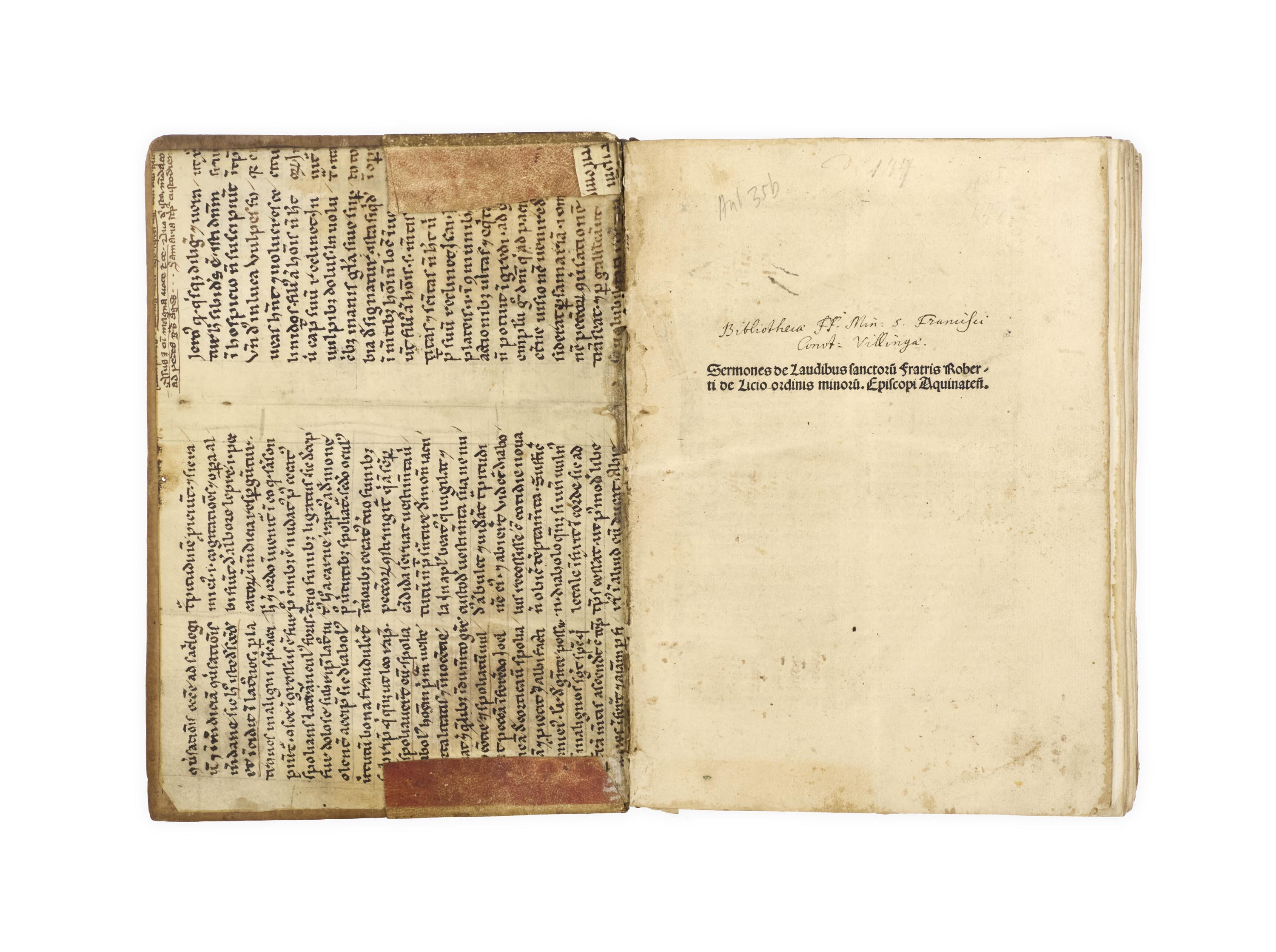
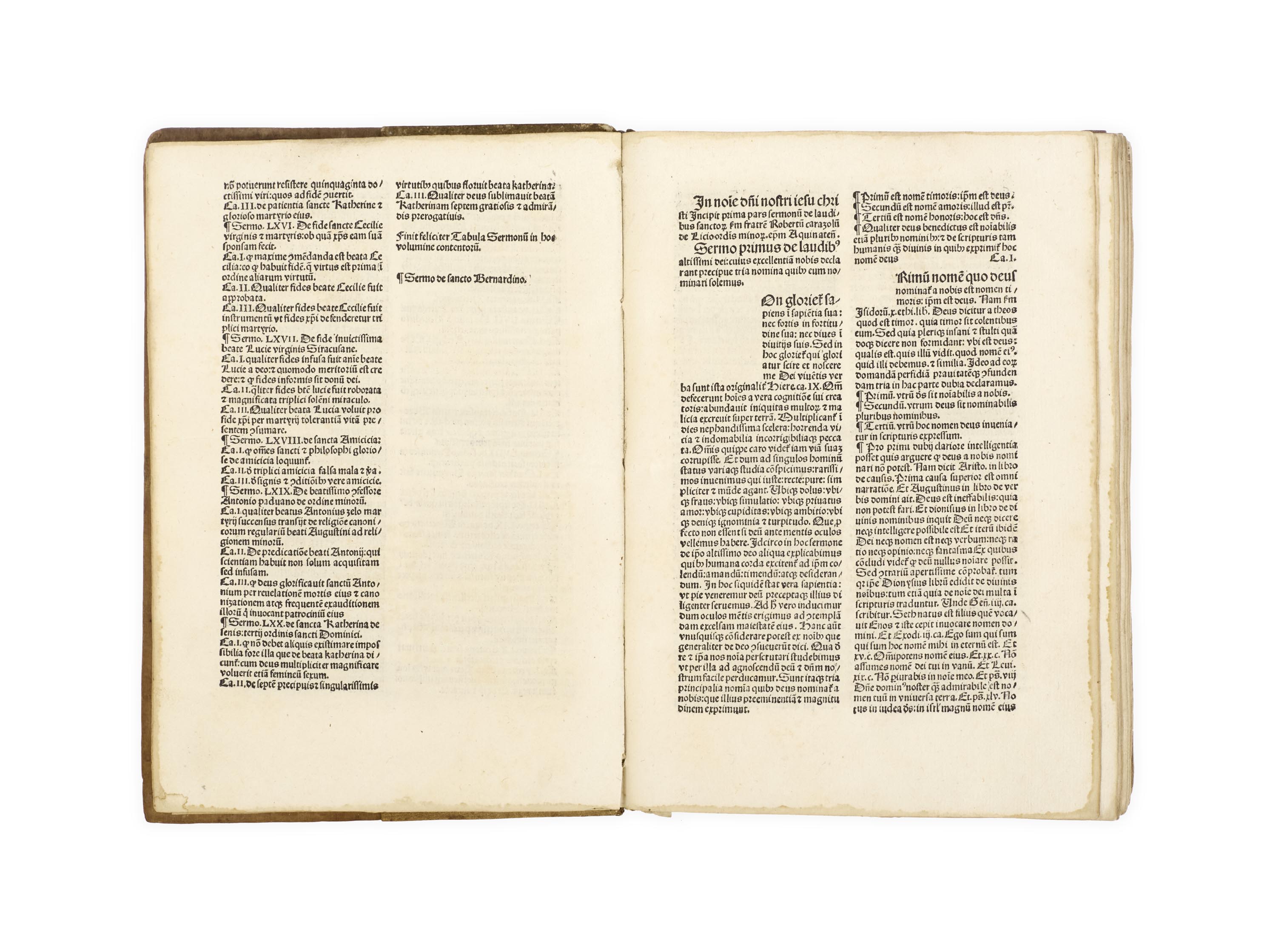
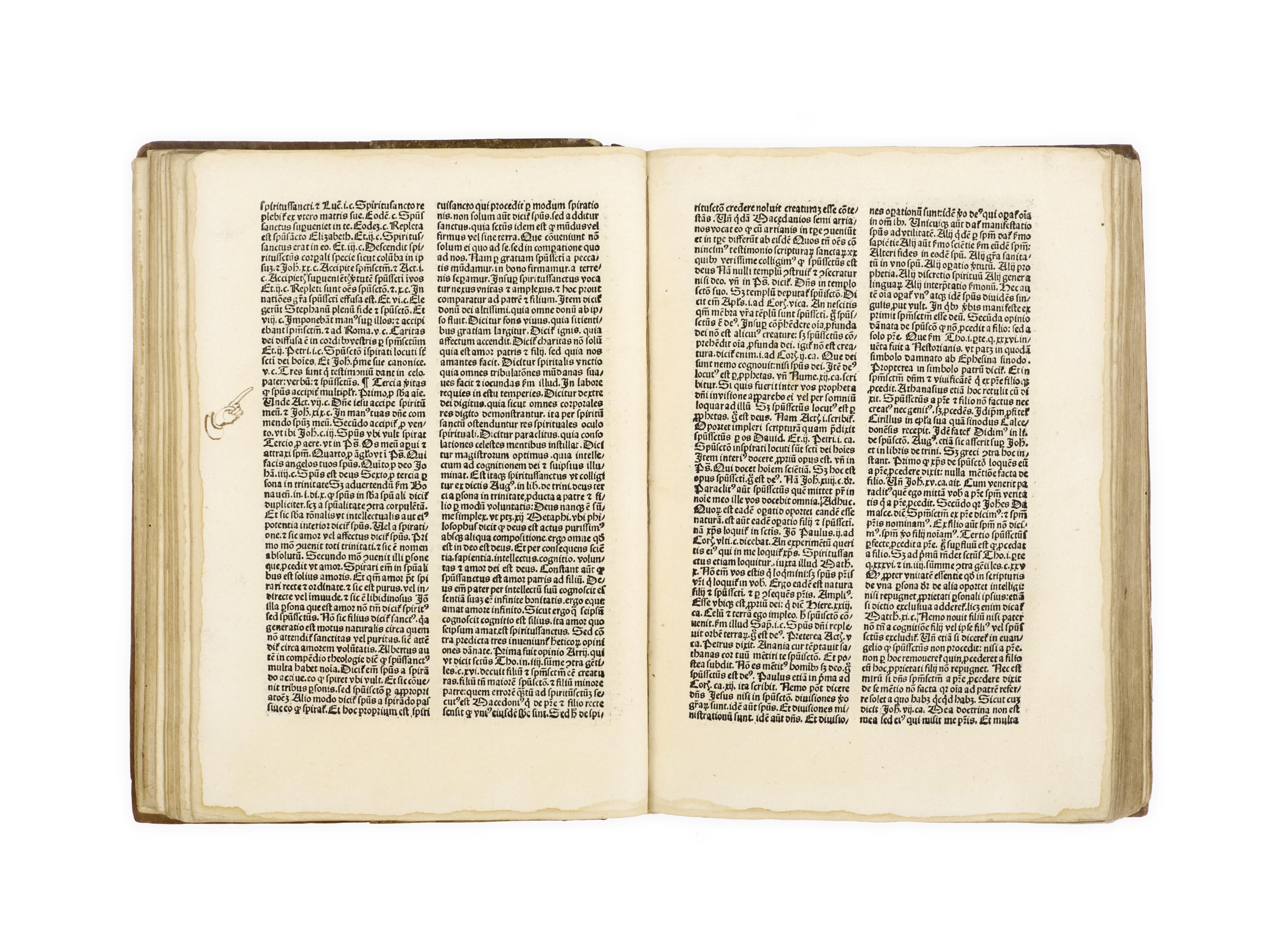
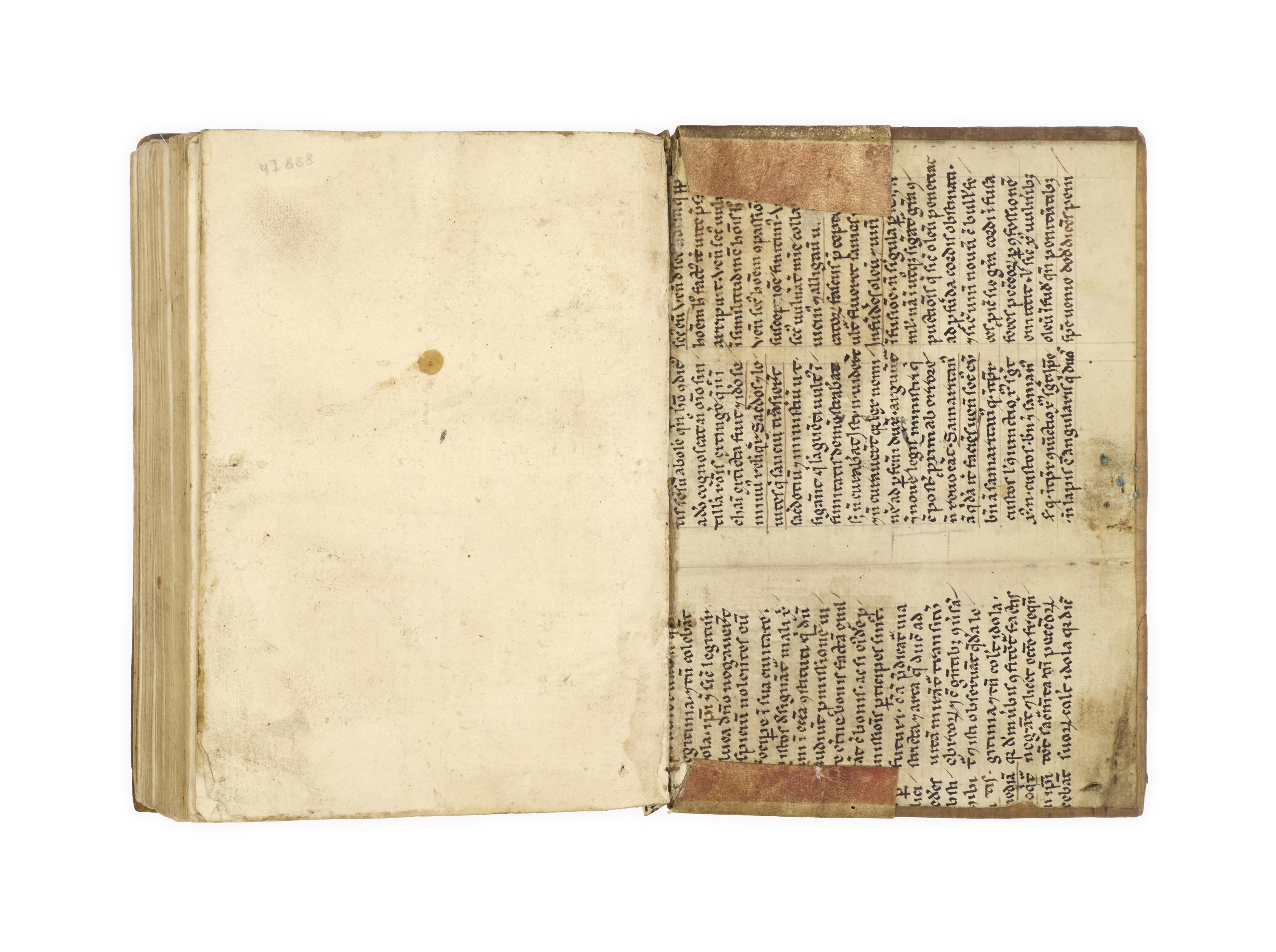
4to, ff. [230]; a–z8 A–D8 E6 F8, with final blank F8; gothic letter, text in two columns, capital spaces; small loss to lower corner of C8 (not touching text), occasional light marginal dampstaining, slight browning to a few leaves, but a very good, crisp copy; bound in contemporary half tawed sheep (originally stained pink) over wooden boards, traces of central clasp and catch, initials ‘G V’ stamped in blind at head of front board, pastedowns comprising fragments from a medieval manuscript (see below), seen on three double cords laced and pegged in; slight splitting to joints, top and bottom of spine reinforced with tawed sheepskin at an early date; remains of later paper spine labels; early marginal annotation to g2r and marginal manicule to i4v; eighteenth-century ownership inscription to title-page ‘Bibliothecae FF. Min. S. Francisci Convt. Villingae’ (the Franciscans of Villingen).
Added to your basket:
Sermones de laudibus sanctoru[m] fratris Roberti de Licio ordinis minoru[m]. Episcopi Aquinaten[sis].
Rare edition of this collection of seventy sermons by the Franciscan Observant friar Roberto Caracciolo of Lecce (c. 1425–1495), one of the most celebrated preachers of the fifteenth century, an attractive copy with pastedowns from a probably lifetime manuscript of John Halgren of Abbeville’s Sermones de tempore.
Caracciolo’s preaching took him all over Italy and earned him Europe-wide renown, Pope Calixtus III recruiting him to promote the crusade against the Turks; in 1475 he was promoted to the bishopric of Aquino. Erasmus records several anecdotes from Caracciolo’s life, depicting the friar as shrewd and witty but also self-centred and vainglorious: he criticised the preacher’s boast that he could reduce any member of his audience to tears, and his melodramatic gesture of preaching a crusade clad in knight’s clothing and armed with a sword.
The Sermones de laudibus sanctorum, first published in Naples in January 1489, was the last of Caracciolo’s Latin sermon collections to appear in print and was an immediate and much reprinted success, a hit with preachers and the public alike. Caracciolo employed a tripartite structure: the first twenty sermons are dedicated to the persons of the Trinity – God (1–2), Christ (3–19), and the Holy Spirit (20); the following ten are then dedicated to beatitude in general (21–23), the Virgin Mary (24–29) (for whom the Franciscan Observants had a special devotion), and the angels (30); and the remaining forty are devoted to saints, martyrs, doctors of the Church and so on, arranged – in a bold and novel move – not in the order of the liturgical calendar, but rather according to the saintly merits of each and their level of beatitude. After a sermon on John the Baptist and a set of sermons on the Apostles, come two on St Francis, followed by groups dedicated to the Church Fathers, Dominicans, and female saints, ending with Catherine of Siena.
The manuscript waste employed as pastedowns comes from an early thirteenth-century manuscript of the Sermones de tempore by John Halgren of Abbeville (c. 1180–1237) produced in Germany or the Low Countries towards the end of John’s lifetime. The text is written ‘above top line’, indicating a date prior to c. 1230. John had a brilliant career at the university of Paris, studying alongside the future Pope Gregory IX, before serving as archbishop of Besançon. Made a cardinal in 1227, he was sent as a papal legate to preach in the Iberian Peninsula, where he met the Catalan friar Raymond of Penyafort. John was a noted preacher, and while his sermons appear never to have made it into print, they circulated widely in manuscript. Our fragment contains part of his sermon for the thirteenth Sunday after Pentecost (Schneyer, Repertorium 3, p. 519, no. 151) and the text discusses sin, temptation, the devil, adversity, and the parable of the Good Samaritan.
ISTC records only one copy in the UK (British Library) and two in the US (Huntington, Newberry).
BMC II 582; Goff C151; GW 6060; ISTC ic00151000.