The Art of the Knockout
[BOXING.]
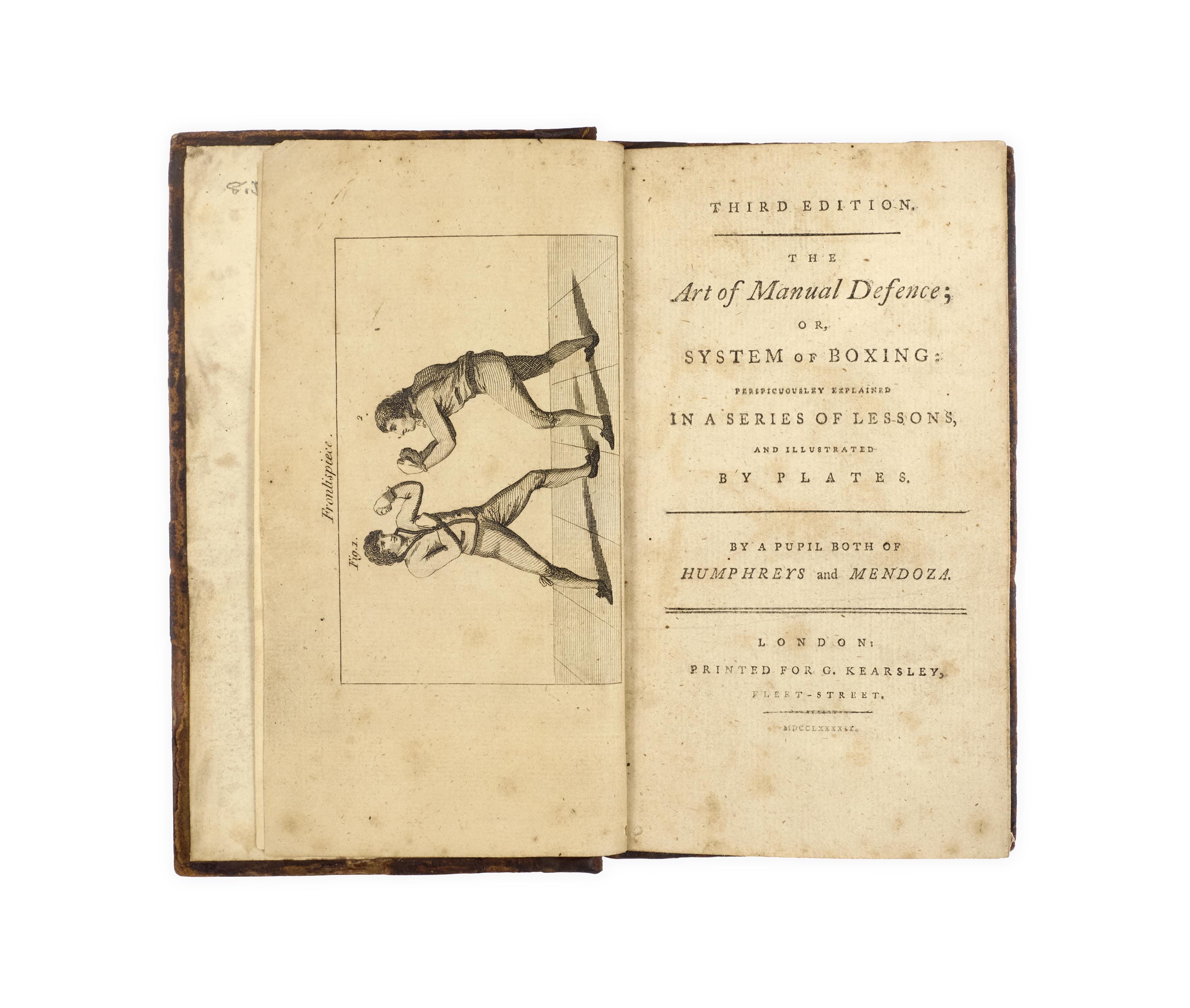
The Art of manual Defence; or, System of Boxing: perspicuously explained in a Series of Lessons, and illustrated by Plates. By a Pupil both of Humphreys and Mendoza. London, G. Kearsley, ‘1799’ [but 1789].
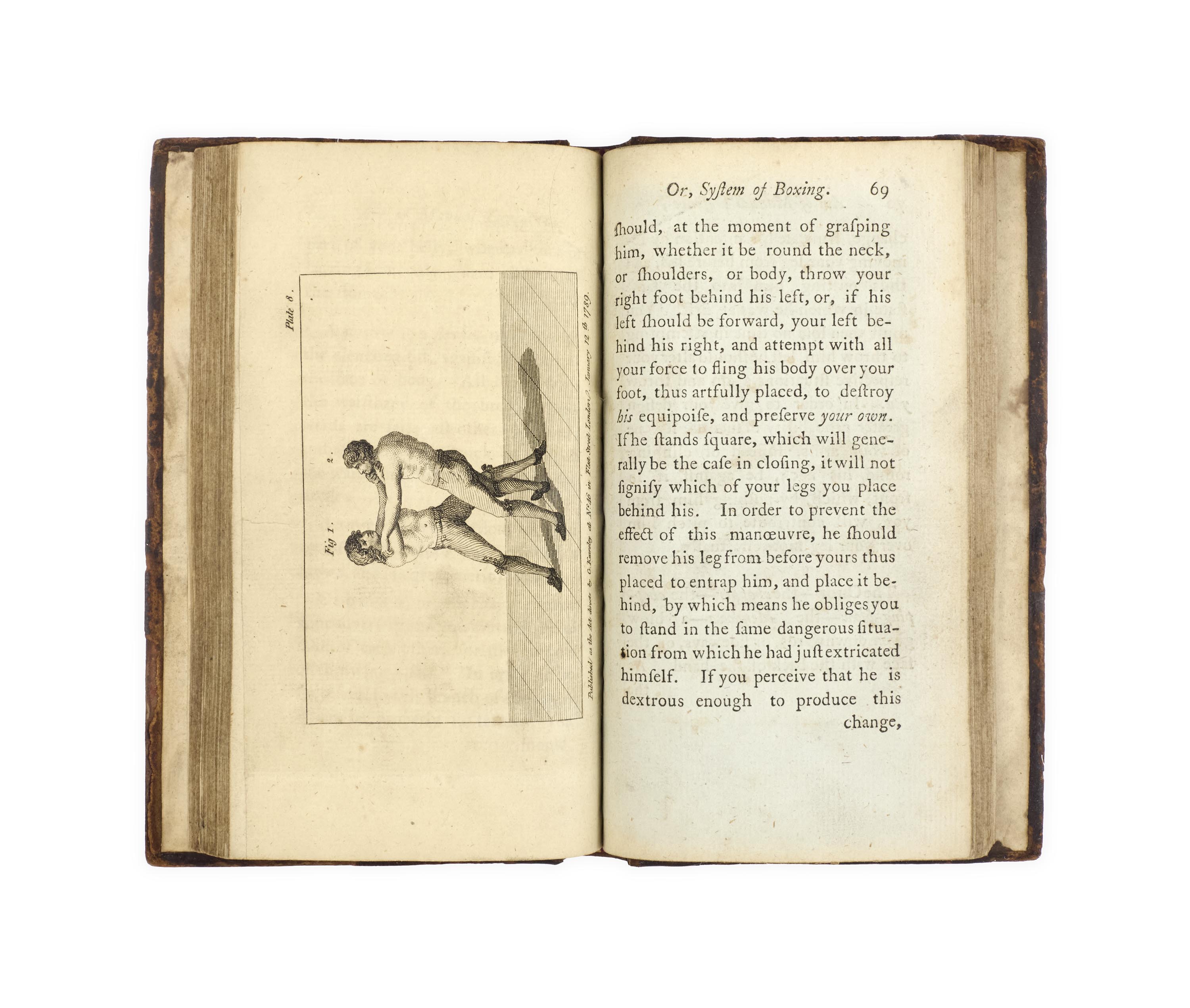
12mo, pp. [v], 8–9, [3], xiv–xxxv, [1], 133, [9 (Index)], wanting half-title as often, with an engraved frontispiece and nine engraved plates (all dated 12 January 1789); title-page toned, some light scattered foxing towards the end, but a good copy in contemporary mottled sheep, edges worn, neatly rebacked.
Added to your basket:
The Art of manual Defence; or, System of Boxing: perspicuously explained in a Series of Lessons, and illustrated by Plates. By a Pupil both of Humphreys and Mendoza.
Third edition, scarce, of an early illustrated English guide to boxing, the first to concentrate on the contemporary sport rather than its history, printed in the same year as the first two editions. The prefatory note to this edition calls attention to the ‘extensive and rapid sale of the former editions’ and asserts the author’s ‘competent knowledge of the subject’, as can now be seen by comparison with Daniel Mendoza’s own Art of Boxing (April 1789).
Daniel Mendoza (1765–1836), born into the Portuguese-Jewish community in London, became one of the most notable prize-fighters of his day, famed for his speed, and in 1787 he established a boxing school at the Lyceum on the Strand. He fought several celebrated bouts with Richard Humphreys (his former second and manager) in 1788–1790 – the frontispiece here shows their contrasting guard stances.
In the Annals of Sporting and Fancy Gazette for May 1823, the boxing writer Jonathan Badcock claimed that the present work was written by a barrister, W. H. Hall (the Advertisement is signed from ‘Clements Inn’), based on the notes of a Captain Topham. As well as a lengthy instructional manual (more detailed than Mendoza’s work which was mostly intended to promote his next fight with Humphries), it featured a ‘Descriptive account of the merits of modern Boxers’ (pp. 97–119), also covering the public sparrers at Mendoza’s Academy. The Introduction sells ‘boxing’ as an important skill for the genteel to learn to protect themselves against the ‘insolence’ and ‘blackguardism’ of the ‘lower order of people’, and explains the work’s superiority to two earlier works, not least in its inclusion of illustrations.
The first edition of The Art of Manual Defence is recorded in three copies in ESTC (BL, Trinity Oxford, Yale), and the second edition in one (Yale). Of the present edition, which is a paginary reprint (except for the Index, which is slightly condensed), ESTC lists copies at BL, Birmingham; Bibliotheque nationale (imperf.); Harvard (-ht), Huntington (-ht), Syracuse (-ht), and Michigan (imperf.). OCLC adds Notre Dame, Texas, Brigham Young, National Sporting Library, and NYPL. The copy at Notre Dame has an ownership inscription dated ‘1792’ confirming that the imprint ‘MDCCLXXXXIX’ is a misprint for ‘MDCCLXXXIX’. The edition of 1784 mentioned by some bibliographies is a ghost based on a copy at Yale with a cropped imprint.
ESTC N16278; Hartley 1578; Magriel 9A.