From Exile with Love
BURNET, Gilbert.
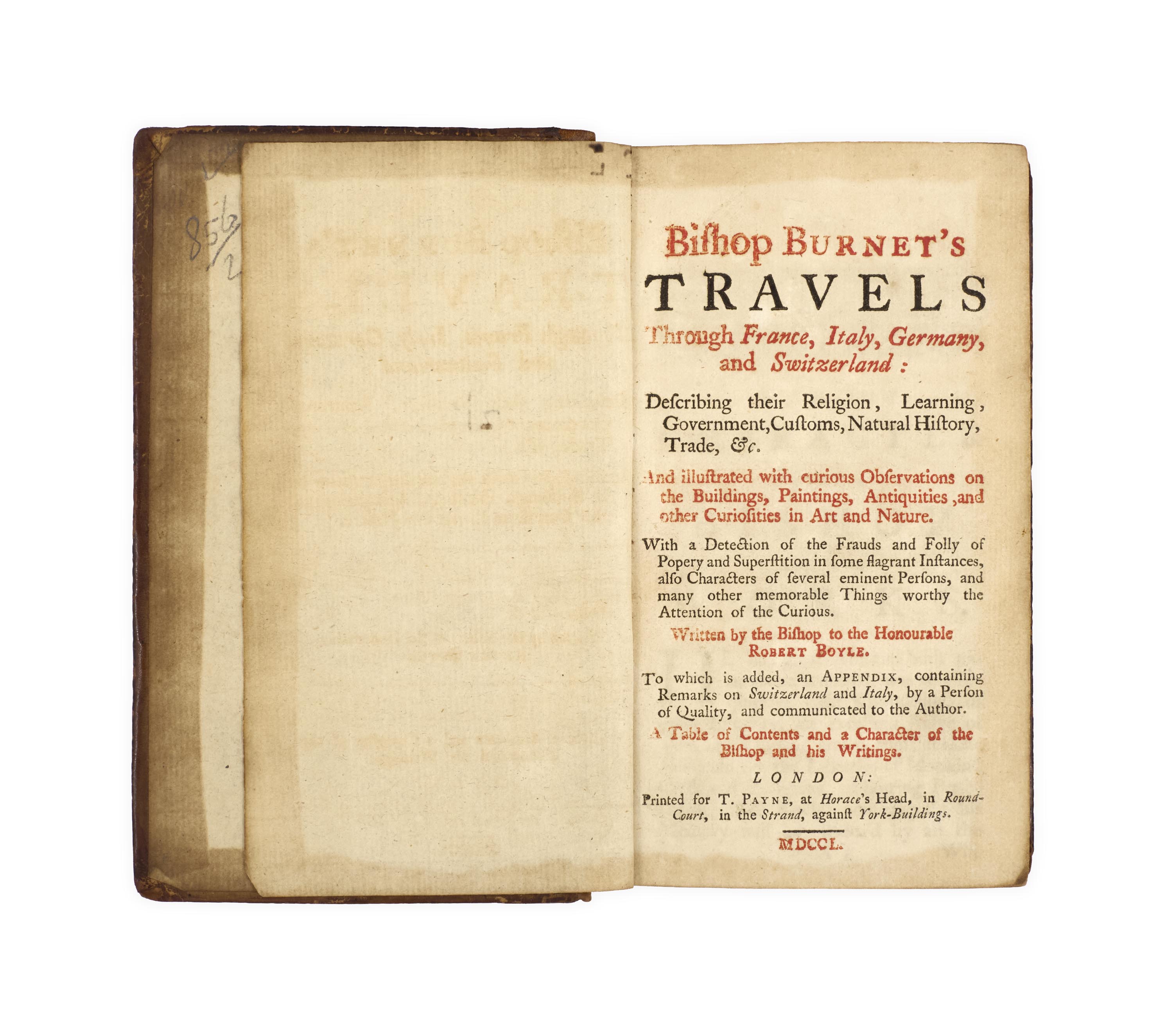
Bishop Burnet’s Travels through France, Italy, Germany, and Switzerland: describing their Religion, Learning, Government, Customs, Natural History, Trade, &c. And illustrated with curious Observations on the Buildings, Paintings, Antiquities, and other Curiosities in Art and Nature. With a Detection of the Frauds and Folly of Popery and Superstition in some flagrant Instances … London, T. Payne, 1750.
12mo, pp. xxiv, 310, [2]; with a cancel title and final advertisement leaf; title printed in red and black, woodcut and typographic head- and tailpieces; small paper-flaw to outer margin of N2, some slight foxing; bound in contemporary speckled calf, sympathetically rebacked with later gilt red morocco lettering-piece; a little rubbed; but a very good copy.
Added to your basket:
Bishop Burnet’s Travels through France, Italy, Germany, and Switzerland: describing their Religion, Learning, Government, Customs, Natural History, Trade, &c. And illustrated with curious Observations on the Buildings, Paintings, Antiquities, and other Curiosities in Art and Nature. With a Detection of the Frauds and Folly of Popery and Superstition in some flagrant Instances …
Later edition of Burnet’s account of the political and religious character of Europe on the eve of the Glorious Revolution; this is the first edition to include ‘A short Character of the Bishop and his Works’.
An ardent opponent of Catholic rule both at home and abroad, Gilbert Burnet (1643–1715) went into self-imposed exile during the reign of James II, publishing his letters to Robert Boyle on affairs in Europe from the Netherlands in 1687. Although an intimate of William of Orange at the Hague – he would return to England as chaplain for the expedition of 1688, preach at the coronation in 1689, and be appointed Bishop of Salisbury that year – he had not yet been made aware of the planned expedition due to his inability to keep a secret; his views on national security are therefore of particular interest, for example declaring that ‘the Feebleness of all [the Venetians’] Neighbours … preserves them from the Apprehension of an Invasion, and the Quarrels and Degeneracy of their Subjects, save them from the Fears of a Revolt; but a formidable Neighbour would put them hard to it’ (p. 144).
ESTC N32010.