Scottish Supremacy
CHALMERS, David.
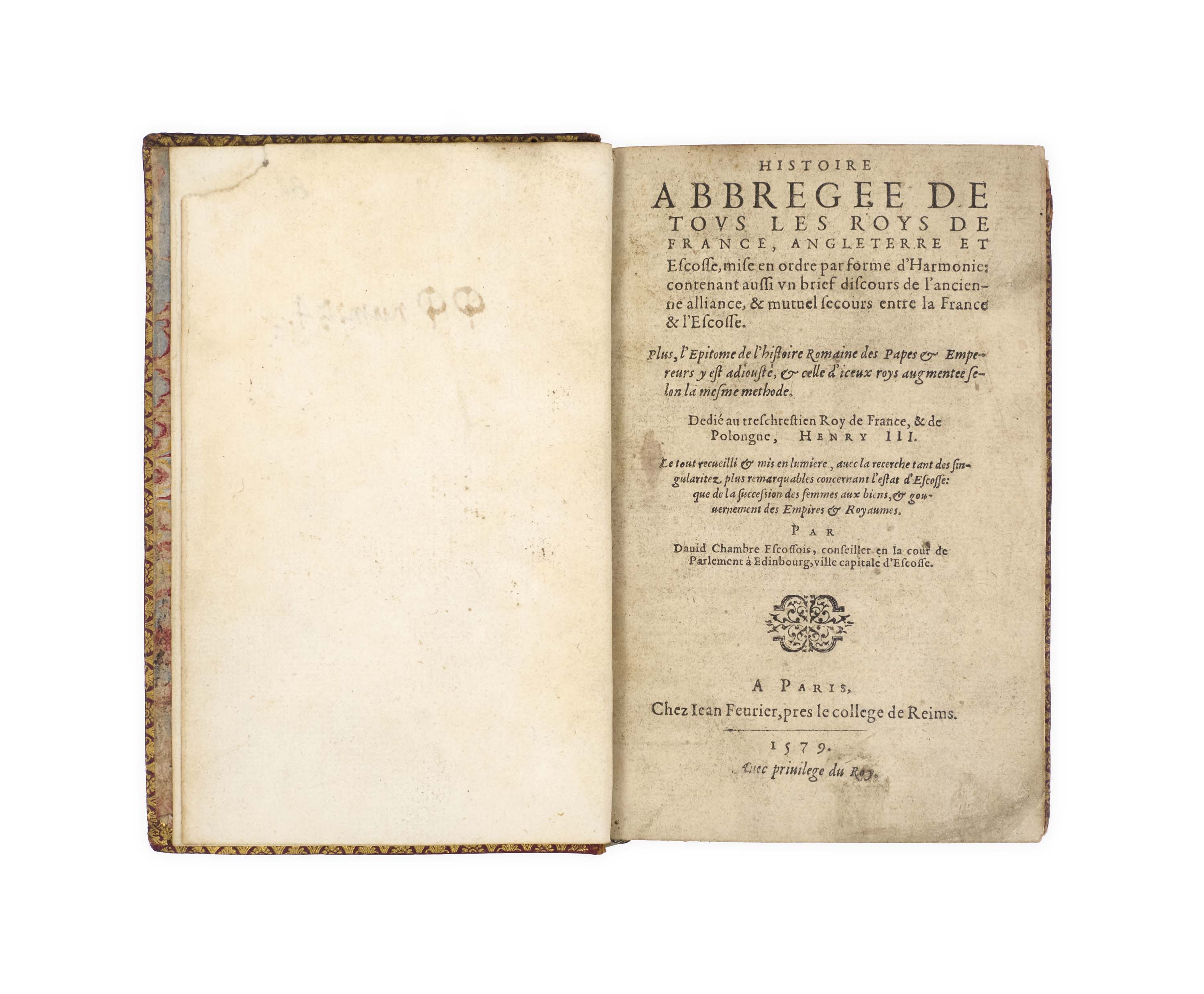
Histoire abbregee de tous les roys de France, Angleterre et Escosse, mise en ordre par forme d’Harmonie: contenant aussi un brief discours de l’ancienne alliance, & mutuel secours entre la France & l’Escosse … Paris, Jean Fevrier, 1579.
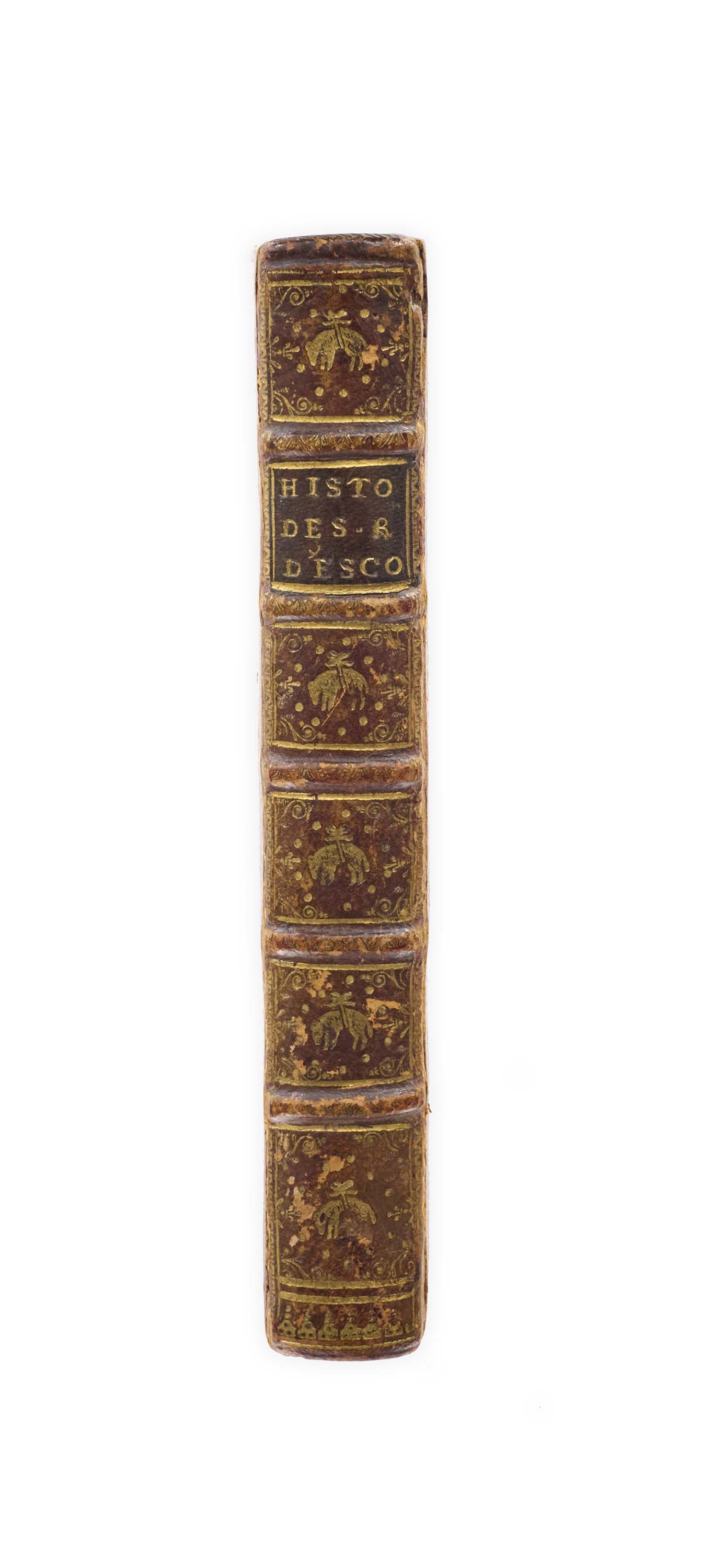
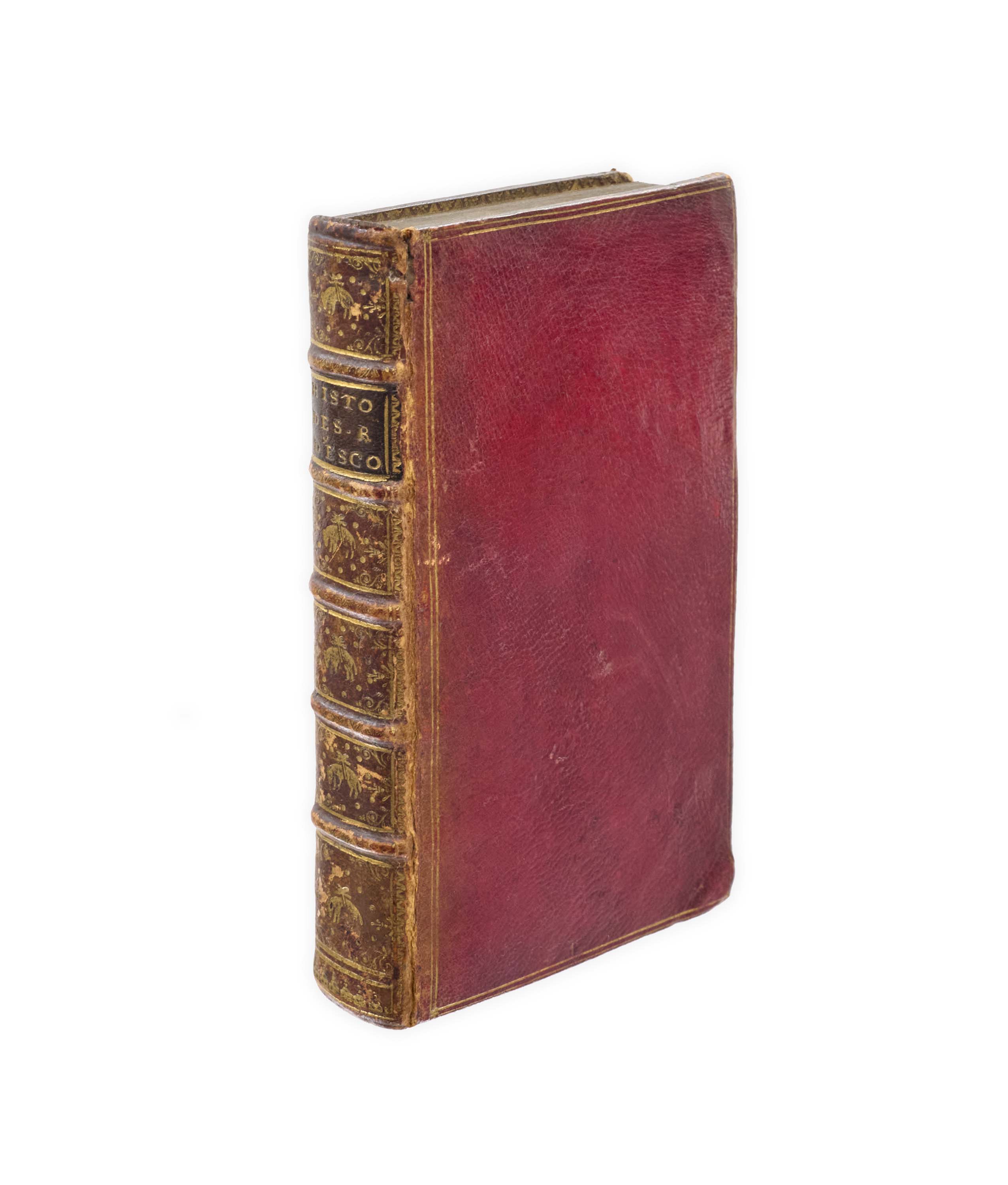
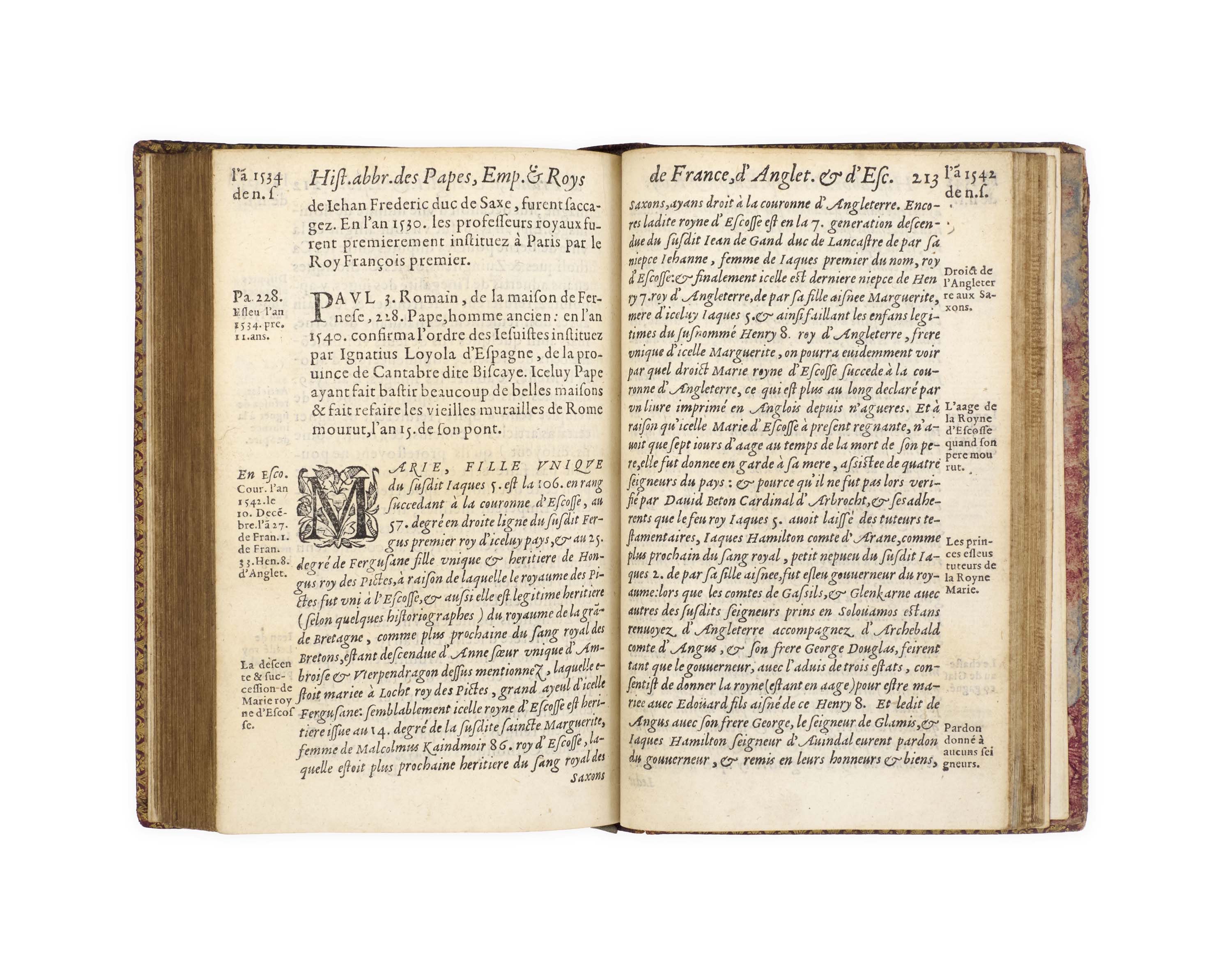
8vo, ff. [8 (pp. 16)], 17–24, 235, [5]; bound without the two short additional texts; woodcut initials and headpieces; title-page dusty with small marginal loss to lower outer corner, occasional light toning or foxing, withal a good copy; bound in early eighteenth-century English red morocco, spine gilt in compartments each with a Golden Fleece stamp, gilt black morocco lettering-piece, edges gilt, green silk place-marker, marbled endpapers; a little rubbed, corners somewhat bumped, very short splits to joints; eighteenth-century ink shelfmarks ‘ΦΦ num: 54’ and ‘8 f’ to front flyleaf.
Added to your basket:
Histoire abbregee de tous les roys de France, Angleterre et Escosse, mise en ordre par forme d’Harmonie: contenant aussi un brief discours de l’ancienne alliance, & mutuel secours entre la France & l’Escosse …
First edition of Chalmer’s historical work focusing on Scotland’s relations with France and England, written at a time of marriage negotiations between England and France, seeking to dispel the idea that England had any overlordship over Scotland.
David Chalmers (or Chambers, c. 1533–1592) was exiled for his role in attempting to free Mary Queen of Scots from prison. He wrote this work in 1572, from the safety of the French court; beyond stating that England had no sovereignty over Scotland, he even claimed that the Scottish royal line, as personified in Mary, had more right to the English throne than the Tudors.
‘The book was a small triumph of compilation, exposition and typography. It placed Scotland in the mainstream of European history as seen by French readers, and emphasized the continuity of the Franco-Scottish alliance against England (dated by Chalmers to AD 792)’ (ODNB). Chalmers used Hector Boece as his main source for Scottish history.
This edition was also issued with the names of Robert Colombel and Michel Gadouleau in the imprint (all three are named in the privilege, which appears at the end of the third work, not here present). The two shorter works mentioned on the title-page, about notable features of Scotland and the right of a woman to inherit, were also available to be purchased separately.
The Golden Fleece tool on the binding may be used in imitation of books bound for Hilaire-Bernard de Requeleyne, Baron de Longepierre (1659–1721), who used this motif on the spines and covers of books bound for him (often by Boyet or Padeloup). According to his biblio-biography by Roger Portalis, there was an English imitator of his bindings in the middle of the eighteenth century, who also used the Golden Fleece stamp.
USTC 312; Adams C 1312; BM STC French, p. 98; Fairfax Murray, French 630; Pettegree, Walsby, and Wilkinson 9664. See Portalis, Bernard de Requeleyne, baron de Longepierre (1659–1721) (1905).