A Sublime Present From a Master at Eton
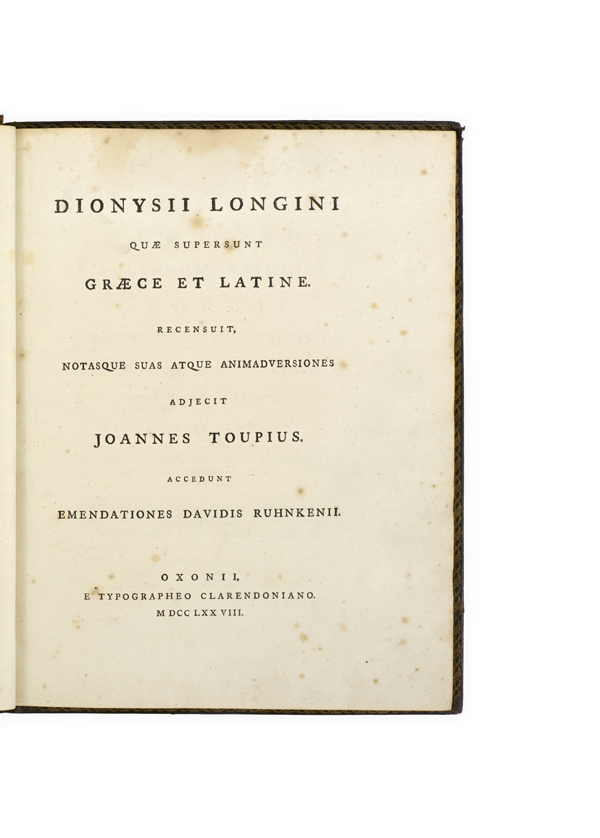
LONGINUS, [Pseudo-]; Jonathan TOUP and David RUHNKEN, editors.
Quae supersunt Graece et Latine. Oxford, Clarendon Press, 1778.
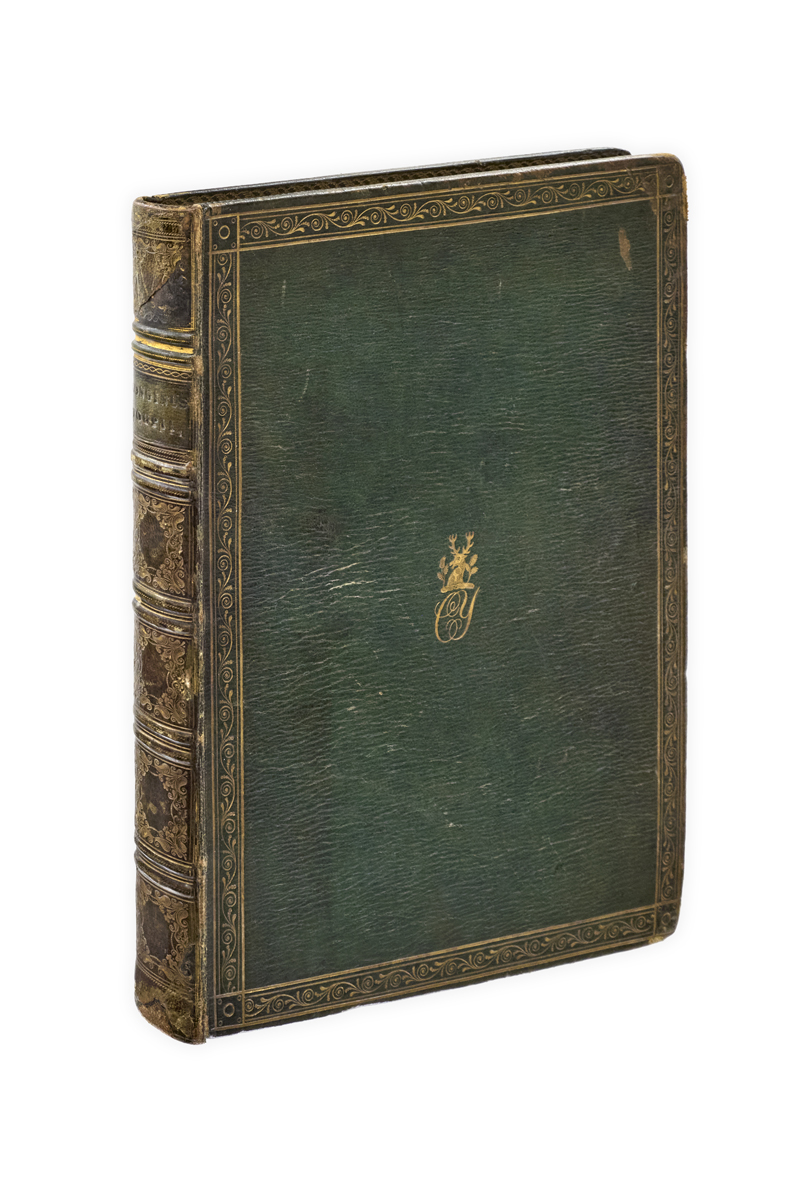
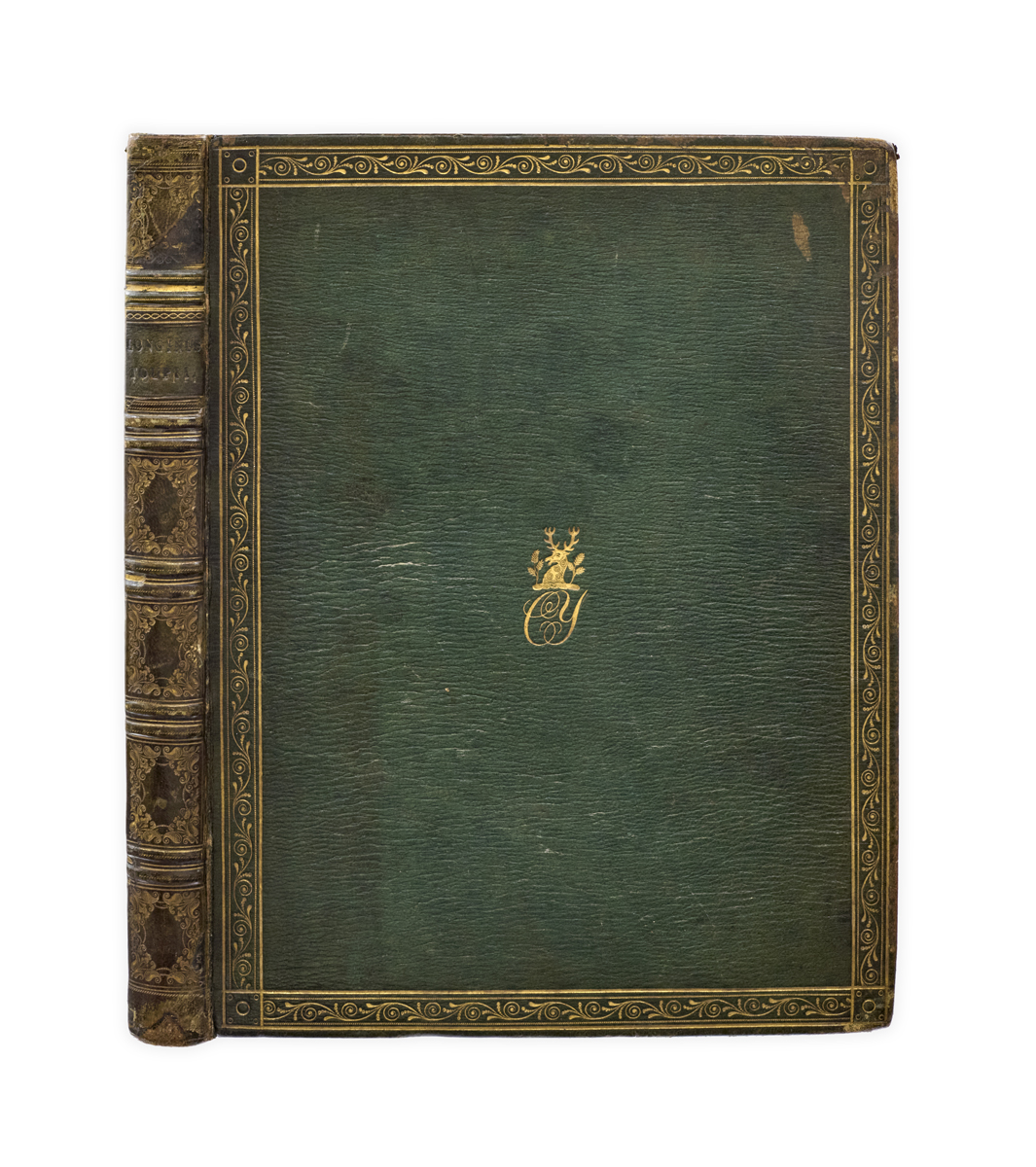
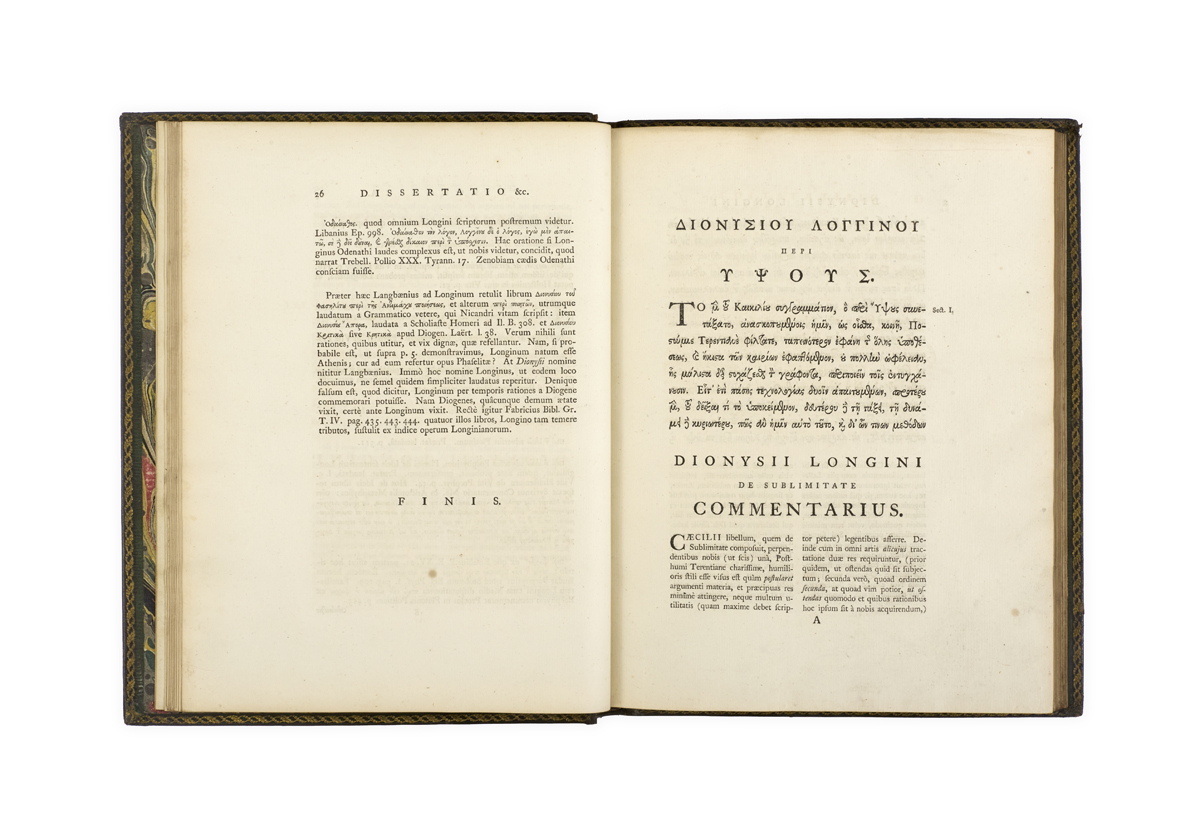
4to, pp. [viii], 26, 254, [6]; some scattered spots, but a very good, wide-margined copy; bound in early nineteenth-century straight-grained green morocco, borders roll-tooled in gilt, central gilt monogram CY (Charles Yonge, see below) surmounted by a stag’s head crest, spine gilt in compartments on slightly later onlaid morocco (chipped to reveal a similarly gilt spine beneath), edges gilt, marbled endpapers; a few scuffs, corners a little bumped.
The first Toup edition of Longinus’ On the Sublime, finely printed and handsomely bound as a leaving present given by the Eton master Charles Yonge.
This philosophical treatise, Περι υψους (literally ‘About elevation’), was probably composed in the first century, and while attributed here to a Dionysius Longinus, it is now considered an anonymous work. The author seeks to establish ‘certain distinctions of conception and expression, with the sources and effects of achieving a state of elevation that he calls ekstasis (transport, in the quite literal sense: a state of being “carried outside” oneself). This sublimity is a quality not easily stabilized, since Longinus variously associates it with the inspired author, the “excited” text itself, and the impact transmitted to the audience. What is clear throughout the work, however, is that the consequences of hupsos are irresistible and lend themselves to a rhetoric of astonishment [ekplexis] and domination’ (Macksey, ‘Longinus reconsidered’ in Modern Language Notes 108 (1993), p. 913). The idea of the sublime was central to eighteenth-century English aesthetics, from Alexander Pope to Edmund Burke.
The text for this edition was prepared by the Cornish clergyman Jonathan Toup (1713–1785) and David Ruhnken (1723–1798). Toup worked on the text for thirty-five years, and he invited Ruhnken, professor of Greek at the University of Leiden, to provide the notes. An octavo edition was also printed in the same year (ESTC T87459).
Provenance:
Charles Yonge (1781–1830) was a master at Eton, and, in accordance with tradition, used this stamp on books he gave out as leaving presents to his students. His son, Charles Duke Yonge (1812–1891), was a classical scholar who published translations of Greek and Latin works into English; these bindings are sometimes attributed to him.
At least two other copies of Longinus in Greek had Yonge’s monogram stamp, one the 1724 London printing, and another the 1793 Bodoni edition. British Armorial Bindings records editions of Virgil and Juvenal with this stamp.
ESTC T87460.