
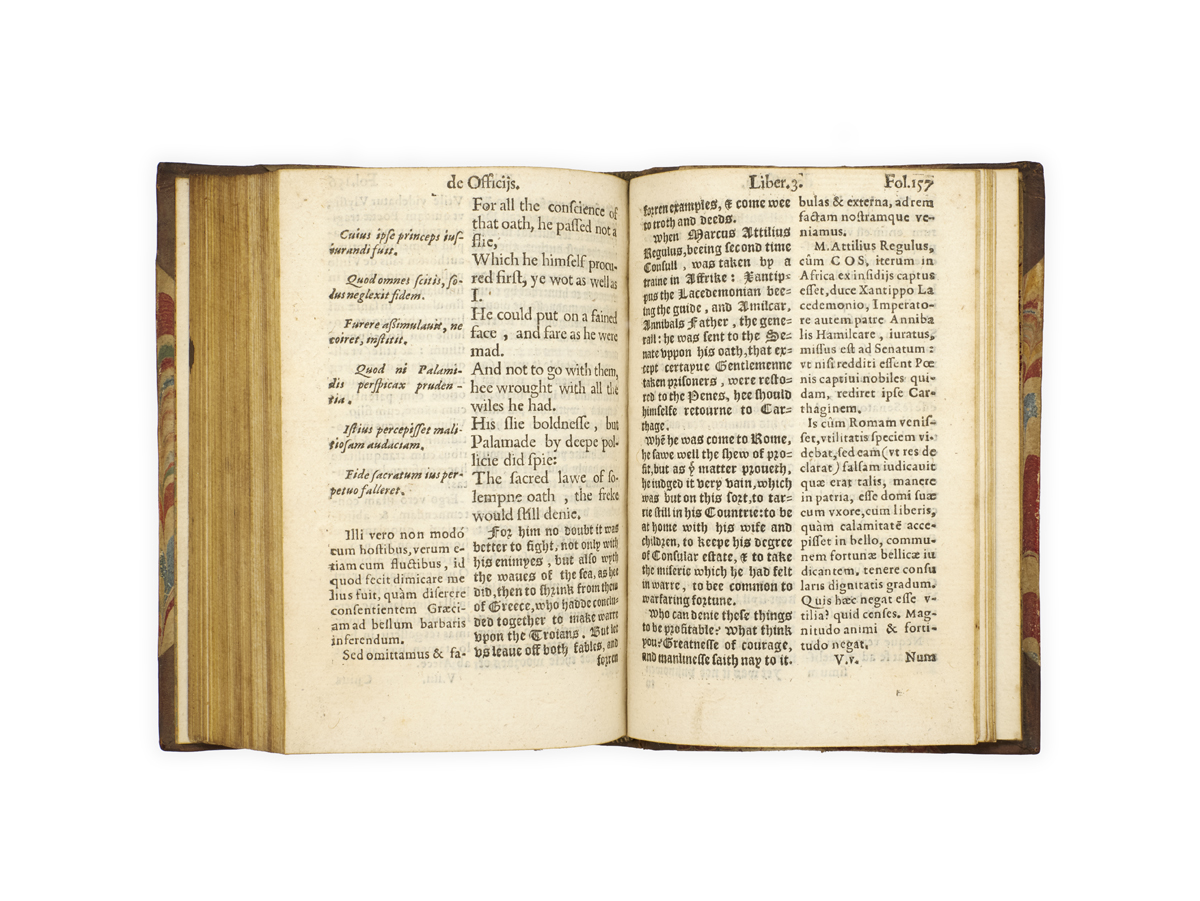
CICERO, Marcus Tullius.
Marcus Tullius Ciceroes three Bookes of Duties to Marcus his Sonne, tourned out of Latine into English, by Nicolas Grimald. Whereunto the Latine is adjoyned … [London, Richard Tottel,] 1583.
Small 8vo, ff. [10], 57, 56–78, 81–168; the English and Latin printed in parallel columns in blackletter and roman type respectively; title-page within a woodcut border; intermittent pale dampstain to lower, outer corner, else a very good copy in eighteenth-century half calf and marbled boards, spine gilt in compartments with a floral tool, morocco spine label; contemporary or early ownership inscriptions to final verso of John Lane and John Longefoote, pen-trials to title in an early hand (the title repeated at the head, at the foot ‘I fear God and the King’), seventeenth-century inscription ‘Francis Whit’ to A1, ownership inscription of Thomas Byron (27 June 1855) to front free endpaper, purple stamp and bookplate to endpapers of Ampleforth Abbey (where Thomas Byron was a student).
Added to your basket:
Marcus Tullius Ciceroes three Bookes of Duties to Marcus his Sonne, tourned out of Latine into English, by Nicolas Grimald. Whereunto the Latine is adjoyned …
Sixth edition of Grimald’s Cicero, first published 1556. De Officiis was perhaps the most pervasive piece of classical writing in early modern Europe – the second or third book to be printed in Europe, standard reading in England from at least the sixteenth century, recommended in Eliot’s The Governor 1531, and a set text at schools and universities throughout the seventeenth and eighteenth centuries. The first edition printed in England was published alongside a rather poor English translation by Richard Whittington in 1534. Grimald’s was by contrast extremely successful, going through eight editions by the end of the century, the first six of which were published by Tottel; it featured a number of passages in English verse.
The humanist scholar and poet Nicholas Grimald (1519–1562) contributed forty poems (of which two were about Cicero) to (and assisted in the compilation of) Tottel’s Miscellany (1557), containing the chief works of Surrey and Wyatt. He was also the author of the Easter play Christus redivivus, the principal source of the oldest known version of the Oberammergau Passion play, and of several others classical translations mentioned by his contemporaries and friends John Bale and Barnaby Googe, but which do not survive. He was chaplain to Nicholas Ridley, which led to a spell in the Marshalsea in 1555.
ESTC S107893; STC 5285.