Rhetoric in Orvieto
CICERO, Marcus Tullius.
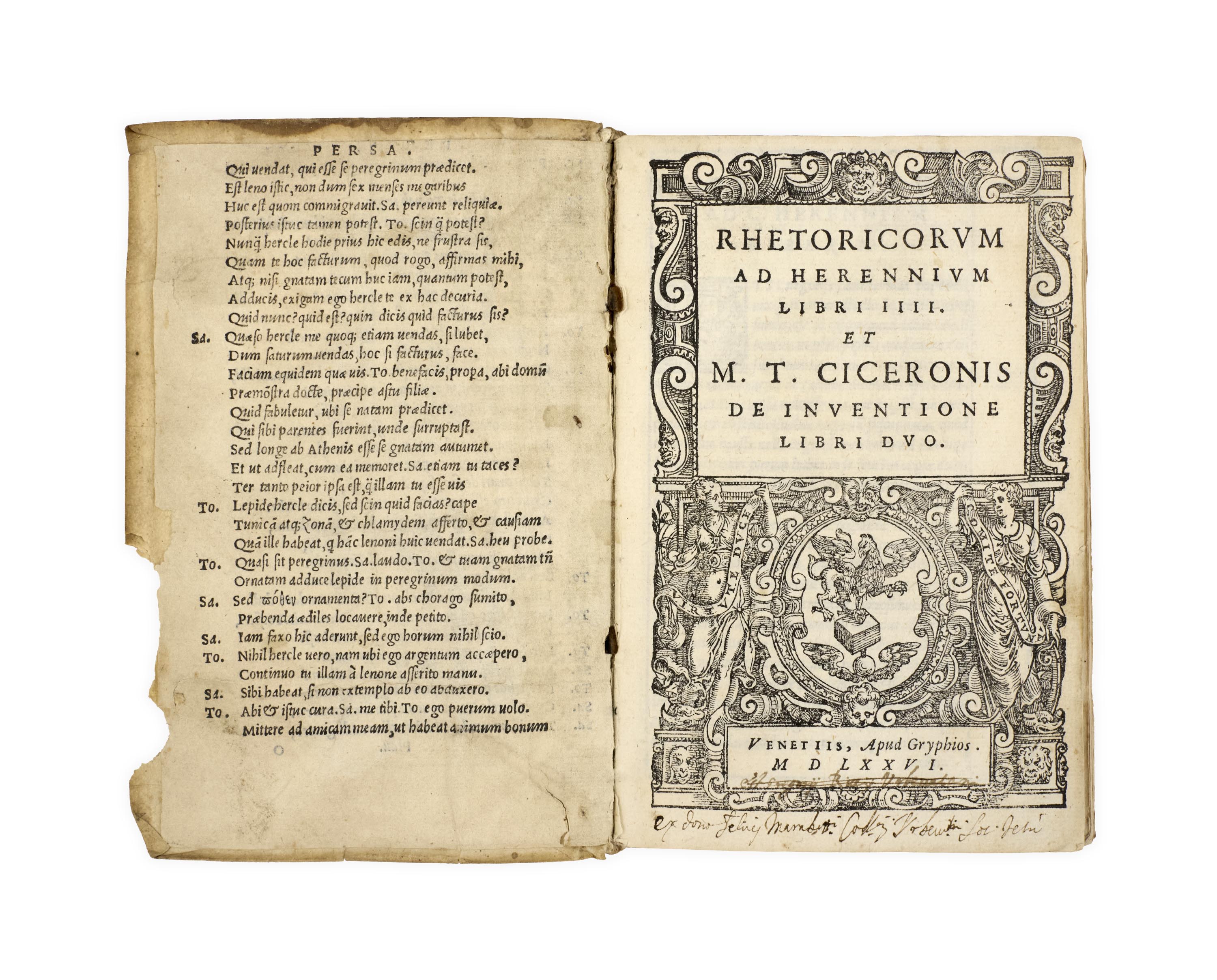
Rheticorum ad Herennium libri IIII. Et M. T. Ciceronis de inventione libri duo. Venice, heirs of Giovanni Griffio, 1576.
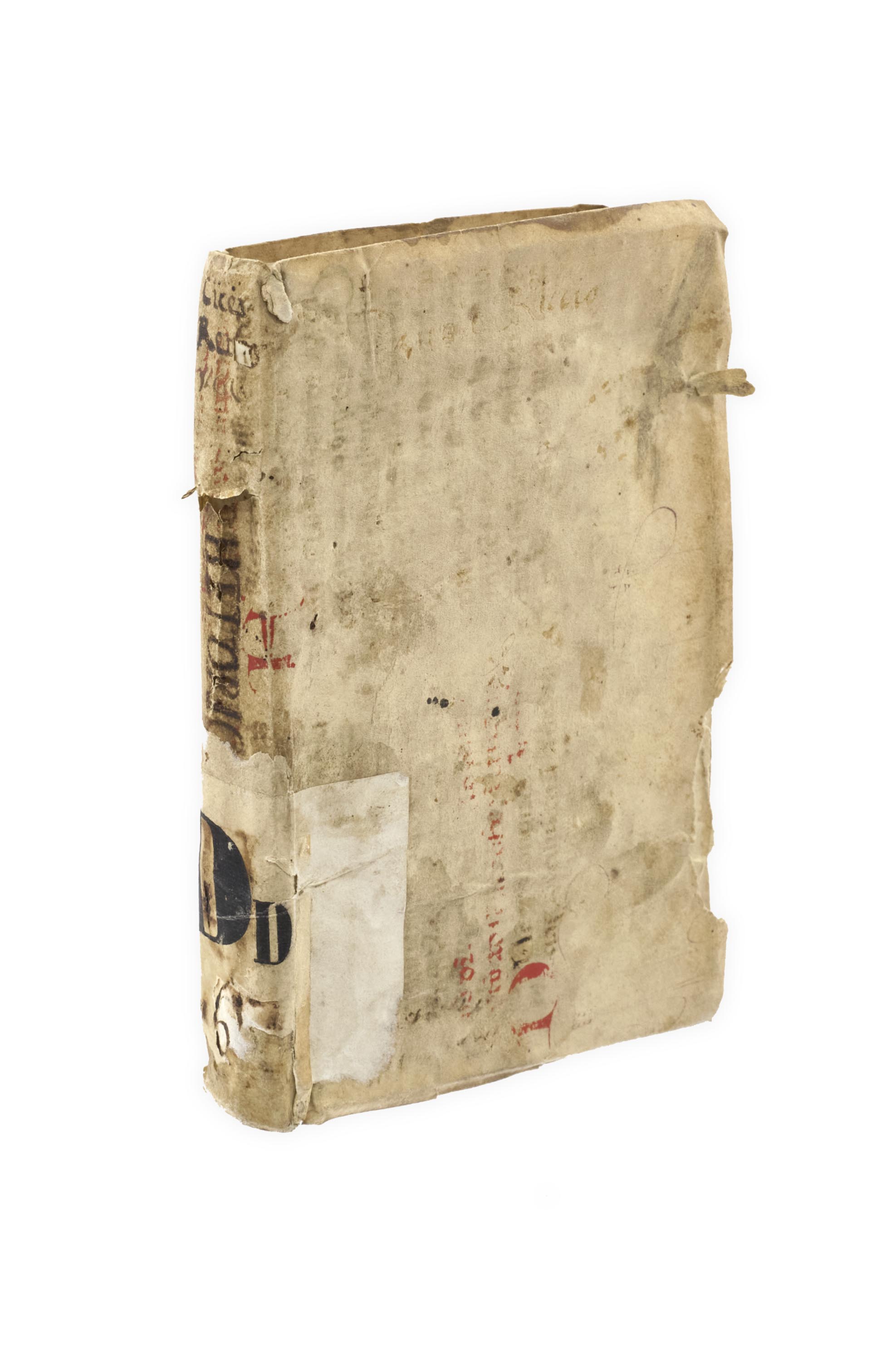
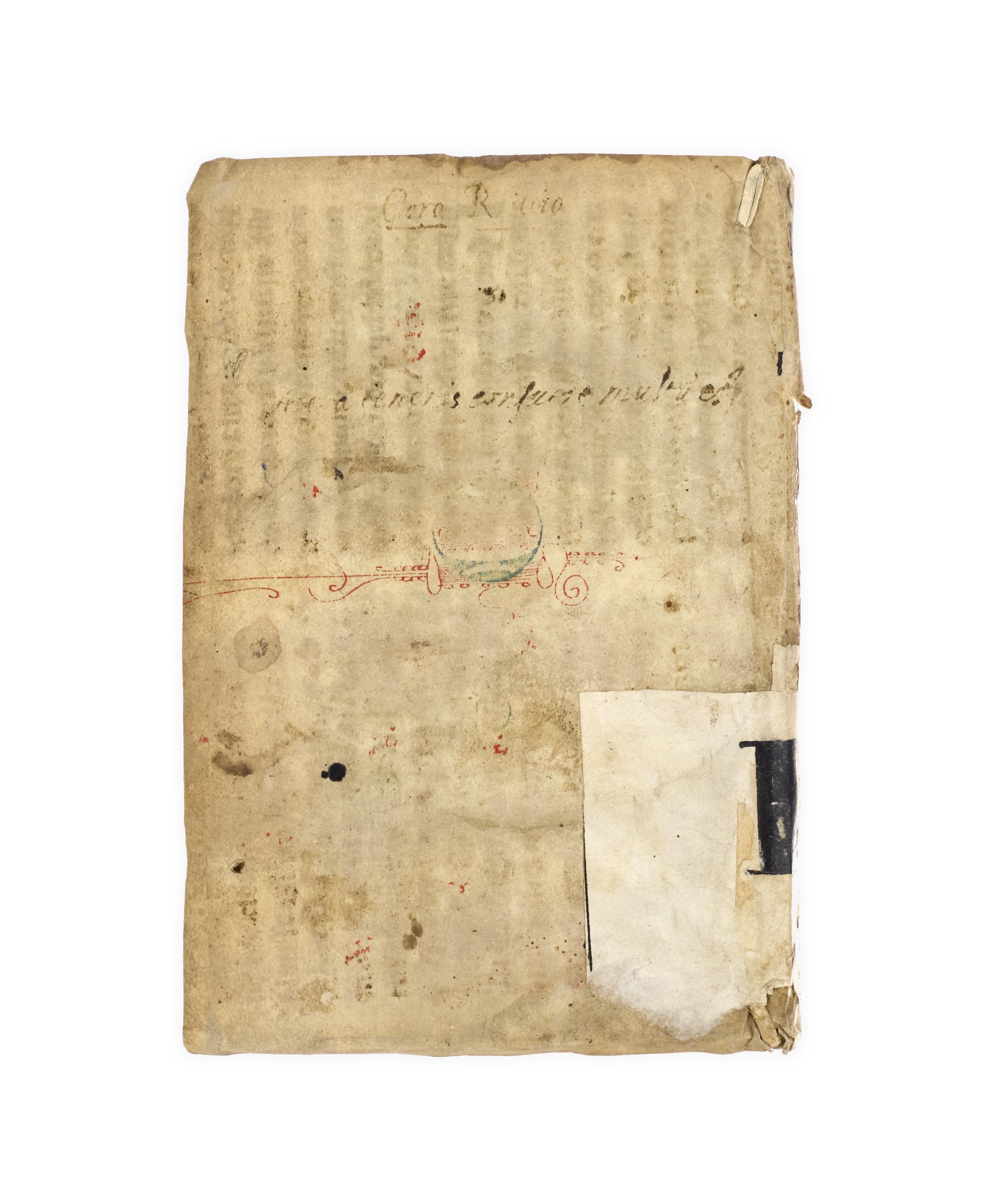
8vo, ff. 144; title within woodcut frame incorporating Griffio’s device, woodcut initials, text printed within border, a very good copy; bound in a contemporary vellum wrapper from a fourteenth-century Italian liturgical manuscript (probably a Breviary), spine with manuscript lettering, remnants of two pairs of tawed ties, traces of later Italian writing to rear cover, pastedowns of printed waste (see below); somewhat rubbed with small tears to spine and small area of loss to fore-edge of upper cover; inscriptions to foot of title-page ‘est Gregorii Riccii Urbevetani’ and ‘Ex dono Felicii Mambelli Collegii Urbevetani Soc Jesu’, rear cover with faded inscription ‘Gero. Riccio’, large shelf-label to spine.
Added to your basket:
Rheticorum ad Herennium libri IIII. Et M. T. Ciceronis de inventione libri duo.
An attractive copy of the two earliest Latin rhetorical treatises, in a wrapper of a medieval manuscript leaf incorporating printed waste, with early Orvieto provenance.
This pair of Ciceronian texts form a handbook on the power of persuasive speech; although the Rhetorica ad Herennium is anonymous, it was probably written c. 86–82 BC and transmitted alongside De inventione, an early work of Cicero’s written around the same time. A popular schoolbook, these works were also influential on the great writers of the time; Machiavelli made good use of Ad Herennium’s ‘political rhetoric of expediency relatively unshackled by moral commitments’ (Cox, p. 116). The dispute over Cicero’s authorship began in 1492 and continued into the sixteenth century, though by the time this edition was published it was no longer issued under Cicero’s name.
This was one of the first books to be issued by the heirs of the prolific Venetian printer Giovanni Griffio after his death. He came from the Gryphe family of printers in Lyon, establishing himself in Padua and Venice, where he worked from 1544 to 1576. His son Giovanni continued the printshop under his own name until 1599.
The pastedowns consist of two leaves of printed waste from the 1522 Florence edition of Plautus printed by the heirs of Filippo Giunta (EDIT16 CNCE 28775), leaf O1 to the upper cover and O7 to the lower, both from the play Persa.
Provenance:
1. Gregorio Riccio of Orvieto, and perhaps Gerolamo Riccio, with their inscriptions.
2. A gift from Felice Mambelli of the Jesuit College of Orvieto, which was established in the early seventeenth century.
An uncommon edition: we have found only four copies in the US (Columbia, Illinois, HRC, Kansas), and none in the UK.
EDIT16 CNCE 12438; USTC 822487. Not in Adams. See Cox, ‘Machiavelli and the Rhetorica ad Herennium: deliberative Rhetoric in The Prince’, Sixteenth Century Journal 28 (1997), pp. 1109–41.