Coleridge Family Copy
DU BOS, Jean-Baptiste, Abbé.
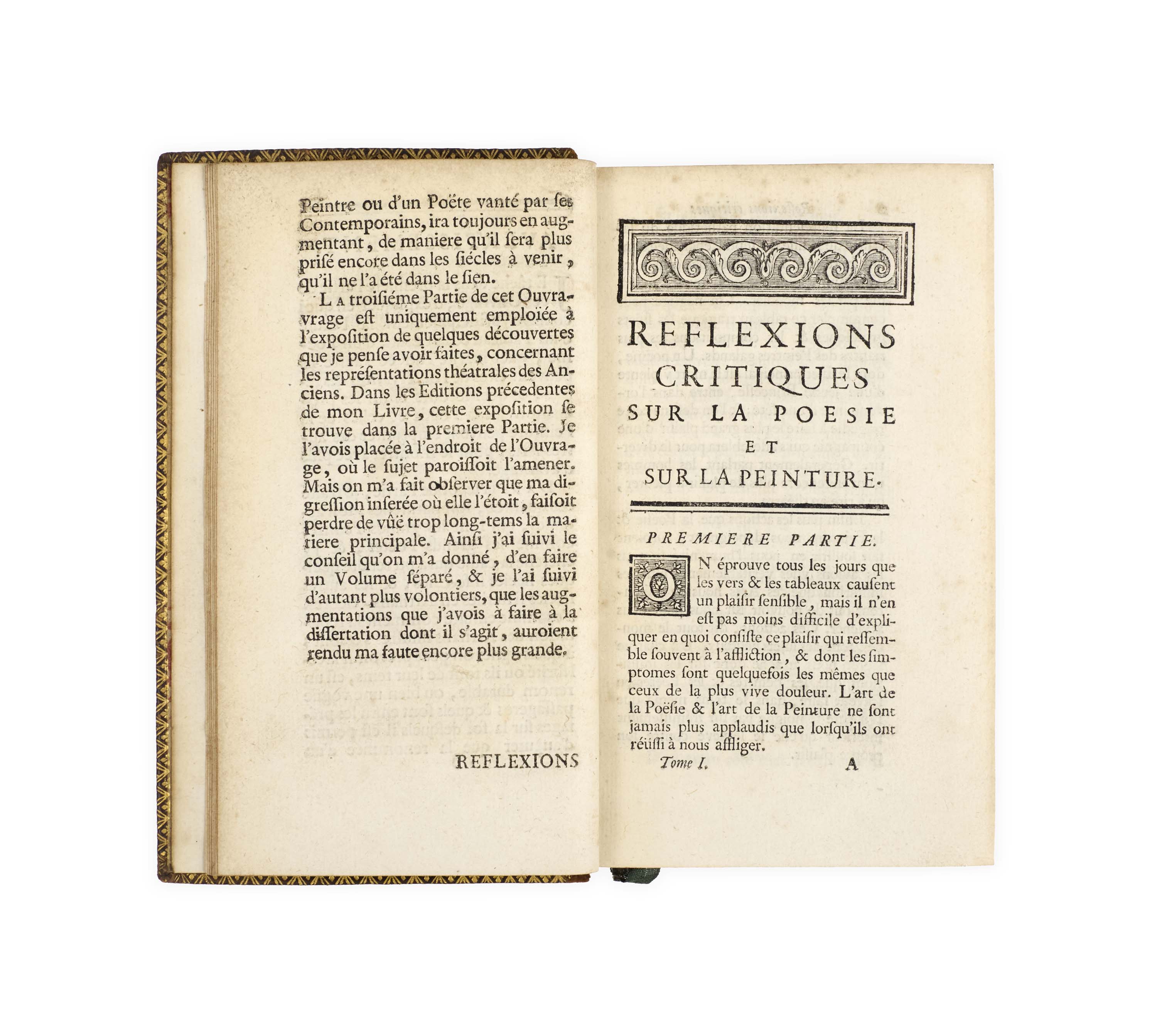
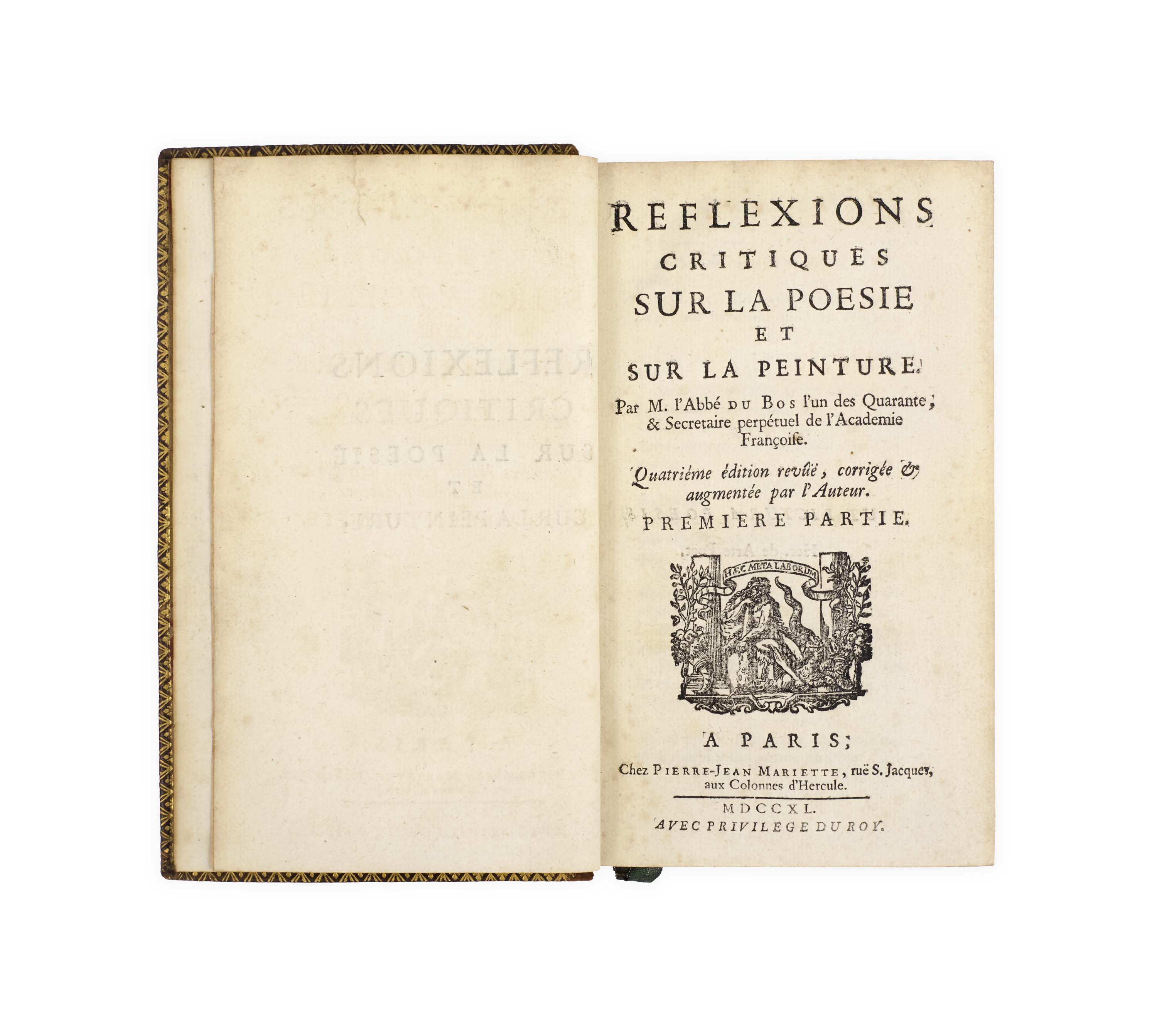
Reflexions critiques sur la poésie et sur la peinture. … Quatriéme [sic] édition revûë, corrigée & augmentée par l'auteur. Paris, Pierre-Jean Mariette, 1740.
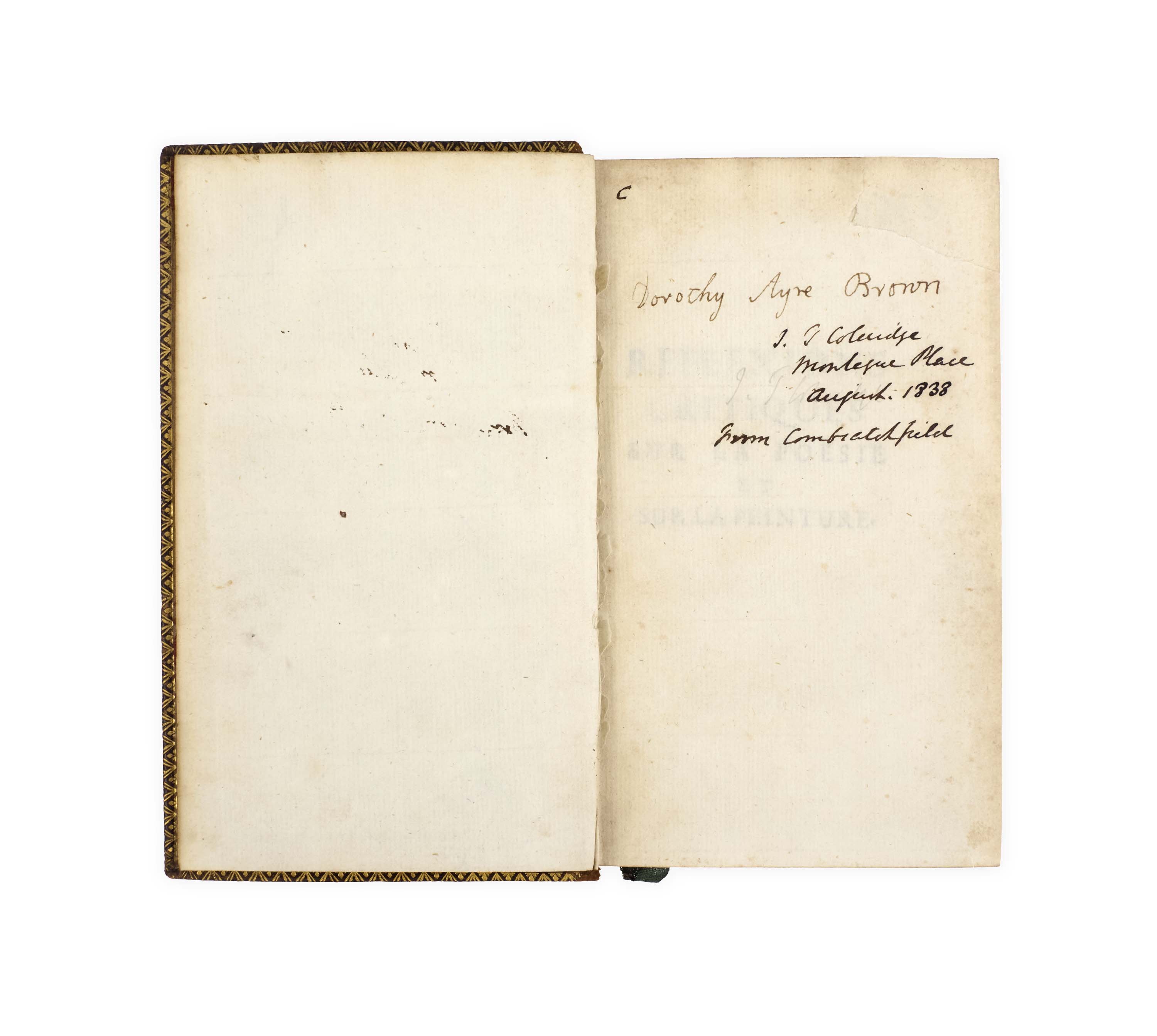
Three vols, 12mo; woodcut device to titles, woodcut headpieces and initials; a little browned and foxed, closed tears to vol. II G12 and T2; else a very good copy in contemporary British speckled calf, gilt lettering-pieces lost from spines, spines numbered directly in gilt, edges speckled red, marbled endpapers, green silk placemarkers; rather rubbed with superficial splits to joints, endcaps chipped; early nineteenth-century ownership inscriptions of Dorothy Ayre Brown and J. T. Coleridge to front flyleaf of vol. I (see below).
Added to your basket:
Reflexions critiques sur la poésie et sur la peinture. … Quatriéme [sic] édition revûë, corrigée & augmentée par l'auteur.
Fourth edition, expanded and corrected, of this key work in aesthetic and sentimental theory, with Coleridge family provenance.
‘An influential figure in the development of aesthetics, Du Bos [1670–1742] acted as a French diplomat before devoting himself to history (Histoire critique de l’établissement de la monarchie française dans les Gaules, 1734) and to discussions of the arts. His major work, the Réflexions critiques sur la poésies et la peinture (1719), locates the enjoyment of art in feeling rather than reason, explaining the appeal of tragedy by the pleasure of experiencing strong emotion in safety. The power of poetry resides not in its ability to instruct, but in the way poetic language affects the senses, the imagination, and the passions. Painting, with its direct representation of objects, is even more affecting. And since pleasure is the criterion of judgement, public taste is a more reliable guide than the experts’ (New Oxford Companion to Literature in French).
The work ‘influenced almost all eighteenth-century contributors to aesthetics’ (SEP), including Diderot, d’Alembert, James Harris, Herder, Hume, Lessing, Moses Mendelssohn, Rousseau, Voltaire, and Winckelmann, almost all of whom Coleridge later read, was influenced by, or reacted against.
Provenance:
1. Dorothy Ayre Brown (née Taylor, d. 1831), sister-in-law of Col. James Coleridge (1759–1836), the brother of the poet Samuel Taylor.
2. Sir John Taylor Coleridge (1790–1876), son of James Coleridge and nephew of both Dorothy Ayre Brown and Samuel Taylor Coleridge. After a sterling undergraduate career at Oxford, John was called to the bar by the Middle Temple and rose through the legal profession, being appointed to the King’s Bench in 1835. ‘In civil cases his judgments were learned and elegant: for example, Stockdale v. Hansard (1839) in constitutional law; the Bishop of Hereford’s case (1848) in ecclesiastical law; and Lumley v. Gye (1853) in the law of contract, a dissenting judgment which was praised by Holdsworth. He was involved in unfortunate controversy arising out of Pooley’s case at Bodmin assizes in 1857. Pooley was convicted of a very offensive blasphemy and sentenced by Coleridge to twenty-one months in prison, but subsequently received a free pardon on grounds of insanity. The case was used in J. S. Mill’s On Liberty to show that penalties for opinion still existed’ (ODNB).
Cioranescu 25556.