Fouquet’s Granddaughter Fights for Her Rights
FOUQUET DE BELLE-ISLE, Marie-Magdeleine.
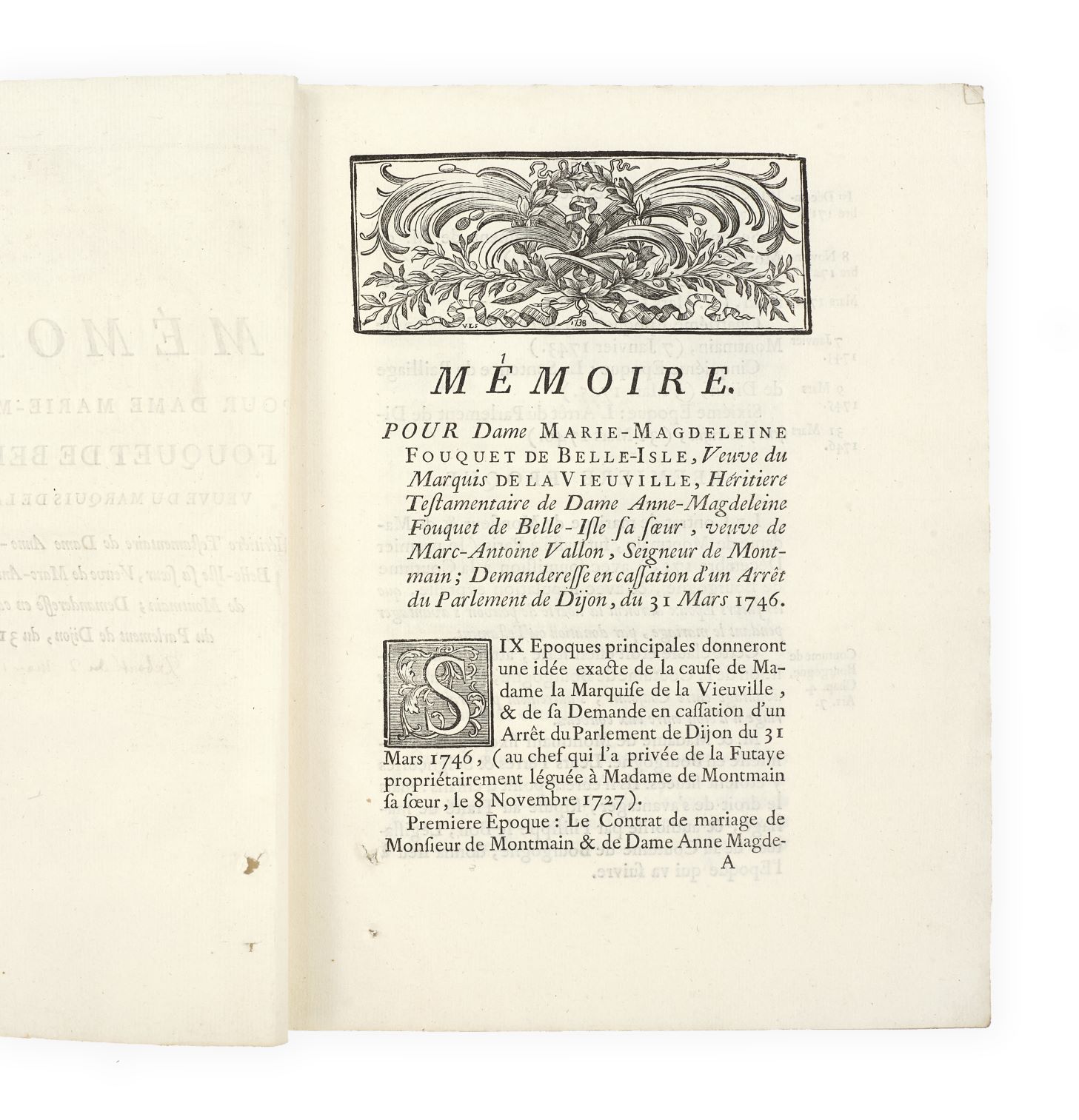
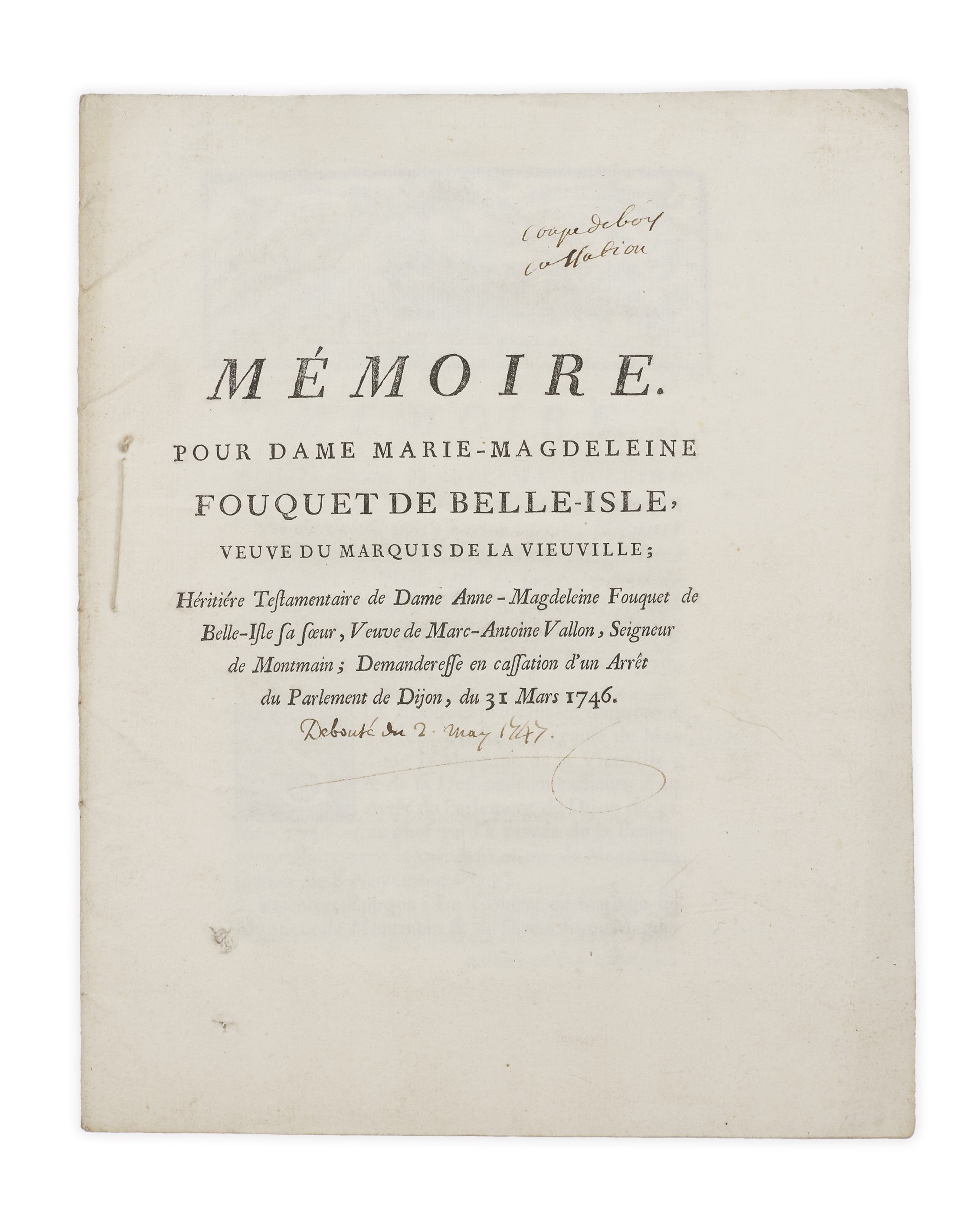
Mémoire pour Dame Marie-Magdeleine Fouquet de Belle-Isle, veuve du Marquis de la Vieuville; héritiére testamentaire de Dame Anne-Magdeleine Fouquet de Belle-Isle sa soeur, veuve de Marc-Antoine Vallon, seigneur de Montmain; demanderesse en cassation d’un arrêt du parlement de Dijon, du 31 Mars 1746. [Paris], Jacques Guérin, 1747.
4to, pp. [2], 24, [2 (blank)]; half-title, imprint from colophon; woodcut initial and headpiece; two small perforations to lower margins throughout; very good, stab-stitched; contemporary ink notes to title ‘coupe de bois cassation’ and ‘Debouté du 2 May 1747'.
Added to your basket:
Mémoire pour Dame Marie-Magdeleine Fouquet de Belle-Isle, veuve du Marquis de la Vieuville; héritiére testamentaire de Dame Anne-Magdeleine Fouquet de Belle-Isle sa soeur, veuve de Marc-Antoine Vallon, seigneur de Montmain; demanderesse en cassation d’un arrêt du parlement de Dijon, du 31 Mars 1746.
A seemingly unrecorded legal brief prepared on behalf of Marie-Magdeleine Fouquet de Belle-Isle (1686–1749), granddaughter of the famous Nicolas Fouquet, Superintendent of Finances to Louis XIV.
Prepared by Marie-Magdeleine’s lawyers, Bertin and Bocquet de Chanterenne, the Mémoire seeks to annul a decree issued by the parliament of Dijon in March 1746 which deprived her of woodland left to her by her sister. It begins with an analysis of the terms of the will of Marie-Magdeleine’s brother-in-law, M. de Montmain, claiming that he left the woodland to his wife with no ambiguity, who subsequently left it to her sister, who to be sure of her rights consulted five lawyers in Dijon and another five in Paris when they were contested by the Marquis de Courgis. The text then examines the legal distinction between rights of property and of usufruct, and between exploited and unexploited woodland, as well as the customary law of the Duchy of Burgundy.
Marie-Magdeleine’s plea was unsuccessful – a manuscript note beneath the title records that it was dismissed on 2 May 1747.
No copies traced on OCLC, Library Hub, or CCfr.