The Inglis–Heber Copy
[GILBY, Anthony, translator.]
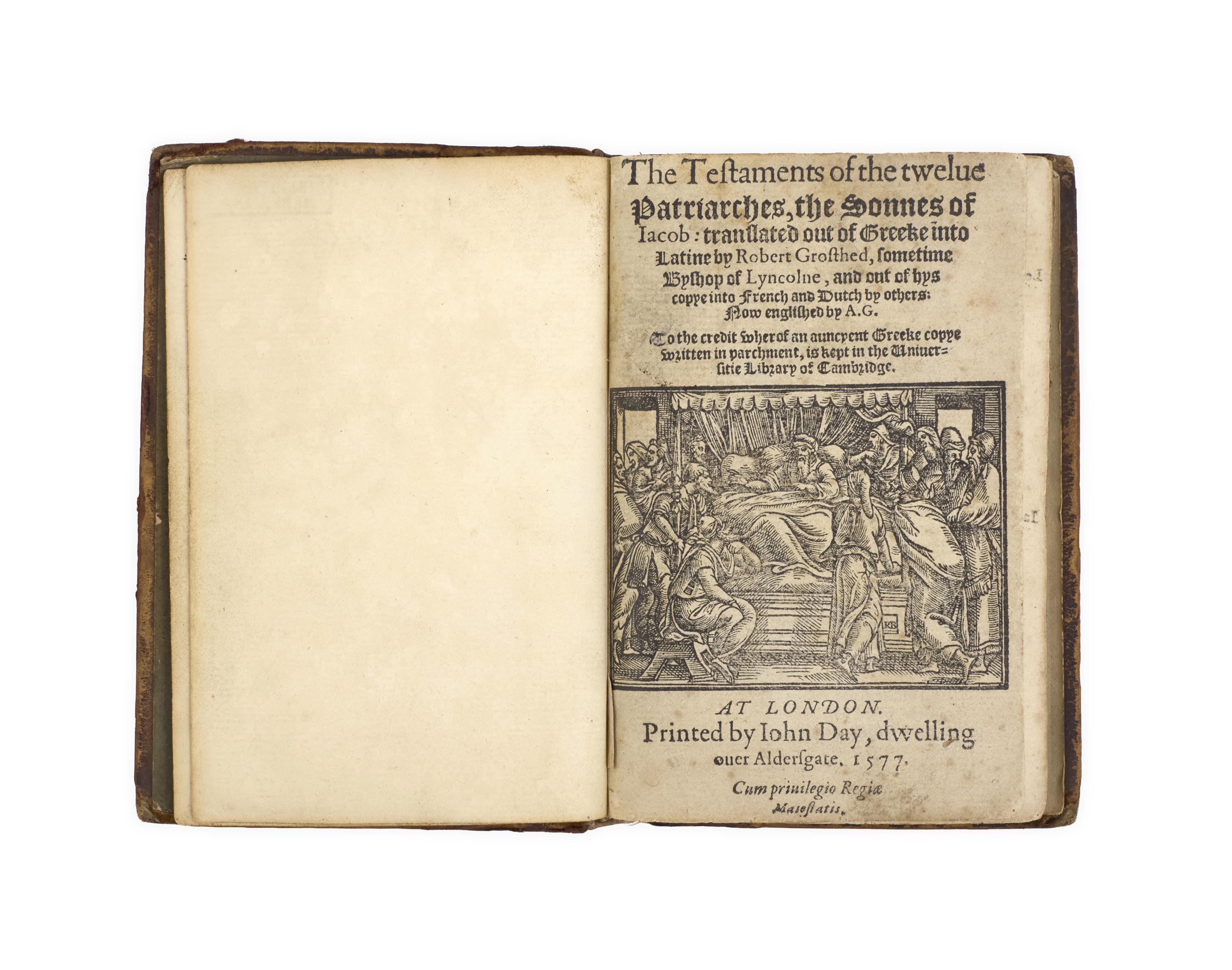
The Testaments of the twelve Patriarches, the Sonnes of Jacob: translated out of Greeke into Latine by Robert Grosthed … and out of hys copye into French and Dutch by Others: now Englished by A. G. … London, John Day, 1577.
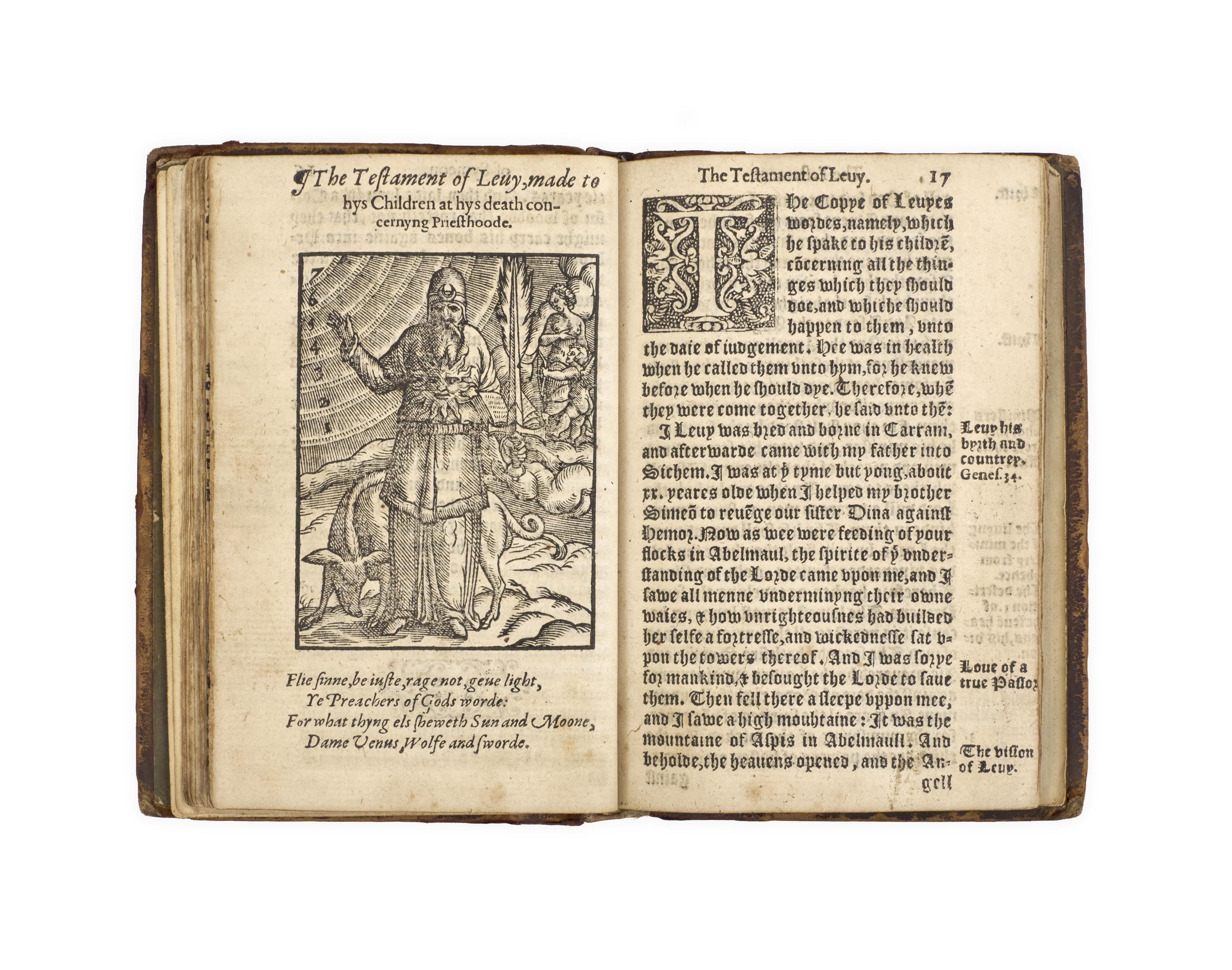
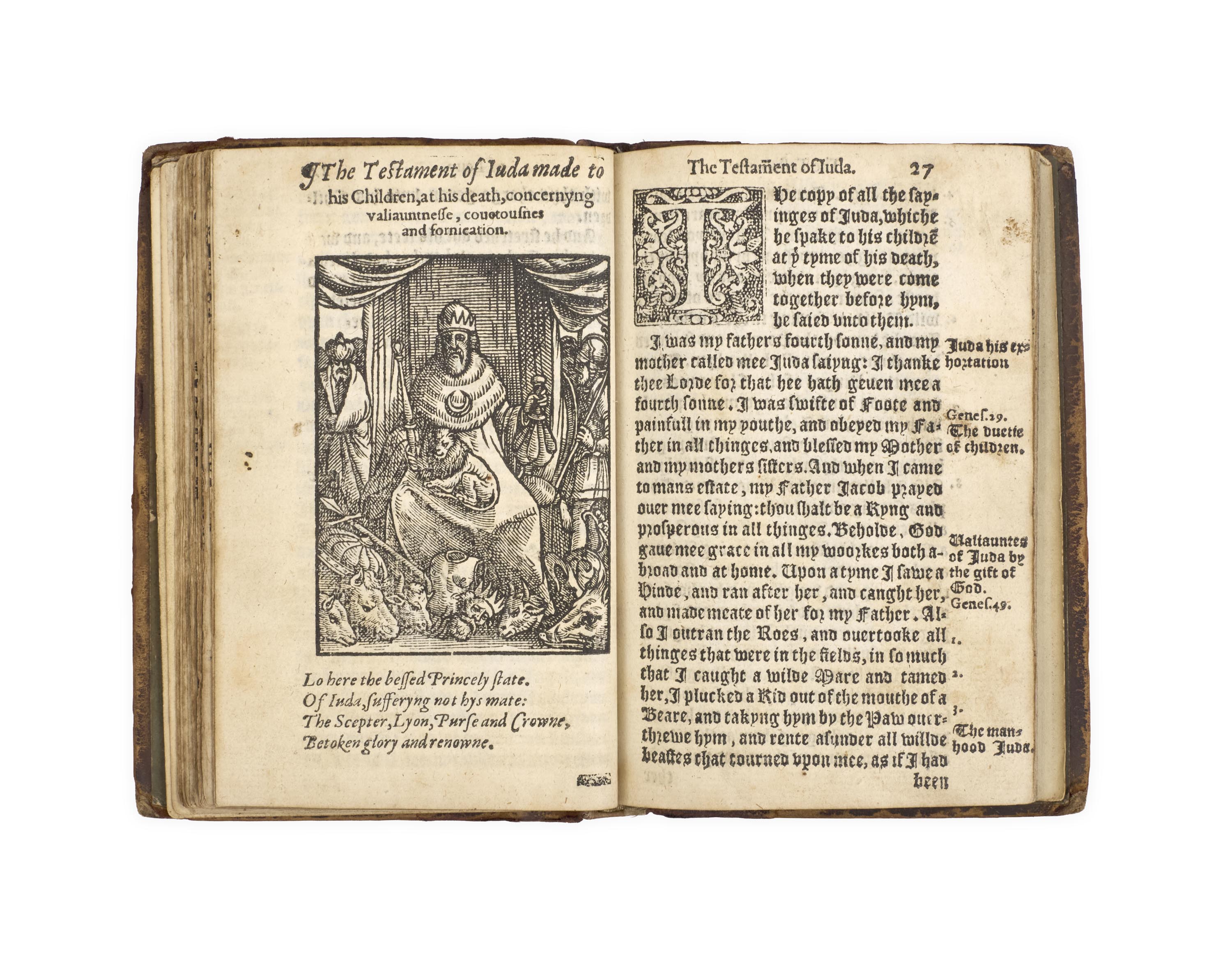
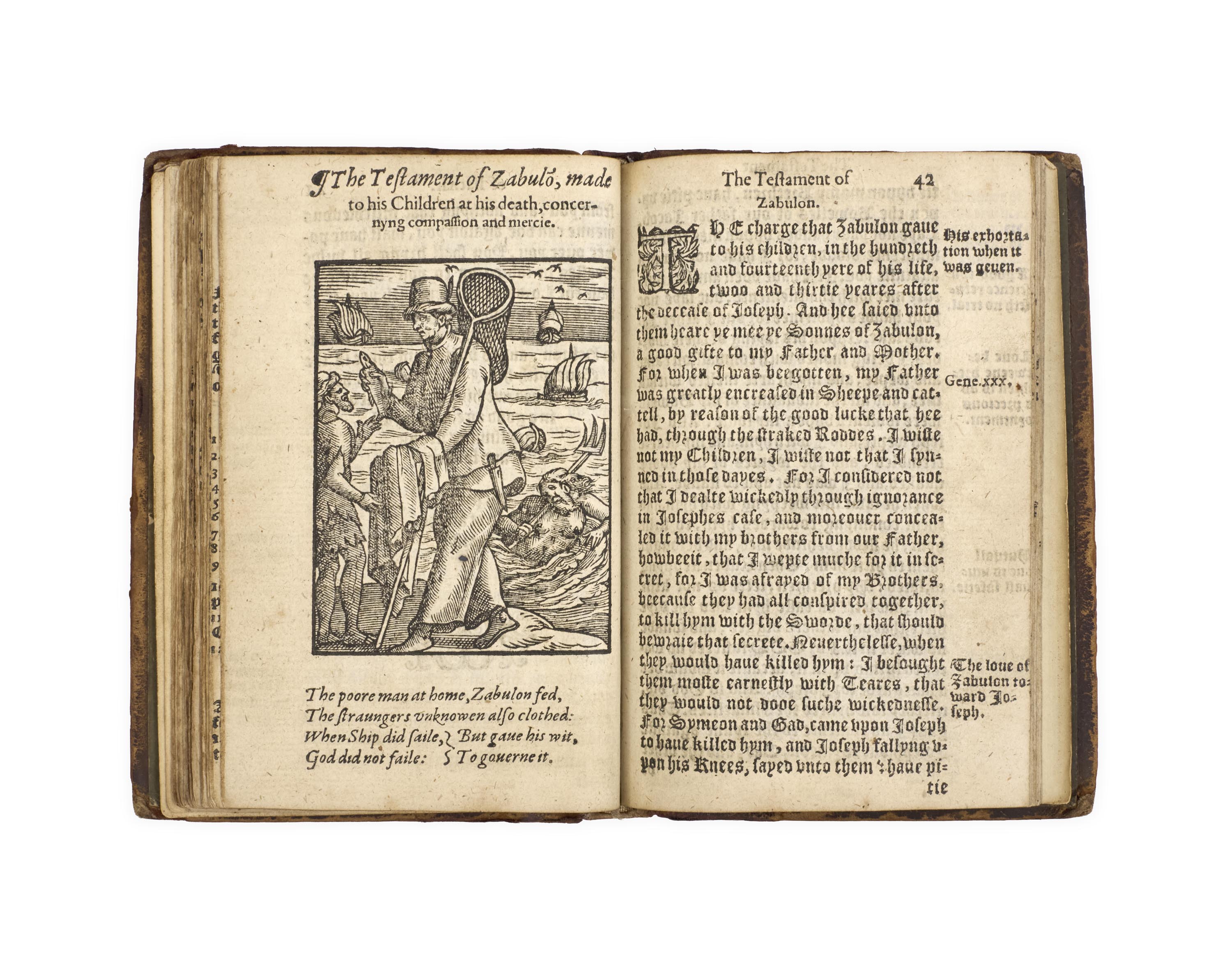
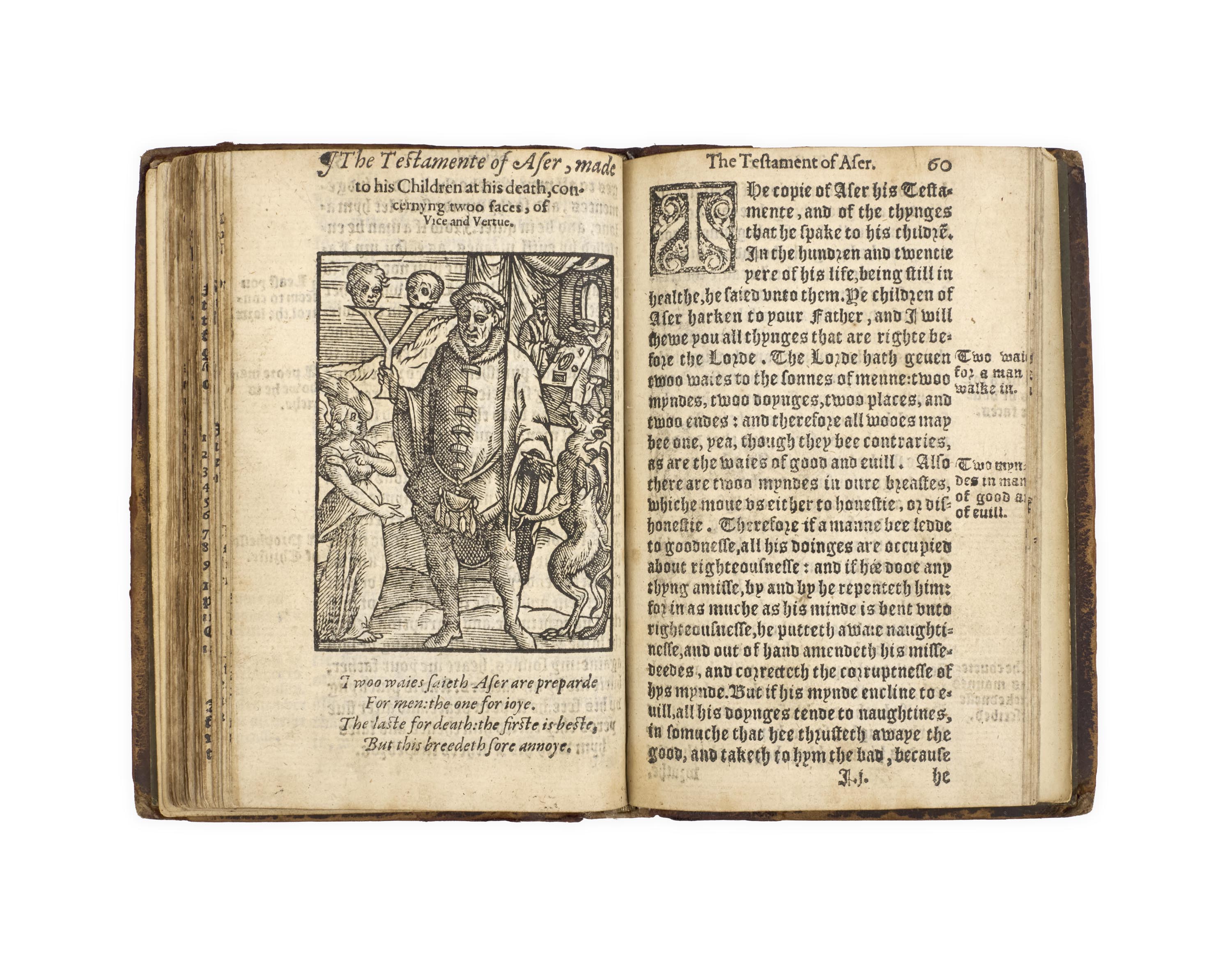
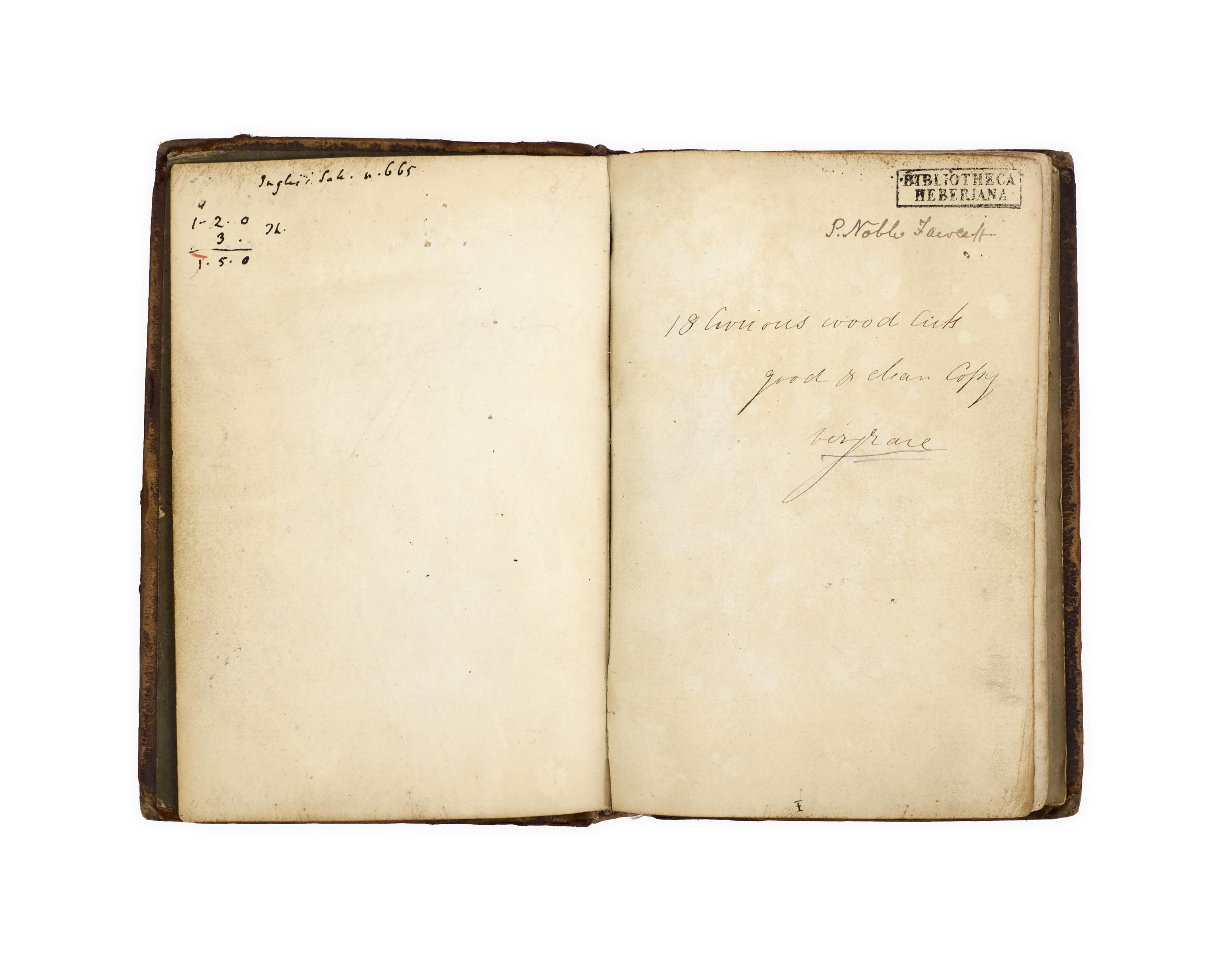
12mo, ff. [5], 78, [1], with frequent mispagination; woodcut illustrations to title-page, thirteen woodcut illustrations, woodcut head- and tail-pieces and initials; cut close, the sidenotes shaved in a few places (no loss of sense), a few spots and stains else good; in early nineteenth-century calf, covers with blind tooled border, rebacked; from the libraries of John Bellingham Inglis and Richard Heber, Bibliotheca Heberiana stamp to endpaper; ownership inscription of P. Noble Fawcett.
Added to your basket:
The Testaments of the twelve Patriarches, the Sonnes of Jacob: translated out of Greeke into Latine by Robert Grosthed … and out of hys copye into French and Dutch by Others: now Englished by A. G. …
Fourth edition (first 1574), very rare, of the first English translation of the Testaments of the Twelve Patriarchs, a piece of Biblical apocrypha probably composed in the first or second century CE detailing the supposed dying commands of the sons of Jacob. The work survived in a number of Greek manuscripts, one of which is the ‘auncient Greeke copye written in parchment … in the University Library of Cambridge’ referred to on the title-page (now MS Ff.1.24), brought from the library of Michael Choniates in Athens in c. 1240 at the request of Robert Grosseteste, Bishop of Lincoln. Grosseteste’s Latin translation introduced the work to Western Europe, and proved very popular – from it various vernacular renditions followed.
Debate continues as to whether the Testaments is a Jewish text with later Christian interpolations or a Christian one drawing on earlier Jewish sources. It takes the form of twelve first person narratives, the ethical focus of most lives being a different vice or virtue, many with apocalyptic and prophetic elements, and seems to bridge Old and New Testament thought.
The English translation, signed ‘A. G.’, has been attributed to Arthur Golding, but is almost certainly by Anthony Gilby (1510–1585), an early Protestant convert in the circle of Becon, Hooper, and Latimer, who had spent the reign of Mary in exile in Frankfurt and Geneva, where he helped translate the Geneva Bible of 1560. He had published an edition of The Testament of Joseph alone in 1539 under the pseudonym ‘William Freelove’ – it is reprinted here alongside the other eleven Testaments, which were the product of a retirement devoted largely to translation.
The Testaments of the twelve Patriarches was frequently reprinted, but all early editions are extremely rare and often in poor condition. ESTC records a single copy of the first edition of 1574 (Folger), two of that of 1575 (BL – imperfect, TCD); one of 1576 (Cambridge – imperfect); and two of the present edition (BL, All Souls – imperfect).
Provenance:
1. John Bellingham Inglis (1780–1870), book collector, known for his ‘particular mania’ of pasting cuttings onto the endpapers of his books, not evident here, though there are some brief bibliographic notes in his hand. Although the majority of his books were sold after his death in 1871, a first library had appeared anonymously at Sotheby’s in June 1826, where this was lot 665 (catalogued as a first edition), bought by Thomas Thorpe for £1 2s on behalf of:
2. The eminent bibliophile Richard Heber (1774–1833), with his note of the cost and of Thorpe’s commission (3s). Heber’s bibliomania was legendary and broad – the total number of volumes in his collection may have been as many as 150,000. Thirteen sales in England were devoted to the library in 1834–1837; this was lot 6673 (7 May 1834), attributed to Golding.
3. Philip Noble Fawcett (1863–1942), barrister.
ESTC S124591; STC 19467.5.