Attraction or Repulsion?
GOELICKE, Andreas Ottomar.
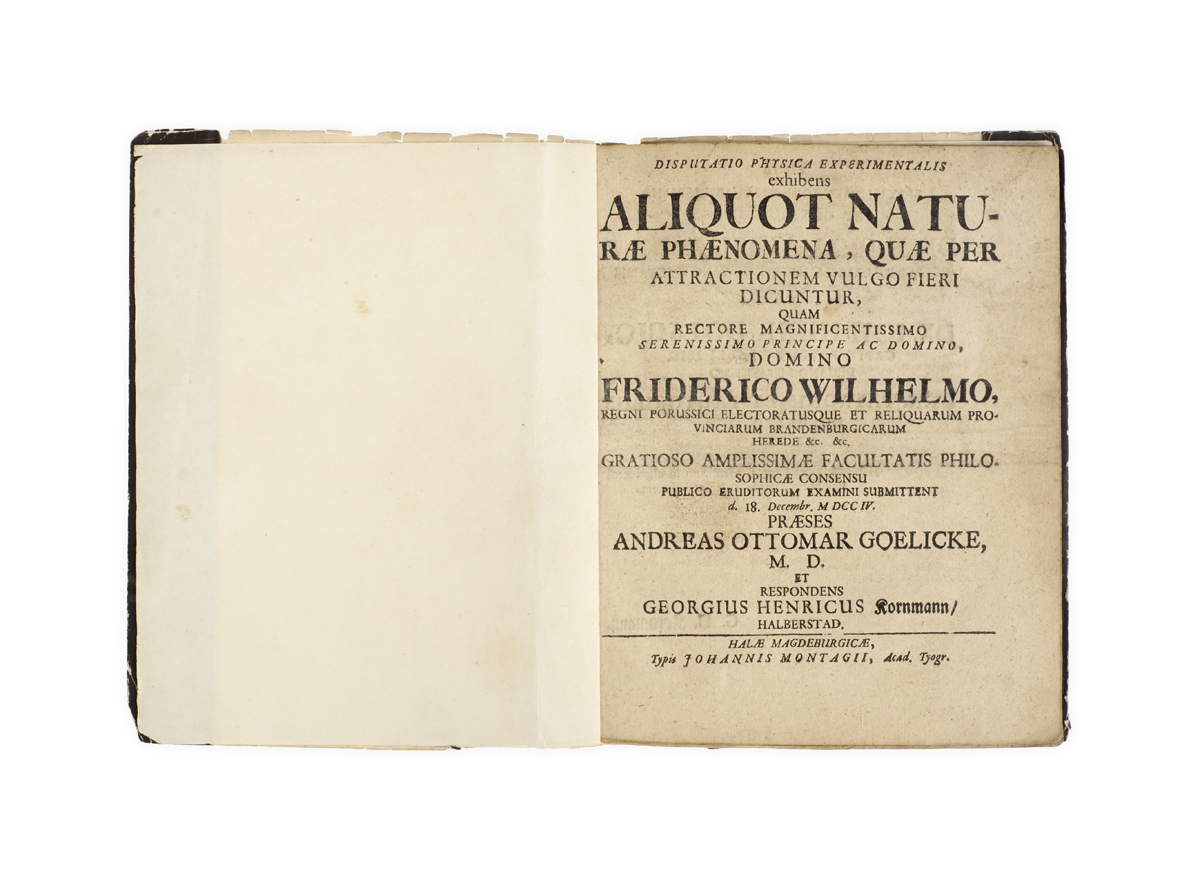
Disputatio physica experimentalis exhibens aliquot naturae phaenomena, quae per attractionem vulgo fieri dicuntur, quam rectore magnificentissimo ... Friderico Wilhelmo ... gratioso amplissimae facultatis philosophicae consensu publico eruditorum examini submittent d. 18 Decembr. MDCCIV praeses Andreas Ottomar Goelicke, M.D. et respondens Georgius Henricus Kornmann, Halberstad. Halle, Johann Montag, [1704].
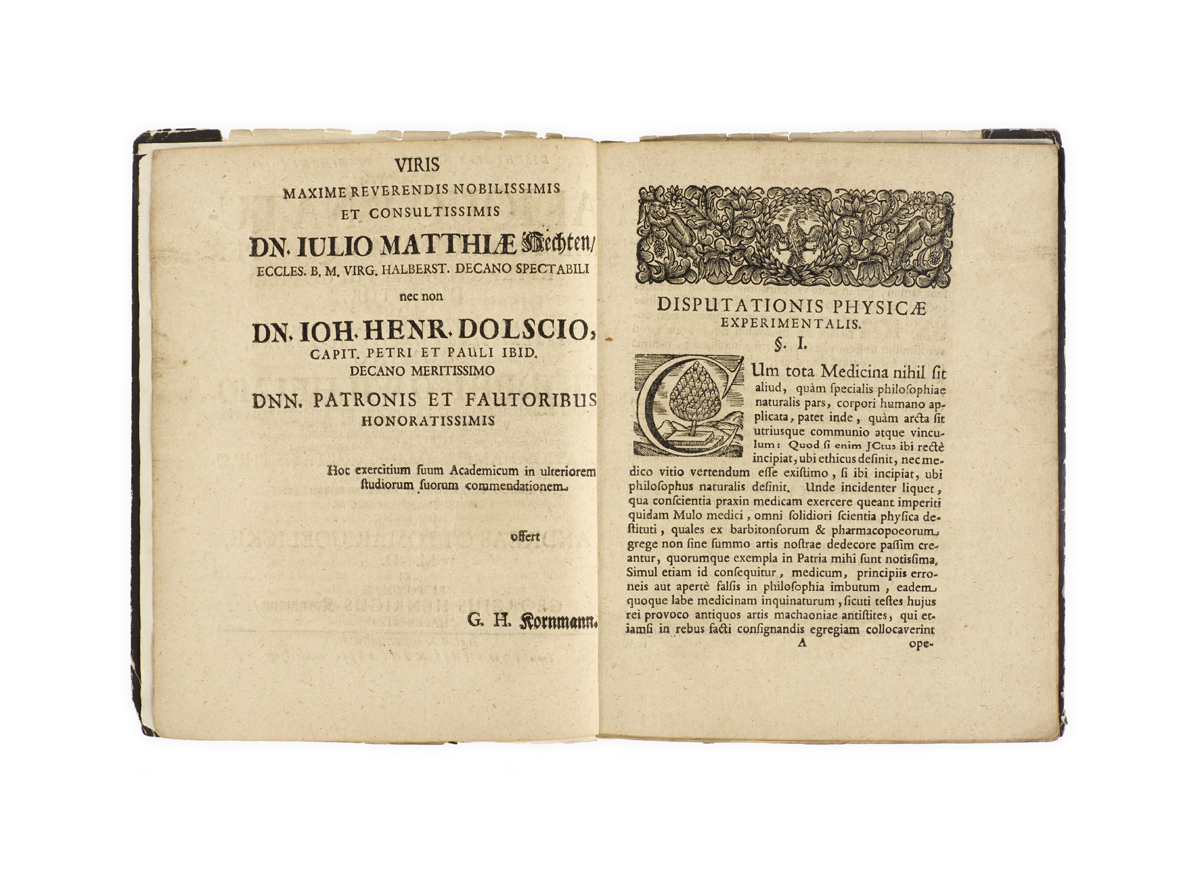
4to, pp. [2], 18; woodcut initial, head-, and tailpiece; toned throughout, some faint marginal dampstaining, a few leaves slightly loose; in modern black paper wrappers; spine worn, edges chipped.
Added to your basket:
Disputatio physica experimentalis exhibens aliquot naturae phaenomena, quae per attractionem vulgo fieri dicuntur, quam rectore magnificentissimo ... Friderico Wilhelmo ... gratioso amplissimae facultatis philosophicae consensu publico eruditorum examini submittent d. 18 Decembr. MDCCIV praeses Andreas Ottomar Goelicke, M.D. et respondens Georgius Henricus Kornmann, Halberstad.
Scarce academic disputation on experimental physics led by the German physician and professor Andreas Ottomar Goelicke (1671–1744).
The text seeks to show that various physical phenomena should be attributed to repulsion rather than to a so-called ‘attractive spirit’. Numerous experiments involving air, mercury, and vacuums are described, with analogies made to pipe smoking and breastfeeding, for example. Reference is made to Evangelista Torricelli’s barometer, as well as to the work of the Scottish natural philosopher George Sinclair and the German physician Friedrich Hoffmann, whose iatrophysical theories the author would vehemently attack in the coming decades, ‘provoking numerous feuds with his colleagues and other contemporaries’ (Deutsche Biographie, trans.). Goelicke had been inspired to pursue medicine after tutoring the children of a Berlin physician; after obtaining his MD he would later become professor of medicine at Halle (1709), Duisburg (1713), and Frankfurt. His ‘literary output was extremely extensive, devoted to all branches of medicine’ (ibid.).
The interesting corollaries at the end encompass doctors who bring their profession into disrepute, the incompetence of pharmacists and surgeons in matters of medicine, the rational soul, and the idea of a universal spirit.
Only one copy traced in the UK (BL) and two in the US (LoC, Stanford).
VD18 10993142.