Fleming’s Faust
GOETHE, [Johann Wolfgang von].
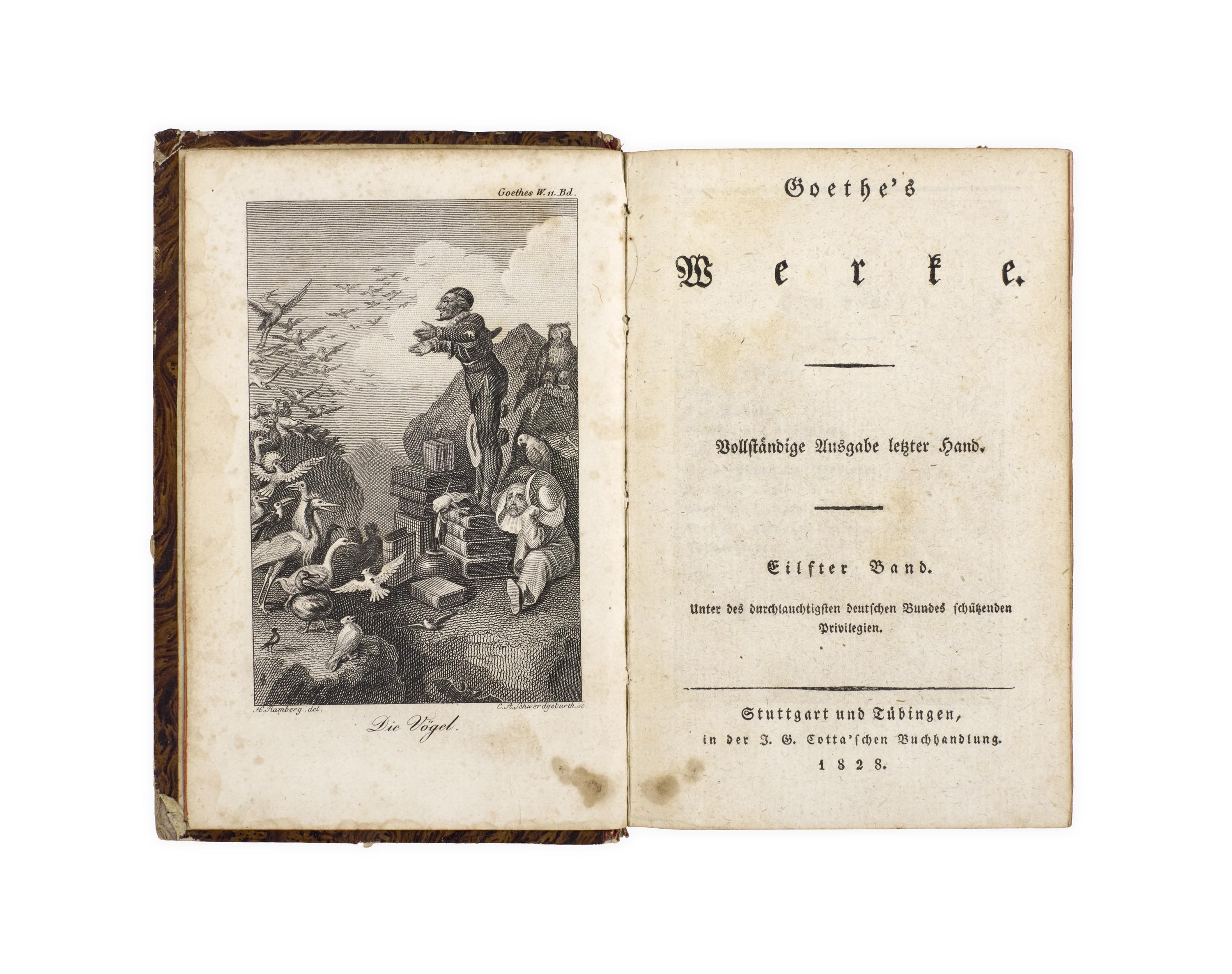
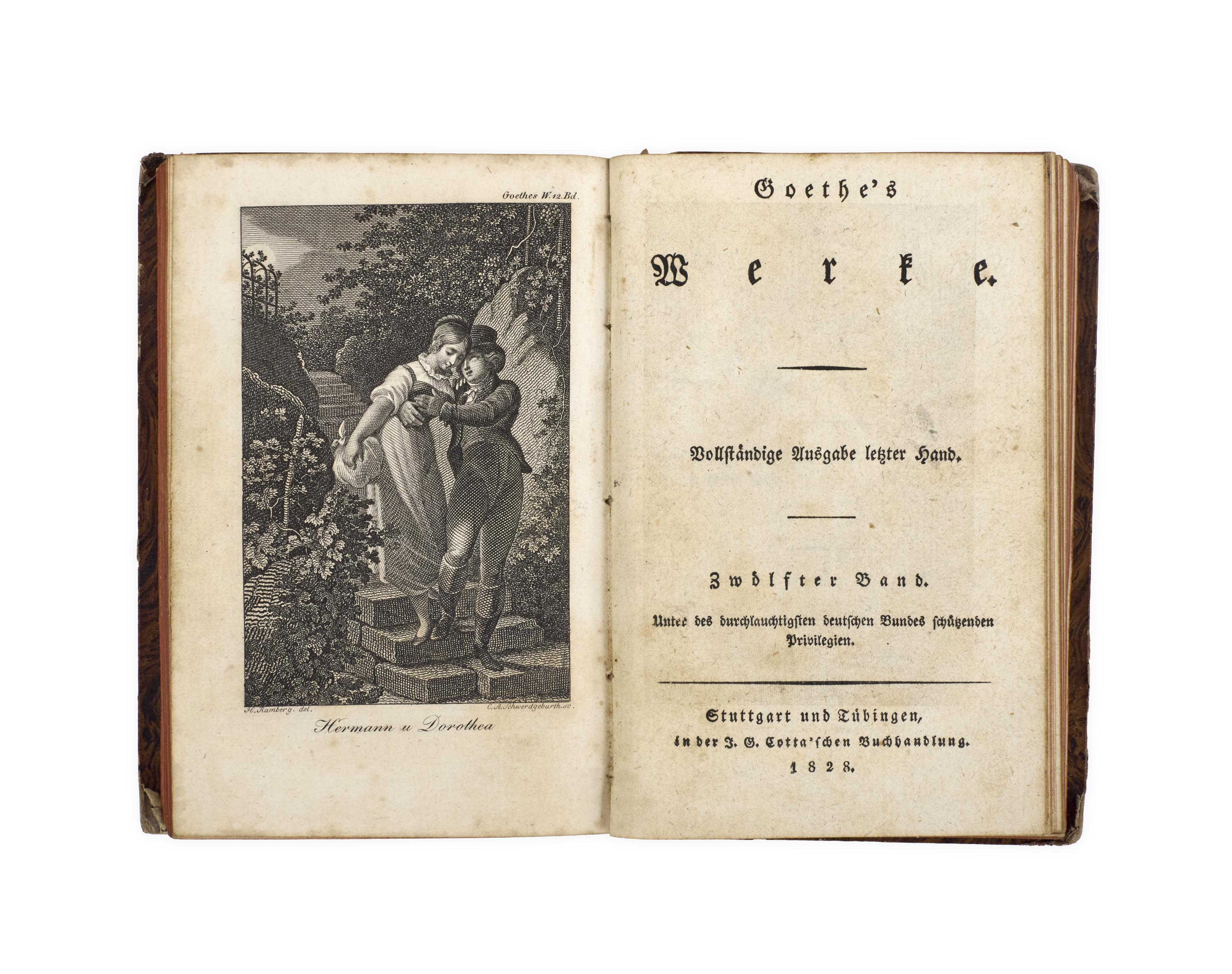
Goethe’s Werke. Vollständige Ausgabe letzter Hand. Eilfter [– Zwölfter] Band … Stuttgart & Tübingen, J. G. Cotta, 1828.
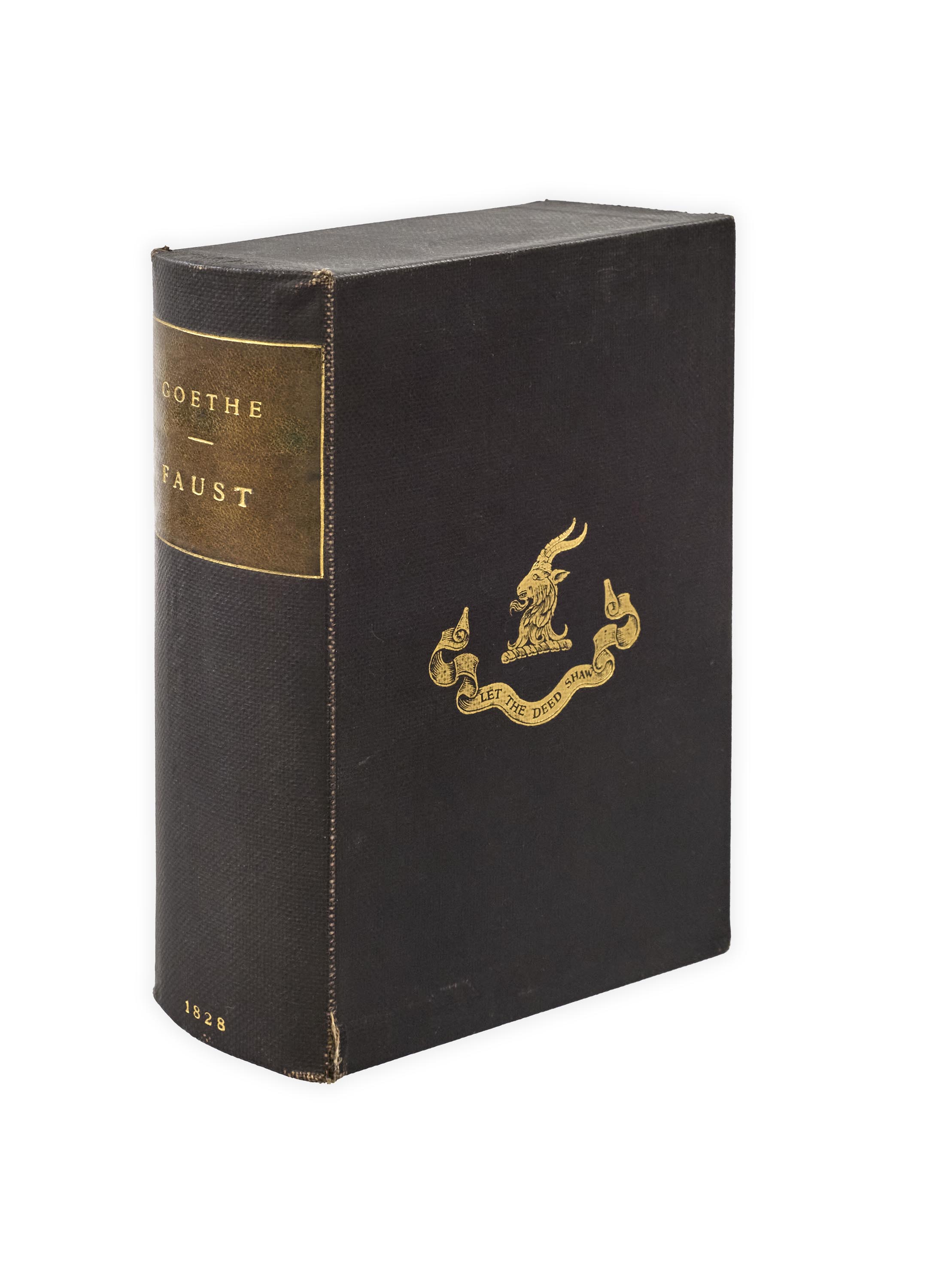
Vols XI and XII (of LX) bound in one, 16mo, pp. XI: [iv], 378, XII: [iv], 313, [1, blank], with engraved frontispiece to each volume; some very slight foxing, but a good copy; bound in contemporary red glazed paper-backed boards with tree-marbled sides, gilt green paper lettering-piece to spine, edges stained red; rather worn; early inscriptions ‘Fr. Schliephacker’ and ‘J. A. an E. Diederichs’ to front free endpaper, twentieth-century bibliographical notes to front pastedown; housed in a black cloth box with the Fleming crest blocked in gilt to front board and gilt green morocco lettering-piece to spine.
Added to your basket:
Goethe’s Werke. Vollständige Ausgabe letzter Hand. Eilfter [– Zwölfter] Band …
First edition, first impression, of the first appearance of any part of Faust part two, published as the twelfth volume in Goethe’s Werke … Ausgabe letzter Hand, from the library of Ian Fleming.
Begun as early as 1775 and continually revised, Faust part one first appeared as a fragment in 1790 but only appeared in a complete version in 1808; a major revision, adding the lines 4335–4342 to the Walpurgis Night’s Dream, is the version included here. Faust part two, however, occupied Goethe’s final years: he sent a draft of the first 6036 lines to his friend and publisher Johann Friedrich Cotta (1764–1832) in 1827, who included it in the collected Werke of the following year as the first and only part of Faust part two to be published in the author’s lifetime; the remaining lines were only finished in 1831 and published posthumously the following year. The Werke were reprinted ‘quite carelessly’ and reissued with the same date sometime soon after 1830 (Hagen, p. 73).
The twelfth volume is here bound with the eleventh, which contains a number of Goethe’s Singspiele (Jery und Bätely; Lila; Die Fischerin; Scherz, List und Rache), the libretto of Der Zauberflöte (part two), the pageant Palaeophron und Neoterpe, preludes to the opening of theatres in Weimar, Bad Lauchstädt, and Halle, and a number of ‘Theaterreden’. The frontispieces to the two volumes are the work of the painters and printmakers Johann Heinrich Ramberg (1763–1840) and Carl August Schwerdgeburth (1784–1878).
Provenance:
From the library of Ian Fleming (1908–1964), bibliophile and writer, in the fleece-lined box with his supralibros as commissioned for all of his books. Despite his activities as a book collector, including establishing The Book Hand-Book and The Book Collector and lending a substantial portion of the exhibition ‘Printing and the Mind of Man’, Fleming is better known for his fiction. He would have known the works in the present volume well: a gifted linguist, Fleming had had good German from a young age, studying at Kitzbühel and the University of Munich. During his stay in Geneva thereafter he came to know one Gisela von Stoltenberg and ‘used to sit with her discussing Goethe and Schiller in the Cozy Corner café’ (Lycett, p. 45).
Fleming’s admiration for Goethe continued in later life. In an interview of 1963 he noted that ‘Goethe, I think, was the only homme complet in history. You can’t fault him. Psychologists say that most geniuses are suffering from some kind of physical inferiority or physical defect. I mean Beethoven was deaf and so on. But they’ve never been able to find anything wrong with Goethe. He was healthy, he lived a full life, his sex life was normal, he covered an enormous range of interest – even the pollination of flowers’ (‘The World of Bond and Maigret: Fleming meets Simenon’ in The Sunday Times, 15 September 1963, pp. 25–26).
For an extensive account of Fleming’s library’s formation and the acquisition of the majority of it by the Lilly Library, see Silver, ‘Books that had started Something: Ian Fleming’s Book Collection’ in The Book Collector 66, no. 1 (Spring 2017), pp. 94–138.
Goedeke IV/3, §235 A.4 C1; Hagen 23. See Bell, ‘Three Recent Editions of Goethe’s Faust: A Review Article’, The Modern Language Review 98 (2003), pp. 634–658; The Oxford Companion to German Literature (ed. Garland & Garland, 1997); Lycett, Ian Fleming (1995).