Catalan Neumes
[GRADUAL.]
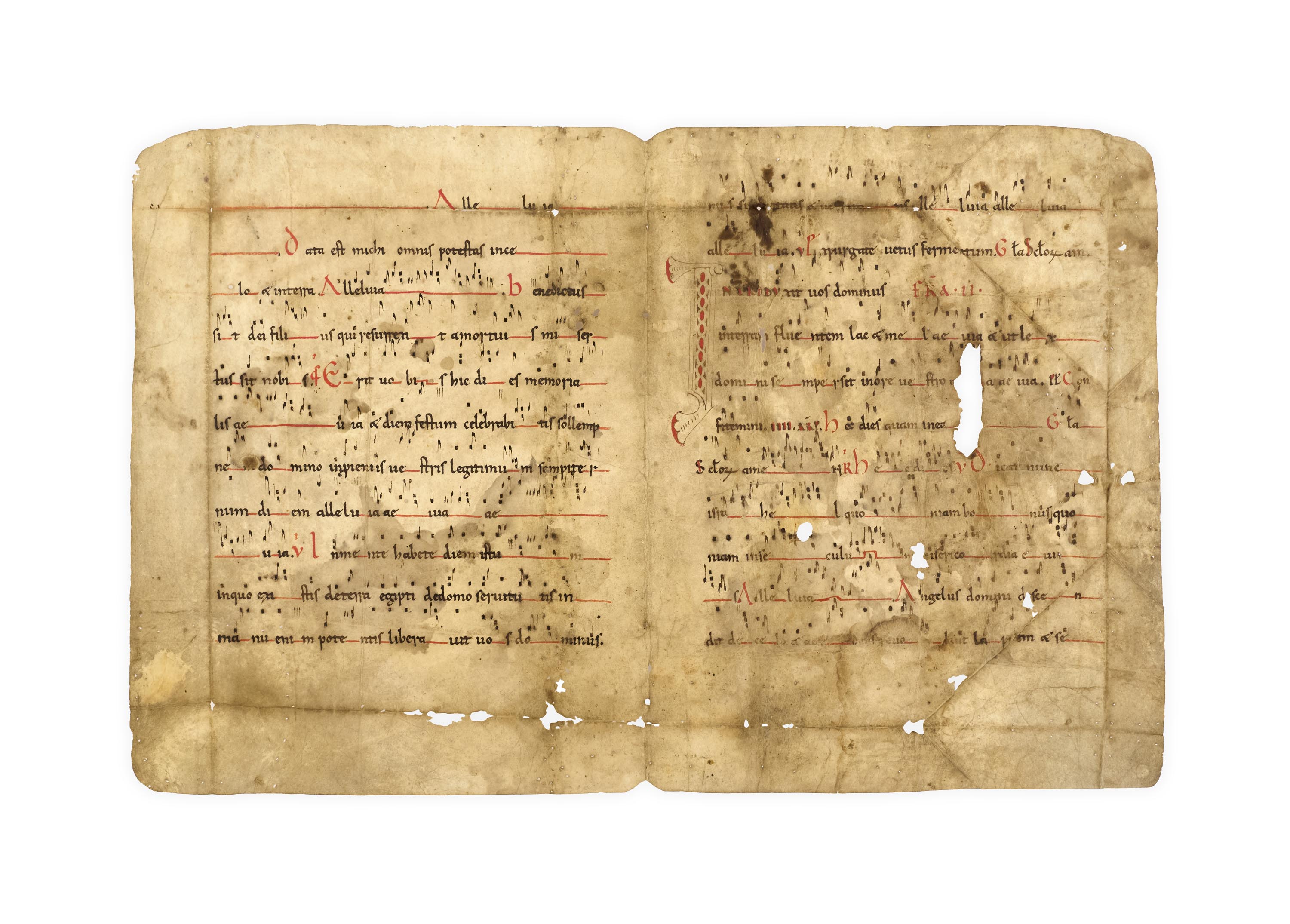
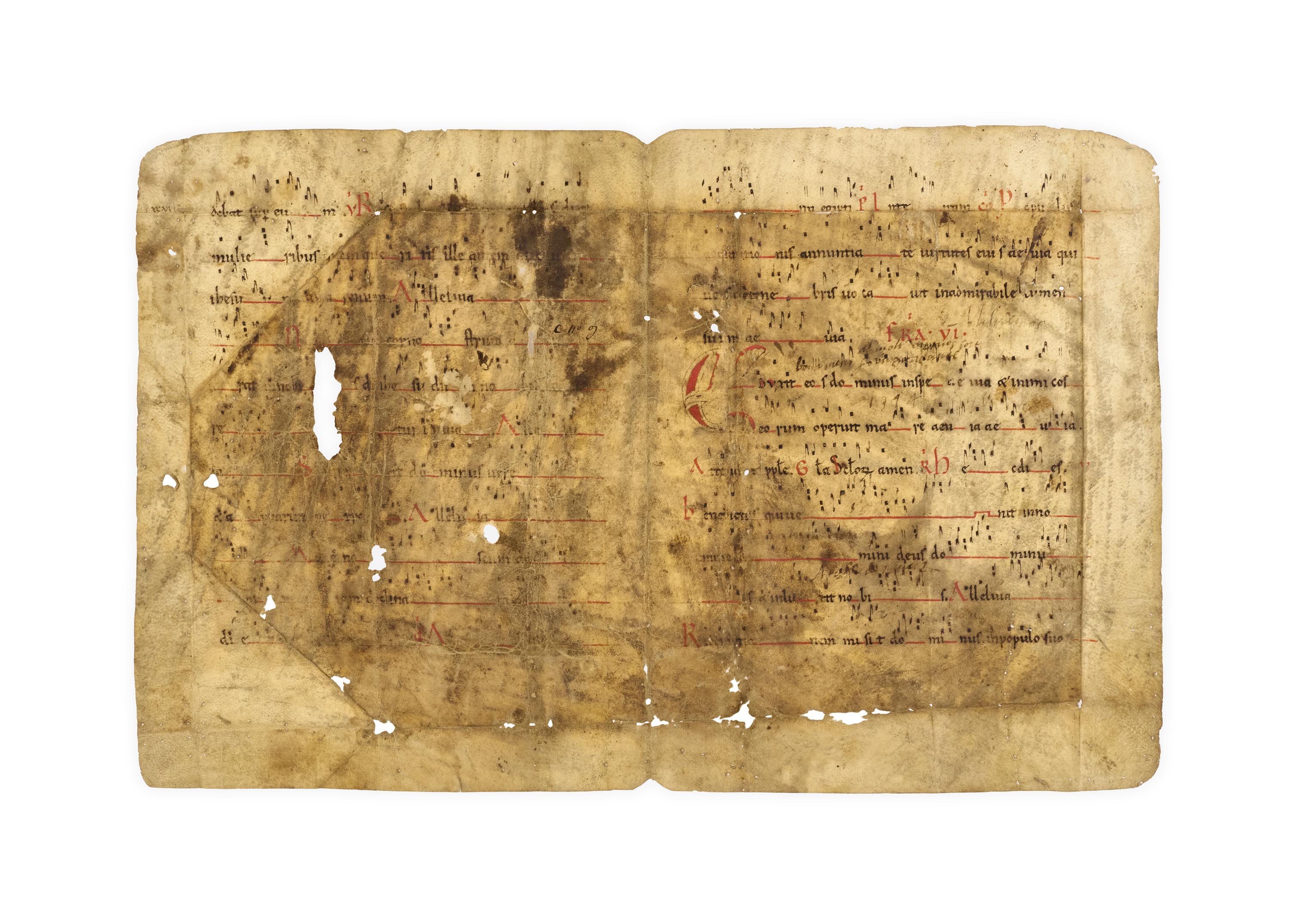
Bifolium containing chants for Easter Monday and Easter Friday. Northeast Spain, 11th century.
A complete bifolium (leaf size c. 295 x 230 mm, text area c. 210 x 180 mm), leaves not consecutive, written in single columns in dark brown and red ink in a neat Carolingian hand, strong ‘st’ ligature, the downstroke of the ‘r’ descending below the line, blank spaces between words filled with a single red line, ‘Catalan’ neumes, three-line initial ‘I’ (Introduxit) to first recto with a simple interlace pattern in the body of the letter infilled in red and pale brown, the ends tipped with red, two-line initial ‘E’ (Eduxit) to second recto incorporating a sharp-beaked bird, infilled with red, capitals in red, rustic capitals touched in red; recovered from use as a wrapper, several holes including a substantial one to the first leaf (c. 50 x 10 mm, with some loss of text), staining and rubbing in particular to the facing inner pages, creases from folding; seventeenth-century(?) note to second recto ‘Al molt virtuos sort bonament sovingura comte'.
A remarkable bifolium containing chants for Easter Monday and Easter Friday, with two forceful initials, and distinctive ‘Catalan’ neumes. Spanish manuscripts of this early date are a rarity.
The chants for Easter Monday (‘feria II’) open with a three-line initial ‘I’ (Introduxit vos dominus in terram fluentem lac et mel) with a simple interlace design, and those for the following Friday (‘feria VI’) with a two-line initial ‘E’ (Eduxit eos dominus in spe) composed of a sharp-beaked and winged bird biting its own body.
The staffless neumes are ‘heightened’ or ‘diastematic’ i.e. written at varying distances from the text to indicate the overall shape of the melody. In several instances here, the height of a neume has resulted in a ‘bump’ in the red line above it. The form of the neumes corresponds to that categorised as ‘Catalan’ by Grove: ‘In north-east Spain, in the area roughly corresponding to modern Catalonia, another type of notation similar to French became established, usually known as “Catalan” notation’ (Notation, Grove Music Online).