War of the Words
GUARNA, Andrea.
Bellum grammaticale. Venice, (colophon:) Francesco Rampazetto for Melchiorre Sessa, 1555.
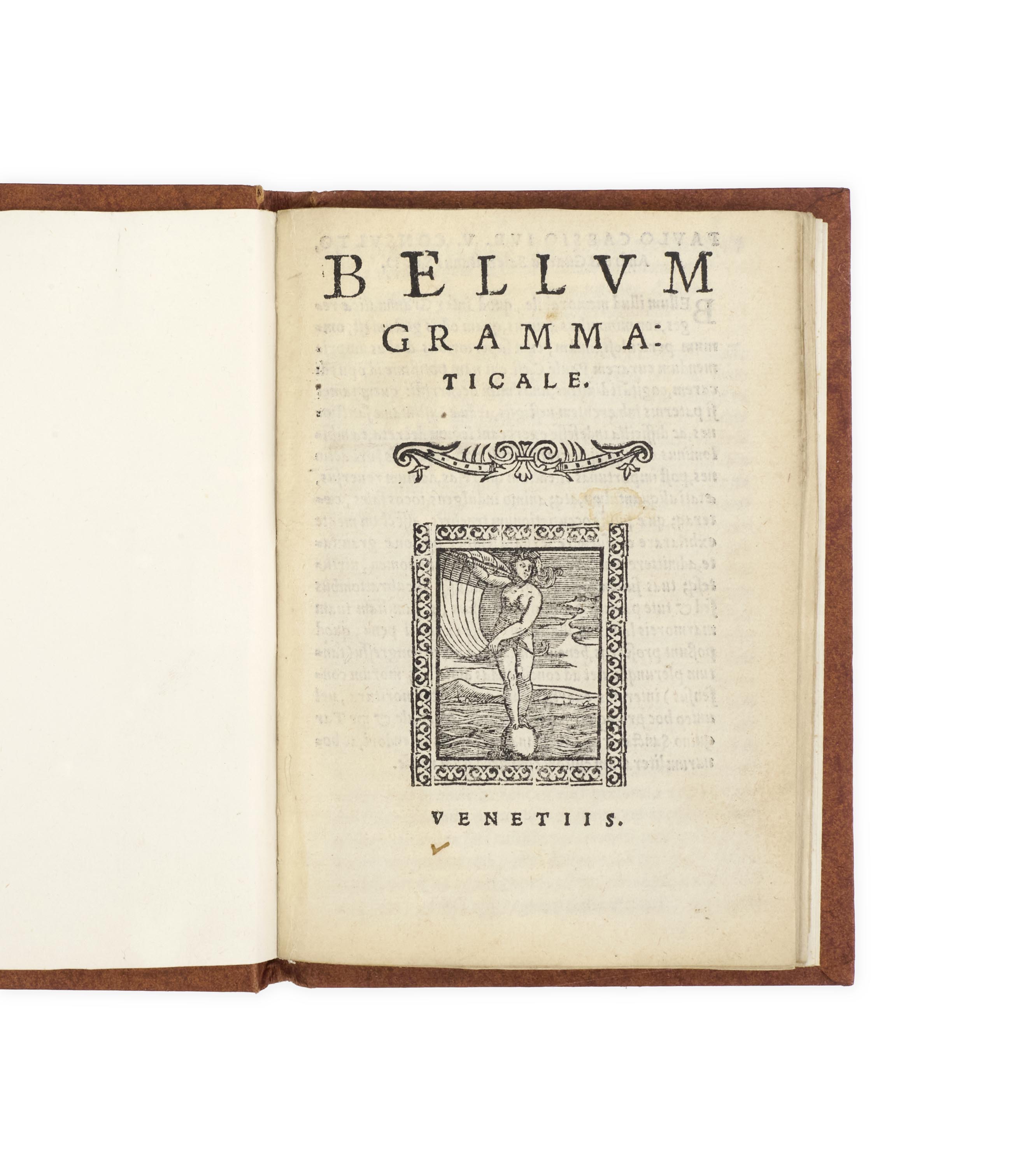
Small 8vo, ff. 16; woodcut allegorical Fortuna device to title; cropped slightly short, affecting running title on A8, otherwise a very good copy, bound in modern boards.
Very rare edition (first published in 1511) of this extremely popular schoolbook on Latin grammar explained as a metaphorical war between the Nouns and the Verbs.
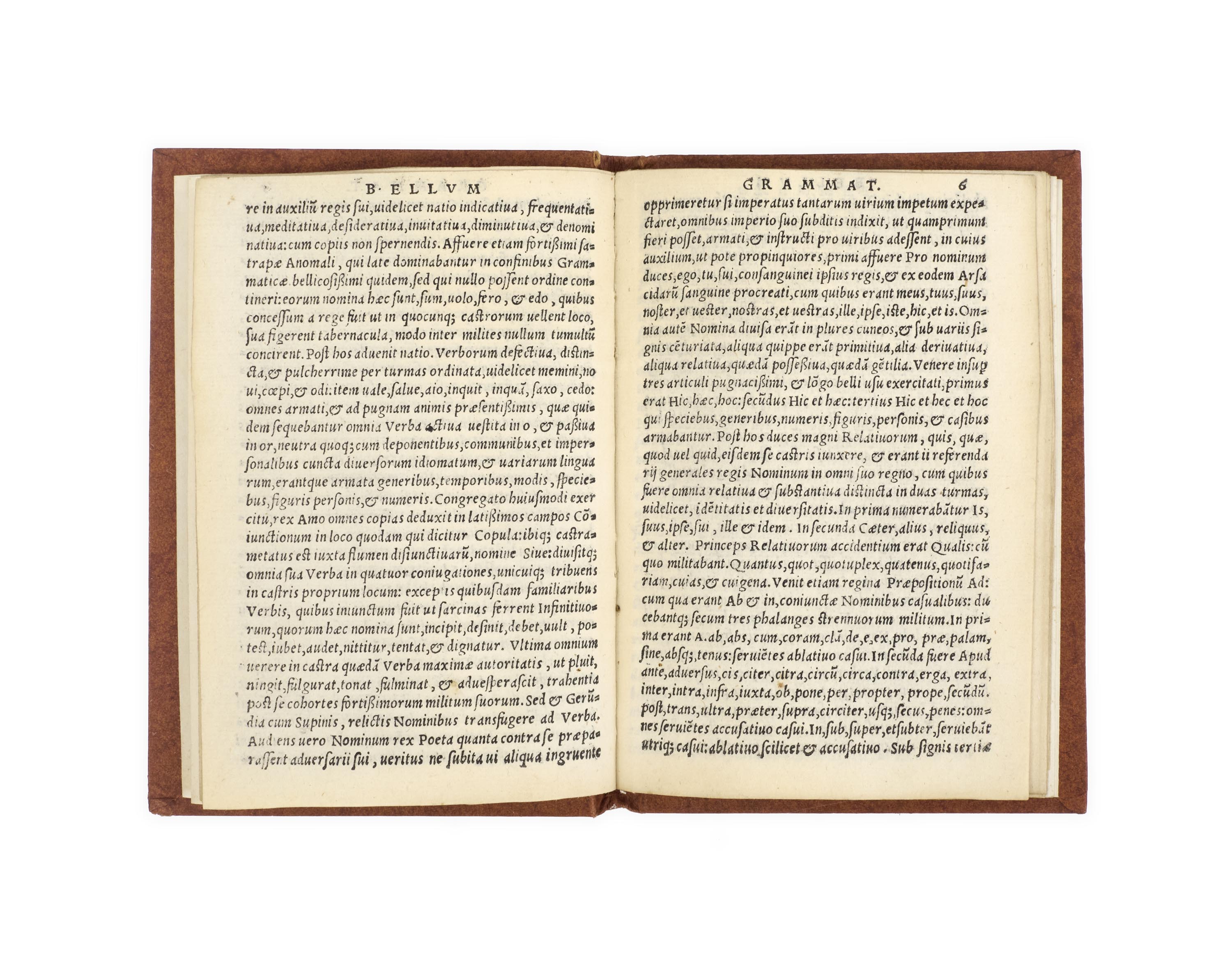
‘Under the influence of alcohol, Amo, king of verbs, and Poet, king of nouns, enter into conflict over which of them should rule the land of Grammar, or rather, over which of them should occupy the most important role in the composition of speech. Their attempts to overturn each other’s convictions, despite their rather elaborate rhetorical arguments, are in vain. Once war has begun, the various parts of speech (Adverb, Preposition, Interjection, Conjunction) are forced to side, each organized in close ranks, with one of the two armies. The only exception is the Participle, a grammatical hybrid by nature, which, having been requested to form an alliance by both sovereigns, shrewdly decides to assume a neutral position. The war continues with alternating fortunes, with mutilations or casualties among the combatants, which the author uses as metaphors to explain the grammatical exceptions. It concludes, finally, with the reconciliation of the two sides and the re-establishment of the original balance, mediated by the most illustrious philologists of the time, united in the common fight against the various forms of Ignorance … The parts of speech are presented as soldiers gathered in camps: all the Verbs, for example, are armed with genders, tenses, moods, species, figures, persons, and numbers, while the Nouns, divided according to the five declensions, fight with species, genders, numbers, figures, and cases. The Bellum Grammaticale can therefore be fully included in the genre of the comic epic’ (Puccio, ‘Le Latin s’en va-t-en guerre. Il Bellum Grammaticale sulla scena: dalla trattatistica alla performatività’, in Dionysus ex machina V (2014) pp. 490–497, trans.).
Guarna’s Bellum grammaticale enjoyed immediate and lasting popularity, not limited to the Italian peninsula; over seventy-five editions were published in the sixteenth century in Italy, France, Germany, the Netherlands, Switzerland, Spain and Denmark, as well as a large number of translations and literary imitations which continued to appear well into the nineteenth century. In England, France and Germany playwrights also discovered the theatrical potential of the work, one of the most famous results being Huttens’s comedy, Bellum grammaticale sive nominum discordia civilis (Oxford, 1635).
OCLC and USTC combined find a single copy outside Italy, at Ohio State University Library.
EDIT16 CNCE 36252; USTC 835023. See Erik Butler, The Bellum Grammaticale and the Rise of European Literature (Farnham, Ashgate, 2010).