‘Neither True Nor Perfect’, but a Source for Macbeth
[GUNPOWDER PLOT.] William CAMDEN, translator
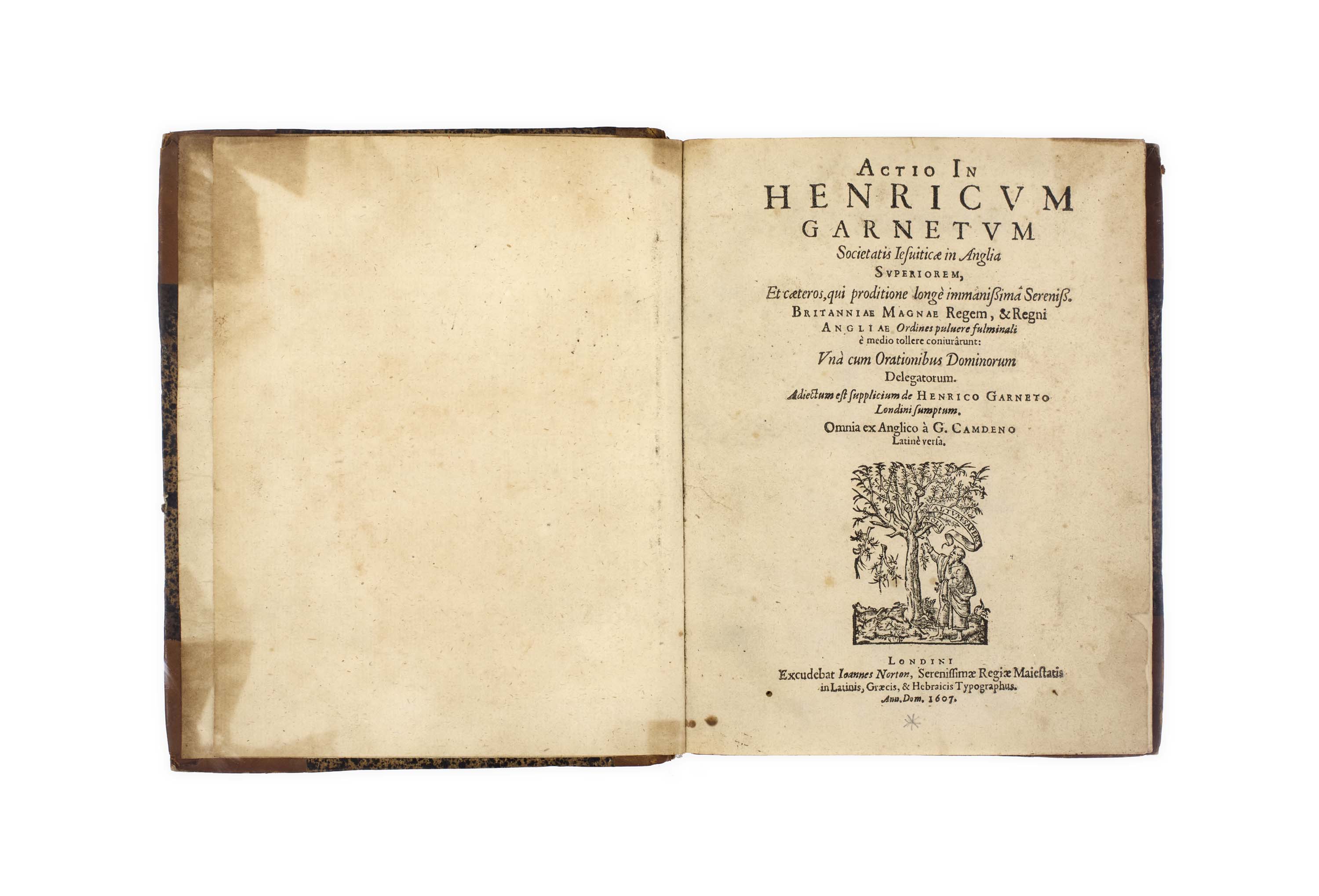
Actio in Henricum Garnetum Societatis Iesuiticae in Anglia superiorem, et caeteros qui proditione longè immanissima Sereniss. Britanniae Magnae Regem, & regni Angliae ordines pulvere fulminali è medio tollere coniurarunt: unà cum orationibus dominorum delegatorum. Adiectum est supplicium de Henrico Garneto Londini sumptum. London, John Norton, 1607.
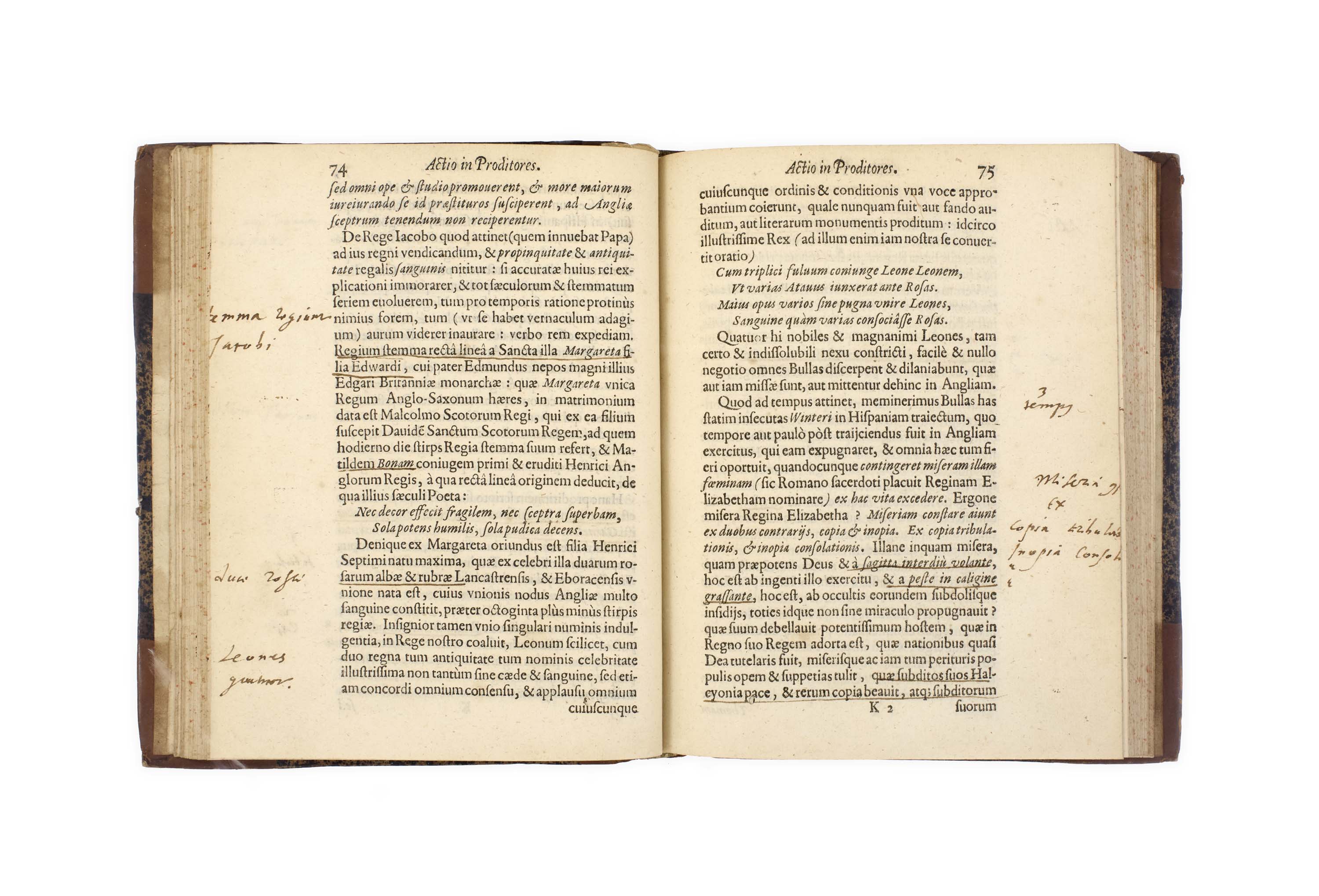
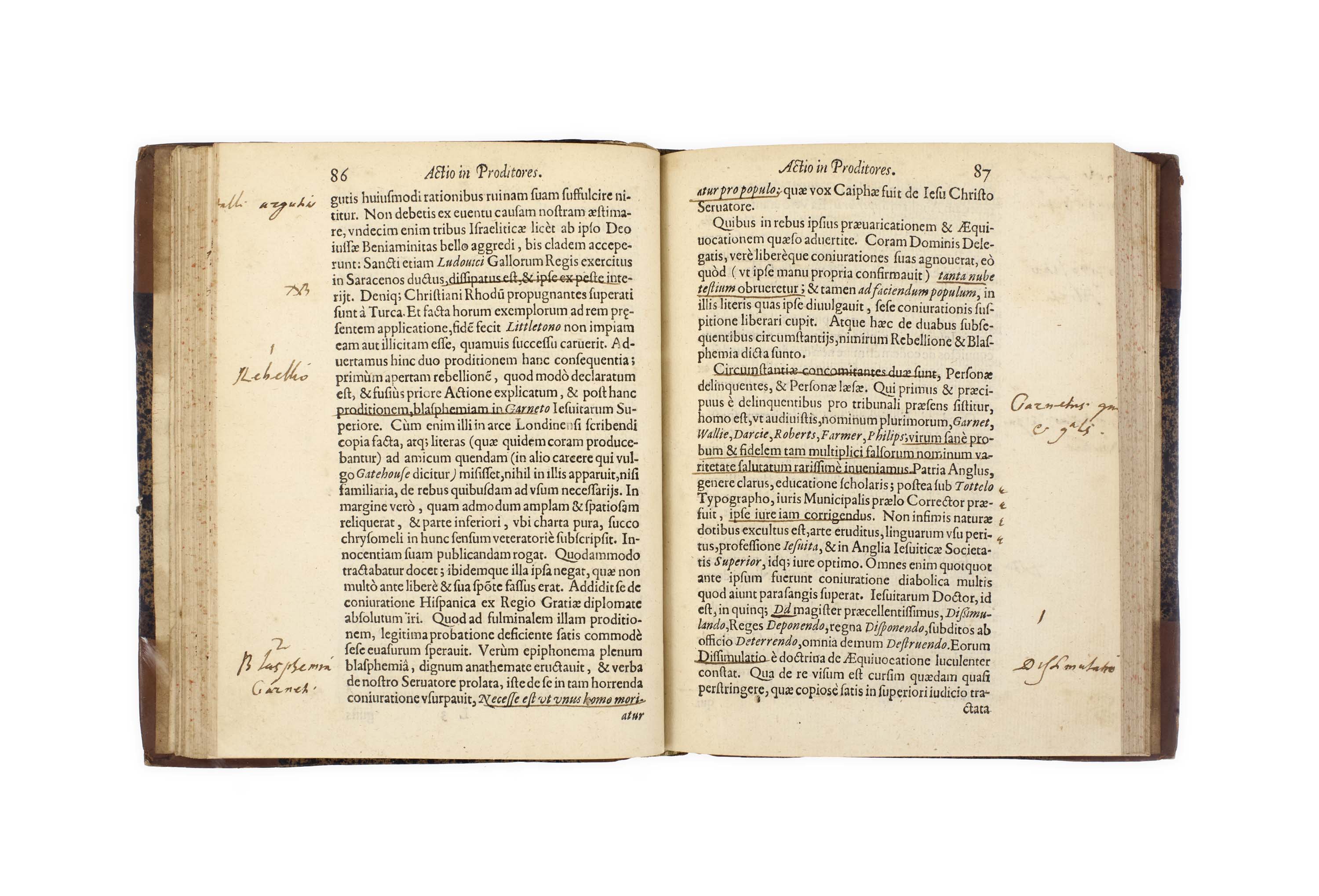
4to, pp. [6], 168, 179–273, [1 (blank)], [6], [2 (blank)]; bound without the initial leaf ¶1 (blank save for the signature); printer’s device after Estienne’s to title (McKerrow 348, supposedly ‘granted to John Norton by Paul Estienne, while on a visit to England in 1594, as a mark of admiration for his printing’), woodcut head- and tailpieces and initials; light foxing throughout, occasional minor dampstains, wormtrack to tail margin affecting a letter or two on some pages; else a very good copy in eighteenth-century German half calf over speckled boards, spine gilt in compartments with title lettered direct; a little rubbed, extremities somewhat worn; contemporary annotations in a continental (possibly German) hand to c. 30 pp., early twentieth-century ink stamp of Oswald Weigel, bookseller and auctioneer of Leipzig, to front pastedown.
Added to your basket:
Actio in Henricum Garnetum Societatis Iesuiticae in Anglia superiorem, et caeteros qui proditione longè immanissima Sereniss. Britanniae Magnae Regem, & regni Angliae ordines pulvere fulminali è medio tollere coniurarunt: unà cum orationibus dominorum delegatorum. Adiectum est supplicium de Henrico Garneto Londini sumptum.
First and only edition in Latin of the official account of the Gunpowder Treason trials, ‘a masterpiece of official propaganda’ (Marotti, p. 133) influential both in England – where it was seemingly mined by Shakespeare – and abroad, our copy with early continental annotations attesting to an international readership.
Translated here by William Camden, the work had first appeared the year before as A True and perfect Relation of the whole Proceedings against the late most barbarous Traitors, edited anonymously by Robert Cotton. It contains accounts of the trials of the various Catholic conspirators, focusing in particular on Henry Garnett, the equivocation practised by him and his fellow Jesuits, and the elaborate trial speeches of Sir Edward Coke and the Earl of Northampton (Cotton’s patron). The account was ‘designed to drive home two points: first, that the Gunpowder Plot was only one of a series of continuing Catholic assaults on English monarchs, the true religion (Protestantism), and the nation itself, and second, that Jesuits were England’s wors[t] enemies, a diabolically crafty order of political subversives defending the papal deposing power and sanctioning regicide’ (ibid., pp. 133–4). Though ‘neither true nor perfect’ (DNB) and marred by ‘rhetorical overkill’ (Marotti, p. 141), the Relation was highly effective, becoming the standard account of the trials into the nineteenth century.
Among its early readers seems to have been Shakespeare, whose Macbeth, a play haunted by the Gunpowder Plot, was first performed in the year A True and perfect Relation appeared. ‘That William Shakespeare read this little book eagerly about the middle of May, 1606, is not to be doubted … From it he learned all he needed to know about the new meaning of the word “equivocation”’ (Paul, p. 243), used famously in the Porter Scene of Act II. ‘There are numerous verbal parallels between the pamphlet and Macbeth, some of them very close.’ Though none is ‘absolutely conclusive’, ‘their number and their cumulative effect’ are ‘remarkable’ (Rogers, p. 50). The government took care to distribute the Relation on the Continent, where it ‘led directly to the international controversy over the Oath of Allegiance in which some of the same issues were stake’ (Marotti, p. 142).
The present copy – annotated in a contemporary continental hand, summarising and cross-referencing the text and referring at one point to ‘Blasphemia Garneti’, and preserved in a later German binding – is a valuable witness to the European relevance of both the text and the Gunpowder Plot.
ESTC S102858; STC 11620. See Marotti, Religious Ideology and cultural Fantasy: Catholic and anti-Catholic Discourses in early modern England (2005); Paul, The Royal Play of Macbeth (1948); Rogers, ‘Double Profit’ in Macbeth (1964); Vince, From ‘Aequivocatio’ to the ‘Jesuitical Equivocation’: changing Concepts of Ambiguity in early modern England, unpublished PhD thesis (2013).