Florentine Neoplatonism
HERMES TRISMEGISTUS; Marsilio FICINO, translator.
Liber de potestate et sapientia Dei … [(Colophon:) Venice, Damianus de Mediolano, de Gorgonzola, 10 May 1493.]
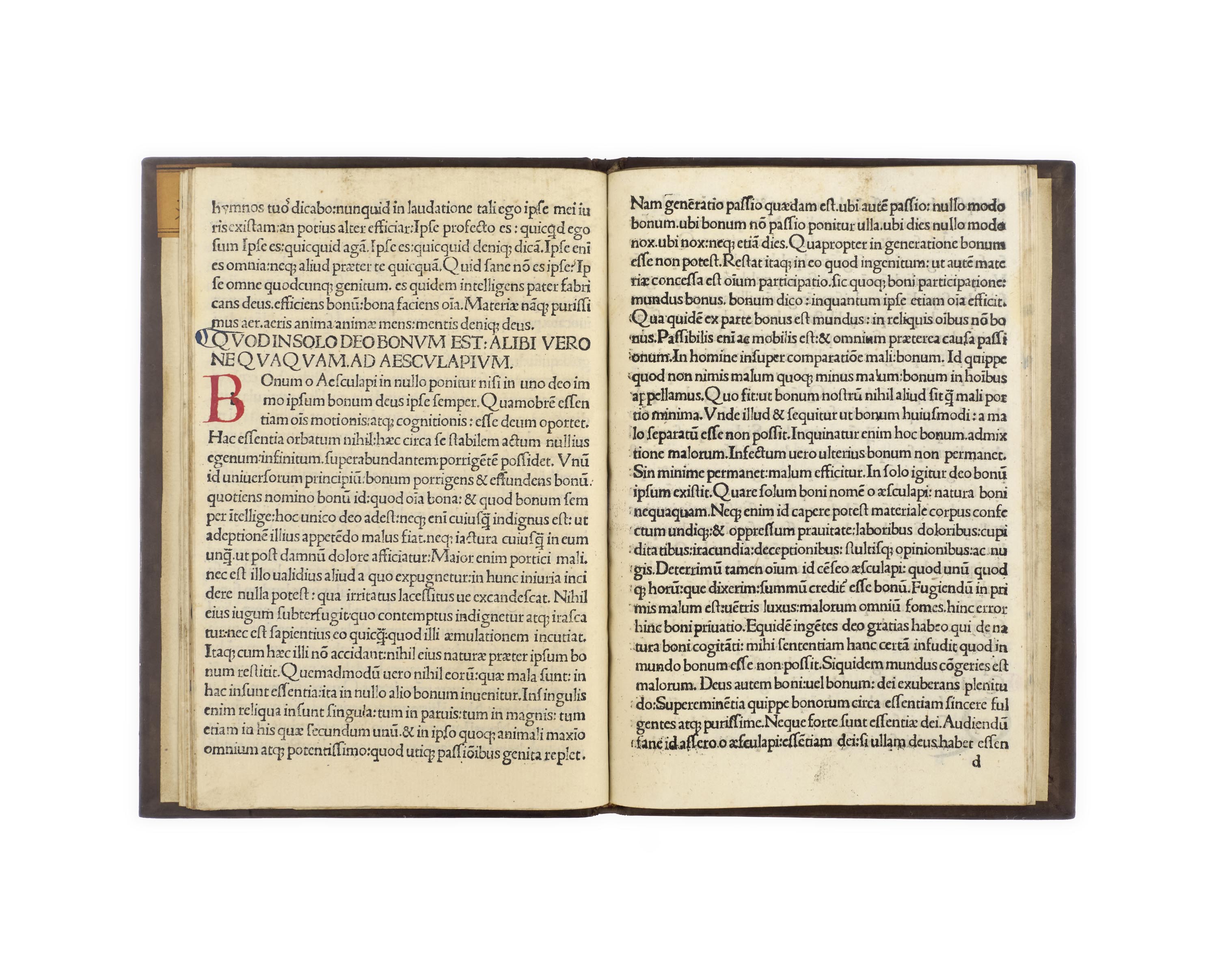
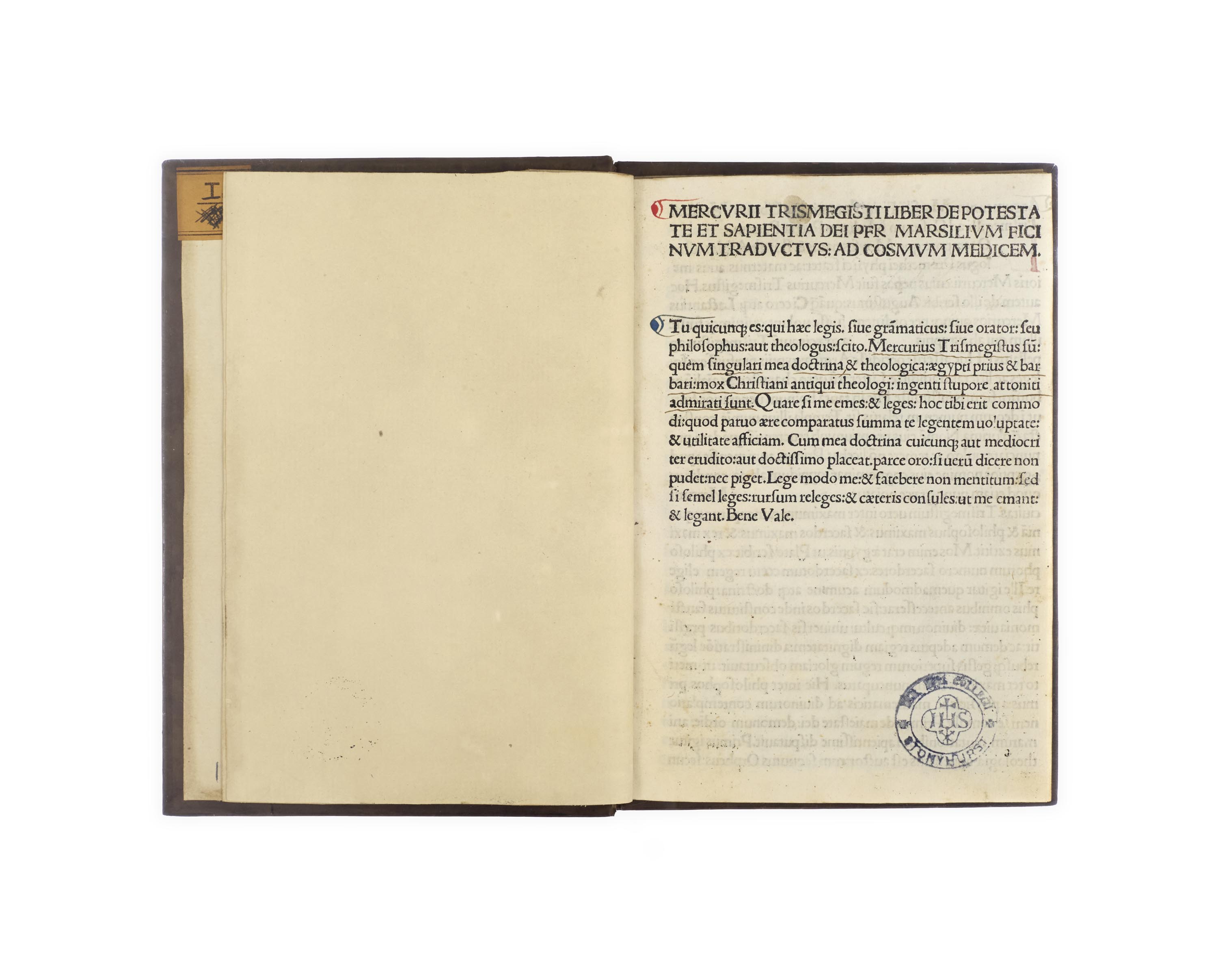
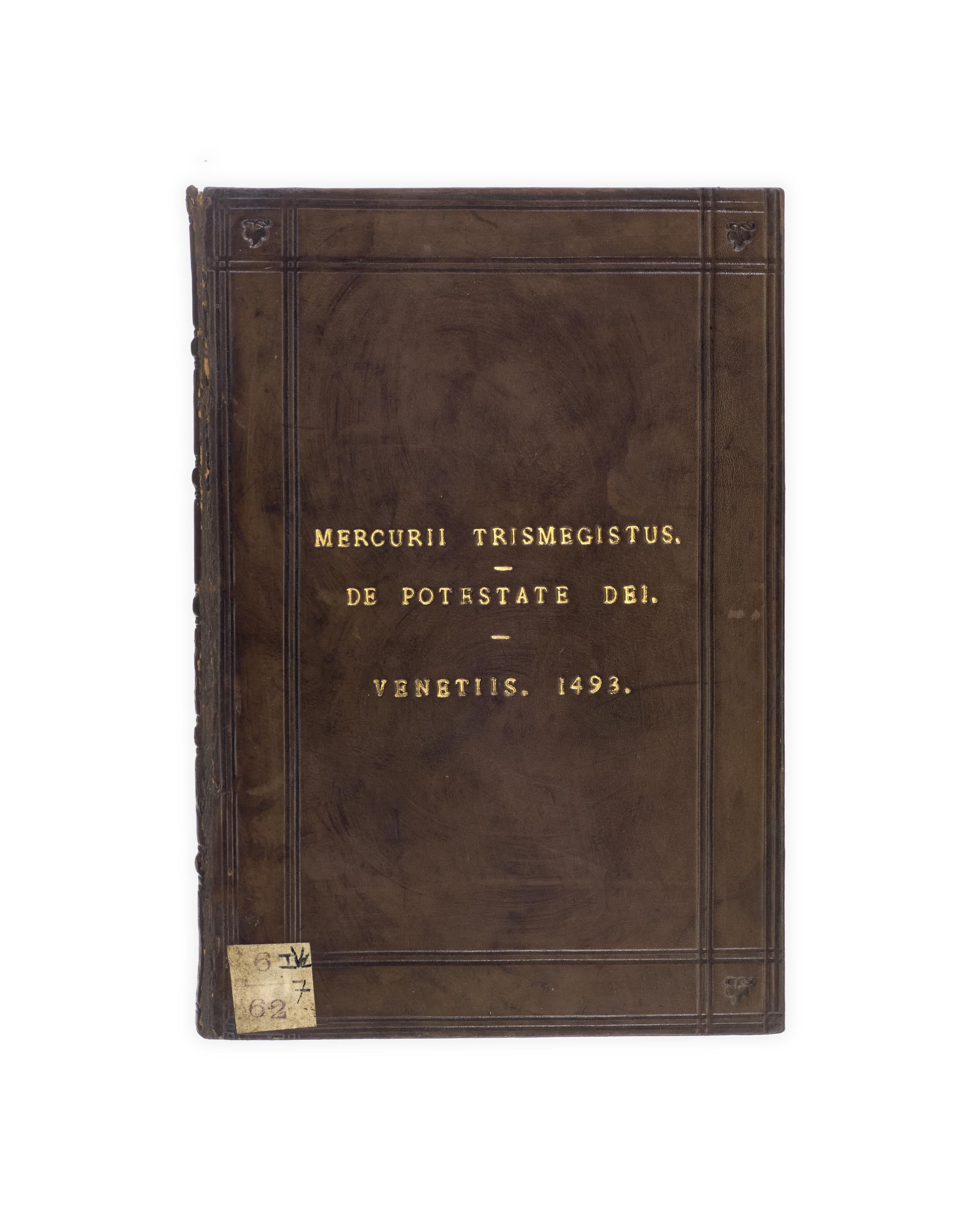
Small 4to, ff. [32]; a–h4; roman letter (with spaces left for Greek words to be inserted), initials and paraphs in red or blue; cut a little close, but a very good copy; bound in late nineteenth-century calf, boards panelled in blind, front board lettered in gilt, spine ruled in blind, edges with traces of marbling; ink stamp of Stonyhurst College to foot of first and final pages, with shelf labels to front board and pastedown.
An attractive Venetian edition of the first Latin translation of the Corpus Hermeticum (sometimes known as Pimander, from the name of just the first of fourteen chapters), the foundation of Hermetic Philosophy and a fundamental text of early alchemy.
‘De potestate et sapientia Dei comprises 14 treatises ascribed to Hermes, and its translation was Ficino’s first work, completed in 1463 at the request of Cosimo de Medici. The Greek manuscript brought from Macedonia by Leonardo da Pistoia excited great interest, as witnessed by postponing the translation of Plato which was about to begin. While the treatises are in fact the work of different authors written at various times in the first centuries after Christ, Ficino believed, as did everyone up to the 17th century, that they were the work of the priscus theologus revealing the divine mysteries …
‘Pimander is the first of fourteen treatises in De potestate et sapientia Dei, and it tells a story of creation similar to that in Genesis. It is in the form of a dialogue between Hermes and Pimander, the divine “mens.” Hermes, in sleep and thus with his corporal senses arrested, asks to know God. He sees suddenly in Pimander a great light, then darkness, and hears the Word: “the luminous Word issuing from the Nous (Pimander) is the son of God.” The Nous creates man, allowing him to participate in divine power, and man descends to earth to join nature. Although he has taken on a mortal body, he still retains an immortality by participation in the divine. This is emphasized at the end of Pimander when Hermes asks Pimander how to live according to the mystery of God: “[you] must live a pure and holy life, rendering the Father propitious to him through filial love and uttering benedictions and hymns.” Finally, at death, the immortal element of man will ascend and return to the sphere of God whence it came.
‘This story provided Ficino with evidence that Hermes was indeed the “father of theology” since its account of creation had obvious parallels to Genesis, it prophesied Christianity, and it taught devotion to God in this life’ (Christ, Plato, Hermes Trismegistus: Catalogue of the Incunabula in the Bibliotheca Philosophica Hermetica I, part 2, pp. 235–7).
The first printing, by Gerardus de Lisa in Treviso in 1471, was executed without Ficino’s knowledge. This is probably the fifth printing of this work, though it was derived from the Treviso edition whose text suffered from numerous inaccuracies. It is quite plausible that Ficino’s translation was only meant for Cosimo and that he never intended for it to be printed.
HC 8461*; BMC V 543; GW 12314; Goff H81; BSB-Ink H-116; ISTC ih00081000.