Who Judges the Judge?
INCHBALD, Mrs. [Elizabeth].
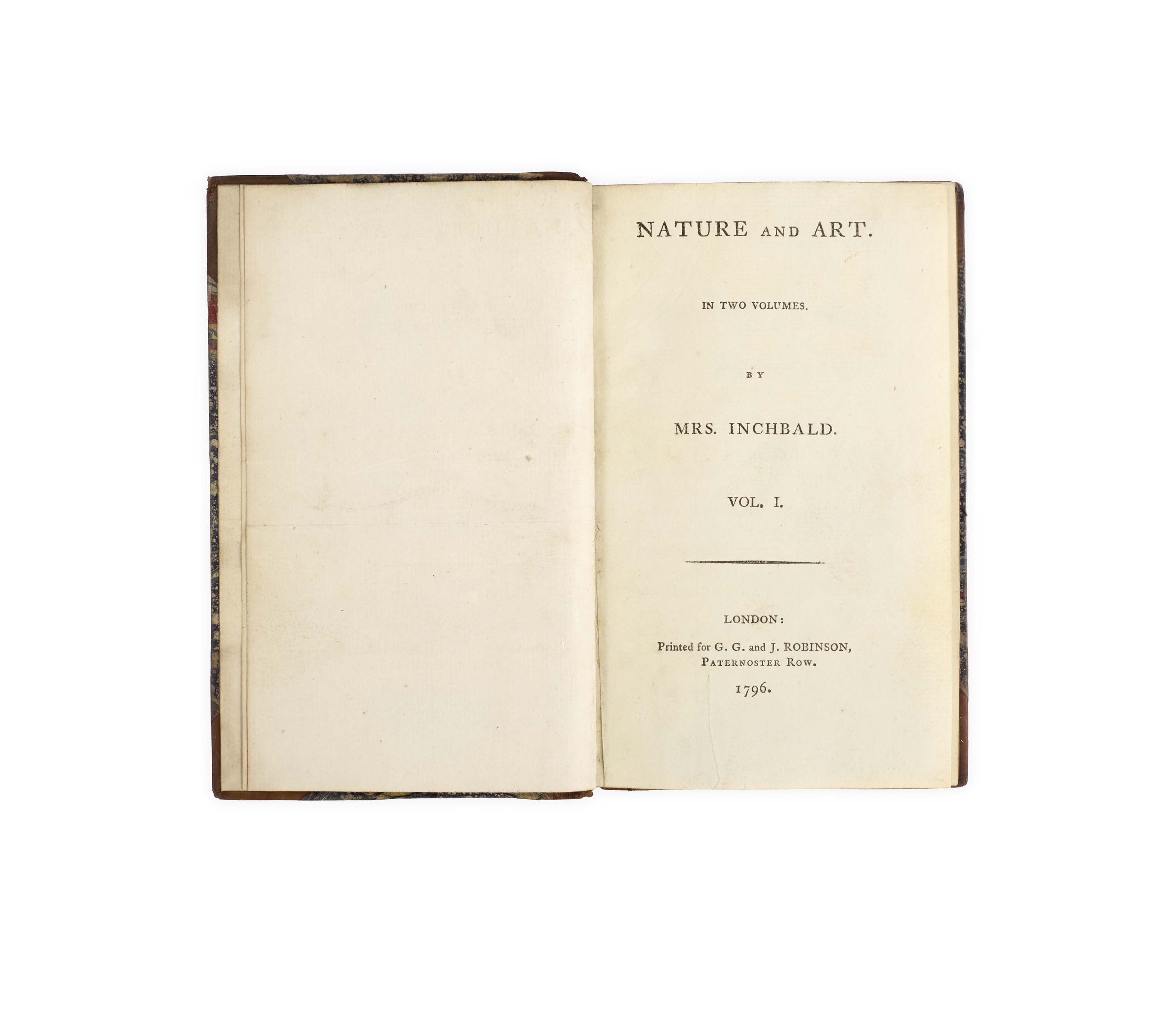
Nature and Art. London, G. G. and J. Robinson, 1796.
Two vols, 12mo, pp. I: [ii], 192; II: [ii], 203; old repair to tear in lower margin of title-page in vol. I, else a very good copy in contemporary half calf and marbled boards, front joints cracked but sound, head of spine chipped on vol. II.
First edition of a powerful and tragic Jacobin novel, ‘remarkable for its dramatic rendering of the feminist point that men destroy women’s chastity and then mete out punishment for its loss’ (Spencer, The Rise of the Woman Novelist, 1986). It is a fearless interrogation of hypocrisy, greed, snobbery, and the effects of education and social position on behaviour that prefigures the works of Jane Austen, who greatly admired Inchbald.
The heroine of one plot strand, Agnes Primrose, a cottager’s daughter, is left pregnant by her lover William Norwynne and sinks to prostitution, theft and forgery, while her seducer rises in the world to become a judge. Eventually, he is the one who passes sentence on her for the crimes she was driven to by his desertion, and he does not even recognise her as he condemns her to death. This theme had intense personal significance for Inchbald, who had been unable to save her own sister Deborah from falling into prostitution. The dichotomous title (a construction later made famous by Austen) is embodied in the two branches of the Norwynne family: William Sr (a churchman) and his son William (the judge and seducer) represent ‘art’, or indeed artifice; ‘nature’ is embodied in the musician Henry Sr, and his son Henry, who was raised in innocence in Africa and is used as a vehicle for questioning social norms in England. While William Jr’s loveless marriage ends childless, Henry is happily united at the end with the modest, bookish Rebecca.
Inchbald (1753–1821) was born a farmer’s daughter at Stanningfield, near Bury St Edmunds, Suffolk, and had an early, impecunious career as an itinerant actress; in 1789 she retired from the stage to concentrate on writing and made a good income from her plays – she is perhaps best known now for Lover’s Vows. In London Inchbald became friendly with Anna Laetitia Barbauld and Maria Edgeworth; Holcroft and Godwin both proposed to her and were refused. Her first novel, A Simple Story (1791), was reviewed at length by Wollstonecraft, and Maria Edgeworth declared ‘I never read any novel that affected me so strongly, or that so completely possessed me with the belief in the real existence of all the people it represents’. Nature and Art developed similar moral arguments about the importance of education, owing something both to Rousseau’s Confessions (which she had translated in 1790), and Godwin’s Political Justice (1793), though Godwin himself was unsatisfied by its less radical conclusions. It was popular enough to have Dublin and Philadelphia editions in the same year, and a ‘corrected’ second edition in 1797.
ESTC T114292; NCBEL II, col. 843; Raven and Forster 1796:57; Tompkins, The Popular Novel, pp. 176–7.