Annotated by a Jurist Concerned with Ethics
[LEXICON.] [ALENIUS, Arnoldus, i.e. Arnout van EYNDHOUTS.]
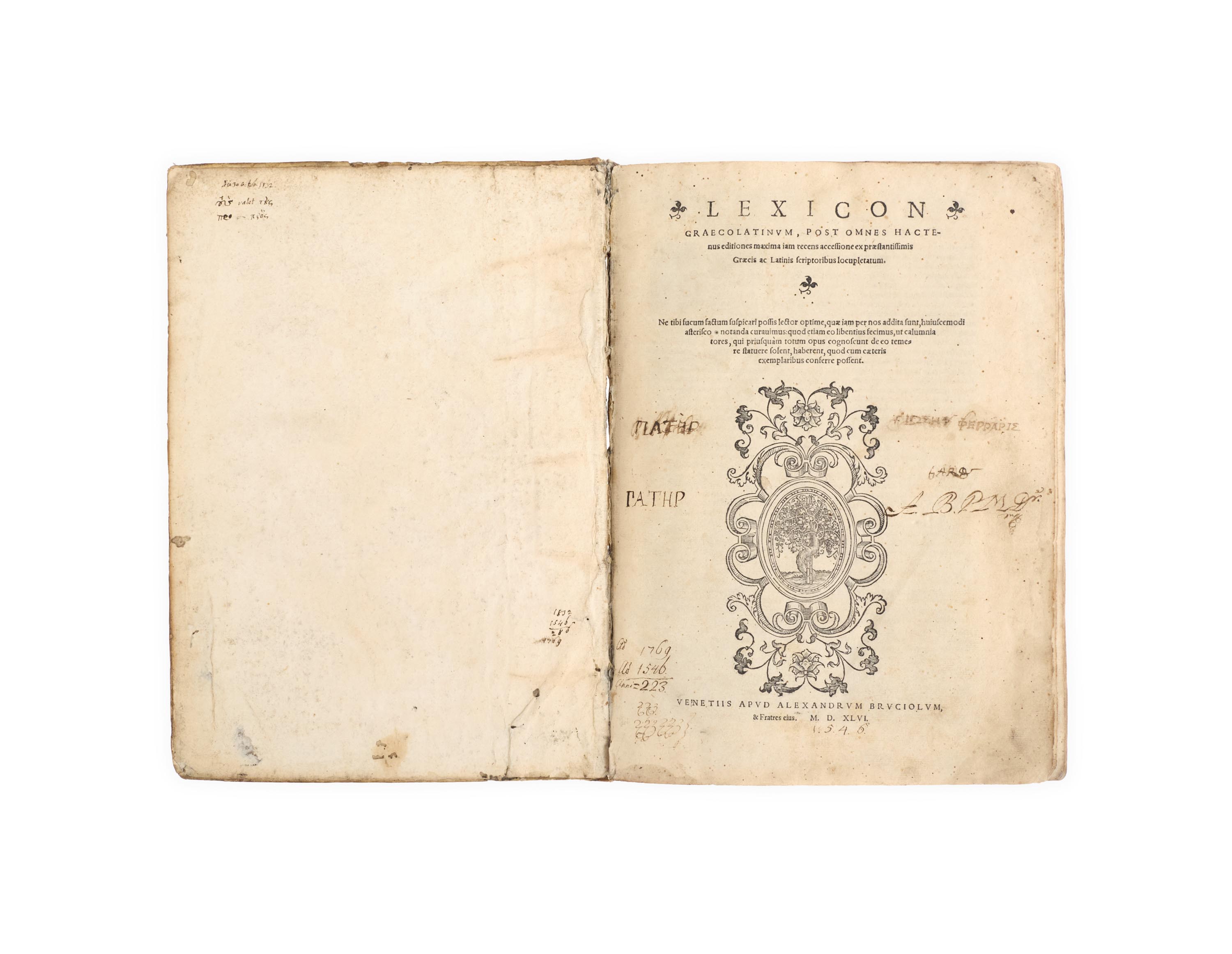
Lexicon Graecolatinum post omnes hactenus editiones maxima iam recens accessione ex praestantissimis Graecis ac Latinis scriptoribus locupletatum. Venice, Alessandro Brucioli and brothers [i.e. Antonio and Francesco Brucioli], 1546.
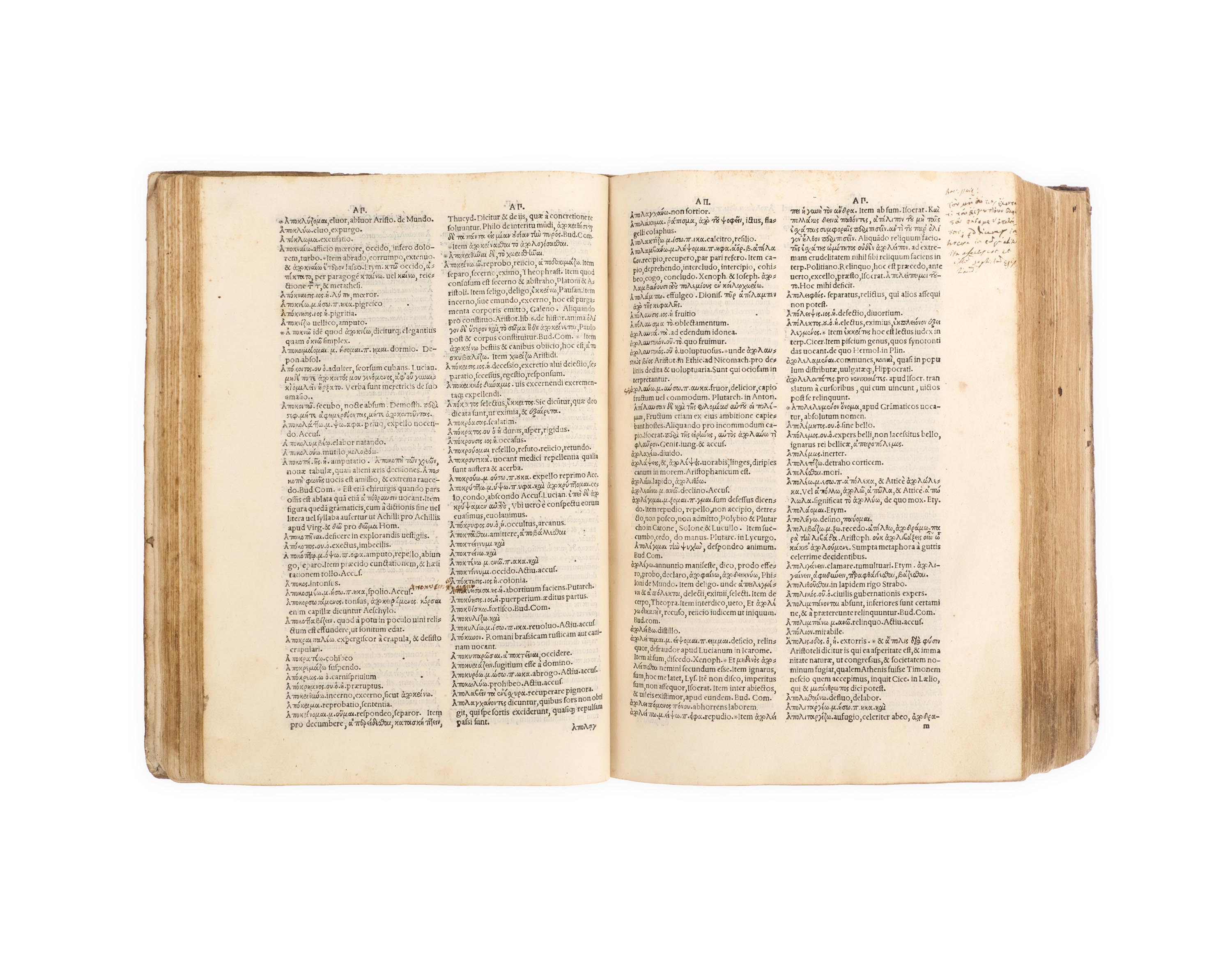
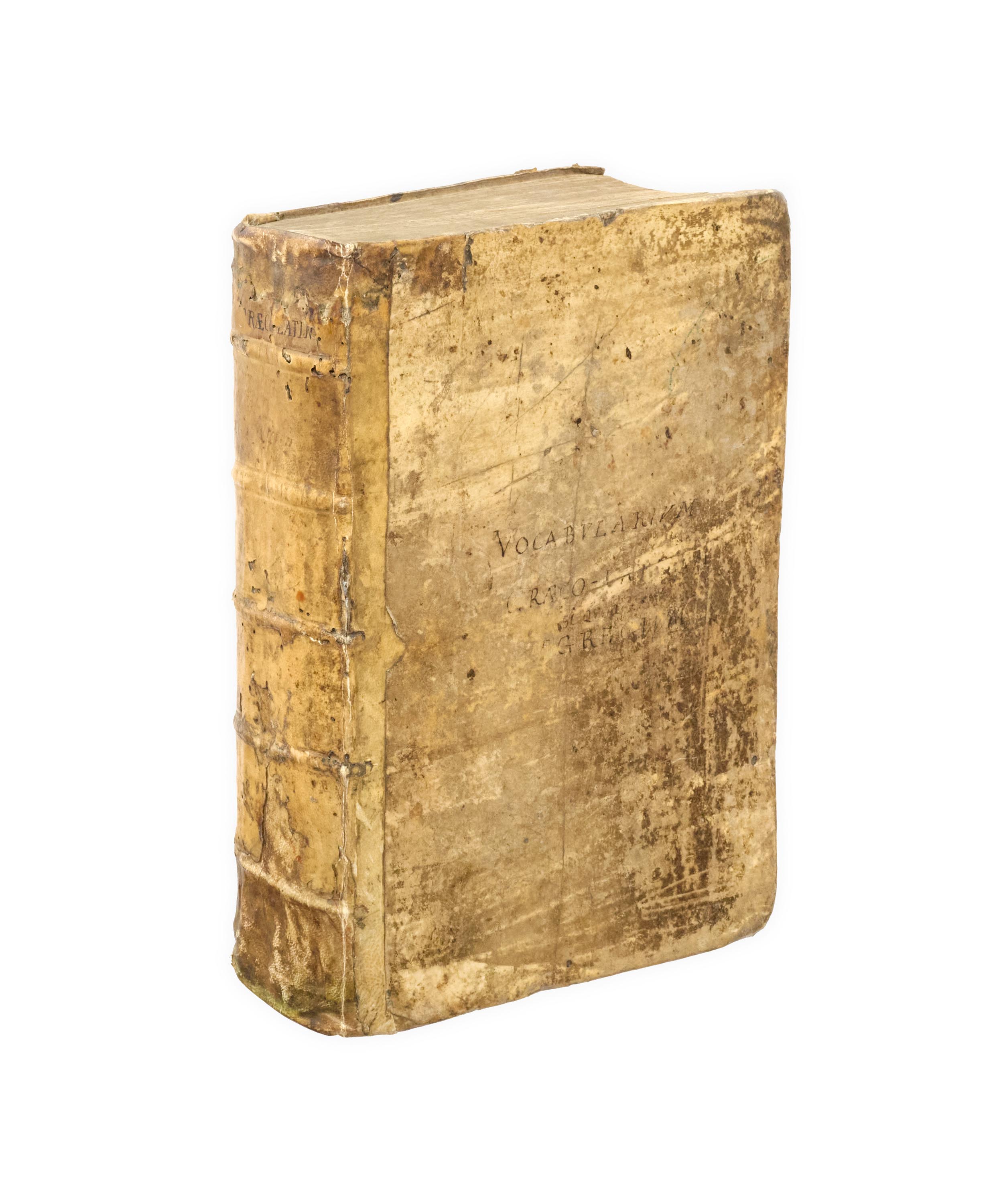
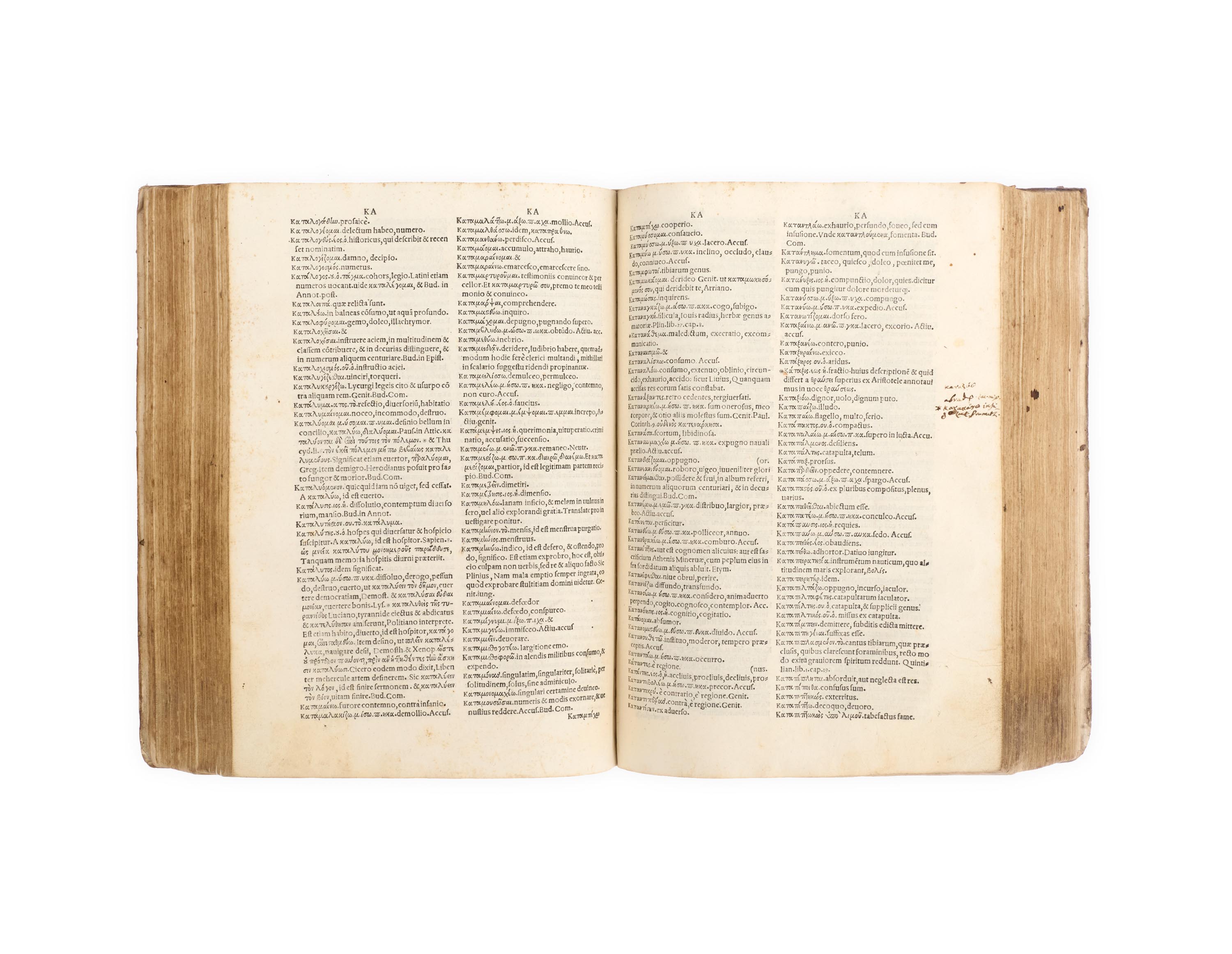
Two parts in one vol., folio, ff. [445], [1, blank], [50]; printed in Greek and roman types, main text in two columns, woodcut printer’s device within large woodcut cartouche to title, woodcut initials; final leaf torn in the upper inner corner with loss of a few characters, old repairs to verso, old marginal repairs to a few other leaves, a few scattered spots and stains, but a good copy; bound in contemporary vellum over boards, nineteenth-century manuscript lettering to front board, vestigial ties to edges; rather worn, old repairs to spine; partially erased and deleted ownership inscriptions ‘ΝΑΤΗΡ ΙΩΣΕΦ ΦΕΡΡΑΡΙΣ’ (i.e. Fr Giuseppe Ferrari) to title, subsequent inscription ‘A.B.P.M.Dre’ with date ‘1769’ in the same hand, a further note dated 1832 and some grammar notes in Greek to front pastedown, acquisition inscription dated 23 July 1829 to the rear pastedown recording the purchase of the book for five giulii in Bologna ‘ad forum Neptunium’ by a ‘Mois. Reggianius’; early marginal annotations to c. 50 pp (see below).
Added to your basket:
Lexicon Graecolatinum post omnes hactenus editiones maxima iam recens accessione ex praestantissimis Graecis ac Latinis scriptoribus locupletatum.
First edition of the Lexicon edited by the Dutch humanist and poet Arnout van Eyndhouts, or Arnoud de Lens, known as Arnoldus Alenius. Alenius’s formation took place in Paris, then Ferrara and Bologna. His proficiency as a Greek scholar earned him the post of librarian to the Spanish ambassador in Venice, Diego Hurtado de Mendoza. There he discovered, catalogued, ordered and transcribed manuscripts, especially Mendoza’s substantial Greek collection, a job which entailed much travelling and resulted in significant findings: in 1544 Alenius was able to produce, with Froben in Basel, the first printed Greek edition of Josephus, as well as other notable early editions; in 1556 he would edit an important edition of Plato, which corrected Grynaeus’ on the basis of newly-collated manuscript evidence.
This considerable feat of lexicography was published by the Brucioli brothers, Florentine humanists of Protestant leanings, exiled to Venice after being associated with a failed anti-Medici conspiracy. They ran a successful business producing, among other editions, Greek books. Alenius’ dedication of this lexicon is to Cosimo de’ Medici, perhaps an attempt on the part of the printers to re-set their relationship with the Florentine ruling dynasty. In the event, it was Alenius who would move to Florence, to work for a compatriot, the Dutch-Florentine humanist Lorenzo Torrentino (Laurens van den Bleeck), printer to Cosimo I.
The type used here is that of the Venetian typographer Bartolomeo Zanetti, as are the blocks used for the woodcut decorative components. Zanetti might have printed this work for the Brucioli brothers from the position of a semi-retired artisan, or the brothers might have acquired part of his equipment.
The dedicatory letter is followed by Janus Lascaris’ Commentariolus de formis et figuris antiquarum Graecarum literarum, on the formation of letters, and Adrien Amerot’s De Graecorum notis arithmeticis, as well as the usual appendix Farrago libellorum and Melanchthon’s short prospectus of the Greek calendar. Unlike the rest of the components of this book, Melanchthon’s text is not signposted with correct running titles: perhaps a precaution against censorship, since Antonio Brucioli had revealed his Protestant sympathies with a commentary on the New Testament, and the brothers had followed up with the publication of a work by the reformer Juan de Valdes. Their printing press was closed in 1548 following Antonio’s arrest.
This copy bears early readership marks. The annotations scattered throughout the volume appear to be mostly concerned with vocabulary of the ethico-legal sphere, suggesting possibly a scholar or practitioner of the law, or of moral philosophy.
EDIT16 CNCE 3008. See Hobson, Renaissance Book Collecting. J. Grolier and D. Hurtado de Mendoza (1999), pp. 72–73.