The Origins of Canary Wharf
WEST INDIA DOCK COMPANY.
Three documents concerning the financing and early success of the new docks at the Isle of Dogs. London, 1799–1810.
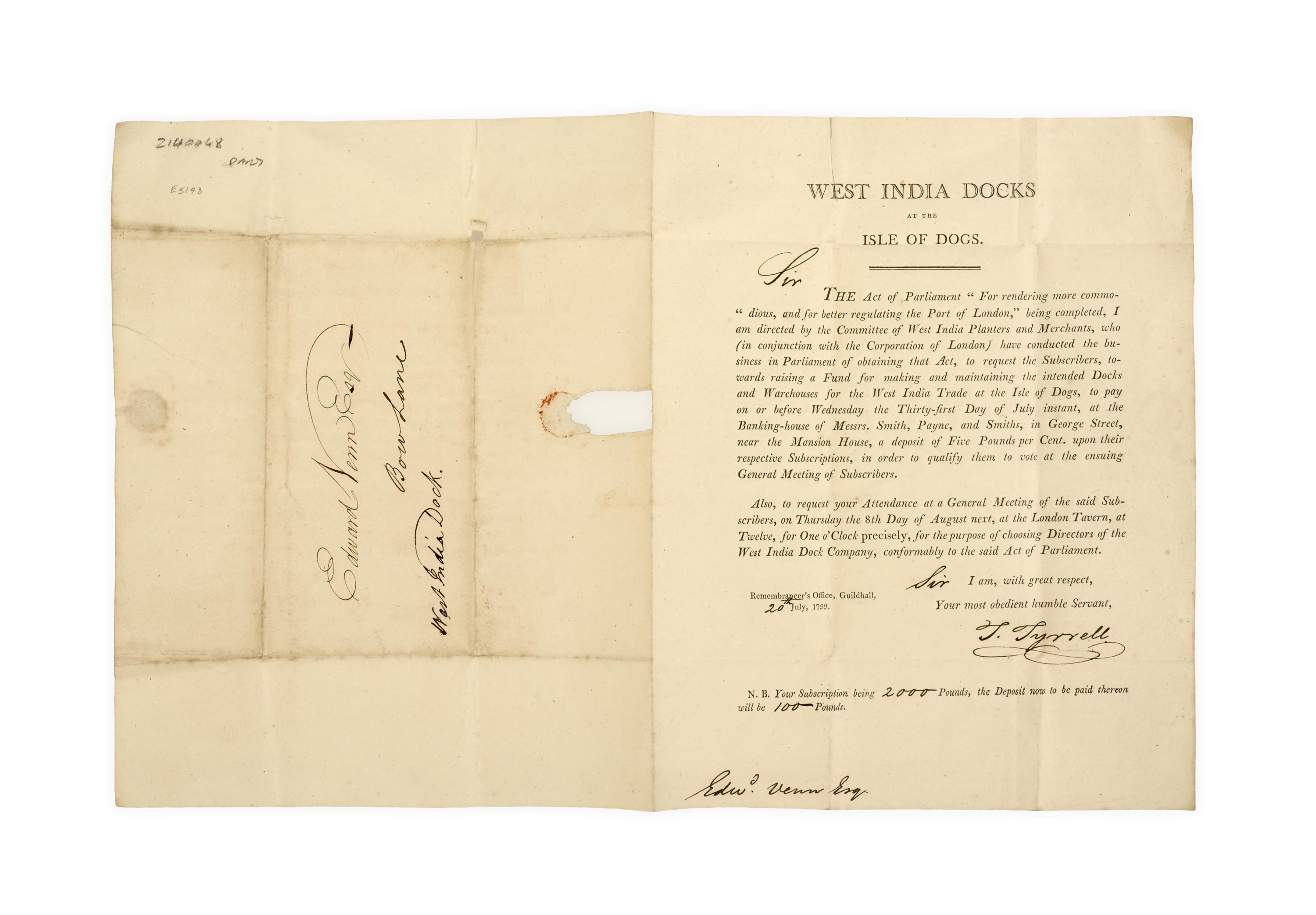
WEST INDIA DOCK at the Isle of Dogs … The Act of Parliament “For rendering more commodious, and for better regulating the Port of London,” being completed, I am directed by the Committee … to request the Subscribers … to pay … a deposit of Five Pounds per Cent. upon their respective Subscriptions …. Guildhall, [20th, in manuscript] July 1799.
1 page, 4to, with integral address leaf, addressed to Edward Venn, Bow Lane, one of the original subscribers whose subscription was £2000. The subscribers are also asked to attend a meeting on 8 August to elect Directors.
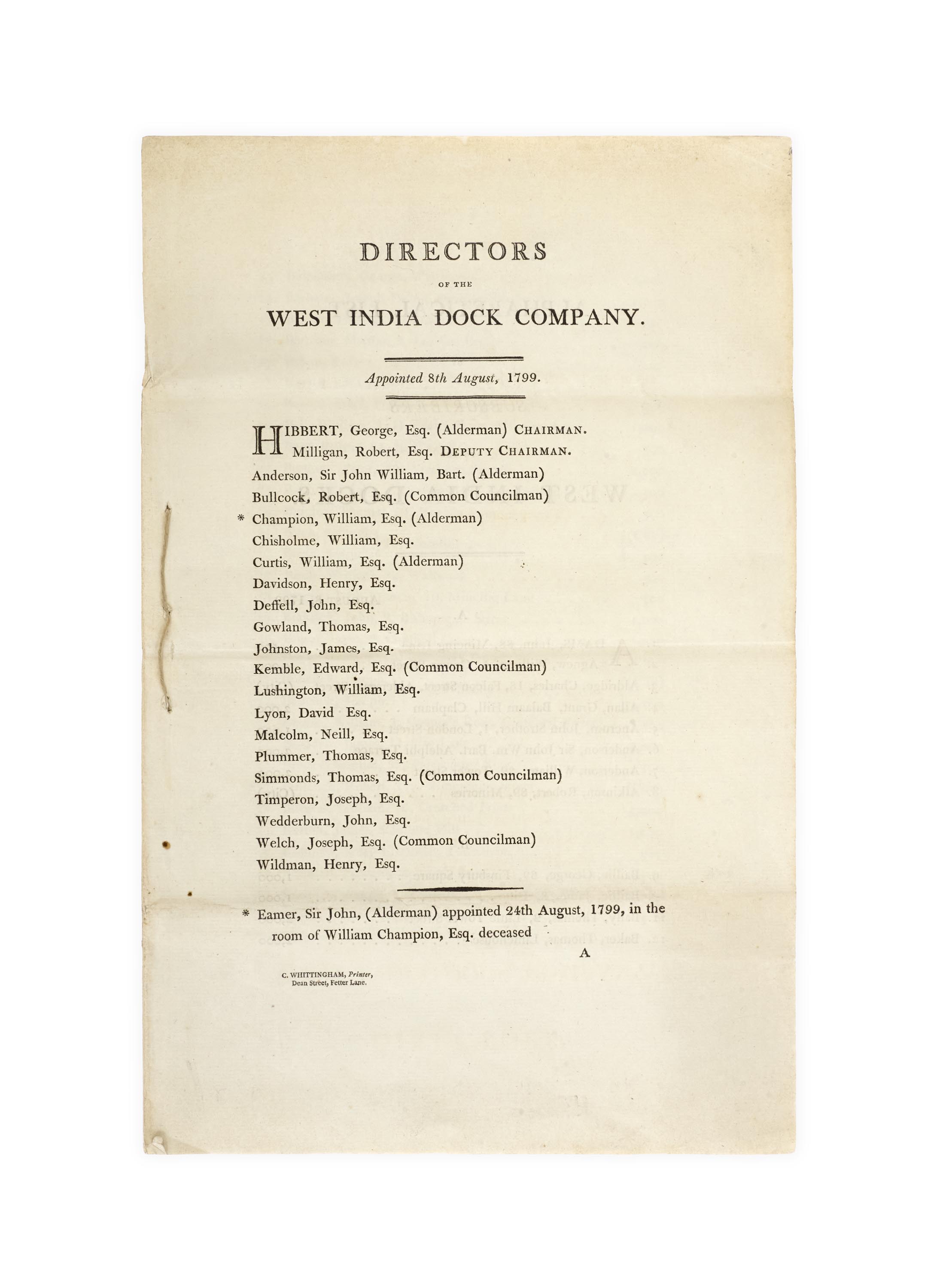
DIRECTORS OF THE WEST INDIA DOCK COMPANY … appointed 8th August, 1799 [and one on 24 August]. Alphabetical List of Subscribers [on] August 8 …. [London], C. Whittingham, Printer, Dean Street, Fetter Lane [1799].
11, [1] pp., folio, the subscriptions totalling £500,000 (including Venn’s £2000).
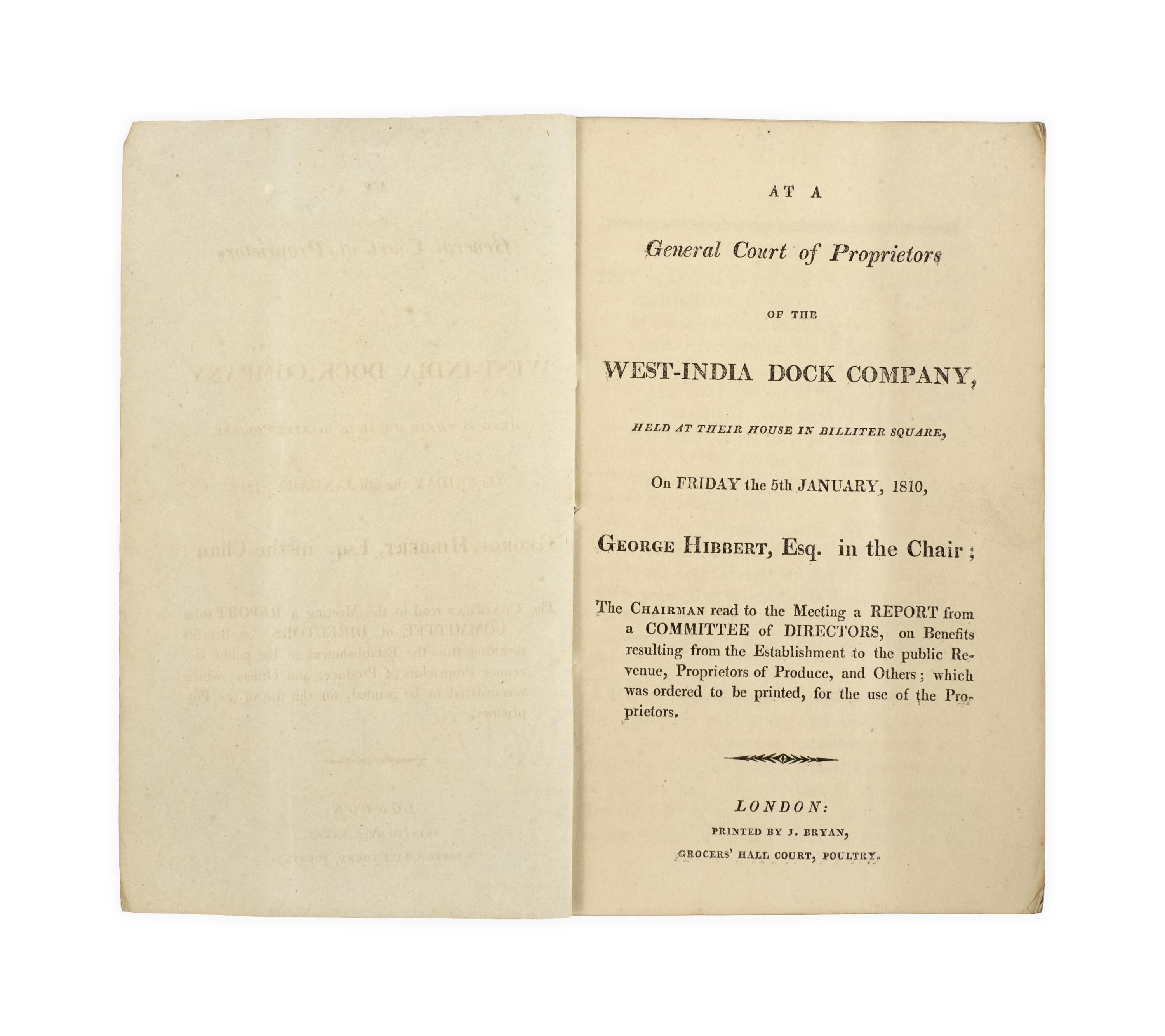
AT A GENERAL COURT OF PROPRIETORS of the West-India Dock Company, held at their House in Billiter Square, on Friday the 5th January, 1810, George Hibbert, Esq. in the Chair; the Chairman read to the Meeting a Report from a Committee of Directors, on Benefits resulting from the Establishment to the public Revenue, Proprietors of Produce, and Others …. London: Printed by J. Bryan, Grocers’ Hall Court, Poultry [1810].
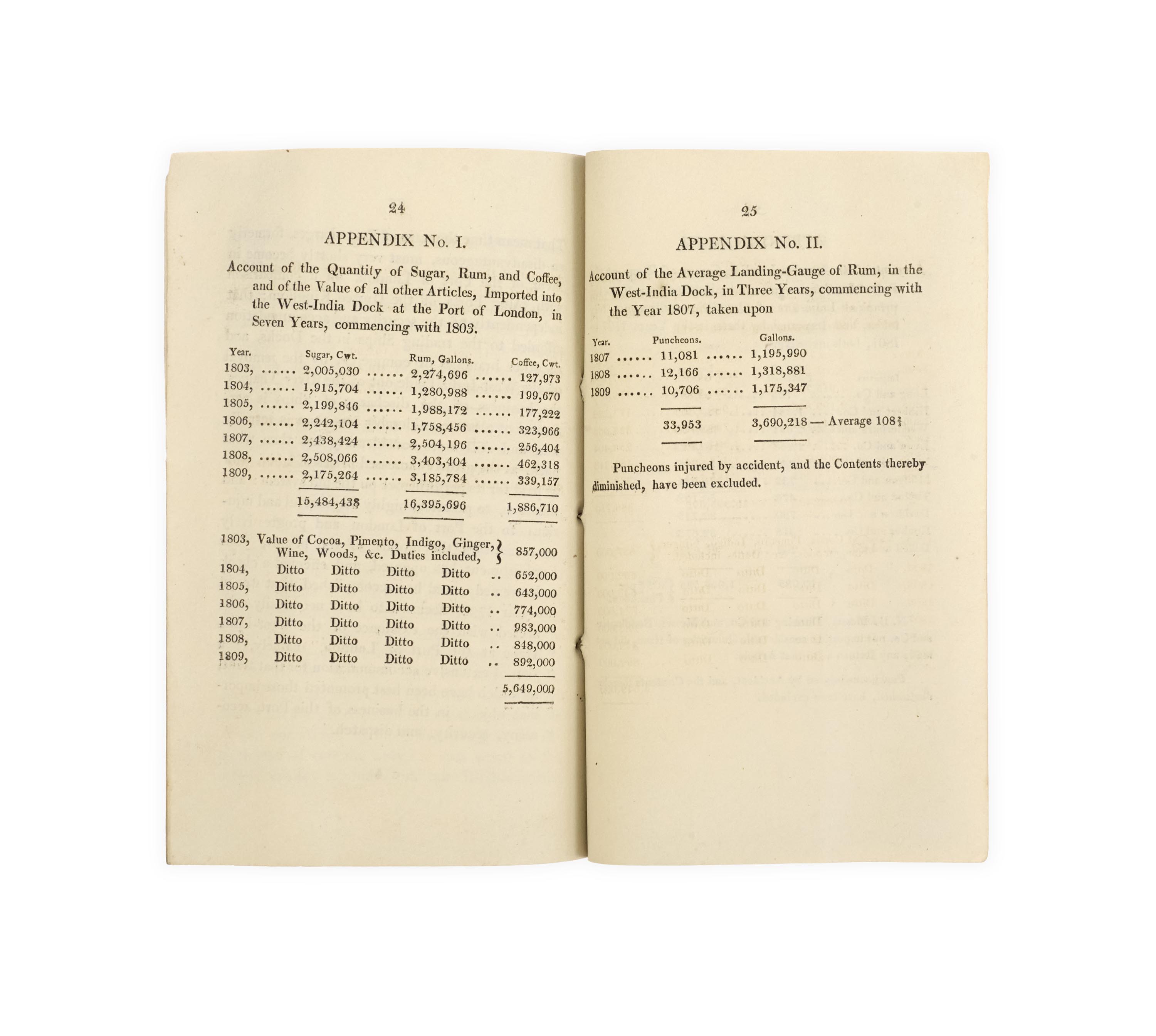
8vo., pp. [2], 34, stitched in original drab wrappers. Losses between landing and delivery at the Port of London had amounted to not less than £400,000 per year in 1799–1801. The Chairman reports that the new West-India Docks has put an end to that, as a series of appendixes shows.
Added to your basket:
Three documents concerning the financing and early success of the new docks at the Isle of Dogs.
Three key documents concerning the financing and early success of the new docks at the Isle of Dogs, the first enclosed wet docks to be established on the Thames. Their construction was prompted by West India merchants and shipowners, outraged at the losses of sugar, rum, and other cargoes due to theft and delay at the old riverside wharves.
The first two docks, surrounded by a high wall, opened officially in 1802. Robert Milligan (c. 1740–1809), the leading promoter, was the first chairman, followed by George Hibbert, the noted book collector whose library included a Gutenberg Bible.
From the 1960s as ships began to unload containers downriver at Tilbury, trade declined and in 1981 the docks were closed to be replaced by Canary Wharf. One original warehouse survives as the Museum of London in Docklands.
Three rare printed documents in fine condition. ESTC and OCLC record no copy of the first, one of the second (Staatsbibliothek Bamberg), and OCLC records one of the third (University of London).