A Paris Binding for Méry De Vic
LUCIAN of Samosata.
Opera, quae quidem extant, omnia, e Graeco sermone in Latinum, partim iam olim diversis authoribus, partim nunc per Iacobum Micyllum, translata. Cum argumentis & annotationibus ejusdem passim adjectis. Lyons, Jean Frellon, 1549.
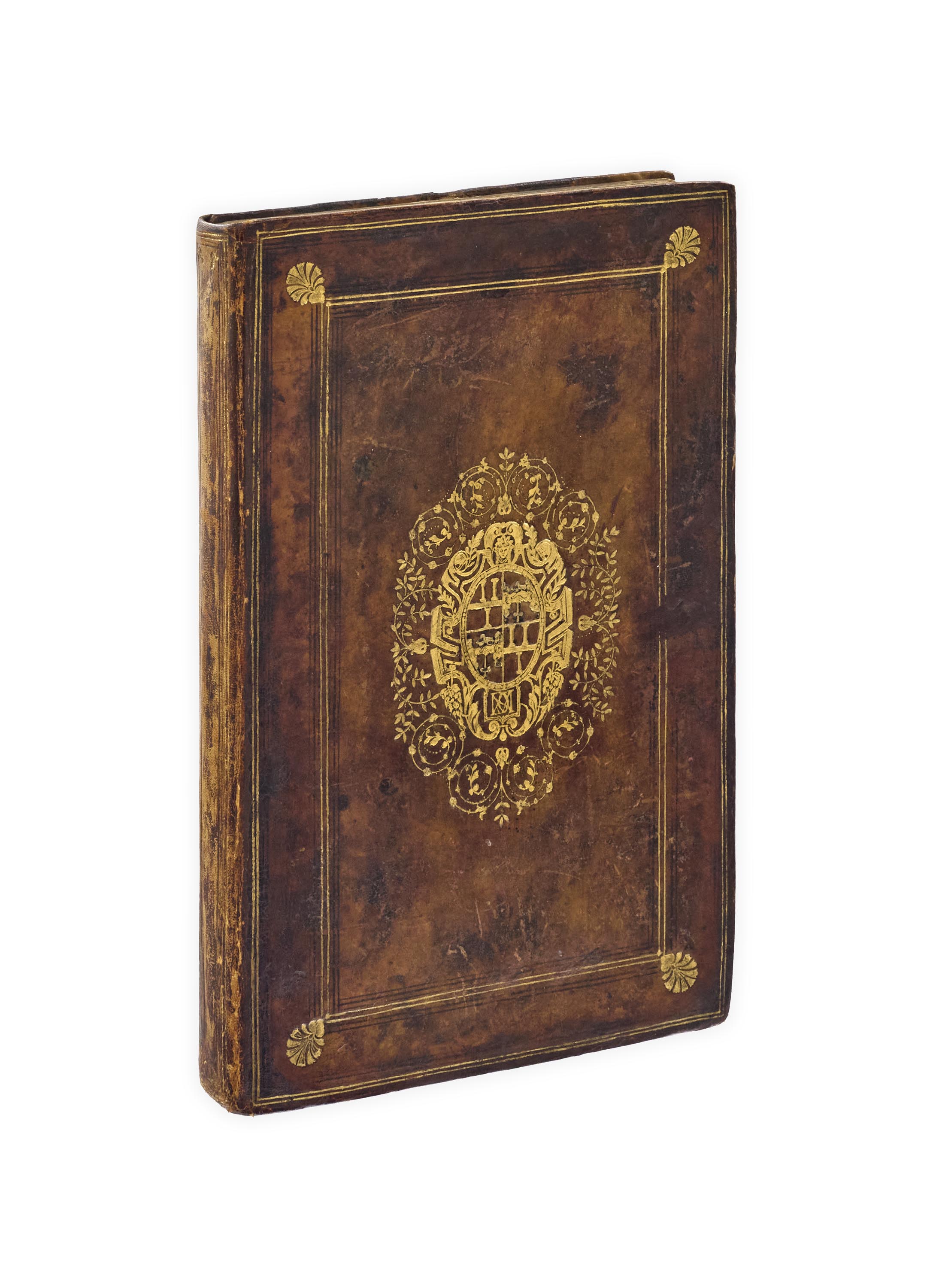
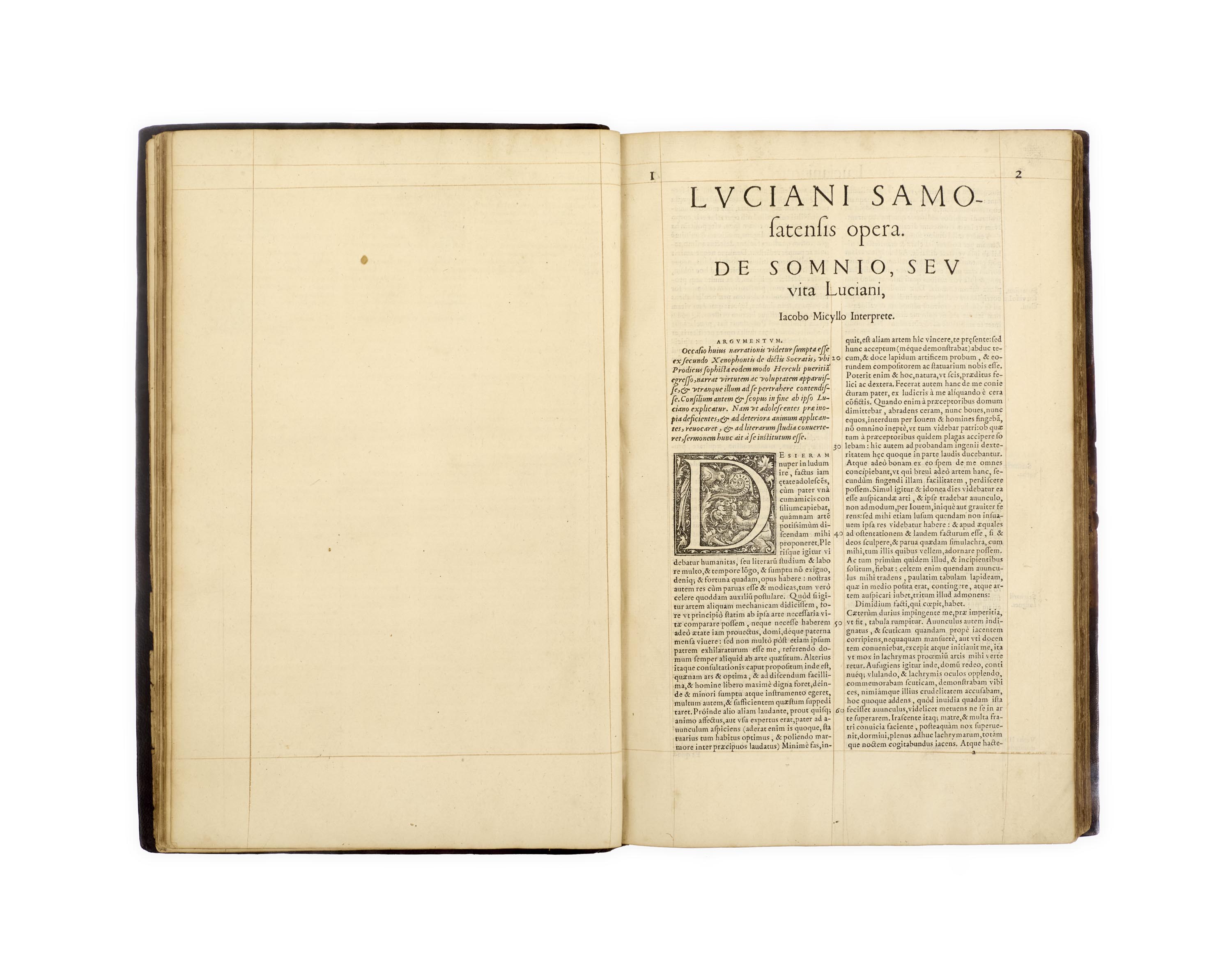
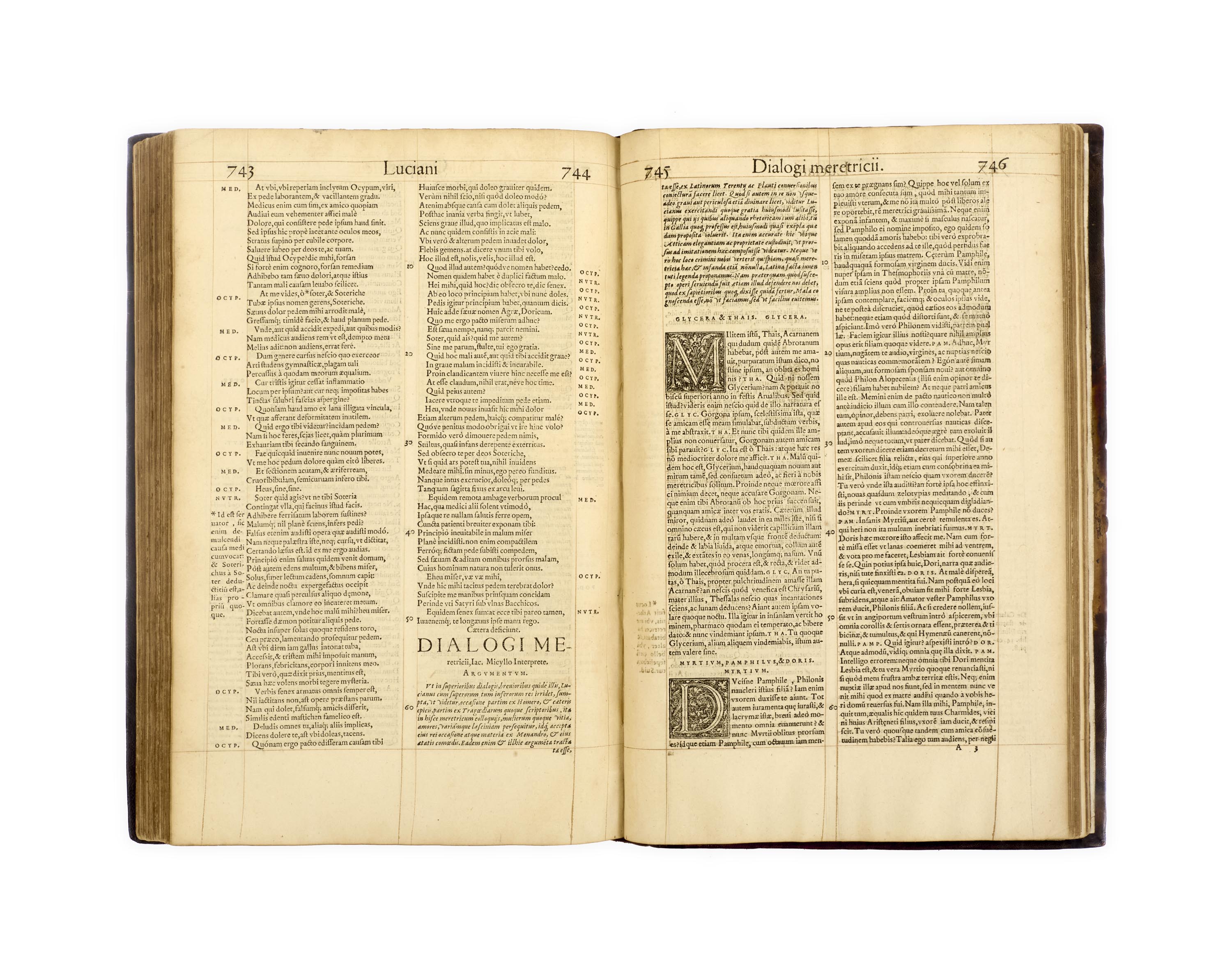
Folio, ff. [xxv], [1, blank], [224 (cols 894)]; ruled in red throughout, woodcut printer’s device to title-page, woodcut initials; lightly toned throughout, title and final leaf reinforced at inner margin with a few small chips and tears, β4.5 repaired in margins (affecting a few characters), small ink stain to upper margin of several leaves, but a good copy; bound in late sixteenth-century Parisian brown calf, central arms of Méry de Vic incorporating his monogram MSDV [Olivier 471 fer 3] blocked in gilt surrounded by foliate tooling gilt aux petits fers, boards filleted in gilt and blind to a panel design with gilt palmette cornerpieces, edges gilt; neatly rebacked to style with skilful restorations to boards, pastedowns renewed.
Added to your basket:
Opera, quae quidem extant, omnia, e Graeco sermone in Latinum, partim iam olim diversis authoribus, partim nunc per Iacobum Micyllum, translata. Cum argumentis & annotationibus ejusdem passim adjectis.
First Lyons edition of the works of Lucian of Samosata, the inventor of the comic dialogue, in a handsome contemporary Parisian binding for the French statesman and book collector Méry de Vic.
‘[Lucian’s] writings address appearance and reality, lies and truth in cultural, philosophical, religious, and social discourses. An important key to understanding his works is their intertextual richness of allusion, not only to the canon of classical literature but also to Hellenistic and imperial writings. By using various author figures and different settings, Lucian’s texts constantly change perspectives and lead their recipients to the most diverse places of the Roman Empire, to its margins or to utopian spaces’ (OCD).
For his edition of the surviving works attributed to Lucian (usually placed in the second century AD), Jacob Micyllus (or Moltzer, 1503–1558), professor at Heidelberg, incorporated translations by numerous scholars (including Erasmus, More, Melanchthon, and Pirckheimer) as well as some of his own. His edition was first issued in 1538 in Frankfurt; this 1549 edition is based on the 1546 Paris printing, with the same prefaces and extensive index.
Provenance:
Méry de Vic (1533–1622), a French statesman from the south of France, owned a substantial library, including several volumes previously owned by Jean Grolier. He bequeathed his collection to his son, Dominique de Vic (1588–1661), soon after Archbishop of Auch, and it was subsequently dispersed in 1676, though no record of the sale survives. His armorial on this binding has been slightly amended, adding a sword and perhaps a winged bird to the quarters with the clasped hands.
A very similar binding in calf, with the palmette corner-pieces and a similar petits-fers foliate border around the central armorial block, on a copy of Horace, was made in c. 1580–1590 (illustrated in Foot, The decorated bindings in Marsh’s Library, Dublin, p. 84). The same foliate tool appears on a Parisian fanfare binding for Méry de Vic from c. 1586 (Foot, Davis Gift III, no. 114).
USTC 150341; von Gültlingen VIII: Frellon 36; not in Adams.