‘What a Gruesome Spectacle’
XENOPHON; [Philipp MELANCHTHON, editor].
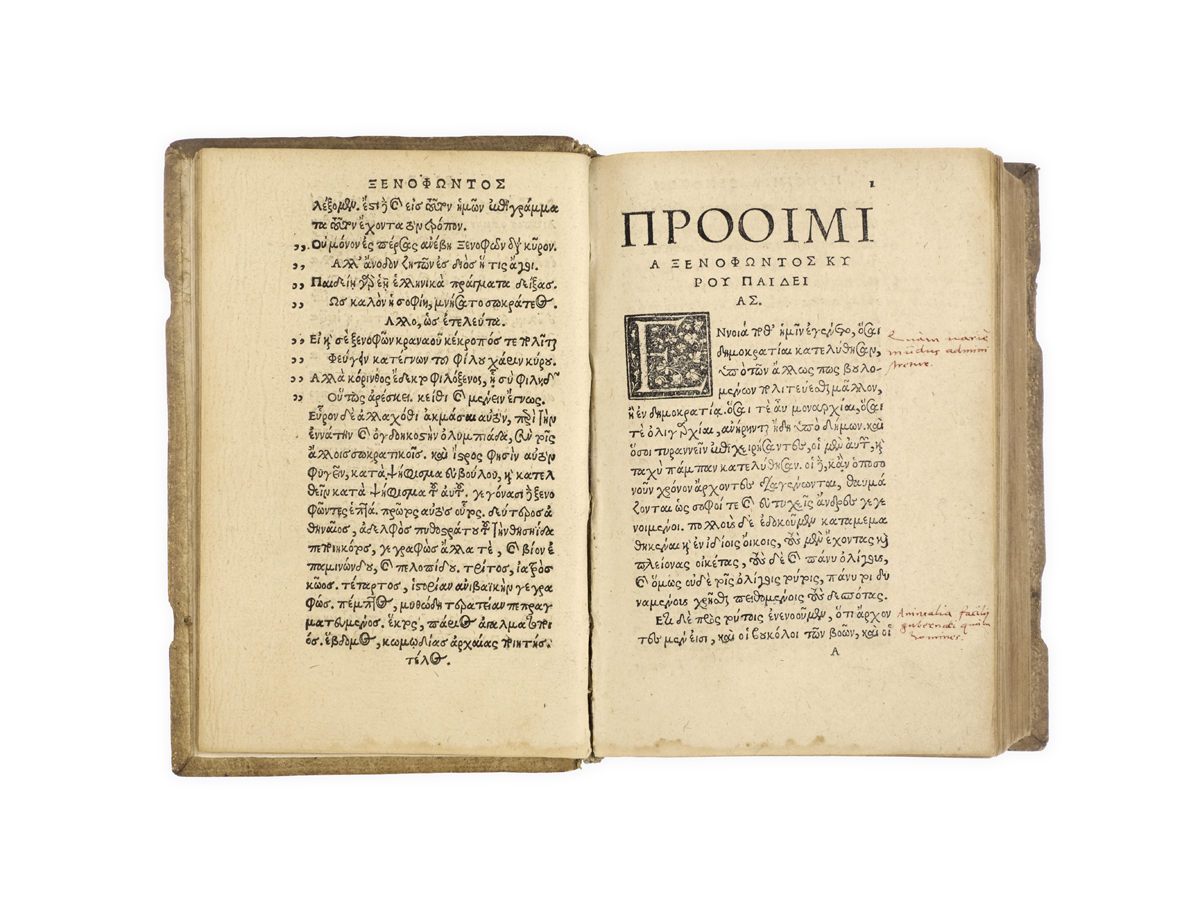
Ξενοφωντος απαντα. Xenophontis opera omnia, in tres partes distincta, quarum quaeque suos libros ostendet … Schwäbisch Hall, [Peter Braubach], 1540.
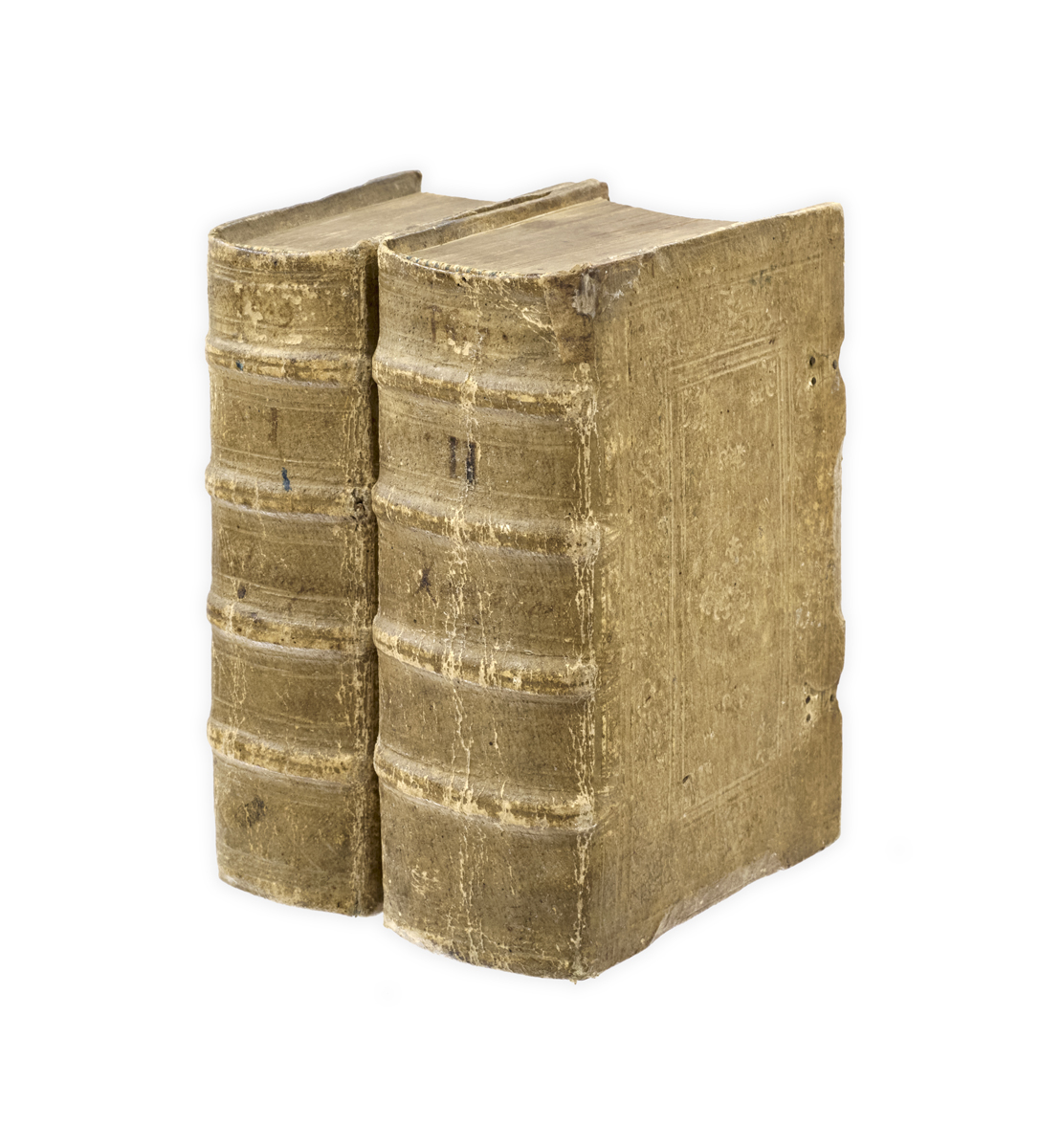
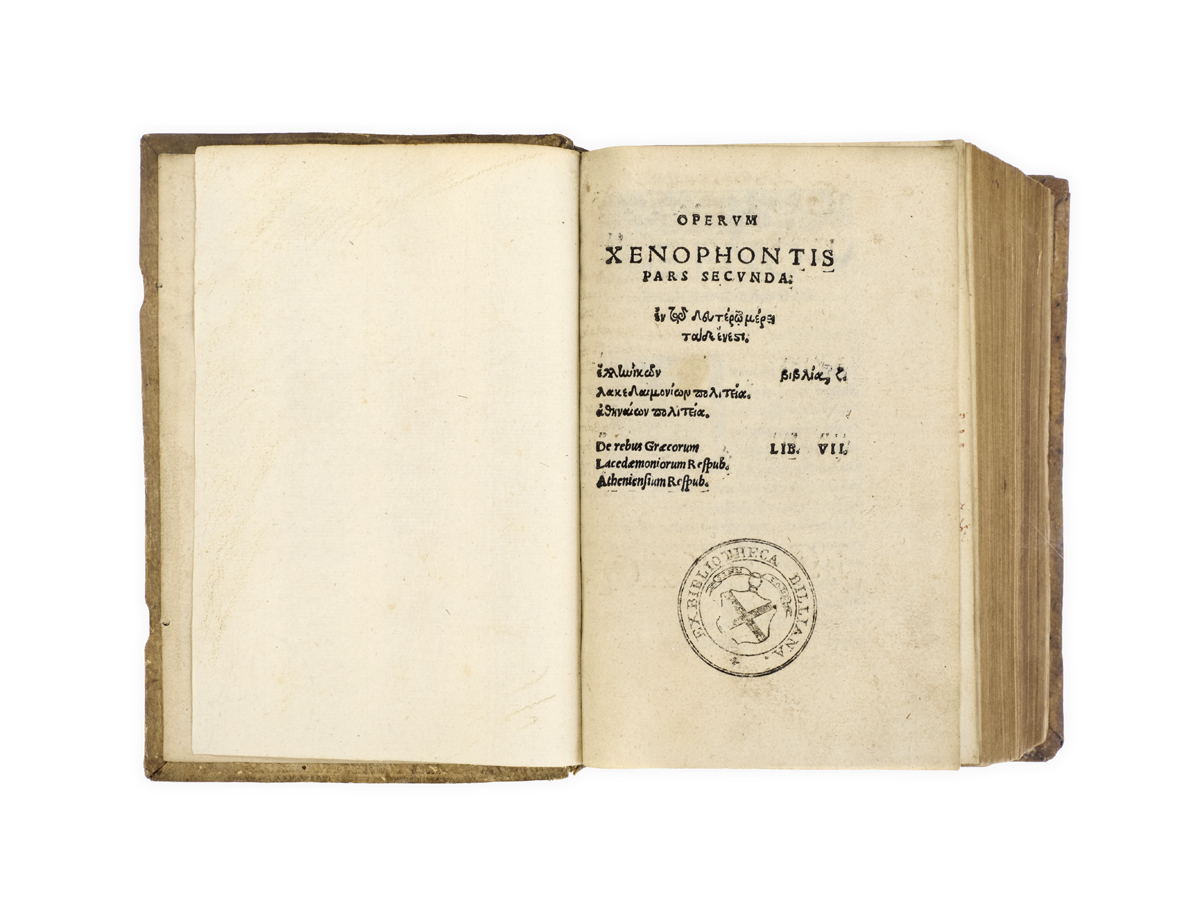
Three parts bound in two vols, 8vo, ff. I: [viii], 418, II: ii: [2], 427–592, ‘601–669’ (i.e. 593–661), [1, blank, used for manuscript title to part iii], iii: 673–983; part iii bound without the preliminary quire *4 (with title and contents to part iii, and extract from Suidas) and without final blank Qq8; large woodcut initials and headpieces; a few very slight stains, small wormholes in last few quires of vol. II (affecting a few characters without loss of sense), but a very good set; bound in contemporary German (plausibly Stuttgart) pigskin over bevelled wooden boards, borders blind-tooled with a roll incorporating a bust of a man in a hat, vol. I with arabesque centrepieces with floral cornerpieces, vol. II with a composite centrepiece of a small leafy tool repeated in corners, spines blind-ruled in compartments with later manuscript lettering, remains of two pairs of clasps; a little rubbed, vol. II with old waterstains to rear board, vol. I front hinge very skilfully reinforced, vol. II endpapers renewed; extensive sixteenth-century annotations in red and black ink in a German hand throughout, ink stamp ‘Ex Bibliotheca Billiana’ to part ii title (see below).
Added to your basket:
Ξενοφωντος απαντα. Xenophontis opera omnia, in tres partes distincta, quarum quaeque suos libros ostendet …
The first complete edition of Xenophon’s works in Greek, the earlier of two issues (see below), richly annotated in Greek, Latin, and German, from the library of Nicolas-Antoine Labbey de Billy.
Xenophon (c. 430–c. 353 BC) served as a mercenary in both the Persian and Spartan armies, resulting in exile from Athens, which he dedicated to writing. His substantial output (most of which survives) covered a broad range of topics on Greek history, philosophy, and political theory, including his renowned biographical study of the sixth-century Persian king Cyrus the Great, and the Anabasis, telling of Cyrus the Younger’s rebellion and the fate of the Ten Thousand. His writings were considered stylistic models and became a staple for the educational market in the first half of the sixteenth century.
This set of the complete works is based on the 1527 Giunta edition, though with the addition of the Apology of Socrates. The first part contains Cyropaedia and the Anabasis, the second part the Greek historical works, and all the shorter works are in the third part. This edition is found in two issues, which is not noted in the bibliographies; ours is the earlier of the two. There is an omission in the text at the end of the pseudo-Xenophon Constitution of the Athenians which concludes the second part; the present copy has six leaves in quire gg, whereas another later issue has quire gg reset with ten leaves (our issue accords with the collation in Adams, but is not noted in VD16). The issue with gg10 also has a printed note in the margin of gg3v: ‘Hic totus locus ad finem usque, non est in Florentino, repositus aut[em] in hunc locum is qui in ποροις est’ (this entire passage up to the end is not in the Florentine [manuscript], yet restored to this place is that which is in ‘Ways and Means’). Similarly, each issue has different text on Ee1r–3r, the end of Ποροι (Ways and Means), and the rest of quire Ee is in different settings but contains the same text.
The introduction to the Loeb edition states that two of the manuscripts containing the Constitution in the Laurentian Library in Florence end at the point where the later issue inserts the additional text. The text for the Constitution in the Loeb edition is the same as here until chapter 17, after which it conforms to the other 1540 printing, with the additional text inserted from Ways and Means.
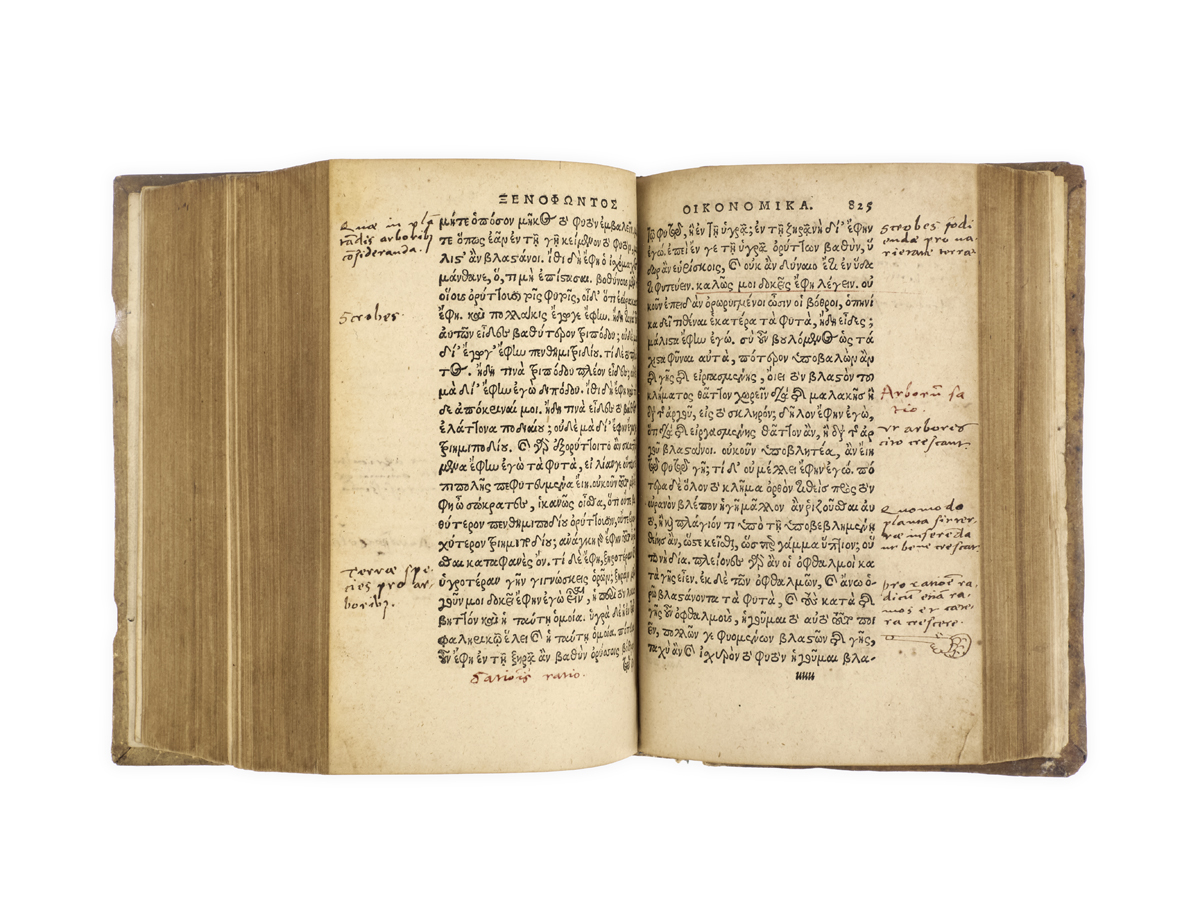
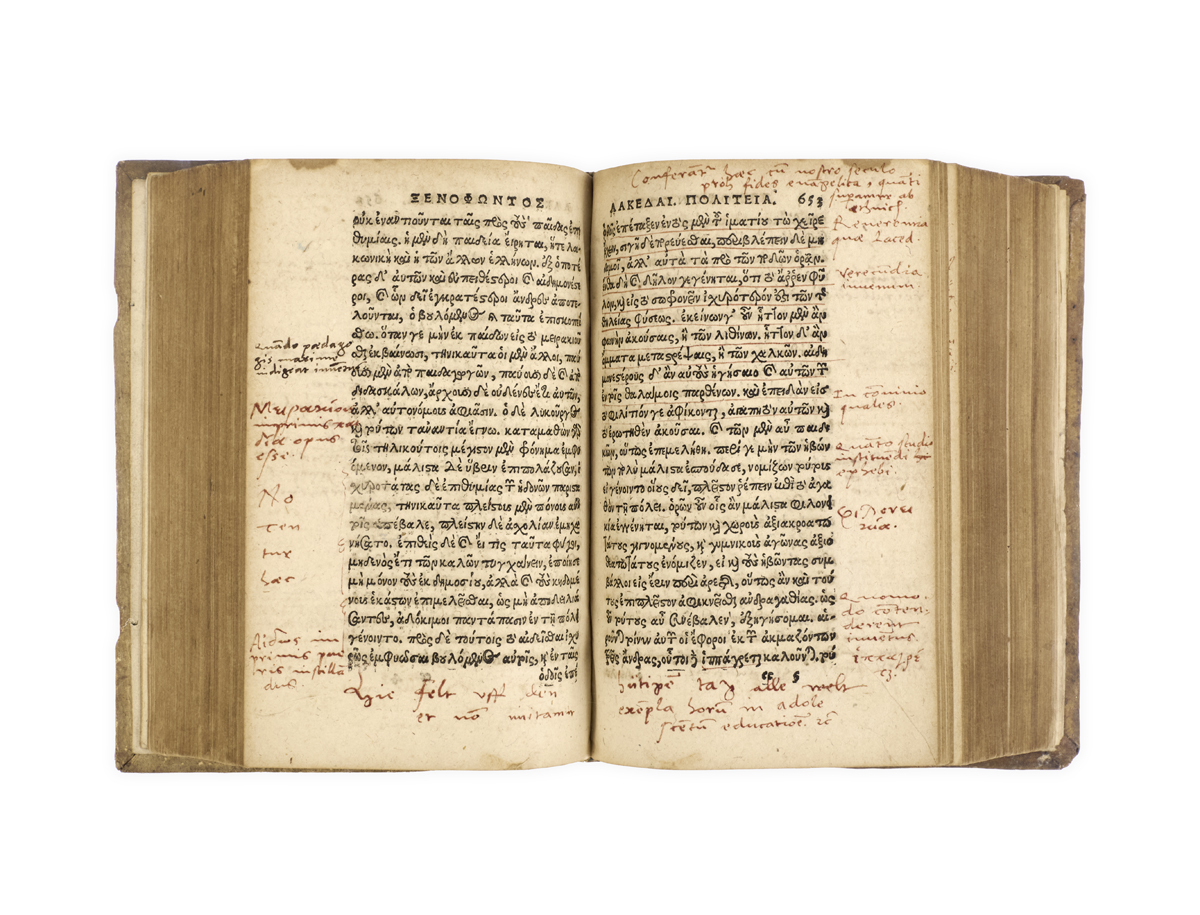
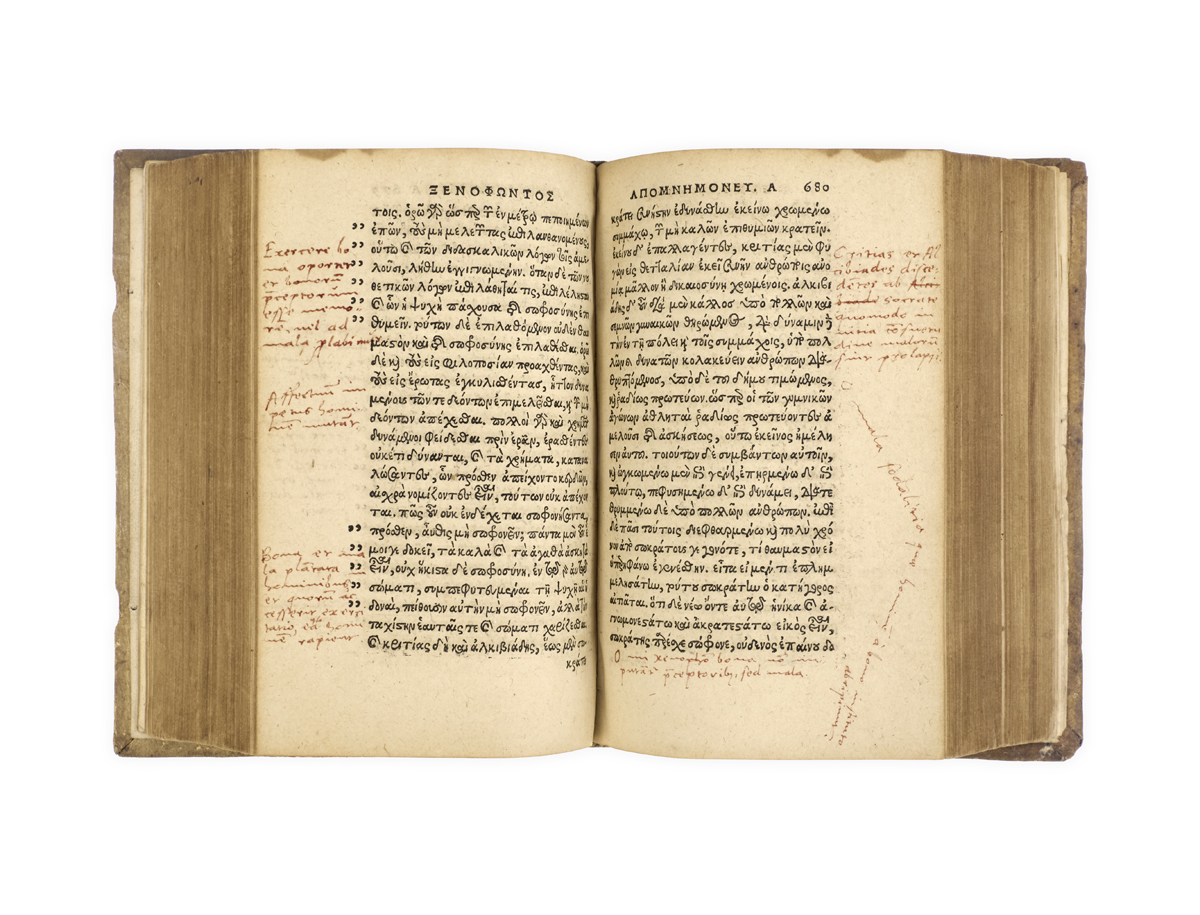
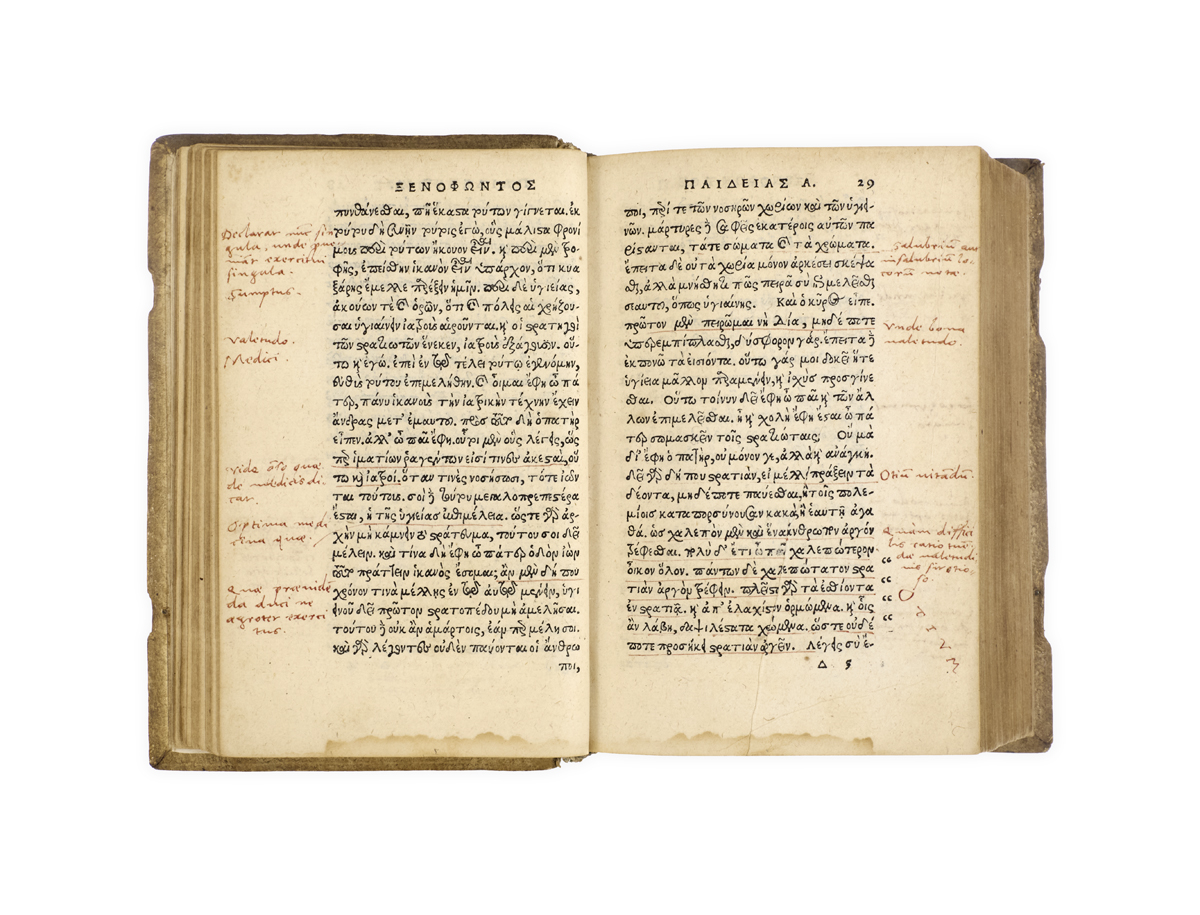
The marginal annotations, which occur on almost every page, are predominantly in Latin, indicating the characters in the narrative and events taking place, as well as translations and interpretations. The notes in Greek repeat words and phrases from the text and occasionally provide textual corrections. There are also marginal notes in German, somewhat unusually, indicating the nationality of the annotator; on f. 841v is written ‘Was ein grusam spectakell’ (what a gruesome spectacle). The first volume is annotated in red ink, and the second volume in black and red; the annotations in black ink are in the same hand but perhaps written later, on occasion correcting an annotation in red ink, and there is some underlining of significant passages. While the volumes are annotated throughout, not just in specific works, we can see that the annotator was more interested, for instance, in the sections on economics and tyrants than on horses; in the Symposium he notes ‘Paupertatis usus iucundi’ (the delightful uses of poverty). A later hand, in a blacker ink, has expanded some of the contractions and ligatures in the text, on ff. 655–656, and supplied the manuscript title wording for the third part.
Provenance:
From the library of Nicolas-Antoine Labbey de Billy (1753–1825), priest, historian, and professor at Besançon. He went into exile during the Revolution, returning in the early nineteenth century with a considerable library of historical works and Greek and Latin books and manuscripts. They were put up for auction by his sister in Besançon in March 1826; we have not been able to trace this volume in the sale catalogue, though item 201 is ‘Xenophontis Cyropediae. In-12’, and 202 ‘Autres ouvrages grecs. 25 vol. de petits formats’.
USTC 707512; VD16 X 2; Adams X 6.