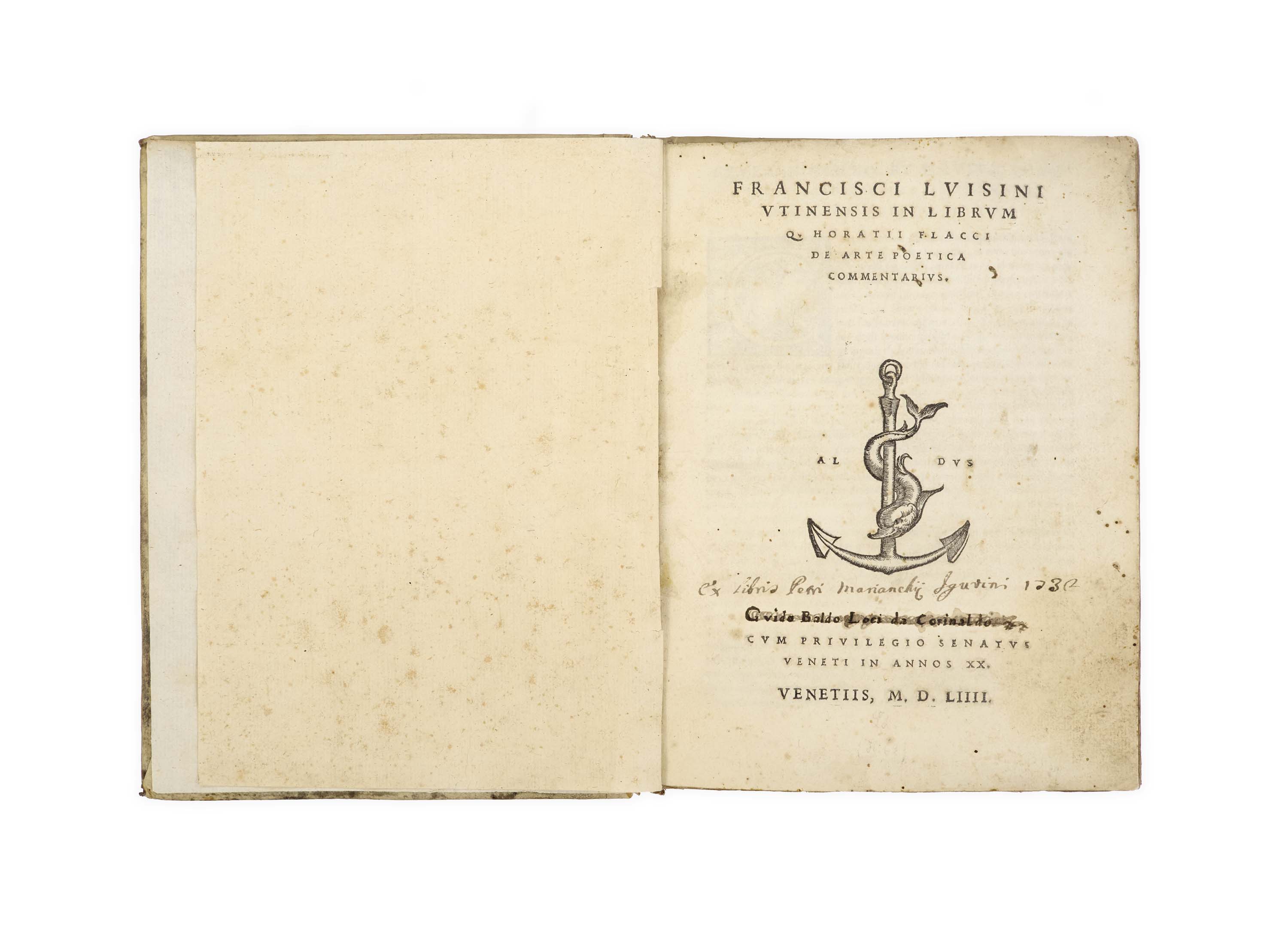
Horace on How to Write a Poem
LUIGINI, Francesco.
In librum Q. Horatii Flacci de arte poetica commentarius. Venice, [(colophon:) sons of] Aldus, 1554.
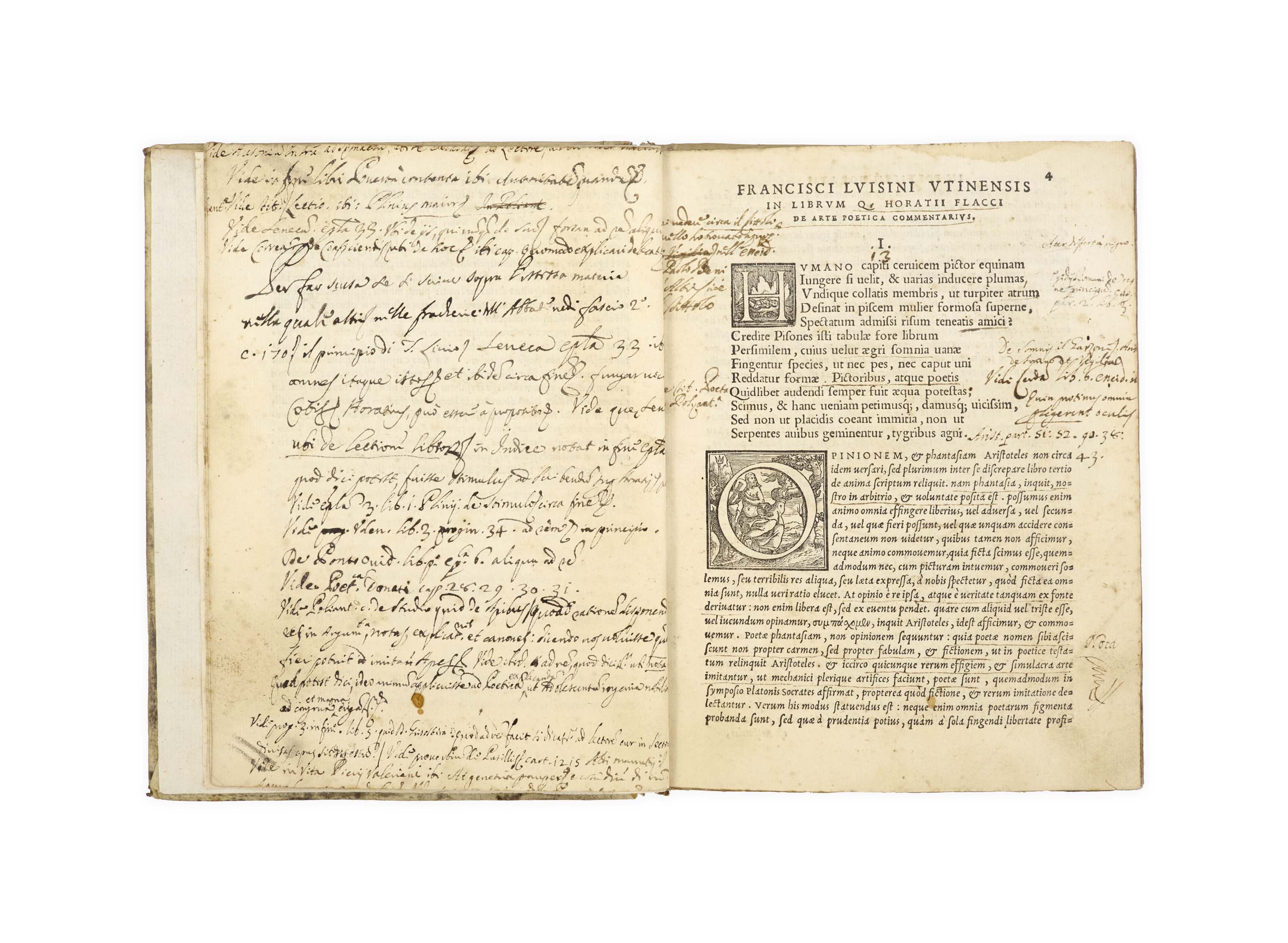
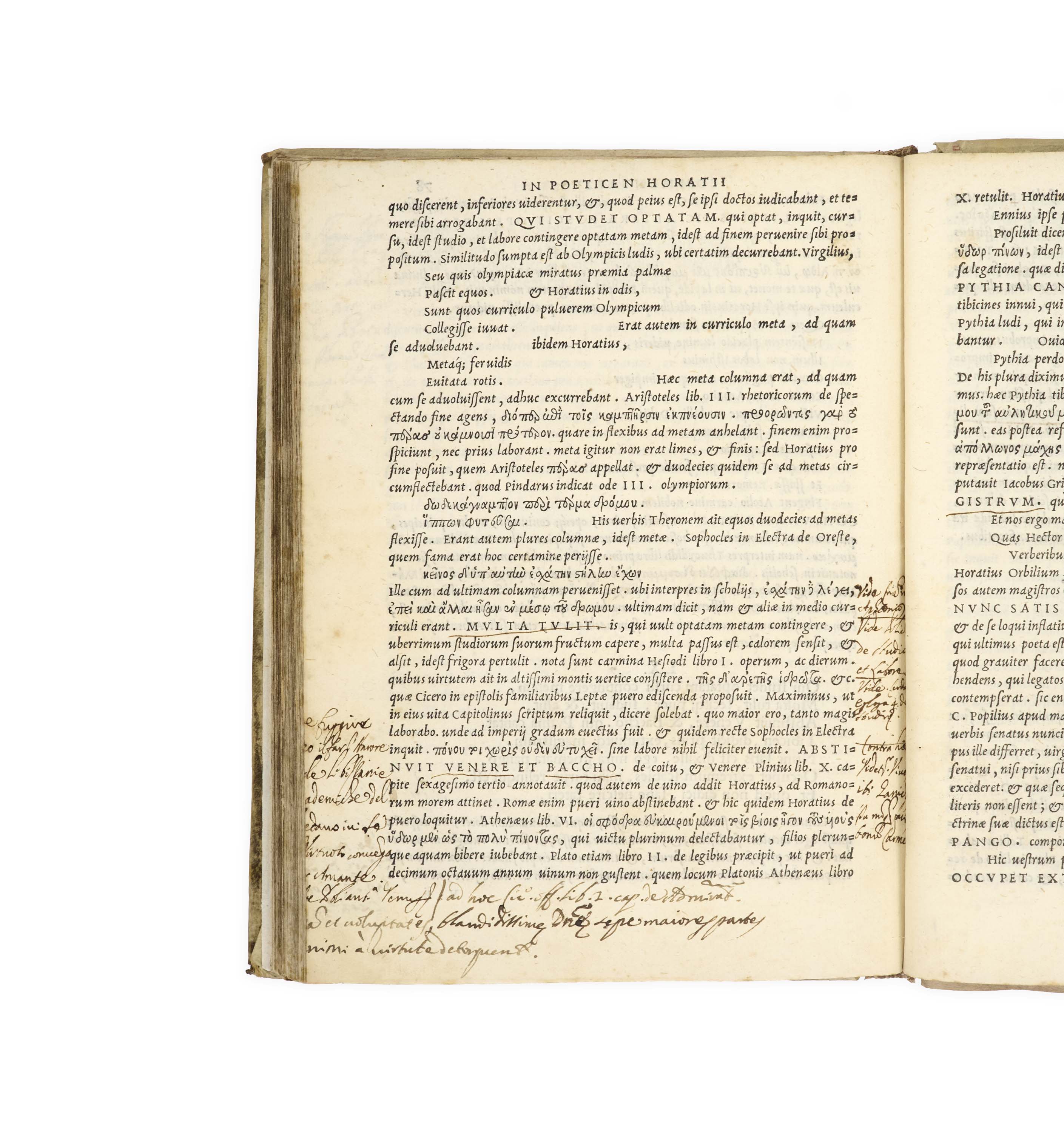
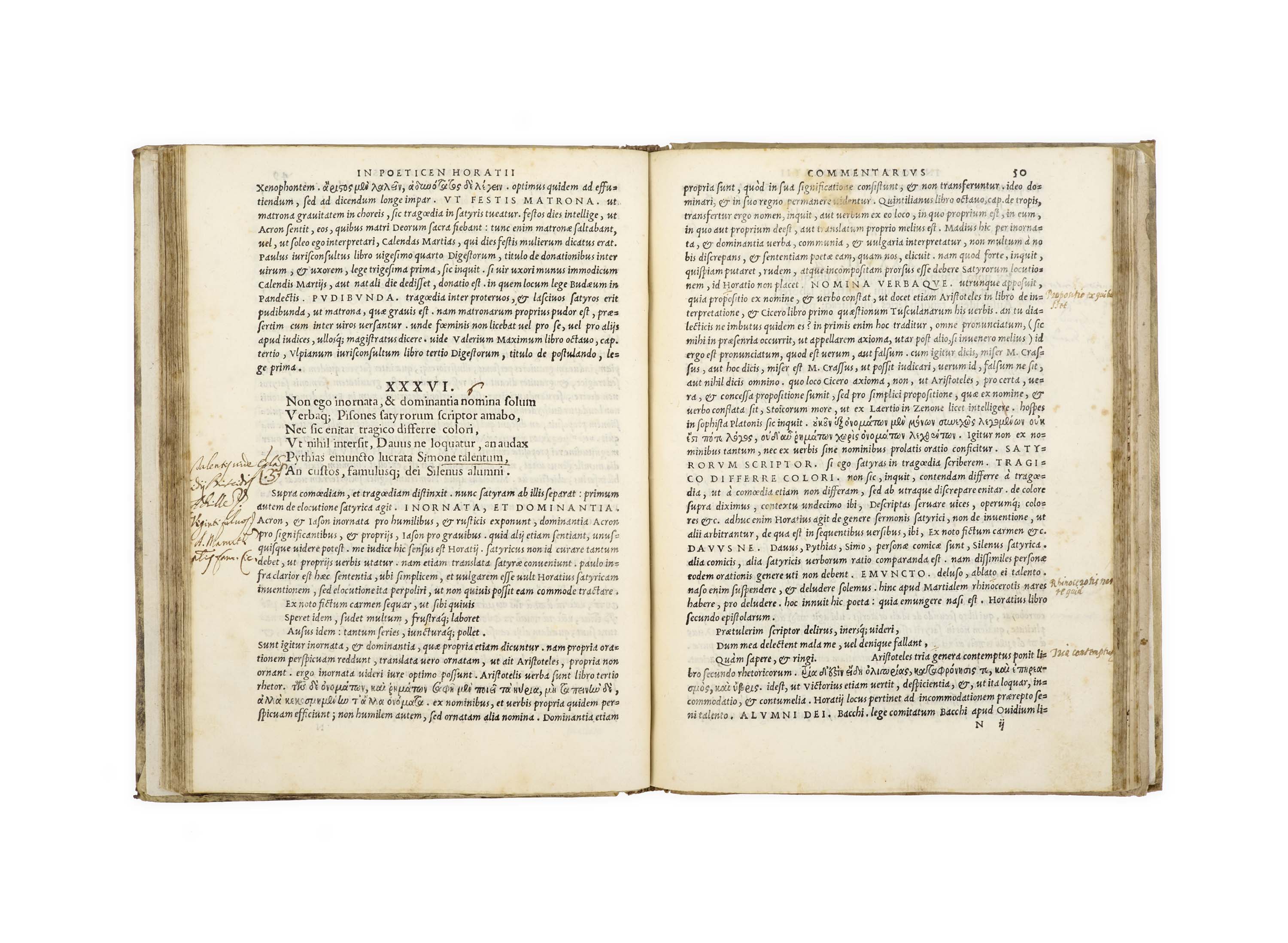
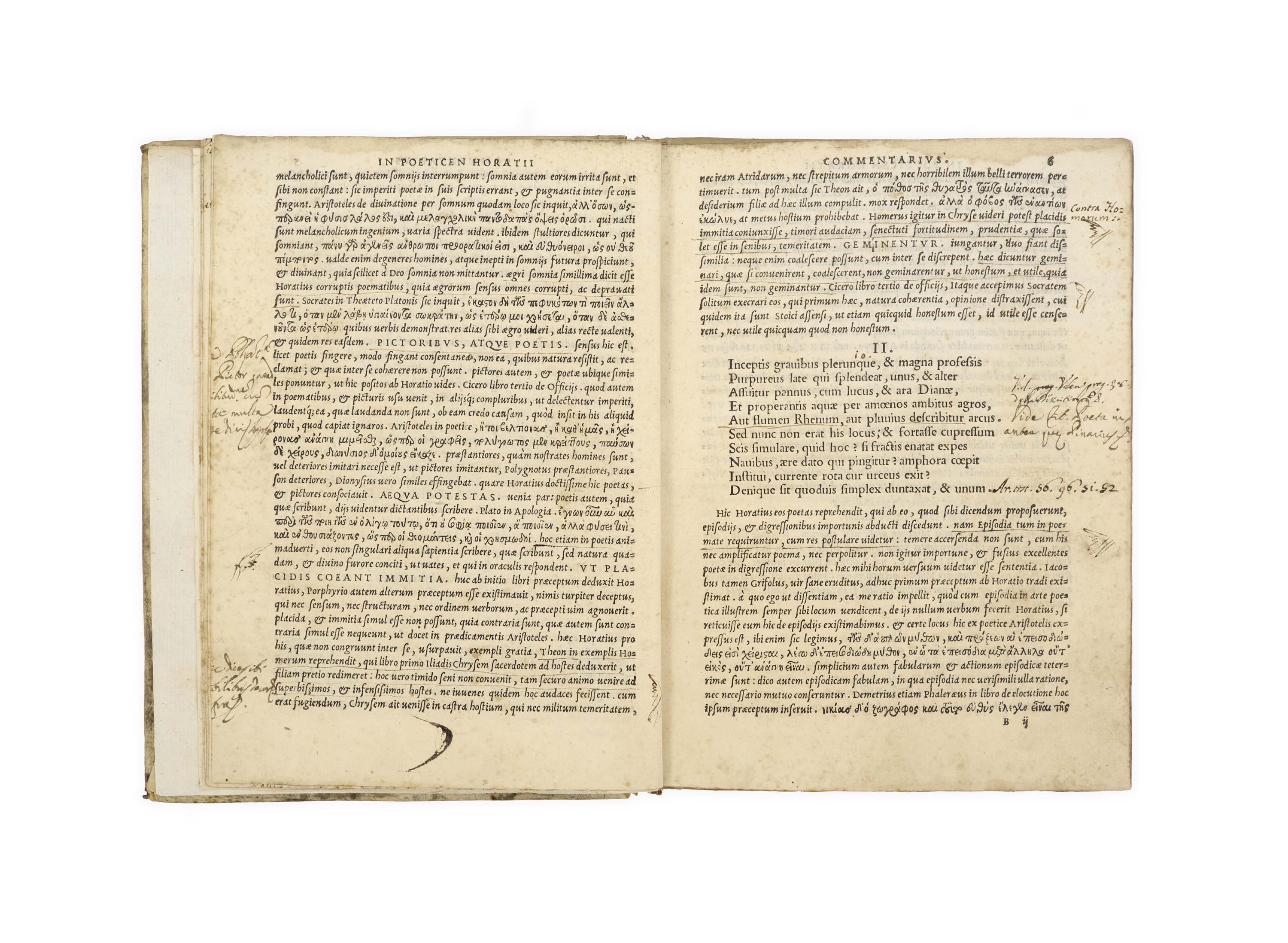
4to, ff. 86, [2, errata and device]; text of Horace in roman type, Luigini’s commentary in italics, and a few words printed in Greek, woodcut Aldine device to title-page and final verso, woodcut initials; light scattered foxing throughout, small dampstain to outer corners of first and last leaves, but a good copy; bound in modern vellum, manuscript lettering in ink to spine; sixteenth- and seventeenth-century annotations in Latin and Italian to c. 90 pp., a few manicules, seventeenth-century inscription of Guidobaldo Loci da Corinaldo to title-page (now crossed through), inscription of Pietro Marianchi dated 1732 to title-page; some annotations cropped.
First and only edition of Luigini’s commentary on Horace’s Art of Poetry, with a preface praising Paolo Manuzio.
Francesco Luigini (1524–1568), a poet and scholar from Udine, studied in Padua, and became acquainted in Venice with Paolo Manuzio and his associates. At the time of publication, Luigini was teaching in Reggio Emilia, having been recommended to the post by Paolo himself, and he dedicated the work to his former pupil, Alvise Correr, who by this time was a cardinal. Shortly after publication, Luigini became tutor and then secretary to Alessandro Farnese (later the 3rd Duke of Parma and Piacenza).
The Latin and Italian annotations are in several different sixteenth- and seventeenth-century hands, predominantly supplying references to other texts, and correcting the text using the errata. The sixteenth-century annotations are simpler, often just repeating a word or phrase from the text, but the seventeenth-century notes are much more expansive; the blank page at the end of the preliminaries has been completely filled with writing, much of it in Italian, with references to other relevant classical texts, including Ovid, Pliny, and Seneca. Contemporary humanists are also referenced in the marginalia, including Piero Valeriano, Paolo Manuzio, Aldus Manutius and Scaliger, and modern editions of classical texts (such as Piccolomini on Aristotle’s Poetics). The annotator also has recourse to works of less obvious relevance, such as Famiano’s De bello Belgico (D4r) and Albertus Magnus (E2r). Several mentions are made of Tommaso Correa (1536–1595), a Portuguese scholar who taught at Rome and Bologna, the author of De arte poetia Q. Horatii Flacci explanationes (Venice, 1587), but the text referred to most regularly is the Polyanthea, an alphabetical compilation of Christian and classical culture, first printed in the early sixteenth century.
The name Erasmus in the text on B3r has been crossed through, a common occurrence in Catholic lands. While it is likely that the annotations are by one or both of the names given on the title-page, the handwriting is not sufficiently identifiable.
Provenance:
1. Guidobaldo Loci, from Corinaldo (near Ancona), was a canon there in the mid-seventeenth century. He wrote a panegyric entitled the ‘Sacred triumph of the miraculous Madonna of Constantinople’, printed in Pesaro in 1654 (USTC 1742933).
2. Pietro Marianchi from Gubbio (Umbria).
EDIT16 CNCE 27191; USTC 838848; Renouard 162/20; UCLA 457.