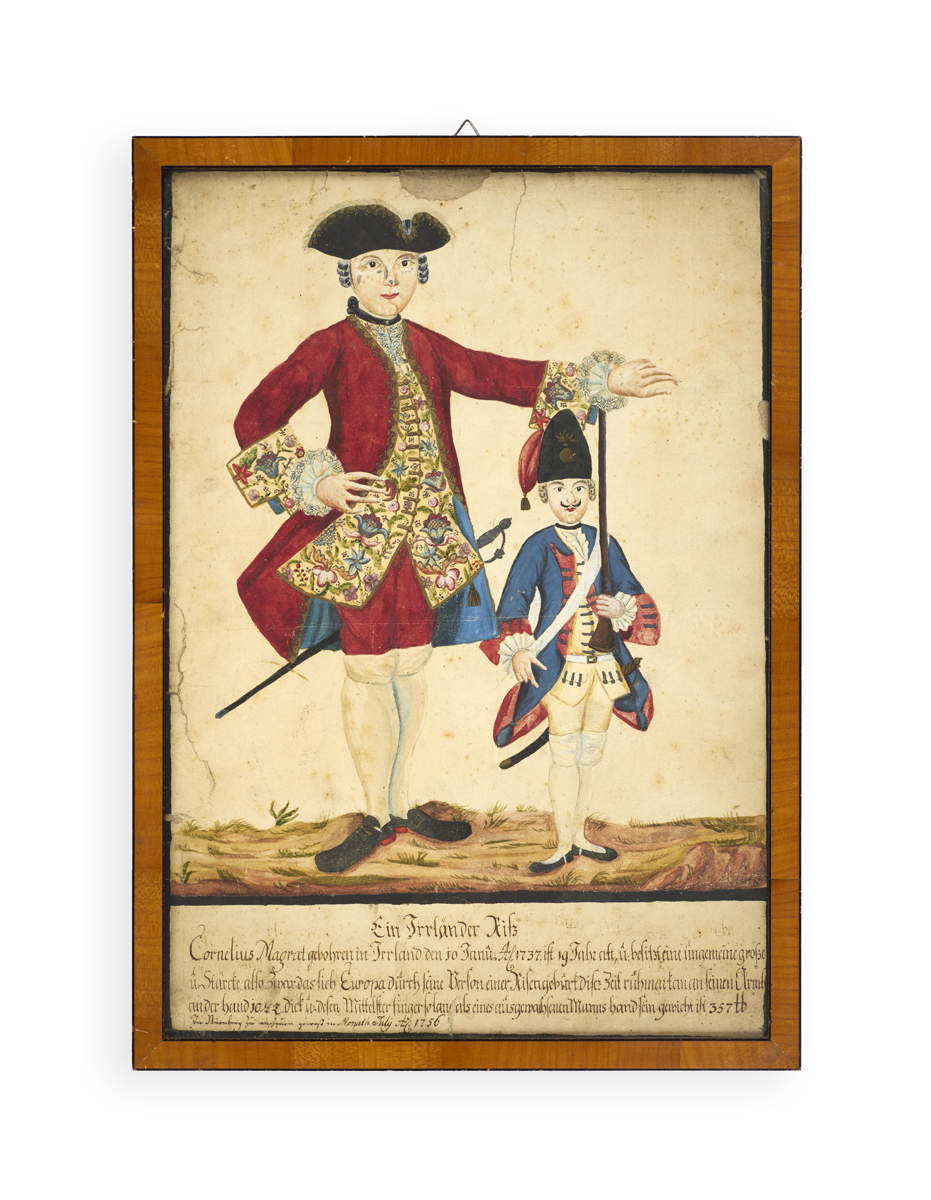
‘The Irish Giant’
[MAGRATH, Cornelius.]
‘Ein Irländer Riss …’ Nuremberg, 1756.
Drawing on paper (c. 410 x 285 mm), in red, yellow, blue, green, and white ink, and gilt, with a black border, lettering in black at the foot; some foxing, old repairs to tears, small portion wanting from head, laid on card, later framed and glazed.
A delightful promotional image for the Continental tour of ‘The Irish Giant’ Cornelius Magrath (1736/7–1760), ‘To be seen in Nuremberg in the month of July 1756’.
Cornelius Magrath (1736/7–1760), born in Tipperary, was already famous for his stature by the time he arrived in London in 1753 at the age of sixteen. Reported then as seven foot three inches tall, he had grown an extraordinary twenty-one inches since the age of fifteen. After touring England Magrath progressed to the Continent, where at least two portraits were made of him, an engraving by Johann Nepomuk Maag (c. 1724–1800) made in Regensburg in 1756 and a painting by Pietro Longhi produced in Venice in 1757. The current image proves that he was in Nuremberg in July 1756. He returned to Ireland after becoming ill in Flanders in 1760 (we now know he suffered from phthisis) and died in May that year. After his death his skeleton became part of the anatomy collection at Trinity College Dublin, though the legend that it was stolen by students is almost certainly false.
The current drawing, showing Magrath towering over a Prussian soldier (the Prussians then known as the tallest in Europe), is very similar to the Regensburg engraving by Maag, though the elaborate floral decoration on Magrath’s waistcoat is different. The text is largely the same as in the engraving but with two differences (‘Irrländer’ for ‘Irrländischer’, and ‘ungemeine’ for ‘ungewöhnliche’), and an additional line at the foot: ‘Zu Nürnberg zum anschauen … in Monath July AC. 1756’. Not enough is known of Magrath’s European itinerary to determine whether this image precedes or is derived from Maag’s more highly finished engraving.