
Gaisford’s Copy with His Letters
PLUTARCH; Daniel WYTTENBACH, editor.
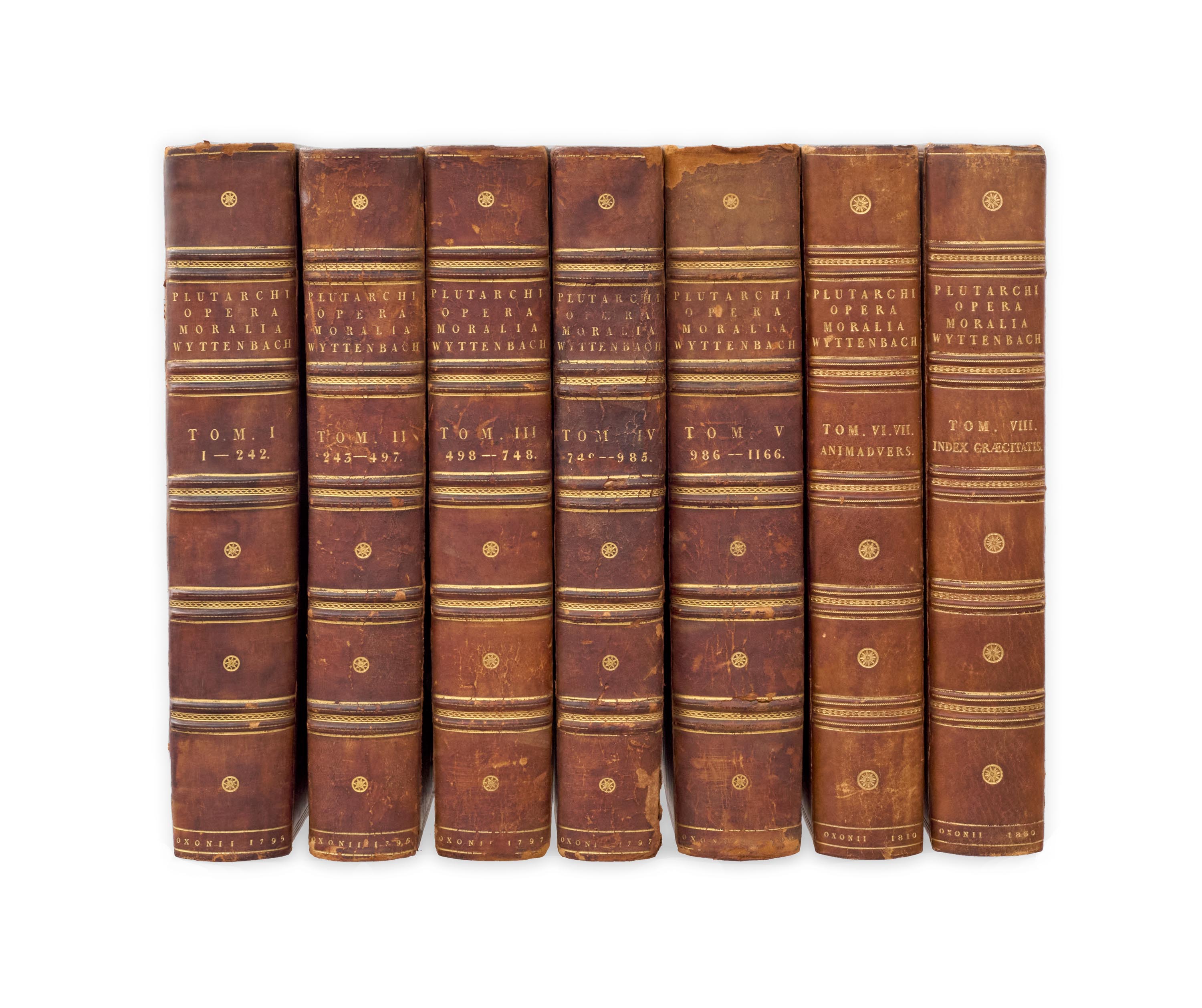
Τα εθικα. Moralia, id est opera, exceptis vitis, reliqua. Oxford, Clarendon Press, 1795–1800; 1810; 1830.
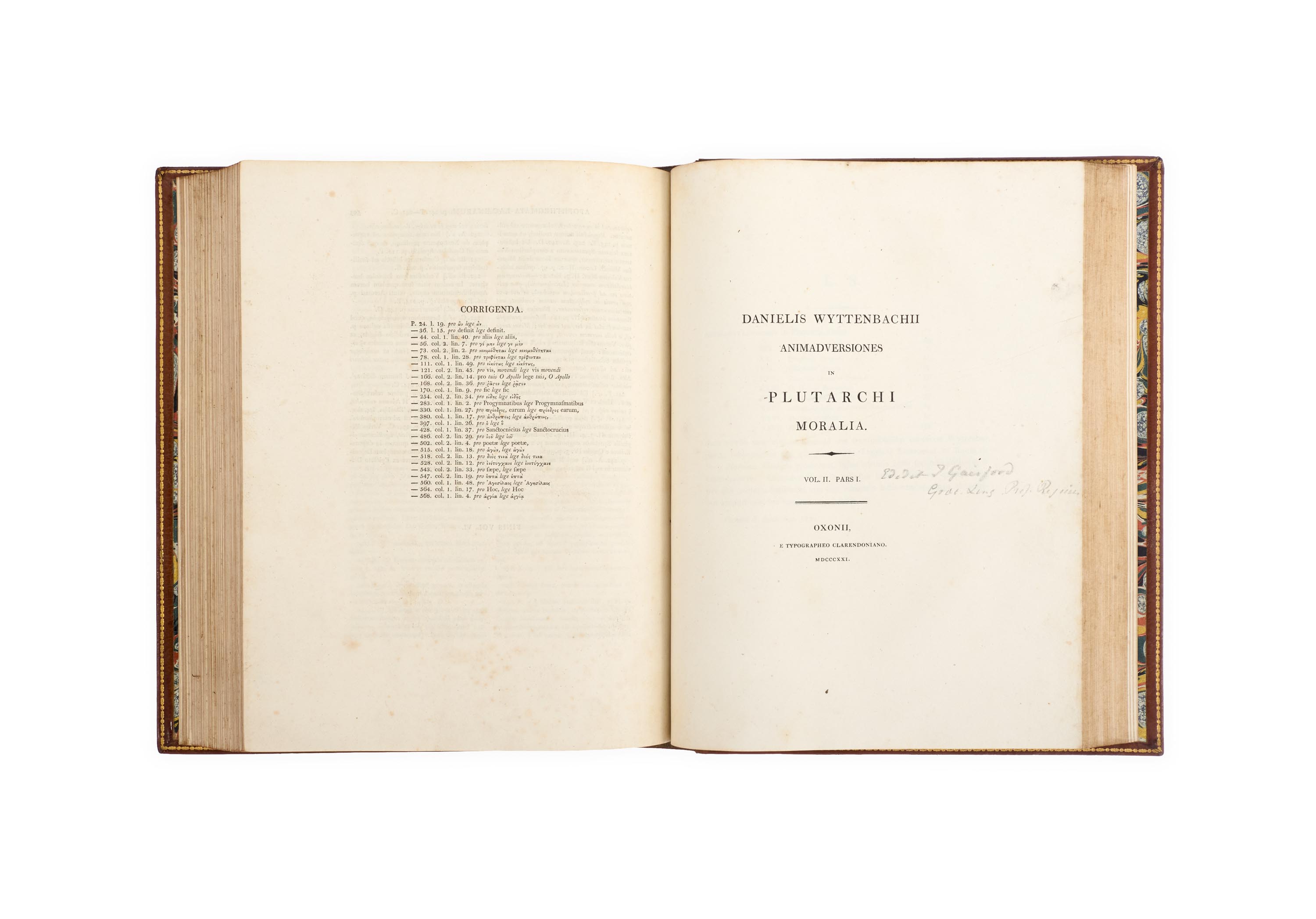
Eight vols bound in seven (vols VI and VII bound together), large 4to, I: pp. xcviii, [2], 683, [1, errata], II: iv, 697 [1, errata], III: iv, 755 [1, errata], IV: [iv], 662, [2, errata and a blank], V: [vi, including replacement contents leaf], 869 [1, errata], VI: [iv], 593, [1, errata], VII: [iv], 224, VIII: [iv], 785, [1, blank]; slight damp-staining towards the end of vol. I, start of vol. IV damp-stained, occasional foxing of endleaves, vol. VIII with some light foxing; a fine copy in near-contemporary smooth calf, triple gilt fillet border, gilt arms of the University of Oxford on covers (vols I–V only), spine gilt-tooled and -lettered, edges gilt; extremities slightly rubbed, some joints cracked, slight loss to spine leather of vols IV and V and to cover of vol. VII; armorial bookplates of Thomas Gaisford, Dean of Christ Church, front cover of the Ulster Journal of Archaeology (vol. XXVII, 1964) loosely inserted at the end of vol. III.
Gaisford’s own copy of the Oxford Plutarch containing letters between him and the editor, Daniel Wyttenbach.
Dr Thomas Gaisford (1779–1855) was appointed Regius Professor of Greek at Oxford in 1812, and later became Dean of Christ Church in 1831. He had an active role at the University Press, promoting the printing of Greek texts, and at the Bodleian. There is an early pencil annotation on the title-page to volume VII: ‘Edidit T. Gaisford Graec. Ling. Prof. Regius’, and a few ink corrections to the text of Wyttenbach’s Animadversiones; and next to the heading for the Monitum at the start of volume VIII is written in pencil ‘by Dr Thos Gaisford’.
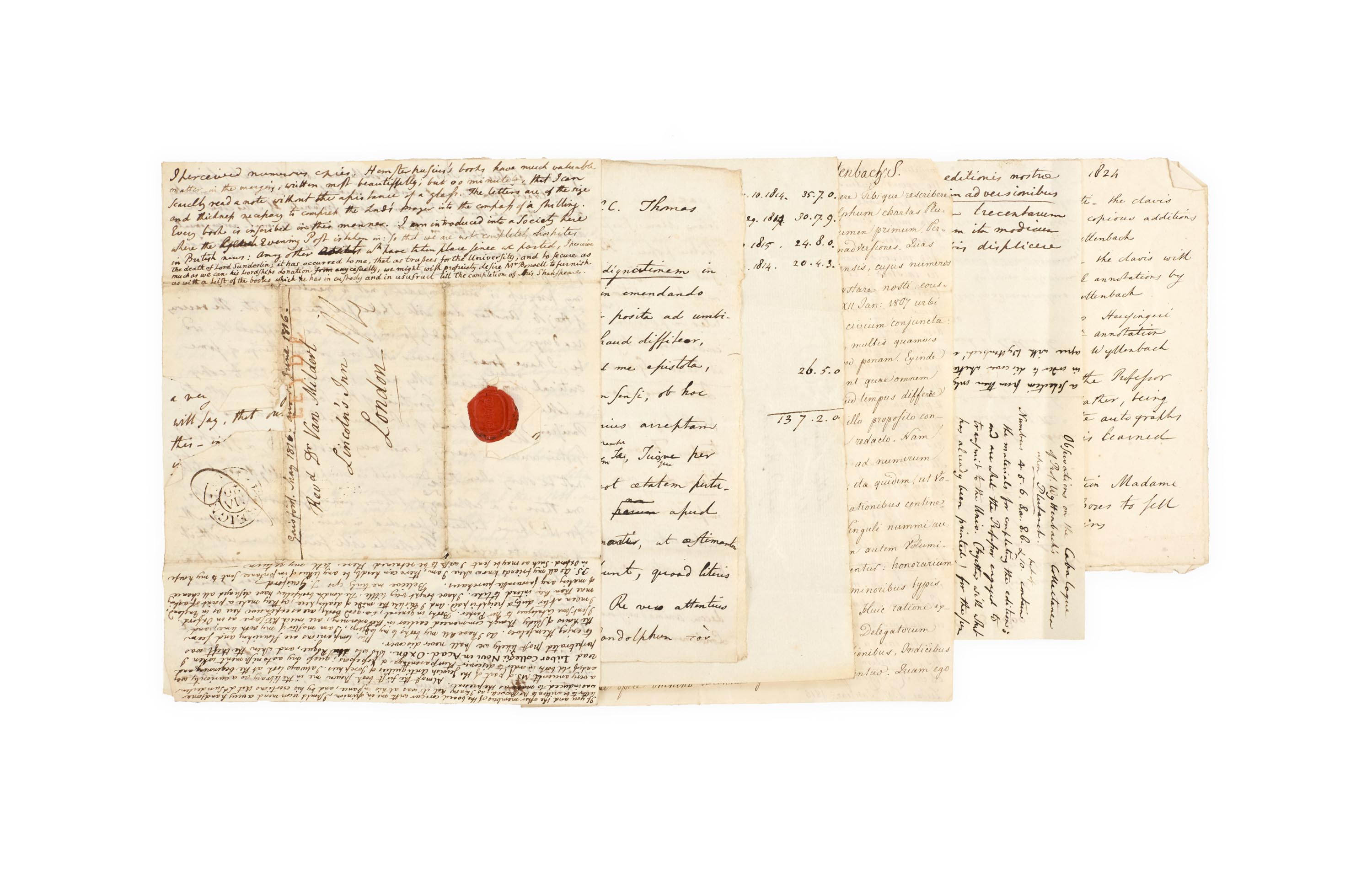
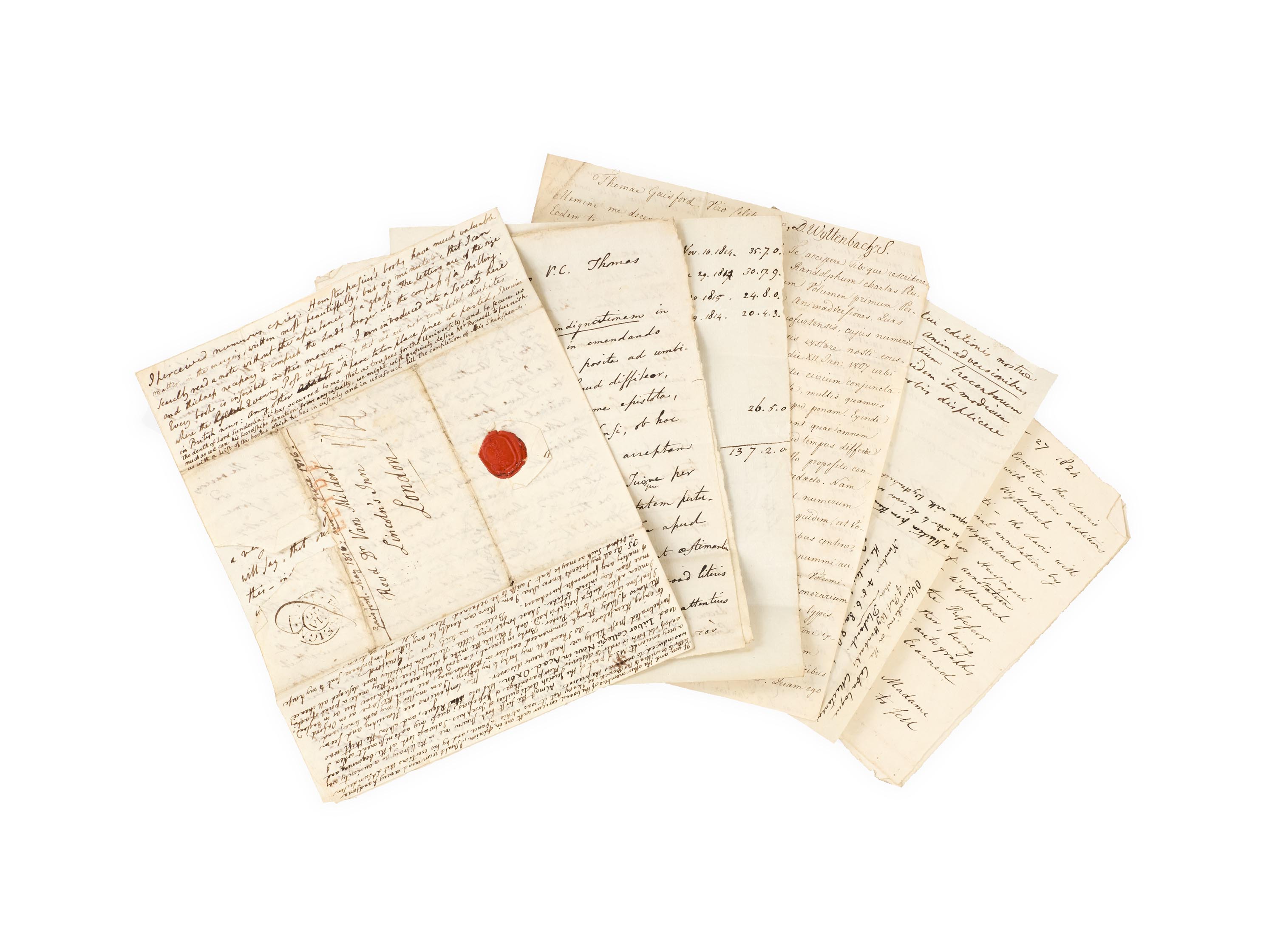
Loosely inserted in this copy are six letters and notes relating to Gaisford and Wyttenbach, and to the publication of this monumental Plutarch. There is an extract copied from the minutes of the University Press, dated 23 October 1800, about Wyttenbach’s Plutarch; a sheet of accounts from 3 January 1810; a letter from Wyttenbach to Gaisford dated Leiden, 17 January 1815 (in Latin, written by a secretary), and a copy of Gaisford’s Latin reply to Wyttenbach, dated Oxford, 31 January 1815.
In 1815 Gaisford had married Helen, the niece of Dr William Van Mildert. A four-page letter (dated Leiden, 17 May 1816, with Gaisford’s red wax seal) is addressed to Van Mildert at Lincoln’s Inn, in which Gaisford describes his visit to Leiden University Library where he was helped by the elderly Daniel Wyttenbach (1746–1820) and looked at Vossius’s books. Gaisford also opines that the Bodleian is much larger and better organised than Leiden, though Leiden has far more manuscripts. He also discusses the libraries of the great Leiden scholars and the bookselling situation in Leiden, which he dislikes.
The final note is dated 27 June 1824, therefore after Wyttenbach’s death, noting that some items belonging to Wyttenbach were offered by his widow to [John] Fell for 2,000 florins.