A Chivalric Swansong
[MAILLES, Jacques de.]
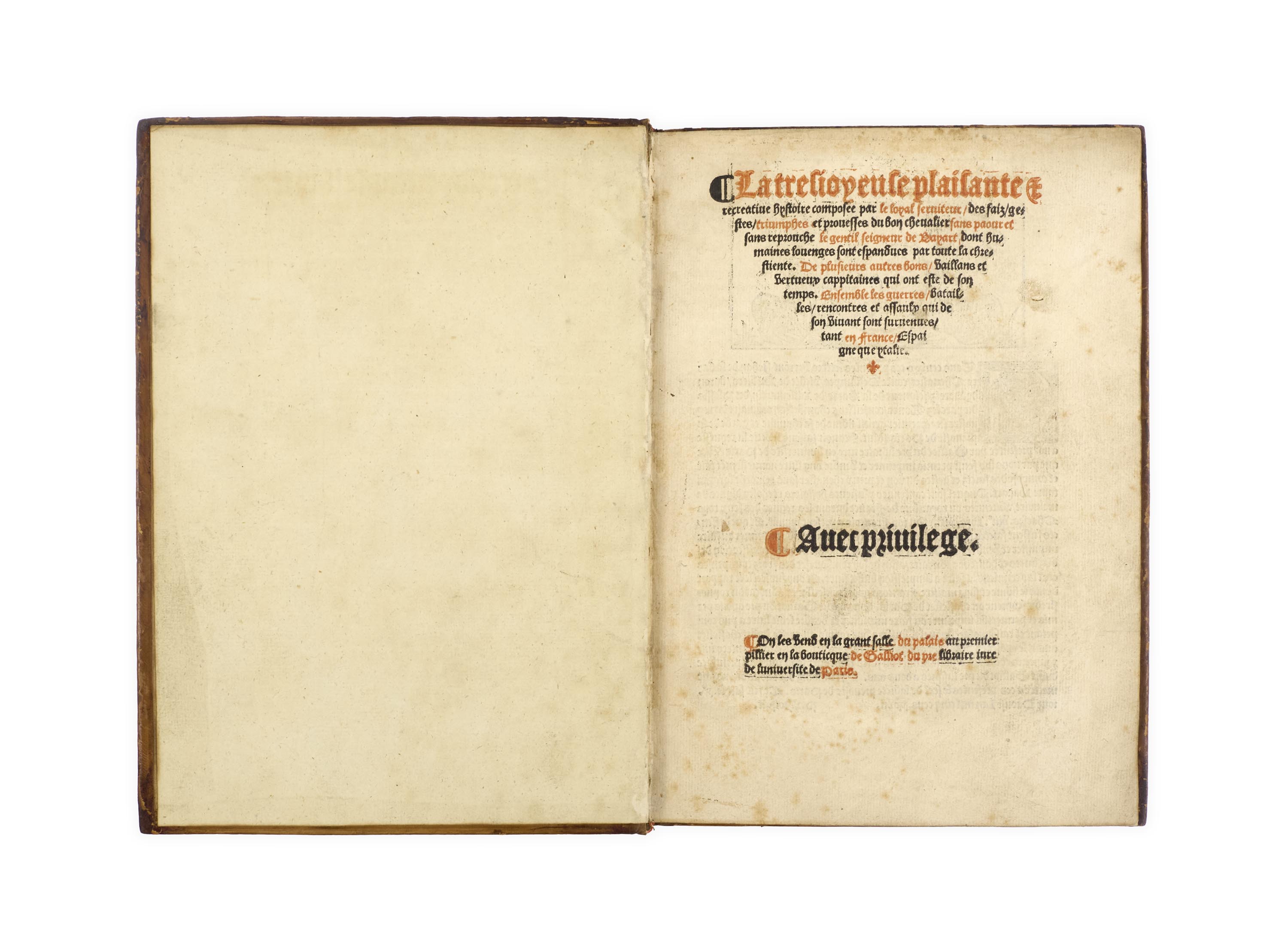
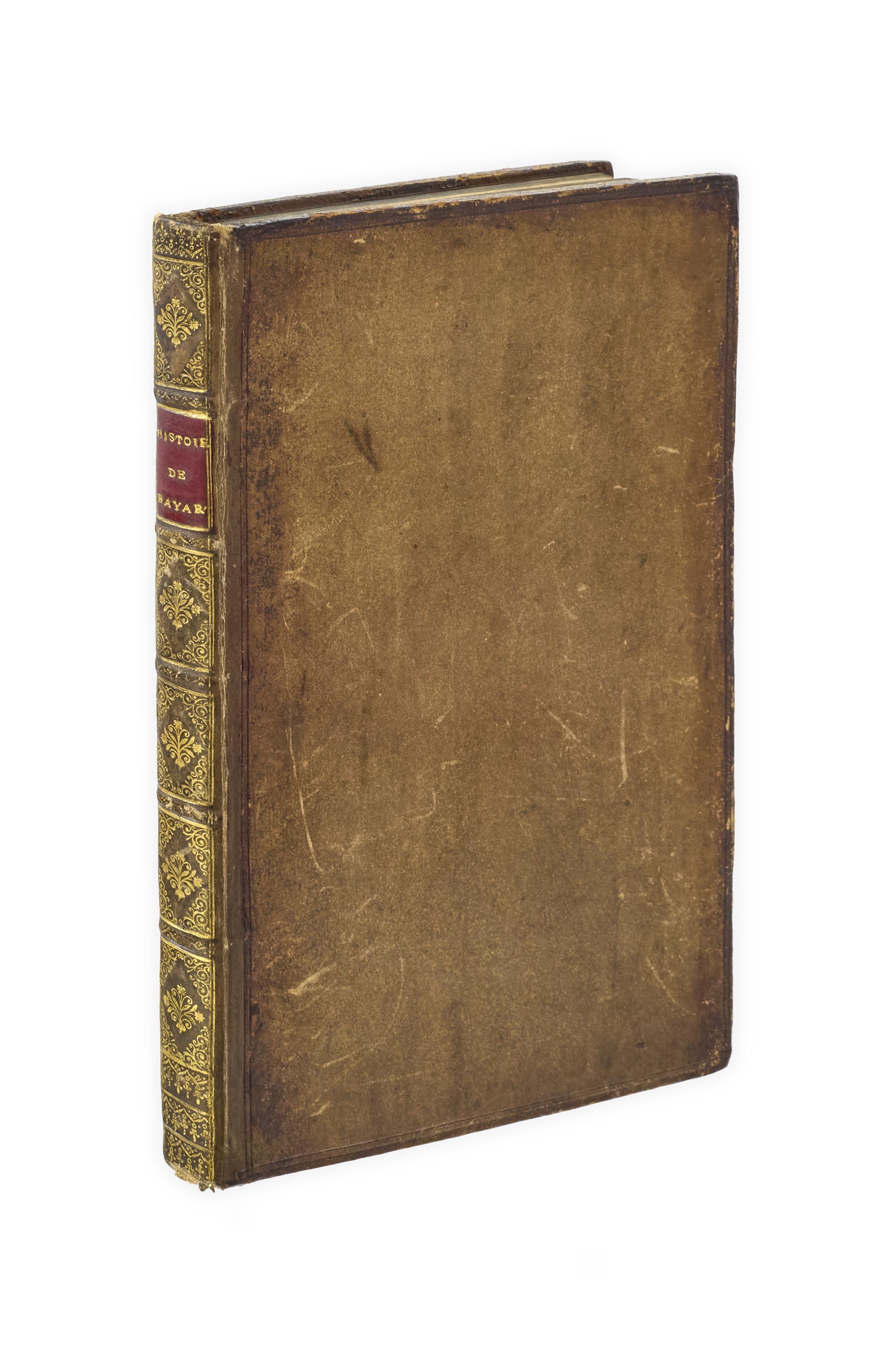
La tresioyeuse plaisante & recreative hystoire composee par le loyal serviteur des faiz gestes triumphes et prouesses du bon chevalier sans paour et sans reprouche le gentil seigneur de Bayart … Paris, [(colophon:) Nicolas Cousteau for] Galliot du Pré, [18 September 1527].
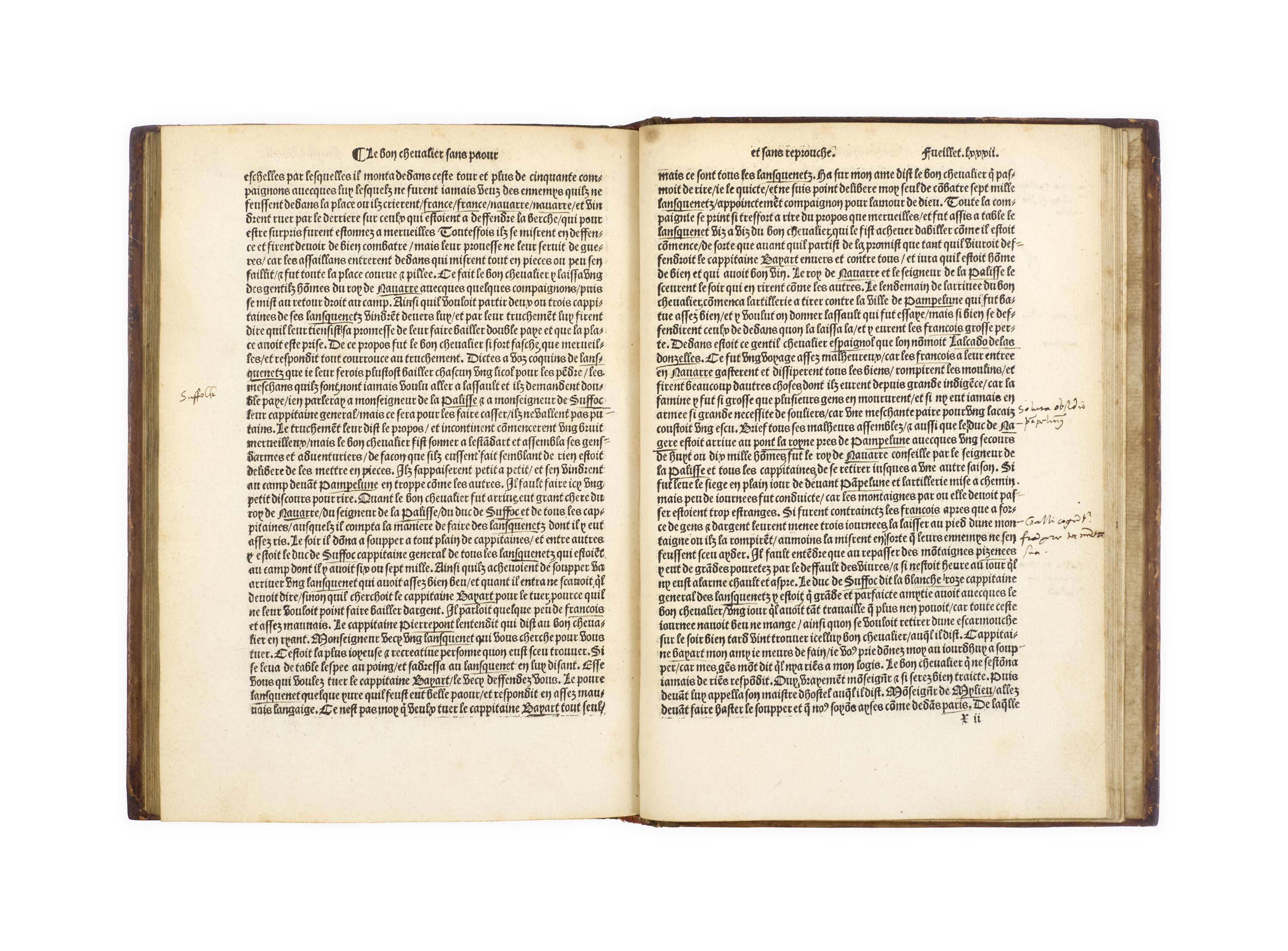
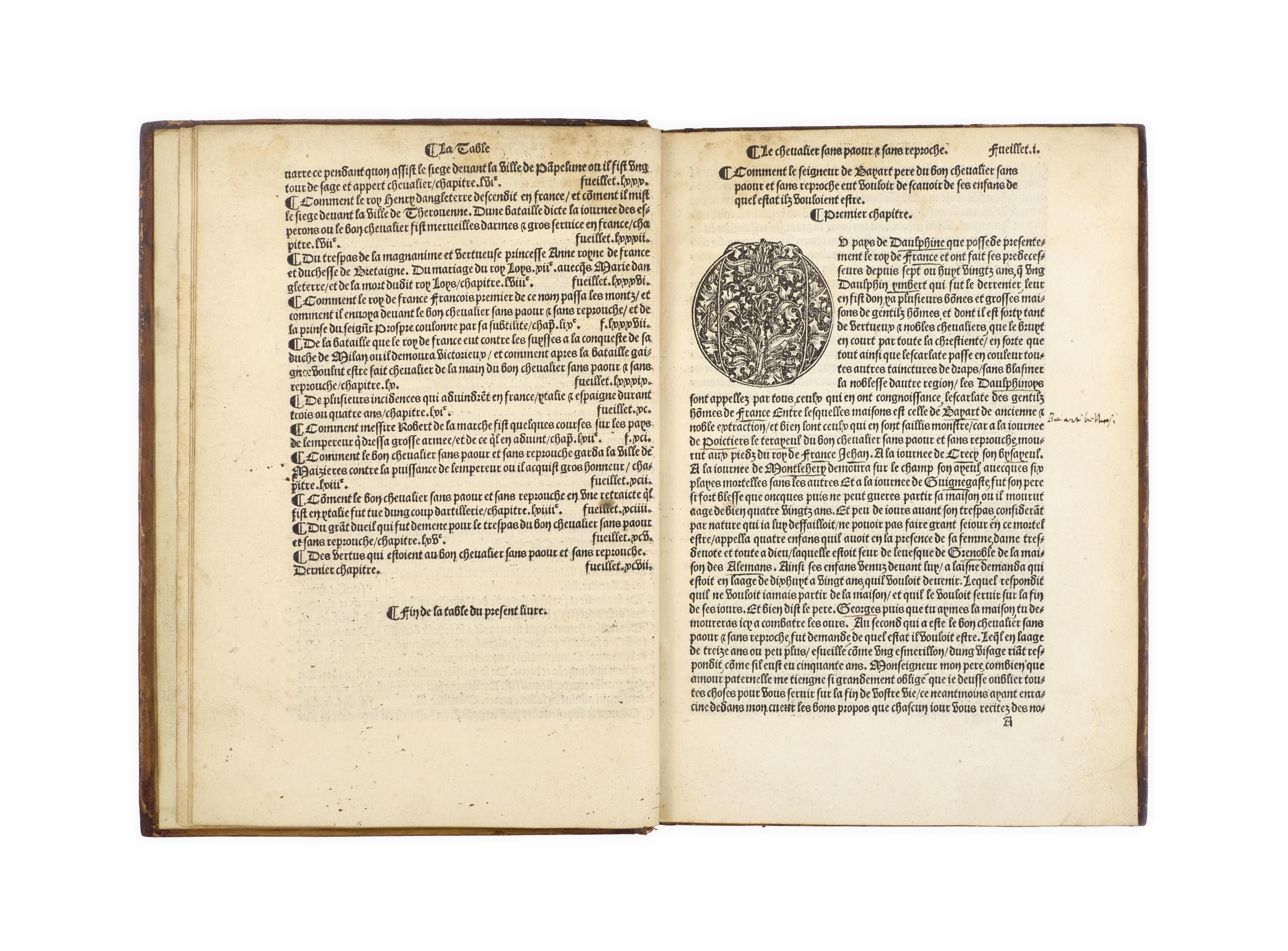
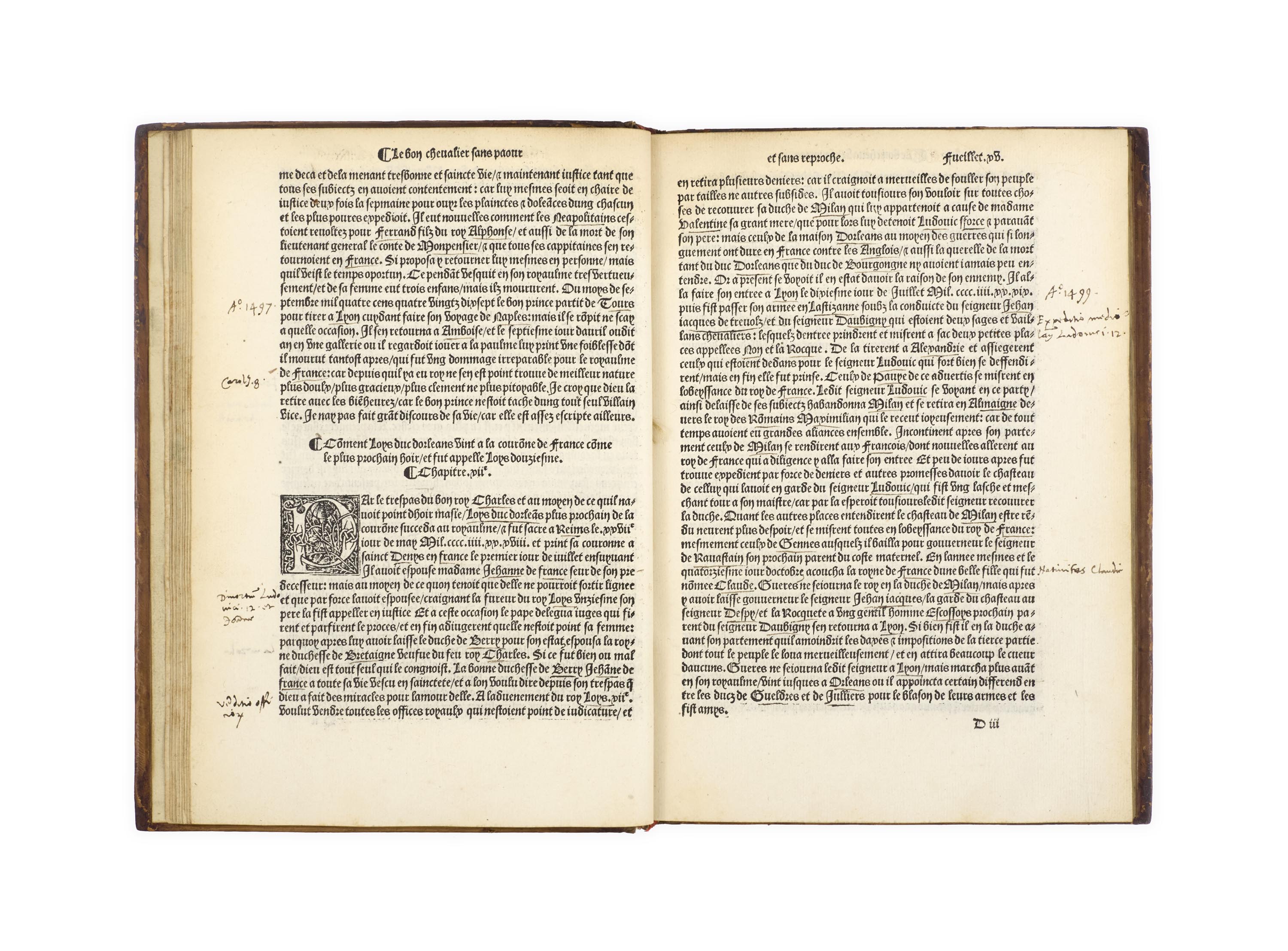
4to, ff. [4], xcviii; lettres bâtardes, title printed in red and black, woodcut royal arms of France to verso of title, woodcut initials; title somewhat toned, last few leaves a little darkened at head, otherwise a very good, unwashed copy; bound in eighteenth-century British speckled calf, board edges gilt, rebacked in period style with gilt-tooling in compartments and red morocco lettering-piece, edges speckled; binding slightly rubbed; contemporary marginal annotations to c. 85 pp. with other underlining and manicules, Royal Society deaccession stamp beneath colophon.
Added to your basket:
La tresioyeuse plaisante & recreative hystoire composee par le loyal serviteur des faiz gestes triumphes et prouesses du bon chevalier sans paour et sans reprouche le gentil seigneur de Bayart …
First edition of Jacques de Mailles’ account of the Chevalier de Bayard, ‘le chevalier sans peur et sans reproche’, one of France’s most celebrated knights considered the epitome of chivalric virtues, written shortly after his death, with contemporary annotations in an English hand.
Pierre Terrail (c. 1473–1524), seigneur de Bayard, fought in the Italian Wars of Charles VIII, Louis XII and François I, starting with the Battle of Fornovo in 1495, Agnadello in 1509, the sieges of Padua and Brescia, Ravenna, and Marignano in 1515. François appointed him deputy governor of the Dauphiné in 1515, and he subsequently took part in military action against Charles V at Mezières in 1521 and finally, in 1524, he was shot and killed in Piemonte as the French army retreated over the Alps. Accounts of his life and deeds were tinged with nostalgia for the age of chivalry made redundant by the invention of gunpowder and artillery.
Jacques de Mailles (1475–1540?), from the Dauphiné, was an archer in the French army in Italy, and later became secretary to the Chevalier de Bayard. His account was one of three written by contemporaries of the Chevalier; seemingly the first to be printed (in 1525) was by Symphorien Champier, a medical man and relative of Bayard’s, and the other was by Aymar du Rivail, of the Parlement de Grenoble, an eyewitness to the events in the last years of Bayard’s life. De Mailles’ account was published anonymously, by a ‘loyal serviteur’. He wrote a simple account of the Chevalier de Bayard, less literary than the text of Symphorien Champier, who had added comparisons with other chivalric examples from history. He describes the ascent of Bayard from page to preux chevalier through various tournaments and engagements.
The narratives of Champier and de Mailles certainly show similarities, and it has been opined that one must have been composed partly from the other. While the dates of publication would indicate that Champier’s account came first, it seems more likely that de Mailles, who was closer to Bayard, wrote his account first, perhaps in a now-lost edition of 1524, the year of Bayard’s death. While de Mailles’ account is now considered more trustworthy, based on his own experiences with the Chevalier and conversations about his past, it was Champier’s account that was reprinted through the sixteenth century; de Mailles’ was only reprinted in 1616, in a ‘modernised’ and expurgated form.
‘It may be said that this most joyous, pleasant and recreative history of Pierre Terrail, the real name of the Chevalier de Bayart, is not a mere biography of a good knight, composed in the best traditions of the courtly romance, but is instead a document; a document which exposes the many problems besetting noblemen of similar rank and which illustrates the destruction of the time-honored code of chivalry by the rise of modern statecraft’ (Vesce, ‘Chivalric virtue and the Histoire du Seigneur de Bayart’, in Romance Notes 12 (1970), pp. 192–197, p. 192).
The marginal annotations are mostly in Latin, occasionally just repeating a key word from the text or specifying who is being referred to; it may be that the reader was a non-native French speaker making the orthography more comprehensible (on K2v, the printed ‘Scandrebec’ has been annotated with ‘Scanderbeg’). On X1r the mention of ‘Suffoc’ has been annotated ‘Suffolk’ in a different, early English, hand, suggesting the book reached England at and early date. On many pages the date has been written alongside the text, and the frequent underlining highlights names and places.
Provenance:
Shortly after its foundation, the Royal Society of London had been presented in 1677 with the Arundel library by Henry Howard, Duke of Norfolk, which often contained an inscription to that effect and/or a stamp on the title-page; there is no visible indication in this book that it was part of the Arundel library (beyond, perhaps, an inference from the note ‘Suffolk’), and it is not listed in the 1681 Bibliotheca Norfolciana, compiled by the Society shortly after the donation. The later binding might indicate that this volume was previously bound after another work, thus hiding it from view in the 1681 catalogue and resulting in the omission of the stamp on the title page.
It was certainly in the Society’s library by 1825, where it is listed on p. 60 of the Catalogue of the Library of the Royal Society, which merged the Arundel books with the rest of the Society’s collections, and it also appears on p. 37 of the 1841 Catalogue of miscellaneous literature in the library. The Society sold a quantity of books from the 1841 miscellaneous catalogue to Bernard Quaritch in 1873; this volume was offered for sale by Quaritch, A Catalogue of medieval Literature, especially of the Romances of Chivalry (1890), item 455, ‘First edition, and very scarce … old calf, cover loose’, for £16-16-0.
USTC 38598; BP16 105443; Bechtel B-69. Levy Peck, ‘Uncovering the Arundel Library at the Royal Society: changing meanings of science and the fate of the Norfolk Donation’ in Notes and Records of the Royal Society of London 52 (1998), pp. 3–24.