
An Economist’s Malthus
MALTHUS, T. R.
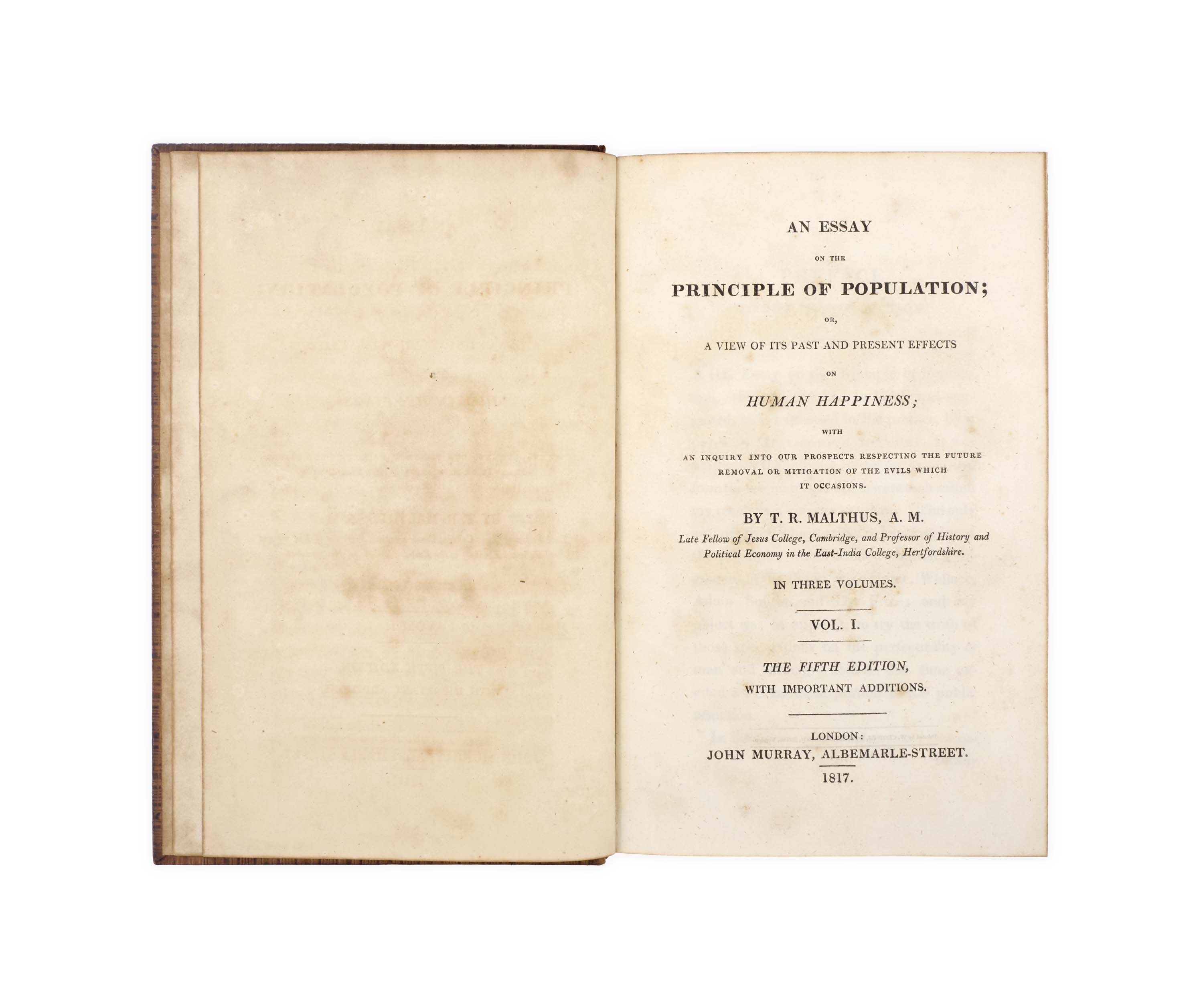
An Essay on the Principle of Population; or, a View of its past and present Effects on human Happiness; with an Inquiry into our Prospects respecting the future Removal or Mitigation of the Evils which it occasions. … The fifth Edition, with important Additions. London, John Murray, 1817.
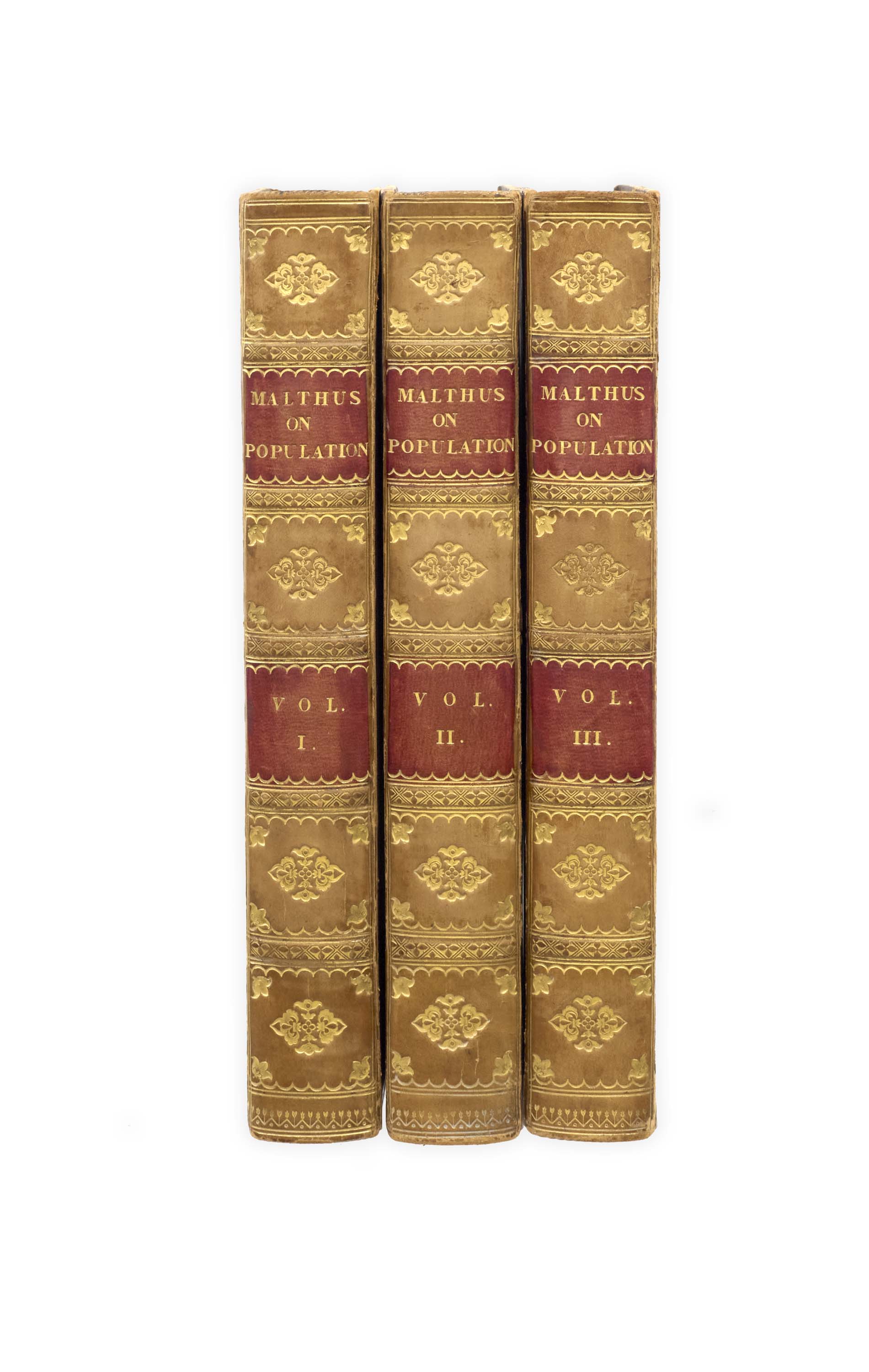
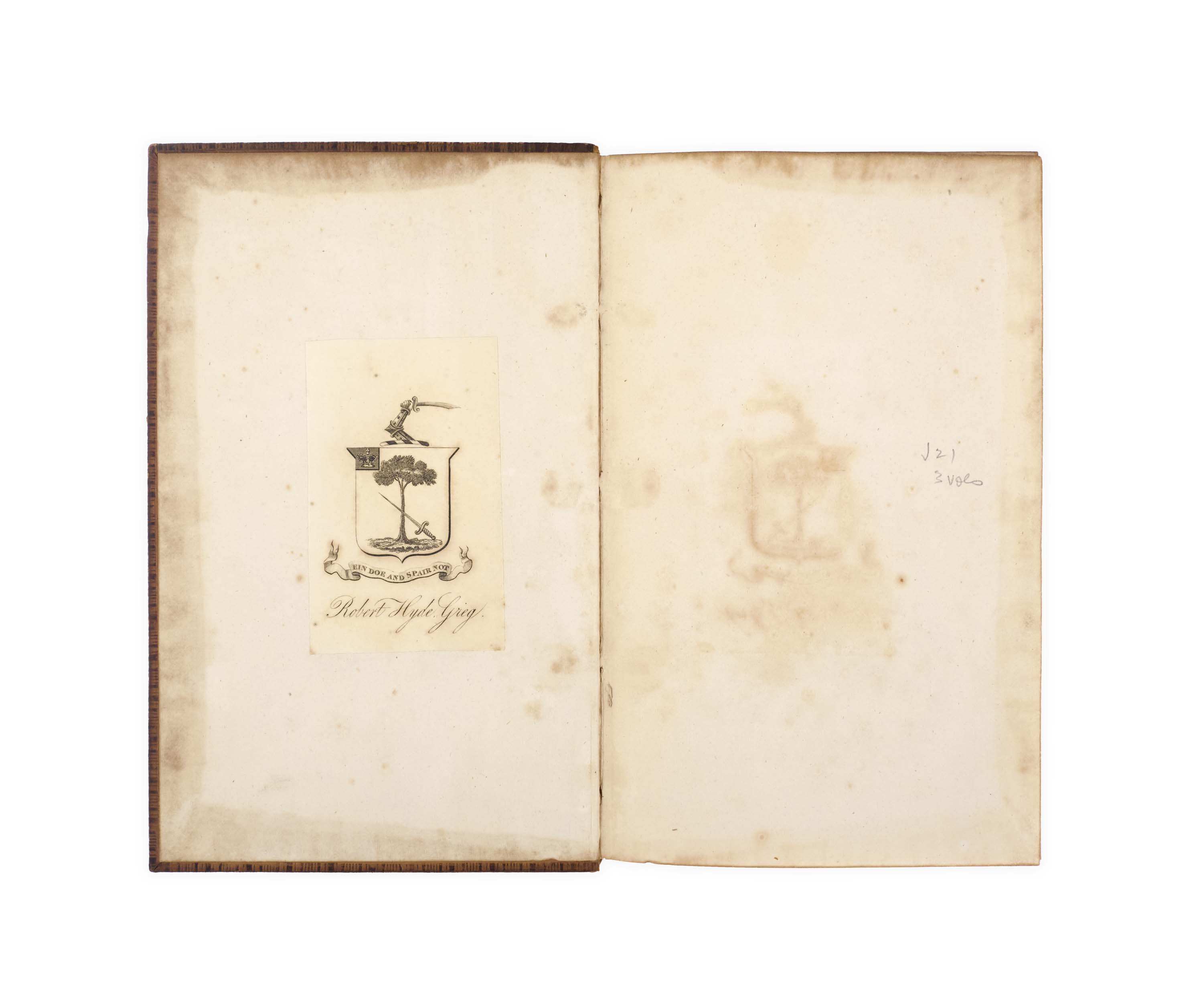
Three vols, 8vo; occasional light foxing, heavier to first leaves of vols II and III; else a very good copy in contemporary calf, gilt fillet border to covers, spines gilt in compartments with red morocco lettering-pieces; minor scuffs, front joints starting at head; armorial bookplate of Robert Hyde Greg to front pastedowns (see below), a handful of pencil annotations.
Added to your basket:
An Essay on the Principle of Population; or, a View of its past and present Effects on human Happiness; with an Inquiry into our Prospects respecting the future Removal or Mitigation of the Evils which it occasions. … The fifth Edition, with important Additions.
Fifth edition, ‘with important additions’, of one of the most influential works in the history of economic thought, a handsome copy owned and possibly annotated by the economist and industrialist Robert Hyde Greg, a critic of Malthus’s.
‘The central idea of the essay – and the hub of Malthusian theory – was a simple one. The population of a community, Malthus suggested, increases geometrically, while food supplies increase only arithmetically. If the natural increase in population occurs the food supply becomes insufficient and the size of the population is checked by “misery” – that is the poorest sections of the community suffer disease and famine. … The Essay was highly influential in the progress of thought in early nineteenth-century Europe’ (PMM) and would come to be an important source for Darwin and Wallace, and, later still, Keynes.
First published in 1798, the Essay was revised in each of its subsequent five lifetime editions. The fifth and present edition is significant, containing new chapters that had appeared in Malthus’s Additions of the same year. These included those on the Poor Laws, which were revised after 1815, and the harsh but prescient critique of Robert Owen’s utopian community at New Lanark. It also adds an appendix in which Malthus takes on his detractors and revisits his influences; Godwin remains ‘irresistible’ while Mandeville is ‘refuted utterly’.
Provenance:
The present copy is from the library of Robert Hyde Greg (1795–1875), who engaged critically with Malthus’s ideas both in print and possibly in the margins of our copy. Son of Samuel Greg, the cotton manufacturer and founder of Quarry Bank Mill in Cheshire, and uncle of the great bibliographer W. W. Greg, Robert joined his father’s business and in 1839 was elected Liberal MP for Manchester. He was a staunch opponent of factory legislation, organised labour, and the Corn Laws, founding the Anti-Corn Law Association and publishing two pamphlets against the tariffs. The association with Malthus is interesting in light of the Parson’s support for the Corn Laws, almost unique among political economists of the time. In the present work Malthus devotes a whole chapter (III. xii) to the subject, arguing for the laws’ ‘tendency to encourage the growth of corn at home, and to procure and maintain an independent supply’. There are conditions under which such laws are ineffective – such as in countries where the supply of corn varies drastically from year to year – but from such conditions Britain is ‘peculiarly free’.
If the contemporary annotations to our copy are Greg’s then this was not the only point on which he differed with Malthus. Apart from correcting an erratum (not noted by the printer) and marking certain passages, our annotator objects to the author’s assertion that putting uncultivated land to use has no effect on the poor: ‘but is not that improvement … exactly what is wanted just now /1818/ [sic] when by the Peace so large a part [of the] population is thrown out of employ?’, reads a marginal note in pencil. More amusingly, our reader responds (sarcastically?) to Malthus’s contention that the ‘degree of filth’ among ‘savages’ renders the air in their houses ‘[not] much purer than the atmosphere of the most crowded cities’, to which a marginal note replies ‘thank you! Mr Malthus – a Londoner’.
Greg would return to Malthus in his 1842 pamphlet Scotch Farming in England, arguing that ‘in spite … of Malthus’, ‘population might continue to increase and to thrive, without fear of treading on the heels of subsistence, for many centuries yet to come’, as there was ‘ample room to expand in our Colonies and in the world at large’ (p. 15 n.). And Robert was not the only member of his family concerned with refuting Malthus: a letter of 1830 reports that his brothers, the philanthropist Samuel and the writer William Rathbone, were ‘at present engaged in some calculations on population’ concerning fecundity which would ‘invalidate a considerable part of Malthus’s theory’ (Morley, p. 227). William Rathbone Greg would go on to publish his objections to Malthusian theory in Malthus re-examined by the Light of Physiology (1868) and his essay ‘Malthus notwithstanding’ (1872).
Einaudi 3670; Goldsmiths’ 21761; Kress B.6974; PMM 251 (the 1798 edition). See Robert Hyde Greg, Scotch Farming in England (1842); John Morley, Critical Miscellanies, vol. III (1886).