An Economist’s Malthus
MALTHUS, T. R.
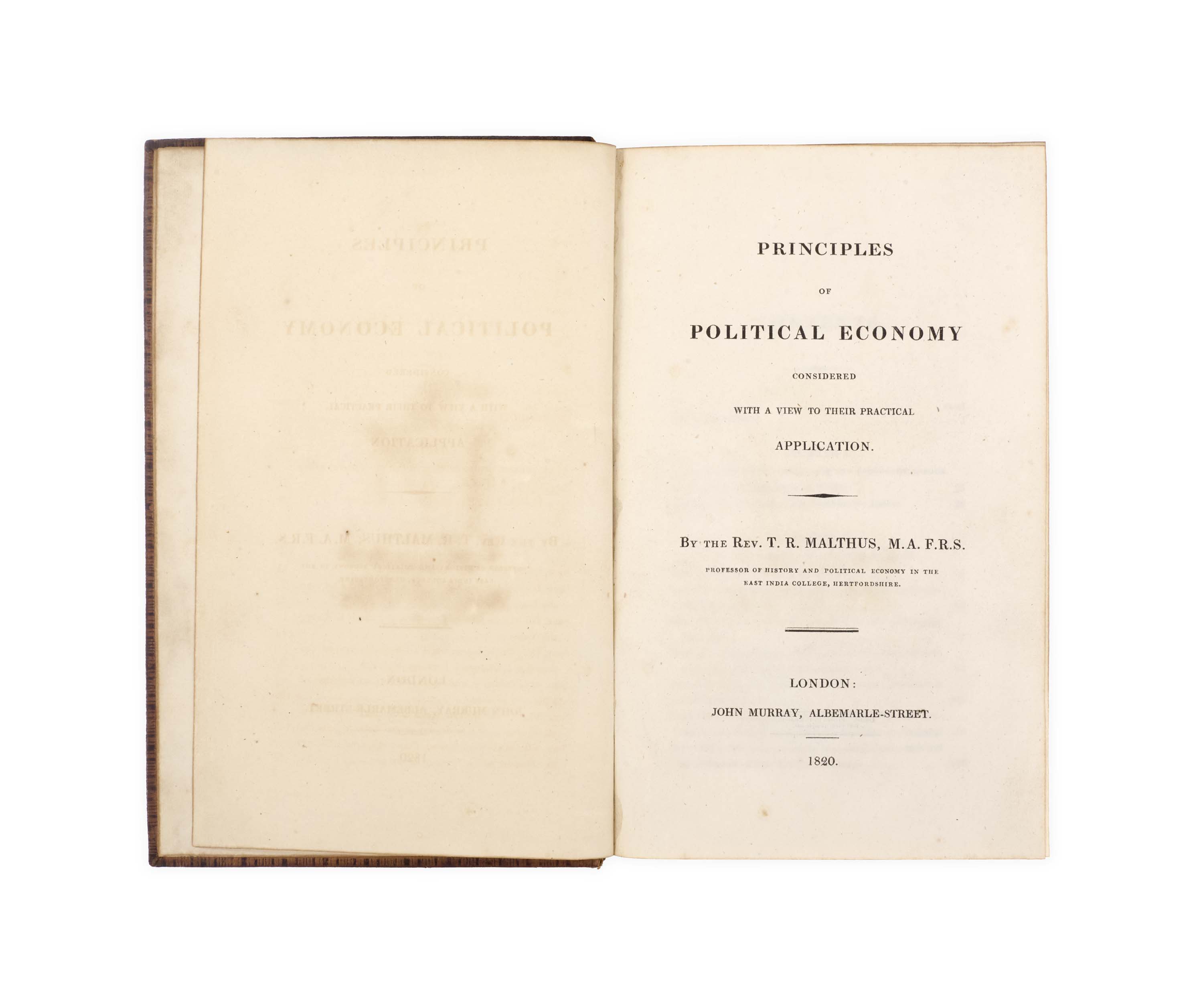
Principles of political Economy considered with a View to their practical Application. London, John Murray, 1820.
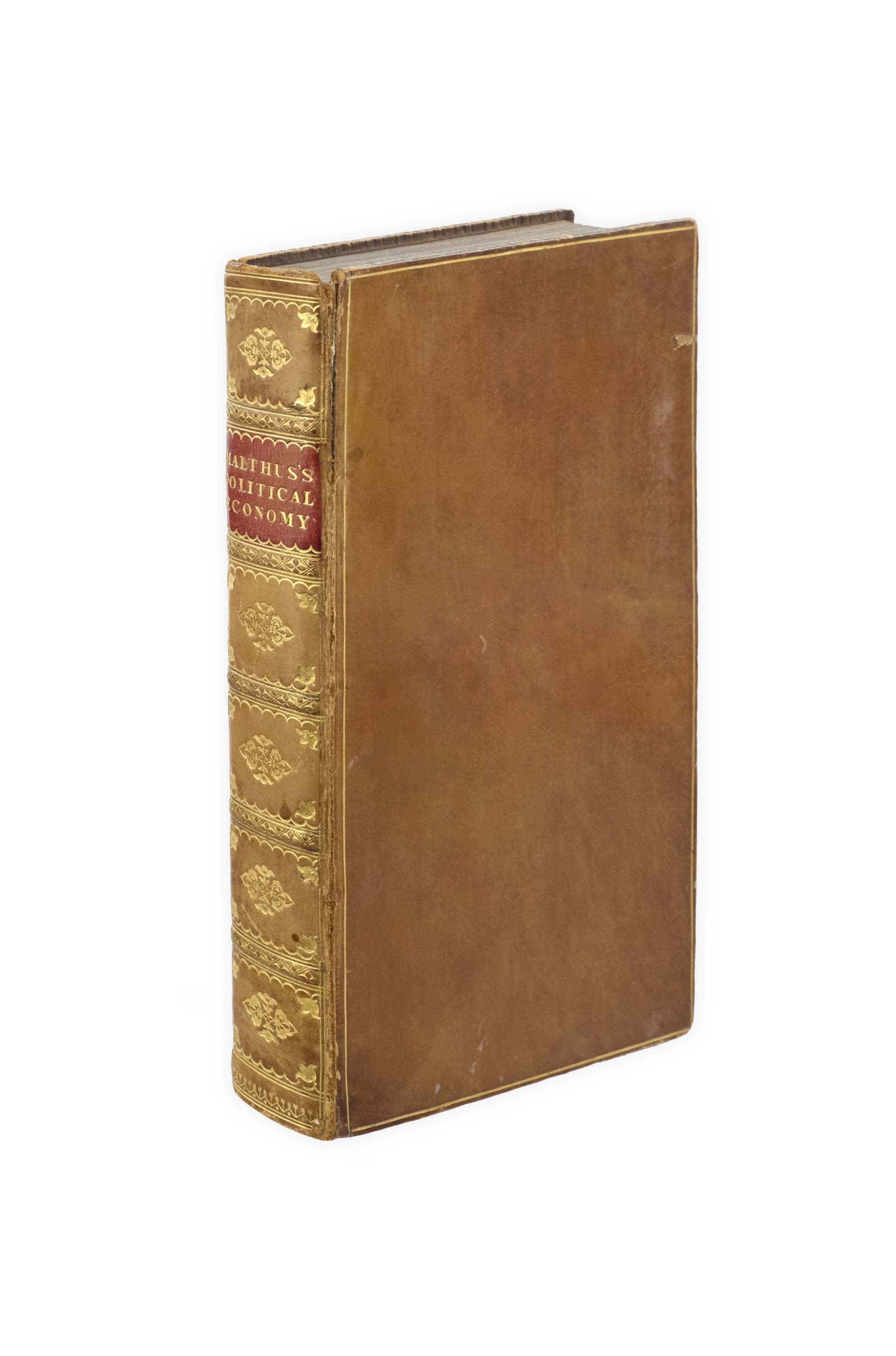
8vo, pp. vi, 601; occasional light foxing; else a very good copy in contemporary calf, gilt fillet border to covers, spine gilt in compartments with red morocco lettering-piece; a trifle scuffed, front joint starting at head; offsetting from armorial bookplate of Robert Hyde Greg (no longer present) to front pastedown and following leaves (see below), a handful of pencil marks to margins.
Added to your basket:
Principles of political Economy considered with a View to their practical Application.
First edition of Malthus’s broadest treatment of issues in political economy, an attractive copy from the library of the economist and industrialist Robert Hyde Greg, a critic of Malthus’s.
‘Although Malthus is best known for the views on population contained in his Essay on Population and although those views are of immeasurable practical consequence, there can be no doubt that his importance for economists today rests mainly on his Principles of Political Economy (1820). It was because of this latter work that J. M. Keynes (1933) reinstated Malthus as a major figure in modern economic thought … [It] was of course influenced by Ricardo’s On the Principles of Political Economy and Taxation (1817). Ricardo had devoted a whole chapter to criticism of Malthus’s views on rent, and Malthus would have been expected to reply publicly. Malthus acknowledged, with regret, that he had been obliged to refer critically to Ricardo in many passages, and that the book had thus taken on an unintended controversial tone. However, it would be a mistake to interpret Malthus’s Principles as only, or even mainly, a reply to Ricardo’s’ (New Palgrave).
‘Keynes argued that Malthus’s theory of effective demand provided a scientific explanation of unemployment, and that the hundred-year domination of Ricardo over Malthus had been a disaster for the progress of economics. Keynes believed that if economics had followed Malthus instead of being constrained by Ricardo in an artificial groove, the world would be a much wiser and richer place’ (ODNB).
Provenance:
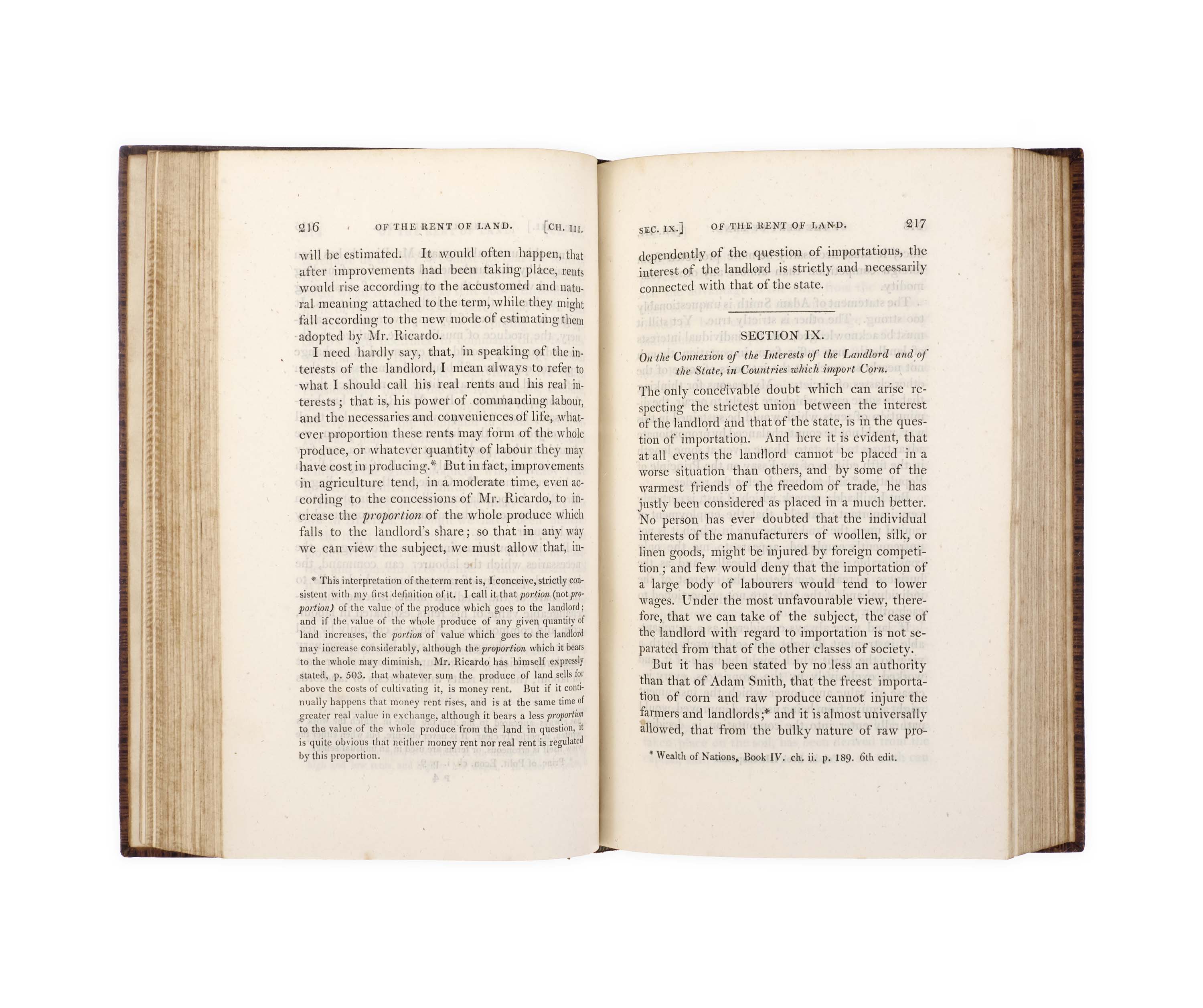
Robert Hyde Greg (1795–1875), bound to form a set with his copy of Malthus’s Population and with remnants of his armorial bookplate. Son of Samuel Greg, the cotton manufacturer and founder of Quarry Bank Mill in Cheshire, and uncle of the great bibliographer W. W. Greg, Robert joined his father’s business and in 1839 was elected Liberal MP for Manchester. He was a staunch opponent of factory legislation, organised labour, and the Corn Laws, founding the Anti-Corn Law Association and publishing two pamphlets against the tariffs. The association with Malthus is interesting in light of the Parson’s support for the Corn Laws, almost unique among political economists of the time. The present work would have been of interest to Greg, containing as it does a chapter on the importation of corn (III. ix) expanding on that published in the Population, as well as much on other aspects of agriculture, a subject on which Greg wrote three pamphlets.
Einaudi 3680; Goldsmiths’ 22767; Kress C.577; Sraffa 3693.